EAA Young Eagles

/ EAA Young Eagles #21  
Mr. Oz, isn't Oz someplace west of Kansas?
The camera is a Canon point and shoot film camera.
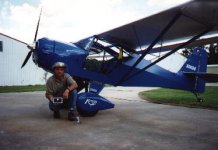
I have built and flew for several years a Kitfox IV, I built a RV4 and sold it and now I am building a Van's RV7A.
Yes, the pic was taken while in a 45 degree bank to the left out the left door of the Fox. On the Fox the doors open completely up which is great for hanging out and taking pics and waving at ground bound sods. Yes, I was flying and I took the pic, the top of the wheel fairing for the left main is in the bottom right hand side of the pic. Just hang the camera out and click away. I also have a mount on the wing tips for attaching my Nikon SLR with motor drive and 17MM lens. Remote control release.
Tractors are cool but everything worth really doing involves airplanes and flying (the tractor will be for mowing my runway someday).
J
 

Attachments

  • 6-158093-Kanfox.jpg
    6-158093-Kanfox.jpg
    18.7 KB · Views: 73
/ EAA Young Eagles #22  
Trescrows

Wow - That is a cool way to take photos. My method currently stands at having a mate hang out the right side with my digital. I'd rather concentrate on flying than taking the pics (A self preservation thing!!!)

I have had a ride in a Skyfox (I think it is the same as the one you pictured). Bit small for me. The Aero Club also has one but yep - too small. Great visibility out of them hey !!

RV7a - Great !!

My mate is building an RV8. Attached is a link showing where he is up to. I can't wait for a ride in it!!! I hope he doesn't mind a back seat driver !!


http://www.saoginc.com/botm/darv8.html

Cheers

PS - Yes flying beats tractoring but not as convenient. (I don't have a runway or a plane !!)

Cheers
 
/ EAA Young Eagles #23  
I have flown for over 30 years, from Navy fighters off carriers to my current job as a 767 captain. I was a partner in a Cessna 310. Thats a twin engine 5-6 seater. We had four guys total and it worked out great. While the costs/hour weren't too bad, about $60per for around 190 mph, the maintenance and hangar was quite expensive. Insurance was remarkably inexpensive because of the experience level of all the partners. Had to sell out when I moved. I'm thinking of getting back into some form of ownership.
I do keep up on the homebuilt market. Really incredible performance, but they aren't cheap. The general aviation market was probably the first real victim of lawsuit craziness, and really hasn't recovered.
 
/ EAA Young Eagles #24  
EAA is the Experimental Aircraft Association. Really good organization, even if its real name should be the Paul Poberezny Glee Club (Tom Poberezny now). The only negative part of the organization is that is of, by and for the Pobereznys. That said, everything else is first rate, and they have done an outstanding job over the years promoting and defending everything that is aircraft.

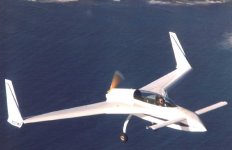
I've been in the EAA now for a little over 20 years. I've built my own aircraft (a Long EZ - see attached), and it's a blast. It can get a tad expensive, but a single engine airplane is a lot less expensive than a Lexus or Mercedes (usually, but not always).


(sorry folks. I was ignorant of the new policy on inline photos) /w3tcompact/icons/blush.gif
 

Attachments

  • 6-158393-BillPlane_640x415.jpg
    6-158393-BillPlane_640x415.jpg
    33.7 KB · Views: 72
/ EAA Young Eagles #25  
They ain't cheap--define cheap please. A 310 is not cheap I do know that. It is of course an aerial vehicle intended for point A to point B flying in a straight line along a Victor airway. That is not the kind of flying I have done. I never fly straight and rarely know were I am going till I get there, usually after a few loops or rolls I don't remember even which direction I was last headed in but heck I could care less. If I need to get somewhere I will take my car or go commerical, if I want adventure, scraping my wingtips along a rock canyon wall in formation with eagles or dropping into a field or landing on a sandbar, I go flying and I make it a point to never be in a hurry much less calculate my hourly costs. J
 
/ EAA Young Eagles #26  
GG

Now that is an unusual plane indeed.

What sort of performance do you get out of it?

I came across a Corby Starlet today when I was at the Aero Club. A home built timber job. Seen one of them?

Hey is anyone aware of a good flying website like TBN??

Seems there is enough of us here to start one or partition Muhammed for a flying forum??

Cheers
 
/ EAA Young Eagles #27  
Neil,

That plane has better than average performance. It uses the same engine as a Cessna 152, but flies almost twice as fast, using the same amount of fuel.

The speed isn't the main feature, however. The most intriguing characteristic is being virtual stall-proof.
 
/ EAA Young Eagles #28  
Nice Long EZ!!! What is the TAS (True Airspeed)? What kind of motor did you put in it??
 
/ EAA Young Eagles #29  
GG

Wow that is impressive performance indeed.

I assume the winglets (aka 747's) and the little front wings contribute to the slow stall speeds.

What is the MTOW? - I assume it is very light too.
 
/ EAA Young Eagles #30  
RM1,

True airspeed depends on altitude and temperature, but 150-155 knots is a reasonable planning number.

Neil

I assume you're asking Maximum Take Off Weight? My EZ is placarded for 1500 lbs maximum. Empty weight is 830 lbs (usefull load of 670 lbs includes fuel/passengers & baggage).

The Long-EZ is not known for slow stall speeds; it is known for no stall at all. It also is not considered to be a "low and slow" airplane. It has no flaps, so the "stall mode" is about 50 knots, depending on weight. That's just a bit spicey for a short runway.

The winglets have three functions on the Long-EZ:

1. Reduce drag caused by wingtip vortices (admittedly low already for such a light airplane with a high aspect ratio).
2. Create an artificial dihedral (Long-EZ main wing is essentially flat, but winglets lift "inward"; so the resulting lift vector (wing + winglet) is up & in)
3. Rudders

The "little front wing" is the canard, or "tail". It provides lift, and has the elevator for the aircraft, so provides attitude control. It also stalls at a lower speed than the main wing; so is an integral part of the stall prevention system.
 
/ EAA Young Eagles #31  
GG - Yes your MTOW was my MTOW. OK so it weighs close to a Cessna 152.

No stall - What happens?? - Can you just doodle along at 20 knots??

Elevators at the front - Cool.
 
/ EAA Young Eagles #32  
The forward canard wing stalls first which pitches the aircraft down reducing angle of attack. Reducing angle of attack prevents the main wing from stalling--thus it is at least semi stall proof in the normal way we think of stalls. Like Glueguy said, stall speed is about 50 knots for a Long Ezi----NOT 20 so he cannot doodle along at 20 knots, my ex-Kitfox could however when lightly loaded because it is in fact a STOL aircraft and while not stall proof uses a Junkers type flaperon to achieve extremely high lift and fly at very high angles of attack. Wings fly on angle of attack, a wing can stall at any speed once it's critical angle of attack is exceeded for that airspeed, which is why many aircraft including jet fighter aircraft use an angle of attack or so called reserve lift meter so they do not stall out when pulling G's during an aggresive manuver. Stalls are not really the problem because the canard wing itself stalls, more accurately it is a spin proof or at least spin resistant design, something which can be achieved in more a conventional manner but heck the canard configuration looks so cool just like it's designers long side burns. J
 
/ EAA Young Eagles #33  
OK I get it now. From a 100% Cessna trained man, I don't think outside the square like these aircraft do.

How would an angle of attack meter work?

I read about the lack of them in light aircraft in my text books, but they didn't go any further into them.

Thanks guys.

Hey we sure need that flying forum now don't you think??
 
/ EAA Young Eagles #34  
Neil,

3C's gave you the straight poop on the stall. I will add that the "stall mode" (at least for my EZ) is variable.

When I'm lightly loaded, there is no up/down oscillation at all, just a kind of "mush", with a steady 500 fpm or so descent. The ailerons, rudders have full control; even though the elevators are in the "full up" position.

When heavily loaded, my EZ does a slow "bob" motion with a cycle time of 20-30 seconds (per "bob"). Still is in full control, but with a slightly higher descent rate.

Re: aircraft weight. I think my EZ is about 1/2 the weight of a C152 (empty weight for both). However, the full-up weight isn't far different (EZ has much higher usefull load).

Re: angle of attack meters. There are many designs. Some are simple "flappers" that attach to the leading edge of a wing at the appropriate angle/position. Go above the critical angle, it gets pushed up, and triggers. Go below the critical angle, it gets pushed down and turns off. Others are variations on that theme; just need to be able to sense the direction of attack.
 
/ EAA Young Eagles #35  
When you fly a prop Cessna as you do you got 1950's technology, a VariEZE or a Vans RV7A can utilize 21st century technology.
The lift meter my RV7 will have is the Fly Safe. See them at www.angle-of-attack.com . These are not avaialble for certified aircraft--homebuilts only. Unlike the kit auto industry where the resultant vehicle is a bit strange and not equal to a factory built car, homebuilt aircraft have evolved beyond the factory offerings and are in general far superior for their intended mission profiles. J
 
/ EAA Young Eagles #36  
Speaking of STOL aircraft; did you ever fly a Heliocourier. The most fun I ever had in an airplane (well maybe except for going from the factory in Kansas to Anchorage, AK, in a new Cessna 152) was in a 1973 Heliocourier. We drove the FAA nuts with calls from people calling in saying some nut was doing things over Dallas that an airplane can't do; like when I flew it backwards across the airport./w3tcompact/icons/laugh.gif
 
/ EAA Young Eagles #37  
GG

OK so it stalls but doesn't turn into an inverted brick and scare the S**t out of you. Sounds like a very nice airplane.

Particing stalls in the Cessna is not a fun experience although the more you do it, the less it feels like a stall as you just get used to it.

Yes CCC I know of the seriously outdated technology we are flying. Very hard to learn in anything else around here though and I don't know many flyign schools who operate anythign other than standard aircraft.

The stats on my mates RV8 seem amazing. He has shown me the videos etc. One day I could be tempted but I have nothing like the patience needed to build one.

GG - Got a website for info on the Long Ez??
 
/ EAA Young Eagles #38  
<font color=blue>Practicing stalls in the Cessna is not a fun experience although the more you do it, the less it feels like a stall as you just get used to it.</font color=blue>

One of the best lessons I ever got was with my primary instructor, when I was just "not getting" stalls. My instructor finally says: "OK, sit on your hands." I do as I am told, and he proceeds to pull the trainer into several different stall approaches. My job was to manage the pedals. That's when it clicked in my head that you could actually avoid a stall (or correct it if you're not fast enough) by managing the rudder. This was just the ticket for getting me to understand the stall mode in a C152. Of course, each aircraft will be a little different, but the rule for the C152 also works in a large number of other "standard" aircraft (just not all of them).


<font color=blue>Got a website for info on the Long Ez??</font color=blue>

One of the best places to look is here:

<A target="_blank" HREF=http://www.canard.com/>Canard Aviator's Page</A>

If you want to see what Burt Rutan is up to these days, try this:

<A target="_blank" HREF=http://www.scaled.com/>Scaled Composites</A>
 
/ EAA Young Eagles #39  
You might also want to look into the United States Ultralite Association (USUA). They have a nationwide network of affiliated clubs and programs simular to EAA. Ultralites (UL) are fun, cost a lot less to build, fly, and maintain than "spam cans" (general aviation aircraft), and can be flown from smaller fields. While the FAA does not require training to operate a UL, it is strongly recommended. There are many UL Basic Flight Instructors (BFI) nationwide. As with any activity you can spend a lot or a little, but you can get in the air for as little as $5,000 and the sky is the limit (no pun intended) from there. Most guys I know have between $7,500 and $15,000 in their planes, and fly almost every weekend. And these are "proper" little aircraft, with full controls, wheels, and doors (well they zip shut but they keep the wind out).I wish your wife all the luck. I took Cesna training and all I have left is the written and the check ride to finish. But UL's have captured my fancy and I have not looked back.
 
/ EAA Young Eagles #40  
On a AOA related matter, we in the airline business have been asking for AOA indications in the cockpit for years. Military fighters have had them forever.Angle of attack is the primary speed indication when flying aboard a carrier. It's the best way to get out of windshear or other lift critical situations. We've been unsuccessful getting the companies to pay to get that data displayed in the cockpit. It is available though-you know where? On the flght data recorder used to investigate accidents. Kind of ironic isn't it? The data is available and already on the aircraft, but why do such a stupid thing as presenting it to the pilot?
 

Marketplace Items

CHALLENGER MT525B TRACTOR (A59823)
CHALLENGER MT525B...
Amada M-3060 Mechanical Metal Shear (Japan) (A59213)
Amada M-3060...
2015 Chevrolet Express 2500 Passenger Van (A61568)
2015 Chevrolet...
2017 ADDCO ROAD SIGN DH1000-ALS (A60736)
2017 ADDCO ROAD...
2025 AGT Industrial MX-MRT14 (A60463)
2025 AGT...
2018 CATERPILLAR 305.5E2 CR EXCAVATOR (A62129)
2018 CATERPILLAR...
 
Top