Electric Sub-Panel Installation

/ Electric Sub-Panel Installation #41  
ZJ,
Maybe I can clarify things a bit for you. Here in the states when we refer to 220V, most times we are talking about 120/240V single phase. We have 2 line wires and a neutral that come to the house. Then, it is grounded (earthed in Europe sometimes) again. The utility has it grounded(earthed) at the transformer. At any point past the service box/circuit breakers, we use a ground which is the same as your PE wire.
Not many homes can be supplied with 3 phase power in my area. But is quite common in a commercial building.
 
/ Electric Sub-Panel Installation #42  
ZJ

Beginning from a transformer on the utility pole you have 3wires. Two 120v AC power lines that are phase shifted 180 degrees which results in a voltage across the two hot wires of 240V. the third is a neutral wire.

These three wires enter the main service panel. In this main service panel the two hot lines L1 and L2 are switched by a main panel switch which then feeds a bank of switched circuit breakers. the neutral wire is not switched and is connected to the neutral buss bar. Also within the main panel is a Ground buss bar which is connected to a grounding rod driven into the ground. Within the main panel and only at the main panel the neutral buss bar and the Ground buss bar are bonded, the purpose of this is to insure a 0 voltage differential between the neutral wire and ground.

4 wires would be needed then to feed any 240v device. (old code allowed 3 new code requires 4) the 4 wires = L1, L2, neutral and ground.

The discussion here has centered around what is the minimum requirement and or what is the best way to wire to a Sub Panel.

The preferred would be to run 4 wired L1 L2 Neutral and Ground, then at the sub panel there are again a neutral bus bar and a separate ground bar and these two do not connect in this panel. Other than that the Sub and Main are wired the same.

The minimum requirement allows 3 wires from the main to the Sub L1 L2 and Neutral. If it is done this way than the Neutral and Ground buss bars are bonded in the Sub Panel and the Ground buss connects to a grounding rod driven into the ground near the Sub.

I hope that helps

Fred
 
/ Electric Sub-Panel Installation #43  
hiteck; Excellent explanation! I see your an engineering consultant, so here goes. All the power generators I'm familiar with are 3 pole machines. Wouldn't that make each phase pretty close to 120 degres out from each other? Also, what happens to the 3rd phase in residential use?

I only make this stuff, so am really only concerned with the supply end at powerplants. Residential wiring, from the drop thru the house, are no mystery either, but the inbetween stuff is where I'm lacking. How about an explanation of that end like you did for ZJ. It's good to hear an engineer that uses simple explanations. /forums/images/graemlins/tongue.gif /forums/images/graemlins/grin.gif /forums/images/graemlins/grin.gif
 
/ Electric Sub-Panel Installation #44  
Quote
4 wires would be needed then to feed any 240v device. (old code allowed 3 new code requires 4) the 4 wires = L1, L2, neutral and ground.


Sorry that should read 4 wires are needed when feeding a 240V device when a grounded conductor(neutral) is present on that device.


We have alot of three phase homes in the older parts of town just for A/Cs and people never replace with 3PH units.
 
/ Electric Sub-Panel Installation #45  
Johnday

Oops didn’t mean to come across as an expert in electrical power systems, my field is in electronics. House wiring is just the favorite part of my “hobby” of building. I just felt I could give a half way descent explanation to JZ.

As to 3 phase systems others would be better qualified to comment.

Sparkkky

<font color="blue"> Sorry that should read 4 wires are needed when feeding a 240V device when a grounded conductor(neutral) is present on that device. </font>

I just had an inspector tell me within the last week that the three wire (L1, L2, neutral) no longer meets code. Any new work (as in wiring to a stove or dryer) requires the four wire outlet with the fourth wire being ground. So I’ll modify my comment and say that this is what I’m told is now required in my county.

<font color="blue"> We have alot of three phase homes in the older parts of town just for A/Cs and people never replace with 3PH units. </font>

My comments were only meant to help ZJ in Croatia understand what the normal wiring of a house in the US would be like. Wasn’t commenting on three phase, You say there are exceptions to the norm, I‘m sure there are.

Fred

Reread my post and maybe there is some confusion.

<font color="blue"> Two 120v AC power lines that are phase shifted 180 degrees which results in a voltage across the two hot wires of 240V. the third is a neutral wire.
</font>

This is a description of standard single phase 240v. Has nothing to do with 3ph.
 
/ Electric Sub-Panel Installation #46  
I understand the explanation; For two voltages 120/240 you just need single phase transformer, on similar way how to get double voltage, let say 24VDC, on power supplies: -24 ... GND ... +24
Seems that you use appliances either for 120V and 240V in same house.
Just little surprised to way how is it done. Maybe it is connected to the history, maybe to long distances (cheaper to run two wires then 3 on high voltage...
Just a curious question: Does every house have own transformer, or you have low voltage overhead network?

Anyway, thanks for enlighten me /forums/images/graemlins/wink.gif

Here we have power lines 3ph 10.ooo volts (phase to phase, no neutral) and transformer in every village (125-250kVA, depends on village), and distribution is run mostly by cables on poles, 230/400V, 50Hz.

All sigle phase consumers are 230V here, all motors above 3hp are 3 phase, and just need 4 wires: L1, L2, L3, PE, and not neutral.

On pic is shown part of 10kV power line with sectioner/isolator on pole, "pole" transformer, and low voltage cables going from transformer to poles. Sorry, haven't better picture
 

Attachments

  • 694137-trafo.JPG
    694137-trafo.JPG
    96.5 KB · Views: 335
/ Electric Sub-Panel Installation #47  
<font color="blue"> Any new work (as in wiring to a stove or dryer) requires the four wire outlet with the fourth wire being ground </font>

That would be for any appliance that is 120/240V. You need the neutral conductor there. On an appliance such as a water heater or A/C where it is straight 240V, no neutral is needed.
 
/ Electric Sub-Panel Installation #48  
ZJ

Correct, 240v single phase with a center tap which gives you the neutral and two 120v with opposite phases.

One transformer can supply a number of houses if their close. the distribution network is high voltage, I believe 12,000v and up, but that’s just a guess.

Fred
 
/ Electric Sub-Panel Installation #50  
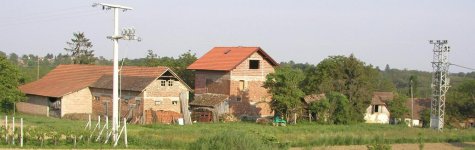
On left side of the pic is our stable for pigs and cows (when we had it) joined with barn (wider building). It is long about 100'. On right side is our house (in rebuilding phase still).
Yes, all buildings are made of brick and concrete. Majority of them are covered with tile (ceramic, and some with cement), and some withother type of cover. Shingle is not so common here. Some people had bad experience, and now is rarely used. Ceramic tile is traditional roof cover here.
On left side, close to front wall, you can see pile of tile from house, and it will be used to cover some new barn additions.
On enclosed picture you can see a sight from house roof to front side of barn.
 

Attachments

  • 694619-mP7170370.JPG
    694619-mP7170370.JPG
    97.1 KB · Views: 320
/ Electric Sub-Panel Installation #52  
ZJ

Beautiful country where you live.

Are brick and concrete buildings built with steel reinforcing? Where I live (practically on top of the San Andreas fault in California) building to withstand earth quakes is a major focus of the building code, all new brick or concrete buildings must be built with steel reinforcing. Most houses are wood construction.
Are earth quakes a concern in your country?

Fred
 
/ Electric Sub-Panel Installation #53  
Fred,
All new houses are made with angles and middle of walls with cocrete posts reinforced with minimum 4 wires of 14mm (9/16"). We didn't have earthquake concern up to now, but who knows. Old part of house on picture is made in begining 50-es, so its 55y old. So, there was no sense to made addition with concrete posts. As you can see, our "pole barn" is done with reinforced concrete poles.
There is no wooden houses in my area, and if so, they are rebuilt old oak (thick 2" or more) houses, totally different built then there (according to the Eddie Walker pictures).
Old barns have mainly oak posts construction and with boards nailed vertically. 99% of them are tile roofed. Rest 1% is covered with rye straw, but very, very rare to find.
 
/ Electric Sub-Panel Installation #55  
quote

I just had an inspector tell me within the last week that the three wire (L1, L2, neutral) no longer meets code. Any new work (as in wiring to a stove or dryer)


Just like I said a dryer and range use a neutral and require a fourth wire, welder, HWT, and A/C does not.
 
/ Electric Sub-Panel Installation #56  
Sparkkky

Your right, Maybe next time I should read slower and engage brain. Wow what a concept! /forums/images/graemlins/blush.gif /forums/images/graemlins/grin.gif

Thanks for keeping me honest. /forums/images/graemlins/smirk.gif

Fred
 
/ Electric Sub-Panel Installation #57  
Fred,
You can see some of machines on one old post here
If you look on my posts, you can find lot of pictures there /forums/images/graemlins/wink.gif , and if you want more, send me a PM.
 
/ Electric Sub-Panel Installation #58  
</font><font color="blue" class="small">( Running only 3 wires for a sub panel is against the national electric code. You must pull all 4 and the ground and neutral must not be bonded in the sub panel as they are in the main panel. Putting in a ground rod at the barn only will not draw enough current to trip a 15 amp breaker but it will draw enough current to kill you. )</font> I don't believe this is true. You can establish what I believe is called a "separately derived system", which has it's own ground. All the branch breakers/circuits, in the sub-panel are then protected in the same manner as the main panel. In a sense, you've just duplicated the main panel installation. Only three conductors -two hots and a neutral, come from the utility to that.
 
/ Electric Sub-Panel Installation #59  
If he is looking to cut cost by pulling three wires instead of four a seperateley derived system is out of the question.
 
/ Electric Sub-Panel Installation #60  
Running only three wires may be against the national electric code unless it is a separately derived system. If the sub-panel is located in a structure that contains the main panel I think that you may need to run the four wires but if the sub-panel is in a separate building isolated from the building that contains the main panel it may qualify as a separately derived system. A problem that could occur would be if the separate building has common utilities with the main structure, such as natural gas in metal pipes, water in metal pipes and probably phone lines. The next issue is do you bond the neutral wire to the sub-panel box in the separately derived system. According to my local code, they want the three wires and the neutral to panel box bonding. The above is what I have learned the hard way from my local inspector and may apply to my area only.
 

Marketplace Items

2015 PETERBILT 367 WINCH TRUCK (A60736)
2015 PETERBILT 367...
Hypac C530AH Compactor Specs (A61567)
Hypac C530AH...
MARATHON 20KW GENERATOR (A58214)
MARATHON 20KW...
(2) 140 Gallon Saddle Tanks w/Brackets (A60463)
(2) 140 Gallon...
Husqvarna Riding Mower (A56857)
Husqvarna Riding...
2019 Deere 35G (A60462)
2019 Deere 35G...
 
Top