y

Electrical question about amp rating: service entrance versus feeder

   / Electrical question about amp rating: service entrance versus feeder #1  

s219

Super Member
Joined
Dec 7, 2011
Messages
8,607
Location
Virginia USA
Tractor
Kubota L3200, Deere X380, Kubota RTV-X
So in the process of planning out a generator install, I have run into an interesting (to me) twist in the National Electric Code (NEC), where wires are rated at one amperage for service entrance use and another amperage for feeder use.

As an example, #2 aluminum is rated for 90 amps as a feeder wire. Scenarios would be wiring from a main panel to a sub panel elsewhere in a home or for a barn, shed, etc. You would need a 90 amp breaker to protect the feeder wire according to code.

That same #2AL is rated for 100 amps as a service entrance wire. Scenarios would be running from power hookup or meter to main panel, or generator to main panel. In that case, you can use a 100 amp breaker to protect the service wire according to code.

Can anyone explain why this might be the case? I'm a mechanical engineer and have researched this up and down, and best I can tell is that it's just the way code is. But I'd really like to know why.

There are temperature ratings for the same wire gauge that show 75 amps for 60C rating, 90 amps for 75C rating, and 100 amps for 90C rating. I am not sure if this is related or not. #2AL I have seen is all rated to 90C, but most home circuit panel and breaker contacts/terminals are only rated for 75C.

(Note: I've use AL for the wire examples, but the same issue applies to copper -- it is rated to higher amperage for service entrance than feeder. The closest example is #4 copper.)

In our new home, we had #2AL run from the original proposed generator location to the main panel, and it is connected with a 100 amp breaker to backfeed into the panel (an interlock prevents that from being turned on unless the main has been shut off, and vice versa). It passed inspection just fine.

Because I am putting the generator farther from the house than planned, I am upsizing part of the feeder wire to #1/0 AL to minimize voltage drop, but plan to tie back into the #2 before it goes into the panel. I am debating whether or not I should pull the #1/0 all the way to the panel, which would be more work and more hassle. That's when I stumbled on this twist in the code for the rating of #2, and it got me wondering...

thanks,
219
 
   / Electrical question about amp rating: service entrance versus feeder #2  
Where in the NEC are you finding this "twist" in the cable's ampacity? (i.e where in NEC does the same cable size/temp rating has different ampacities? ) There are various cases in NEC where you "size the cable" differently, sometimes based on 100% of load, other times 125% of load, whether load is continuous, noncontinous, a service, a feeder, a branch, etc, etc,etc.., but once sized, the ampacity is the ampacity. - based on Article 310 (for a given size and temp rating, and location (air, ground, raceway) . That's oversimplifying alot, assuming no other "derating" conditions exist. (e.g. high ambient temps, more than 3 conductors in a conduit, etc...))

"There are temperature ratings for the same wire gauge that show 75 amps for 60C rating, 90 amps for 75C rating, and 100 amps for 90C rating. I am not sure if this is related or not. "- I think it may be. As per Article 310 tables, the ampacity for a given wire is based on the temperature rating of the insulation type. As you noted a 90C wire has to be limited to its 75C rating if the temperature rating of the terminations are 75C (Article 110.14.c)
 
   / Electrical question about amp rating: service entrance versus feeder
  • Thread Starter
#3  
I don't have the code in front of me (and their free web version won't load on this computer for some reason) but I seem to have scribbled down that 310.16 pertains to feeders and 310.15 pertains to service feeds. Let me see if I can dig that up...
 
   / Electrical question about amp rating: service entrance versus feeder #4  
I'm not an electrician but I would guess that it's partly due to the fact that when a main panel is installed the 110v circuits are load balanced. That puts less demand on the neutral wire (which is smaller). The NEC may think a feeder line may not always have the same flexibility so the derate it.
 
   / Electrical question about amp rating: service entrance versus feeder #5  
I'm wondering if the comparison is between the same conductor in free air vs in a conduit.
 
   / Electrical question about amp rating: service entrance versus feeder
  • Thread Starter
#6  
OK, so I got to look at the 2014 NEC online, and it has changed from the 2011 hardcopy book I was looking at last week. Now in the 2014 code, I saw this:

Table 310.15(B)(16) still shows #2AL ampacity as 75A@60C, 90A@75C, and 100A@90C. This is the starting point for wire loads in the absence of other factors (temperature, conduit sizing, etc).

There is no longer a table for service entrance ratings -- what was formerly the table 310.15(B)(7) that showed 100A service could use #2AL or #4CU is replaced by some paragraphs. The new paragraph 310.15(B)(7)(1) says that service conductors supplying a load to a dwelling shall have an ampacity no less than 83% of the service rating. So under this, a 100A service can have cables sized to handle 83A and up. In which case #2AL is fine even at a 75C rating.

The 2014 code is certainly clearer on this. The 2014 language seems to suggest that they don't expect the service conductors to ever continuously carry more than 83% of the load of the service rating, which is likely true. They are not saying that #2AL is rated to carry 100A as a service feed as the previous 2011 table may have suggested.

Now as for what this means for a 100A generator supply backfed into a panel arranged for 200A service, I have to think about that more. It suggests I should not let the generator dish out continuous current more than 83% of 100A through the supply line to stay inline with the code rules for #2AL as a supply. Since the generator has a 20kW continuous rating (83 amps) I don't think it will be a problem to leave that section of #2AL going to the panel. However, I still have the option of disconnecting the #2 entirely, and pulling 1/0 straight to the panel if that would be better.
 
   / Electrical question about amp rating: service entrance versus feeder #7  
Thanks for the update. I'm not a "sparky" but initial reaction was that the code covers "line loss". Your service entrance from the meter is very short so line loss is minimal. Branch that out to sub panels and your line loss potential increases with distance. So put a 100a sub panel several feet away. The breaker in the sub will only trip at 100a. Because of line loss it seems to me that your feeder cable will get hotter.

That's just a wild guess on my part. On some sites a pro will come in and bash my brains out.
 
   / Electrical question about amp rating: service entrance versus feeder
  • Thread Starter
#8  
I think there are additional corrections that can be made for distance on top of the baseline numbers. Just like I could potentially correct the baseline capacity of #2AL for things like temperature, number of conductors in a conduit, etc.

When I was figuring out which wire to use for the long run out to the generator, I looked at voltage drop and tried to keep it below 3%, which pushed me to 1/0. I think what normally happens with a voltage drop condition is that the current shoots up higher than design and trips the breaker. So though the current rises above what you design for, it also trips the breaker so it's not a continuous condition. I guess I'd still like to know where they get that 83% number for the service feed though...

I received my shipment of 1/0 wire, and there's no way I could route that into the breaker panel without wreaking havoc -- it's just too thick and stiff, and I know I would be asking for trouble (maybe if it was an empty panel and this was the first wires coming in, no problem, but not with a full house already). So based on that, I will leave the #2 in place from the panel to the exterior wall about 6 feet away, and connect up to the 1/0 at that point to run approx 100' to the generator.
 
   / Electrical question about amp rating: service entrance versus feeder #9  
From my limited knowledge of things, I think the 83% is probably a worst case scenario to feed a sub panel several hundred feet away. Shorter distances it would be overkill but when it comes to electricity I think you want to err on that side. Your breaker will not trip until the load exceeds the breaker rating. In long runs the feed wire can get pretty hot in trying to supply that load (you'll note that on long extension cords). As for temperature rating, I think that is more a function of the wire construction (it's printed on the sheathing so I think distance is not a factor). And finally, I've done a few installs with that thick wire. Feed it into the conduit on the ground using LB's and dull tools...then use the conduit as a lever to bend it up to final position. You will learn some new swear words regardless of how you approach it.
 
   / Electrical question about amp rating: service entrance versus feeder #10  
Since your breaker (100A) is lower than the #2/0 ampacity, you can certainly run the first 6' with it and transition to the #1/0 for the long run. Just watch that the splice is done with the correct materials for the wire and you cover with an anti-oxidizing grease made for that purpose.

Funny when we built, I had a 200 amp service put in. Of course I had to run #4/0 wire from the meter base to the distribution box. After inspection, the utility company came in and hooked up. From the transformer to my meter base is about 50' and they ran #4 wire. I asked the installer about code and he said that they do not follow code. He later told me that the wire is sized to limit the supply fault current to stay under 10KA. Funny how we have to jump through hoops and then have the utility hook you up with their easy to handle wires.

paul
 
   / Electrical question about amp rating: service entrance versus feeder #11  
Uniform building code does not allow for facts...it's a "one size fits all" solution. I watched my foundation guys putting in drain tile on the footings inside and out of the footings (inside leading to a required sump pit with a pump). They were laughing since in our soil there will never be a drop of water in that pipe or sump pit and the pump will never turn on. Same for electrical code I think..."one size fits all" dictates the wire size that should be based on distance but isn't.
 
   / Electrical question about amp rating: service entrance versus feeder #12  
I think Buikanddeere nailed it. Freeair!
If you were to run same amps in a conduit, sizes would change again.
 
   / Electrical question about amp rating: service entrance versus feeder
  • Thread Starter
#13  
I think Buikanddeere nailed it. Freeair!
If you were to run same amps in a conduit, sizes would change again.

Nah, they have a different set of tables in the code for free air. All the tables I have been referencing are for conduit/raceway runs with up to three current carrying per group (above three and you have to start de-rating).
 
   / Electrical question about amp rating: service entrance versus feeder #14  
I think the temp rating on the wire comes into play. When I wired our new house all cables were rated at 90 and I guess I don't know how a piece of wire gets a 90 or an 80 or a 70. It was interesting though that I bundled all the down drops together to make it look nice but the inspector told me to cut them loose to permit free air flow around them. I've witnessed heat on 14ga extension cords before so I guess line-loss is more than what I thought it would be (i.e. back to the original topic...the 83% factor has to be related to the heat factor).
 
   / Electrical question about amp rating: service entrance versus feeder
  • Thread Starter
#15  
And finally, I've done a few installs with that thick wire. Feed it into the conduit on the ground using LB's and dull tools...then use the conduit as a lever to bend it up to final position. You will learn some new swear words regardless of how you approach it.

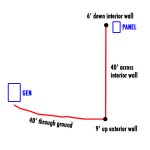
Yeah, it's going to be interesting feeding three #1/0 (two hots and neutral) and one #2 (ground) through approx 100 feet of conduit. I have about 40 feet to run underground from generator to foundation, then 9 feet up an exterior wall, then 40 feet across an interior wall, then 6 feet down interior wall to panel, with a few turns here and there. See attached image, which is a top-down view from above. Trying to strategize the best way to do it, where to start, where to end, etc....

The underground and exterior conduits will be glued up ahead of time. For the interior, I may just friction fit the conduit together one at a time, sliding it over the wiring as I go. Though I have the option of running through a "raceway" for the interior portion, and I need to learn exactly what raceway means for residential code. Seen everything from cable trays, closets, and wall openings defined as raceways on the industrial side.

One strategy is to start at the halfway point and feed wire through the 9' vertical and 40' underground legs towards generator, before I swing the whole assembly up toward the exterior wall. In the process of doing that, I can start feeding the remaining cable through the wall into the interior and at the end swing the vertical up and affix the LB to the wall.
 

Attachments

  • route.jpg
    route.jpg
    31.5 KB · Views: 101
   / Electrical question about amp rating: service entrance versus feeder #16  
Just out of curiosity how far from the main panel are you running ???
 
   / Electrical question about amp rating: service entrance versus feeder #17  
When I installed my service line, 350 mcm, I just laid the cable out and slid the conduit from each end. The hardest part was the elbow. I started there and slid the conduit from each side to it then kicked it into the hole. My not have bee how the pros do it but worked just fine. You do have to be a little careful as the edges on the conduit are sharp and will damage the wire. 40 feet should be easy. Mine was more than 200'.
 
   / Electrical question about amp rating: service entrance versus feeder
  • Thread Starter
#18  
   / Electrical question about amp rating: service entrance versus feeder #19  
... You do have to be a little careful as the edges on the conduit are sharp and will damage the wire. 40 feet should be easy. Mine was more than 200'.

Use a machinist's deburring tool on the ends of the conduit. The tool is under $10, the time is a few seconds per piece of conduit, and the wire will not be damaged.
 
   / Electrical question about amp rating: service entrance versus feeder #20  
Use a machinist's deburring tool on the ends of the conduit. The tool is under $10, the time is a few seconds per piece of conduit, and the wire will not be damaged.

I use a large drill bit in a cordless drill as a reamer when I play with metal conduit. Not so sure you need it on pvc.
 

Marketplace Items

2022 Ligchine Spiderscreed Concrete Screed (A59228)
2022 Ligchine...
SKID STEER ATTACHMENT HAMMER (A58214)
SKID STEER...
2009 Peterbilt 335 Cab and Chassis Truck (A55852)
2009 Peterbilt 335...
Lee Boy 250 Gal Tack Distributor (A53317)
Lee Boy 250 Gal...
2016 CATERPILLAR 330FL EXCAVATOR (A60429)
2016 CATERPILLAR...
2022 BOBCAT T76 HIGHFLOW SKIDSTEER (A60429)
2022 BOBCAT T76...
 
Top