Fencing on a slope

/ Fencing on a slope #1  

Fastball

Silver Member
Joined
Jan 9, 2017
Messages
179
Location
North Okanagan, British Columbia
Tractor
Kubota L2900
Hi, all....am replacing some torn-down fencing on my acreage. The deer have been living on the lot, eating my apple trees, my berry shrubs - and worse of all, my wife's flowers. **** hath no fury than a gardener's flower garden defaced.
Anyways, the problem area is sloped...gradually at first, and then the last 25 feet go up at quite an angle. I know I will have to do it in sections, but my question is this....do I keep the top of the welded wire deer fence parallel with the ground, or try to keep the top dead level and perhaps cut the bottom of the fence to follow the contour of the ground? It's in the back corner, so cosmetics aren't a big concern.
Thanks for any/all suggestions..
 
/ Fencing on a slope #2  
How tall is the welded wire, and how large are the contour changes?

Bruce
 
/ Fencing on a slope
  • Thread Starter
#3  
How tall is the welded wire, and how large are the contour changes?

Wire is 5 feet tall...I have 10 foot poles, so I want wire at least 7 feet up. The major part is about 25 yards long with a foot or two elevation. The last 20-25 linear feet goes up 5-odd feet.
 
Last edited:
/ Fencing on a slope
  • Thread Starter
#4  
Not sure yet if I'm going to run/overlap two courses of the mesh wire to get to my preferred height...or just run one 5ft high course and then do a couple of strands of high-tensile or barbed wire to make up that 2-3 feet. **** deer will jump a 6-7 foot fence like nothing.
 
/ Fencing on a slope #5  
I don't know enough about what you are doing to help out. But I thought I would mention that we had deer cleaning out our orchard recently. This was the first time in 30 years we had the problem - three sides were 8' chain link fence and one side was the house-yard. They were bolder I guess and came through the yard to the orchard. They only came at night. We noticed that as soon as we turned on a light they would scatter. So we put a solar motion detecting light on a pole in the orchard and that solved it for us.
 
/ Fencing on a slope #6  
I have 2 suggestions. First, keep the fence top parallel to the ground so that the height remains consistent and they don't get a short area to step over. The second suggestion is to use 8' woven wire game fence with a strand of barbed wire at the top instead of 5' welded wire fence. The woven wire will do better in the season changes and while acdeer can clear an 8'-9' fence they need to have a good reason to do it. It'll be cheaper to go ahead and build it this way now than to have the deer laugh at you 5' fence, continue eating what they want,your wife blame you and then you have to redo it or add to it anyway.
 
/ Fencing on a slope
  • Thread Starter
#7  
STx - an 8-ft fence wasn't an option at my supplier. I got what was available, which was a 330 foot roll of 60-inch. I figured I'd either stack one length on top each other to get up my 8-foot target....or run a 5-ft chunk with a few strands of barbed or high-tensile wire spaced a foot or so apart on top.
 
/ Fencing on a slope #8  
Hi, all....am replacing some torn-down fencing on my acreage. The deer have been living on the lot, eating my apple trees, my berry shrubs - and worse of all, my wife's flowers. **** hath no fury than a gardener's flower garden defaced.
Anyways, the problem area is sloped...gradually at first, and then the last 25 feet go up at quite an angle. I know I will have to do it in sections, but my question is this....do I keep the top of the welded wire deer fence parallel with the ground, or try to keep the top dead level and perhaps cut the bottom of the fence to follow the contour of the ground? It's in the back corner, so cosmetics aren't a big concern.
Thanks for any/all suggestions..

Typically you don't cut the bottom of the fence. If a little LIGHT digging needs to be done to run straightish runs that's what is done. Don't try to keep the top parallel with the ground per say as this will make for a lumpy looking fence. Keep it straight with the overall grade instead. Run what you can with the method above and keeping the top straight. Then change direction for steeper section and run that straight. Hopefully that makes sense- I may not be describing it all that well.

I'm sure you are aware but the change of directions come out best when two post and some cross braces are used. Set up a pipe or 2x4 that can pull the wire with your tractor and or come along to get it tight.

We have thousands of acres of winery vineyards in our hilly area and this method works to keep the deer out.
 
/ Fencing on a slope #9  
Hilly areas are hard to do - and keep the fence stretched tight. It has to be tight to some degree to function right. I have some short areas at my place that are too short to feasibly stretch a fence. I put in wood posts every 8 feet and use 16 ft sections of cattle panel. These I fasten on with barbed fence staples(at least 1 1/4" or longer). When I really want to get fancy I take my generator welder and stitch the ends together. Use a bolt cutter and a friend and trim the ends so that the fence can contour the ground. It will be wavy even when you stretch it. One thing you might do is tack a top rail on the top made of 1 1/2 x 3/16 steel. You'll need a helper pretty much for the whole job but this will make a pretty durable fence that wont need constant attention. The panels run about $20 a piece at TSC or similar.

Good luck with it
 
/ Fencing on a slope
  • Thread Starter
#10  
Typically you don't cut the bottom of the fence. If a little LIGHT digging needs to be done to run straightish runs that's what is done. Don't try to keep the top parallel with the ground per say as this will make for a lumpy looking fence. Keep it straight with the overall grade instead. Run what you can with the method above and keeping the top straight. Then change direction for steeper section and run that straight. Hopefully that makes sense- I may not be describing it all that well.

I'm sure you are aware but the change of directions come out best when two post and some cross braces are used. Set up a pipe or 2x4 that can pull the wire with your tractor and or come along to get it tight.

We have thousands of acres of winery vineyards in our hilly area and this method works to keep the deer out.

When you say "straight with the overall grade", do you mean LEVEL (as in put a level on it and hit the bubble)...or do you mean to ROUGHLY follow the slope? There's a couple of sections I can't get a tractor or come-along in...so I'm gonna have to do a "good enuff" kinda job.
 
/ Fencing on a slope #11  
Roughly follow slope. Much better way to say it....haha

So if a 30' run dips 3" at 10' and raises 8" at 20' rather than make 3 fence angle changes just pull it tight and use a pick to move a little dirt as needed to get one height across the entire 30' length.
 
/ Fencing on a slope #12  
Here is what I did for my garden, field fence with 3 strands of barbed wire 8' total.
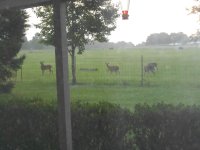
I took deer pic out my front window at my pasture, 3 Does and a 6 point! They are small down here.
 

Attachments

  • DSCN0862.JPG
    DSCN0862.JPG
    718.4 KB · Views: 547
  • DSCN1236.JPG
    DSCN1236.JPG
    837.9 KB · Views: 563
/ Fencing on a slope #13  
Some thoughts, I'm icing my hands after spending the day putting up fence!

My experience is with woven wire instead of welded. I've never worked with good quality welded so I don't know how much of this transfers. The thing to keep in mind is that if you have dips and hills the top of the fence travels a different distance than the bottom. With woven wire, you have to stretch it to install it, so if you stretch it from the top and bottom separately they can be different distances. With woven wire your ends have to be very sturdy -- something like telephone poles or h-braces -- and your line posts can just be t-posts, they mostly just hold the fence up. If the line posts are put on the tops of hills and the bottoms of dips the fence will run straight between them.

What I do is put in my end braces and attach the fence to one end. At the other end I clamp two pieces of 2x4 with eye bolts and put two come-alongs, one on the top and one on the bottom, on the eye bolts. I park my tractor behind the second end and attach the come-alongs to it, and pull the fence tight. Note that the top and bottom may not move the same amount. When I get it tight enough that the fence stands up, I go back to the starting brace and I put in line posts working toward the pulling end, a t-post every ten feet. If the ground is uneven I try to position posts at the highest and lowest spots and try to make the runs straight. As I go, if I feel the tension on the fence needs to be adjusted I do it using the come-alongs. When I get to the end I fasten the fence to the brace and disconnect the come-alongs. If I did it right the fence will be tight as a drum and follow the ground over its whole length.

It may not be necessary for deer, but I like the fence to be very tight to the ground. When placing line posts I pound the post about three quarters of the way in, then attach the bottom of the fence to the post and pound it the rest of the way in, until the fence material is about a half inch to an inch under the ground. It's also easier to attach the fence when you're working a few inches off the ground.

For deer you're going to need an 8 foot fence which probably means 10 foot posts. To use a normal pounder you'd need a stepladder. I saw online recently (can't remember where) a post pounder with extra-long handles that allows you to pound 10 foot posts from the ground. I don't think you're going to be successful stacking two rolls of fencing, those rolls weight about 250 pounds and it's a lot to get them up in the air. I think running barbed or high-tensile is a better idea.
 
/ Fencing on a slope
  • Thread Starter
#14  
Some thoughts, I'm icing my hands after spending the day putting up fence!

My experience is with woven wire instead of welded. I've never worked with good quality welded so I don't know how much of this transfers. The thing to keep in mind is that if you have dips and hills the top of the fence travels a different distance than the bottom. With woven wire, you have to stretch it to install it, so if you stretch it from the top and bottom separately they can be different distances. With woven wire your ends have to be very sturdy -- something like telephone poles or h-braces -- and your line posts can just be t-posts, they mostly just hold the fence up. If the line posts are put on the tops of hills and the bottoms of dips the fence will run straight between them.

What I do is put in my end braces and attach the fence to one end. At the other end I clamp two pieces of 2x4 with eye bolts and put two come-alongs, one on the top and one on the bottom, on the eye bolts. I park my tractor behind the second end and attach the come-alongs to it, and pull the fence tight. Note that the top and bottom may not move the same amount. When I get it tight enough that the fence stands up, I go back to the starting brace and I put in line posts working toward the pulling end, a t-post every ten feet. If the ground is uneven I try to position posts at the highest and lowest spots and try to make the runs straight. As I go, if I feel the tension on the fence needs to be adjusted I do it using the come-alongs. When I get to the end I fasten the fence to the brace and disconnect the come-alongs. If I did it right the fence will be tight as a drum and follow the ground over its whole length.

It may not be necessary for deer, but I like the fence to be very tight to the ground. When placing line posts I pound the post about three quarters of the way in, then attach the bottom of the fence to the post and pound it the rest of the way in, until the fence material is about a half inch to an inch under the ground. It's also easier to attach the fence when you're working a few inches off the ground.

For deer you're going to need an 8 foot fence which probably means 10 foot posts. To use a normal pounder you'd need a stepladder. I saw online recently (can't remember where) a post pounder with extra-long handles that allows you to pound 10 foot posts from the ground. I don't think you're going to be successful stacking two rolls of fencing, those rolls weight about 250 pounds and it's a lot to get them up in the air. I think running barbed or high-tensile is a better idea.

10-footers in. Holes about 24-30 !inches deep - tamped with soil and quick-set cement mix. Tomorrow will brace between posts and run diagonal supporting wire. Will run the 5-foot wire on the posts along the run, but might have to do it in a couple of sections because of the slope. Will TRY to hoist the second length on top of the first...but probably will run a couple-three strands of barbed wire up higher if it's too heavy.
 

Marketplace Items

2015 CAT 950M Wheel Loader (A55272)
2015 CAT 950M...
CASE TR310 SKID STEER (A60429)
CASE TR310 SKID...
Enmark Z Spray (A53316)
Enmark Z Spray...
2020 KENWORTH T680 SLEEPER (A59904)
2020 KENWORTH T680...
2021 Chevrolet Silverado 1500 4x4 Crew Cab Pickup Truck (A59230)
2021 Chevrolet...
2013 CHEVROLET SILVERADO EXT CAB TRUCK (A60430)
2013 CHEVROLET...
 
Top