You are using an out of date browser. It may not display this or other websites correctly.
You should upgrade or use an alternative browser.
You should upgrade or use an alternative browser.
finish mowers
- Thread starter cj7
- Start date
- Views: 8172
More options
Who Replied?
/ finish mowers
#21

Zork
Veteran Member
- Joined
- Dec 14, 2003
- Messages
- 1,135
- Location
- Virginia
- Tractor
- '04 Branson 3520, '51 Fergy, '96 MTD 18/46, '02 Craftsman GT5000/48
I tried replying to post above and it wouldn't take, also the kioti site keeps locking up my computer---not your fault. /forums/images/graemlins/laugh.gif This is great, Ill do some research and maybe save some doe-ray-me$$$$ /forums/images/graemlins/grin.gif If this mower is as good as everyone says, than, Ill buy it. Franz
yellowsocks93
Veteran Member
Everybody who needs a good finish mower and wants a good paint job should treat themself to a John Deere rear mount. They come in two sizes; a 60'' 261 model and the big 72'' 272. I love my 272. Cuts just as good as our 72'' mid mount.
Zork
Veteran Member
- Joined
- Dec 14, 2003
- Messages
- 1,135
- Location
- Virginia
- Tractor
- '04 Branson 3520, '51 Fergy, '96 MTD 18/46, '02 Craftsman GT5000/48
Is jd really that good for the extra money? Are they actually making that mower or can I get the same item at a cheaper price and different color from somewhere else? /forums/images/graemlins/grin.gif /forums/images/graemlins/grin.gifFranz
yellowsocks93
Veteran Member
No, you can't get the JD mowers anywhere else. They look almost identical to the JD mid mounts. They are side discharge but I have not experienced any problems with windrowing and I have only had one bolt snap off that holds down the safety shield on top. I like it and I find it is worth the extra money over a Woods or other brands. I love the way the JD mower decks are built. They are about 2 grand new for the 72'' I believe. I would go to JDs website and price one with your options if interested. I would recommend the front gauge wheels to compliment the standard front rollers. I looked at Frontier as my dealer sells them and Woods and we agreed that the JD was better built. Plus you will always be able to get parts for the Deere mower unlike some brands.
I have been very happy with my JD 60" mid-mount.
One good example of its durability: for some reason, I cannot master the manuever around a small fire-pit in my yard built out of large retaining wall blocks. Results of the six meetings between these two objects:
JD mower: 6
Fire-pit blocks: 0
No dents, not bent, just a little yellow paint lost.
- Rick
One good example of its durability: for some reason, I cannot master the manuever around a small fire-pit in my yard built out of large retaining wall blocks. Results of the six meetings between these two objects:
JD mower: 6
Fire-pit blocks: 0
No dents, not bent, just a little yellow paint lost.
- Rick
Concerning finish mowers;
On some web pages, it's proudly written that "our/my finish mower is single deck".
Here we go;
What is/are the technical advantage(s) of single deck mowers over welded deck mowers? Is it only aesthetic?
On some web pages, it's proudly written that "our/my finish mower is single deck".
Here we go;
What is/are the technical advantage(s) of single deck mowers over welded deck mowers? Is it only aesthetic?
yellowsocks93
Veteran Member
Welds can break over time and grass will flow more easily through a stamped steel deck rather than a deck which is welded together. I prefer stamped decks and that's what JD builds. Are mowers like the first choice and others welded? They look like they are. The only other finish mower I have seen in person would be the Frontier batwing models.
Old_Hickory
Platinum Member
Frontier is made by Woods for John Deere are they not ?
I would think the Frontier brand would have to meet John Deere specs.
I would think the Frontier brand would have to meet John Deere specs.
</font><font color="blue" class="small">( grass will flow more easily through a stamped steel deck rather than a deck which is welded together.)</font>
Why will it flow more easily? Is the weld acting like an obstacle in flowing path of the grass? Technically, this isn't making much sense. That weld will have no effect on the flow unless it is a flow like a cigaratte smoke. As for the welds break over time; I can't think that either because the load on the finish mower is not much unlike the rotary cutter. Stamped deck, to me, can only reduce the production time and production cost. Once its stamping tooling which costs some money is made the rest of production is easier and cost less than the welded deck. But the price of stamped deck mower is more expansive although it costs less than welded deck mower. Interesting.
Why will it flow more easily? Is the weld acting like an obstacle in flowing path of the grass? Technically, this isn't making much sense. That weld will have no effect on the flow unless it is a flow like a cigaratte smoke. As for the welds break over time; I can't think that either because the load on the finish mower is not much unlike the rotary cutter. Stamped deck, to me, can only reduce the production time and production cost. Once its stamping tooling which costs some money is made the rest of production is easier and cost less than the welded deck. But the price of stamped deck mower is more expansive although it costs less than welded deck mower. Interesting.
kemartin3
Bronze Member
My experience with welded walk behind mowers (the big hydros like you see landscapers use) is that their design results in sharp corners and blind corners where wet grass will stick and dry, eventually building up quite a layer of moldy, stinky gunge. They also don't expel material quite as well because the blades are creating a circular pattern inside of a squarish cover. The positive side is that they are usually built from much thicker material. So some plusses and some minuses for each type.
Kevin
Kevin
yellowsocks93
Veteran Member
Yes, Frontier are made by Woods but they look similar. It is not really JD brand but an economy line of implements sold through dealers. Also the JD snowblowers are now Fronteir and no longer have the cast iron gear box for the auger like the true JD's had.
yellowsocks93
Veteran Member
Yes, welds have an effect on flow like the last poster mentioned because if you have ever looked under your mower deck you can see grass gets caught on the rough edges and sharp corners and not so much where it is smooth. A pressed deck has all smooth edges with a baffle(even the JD rear finish mowers) that helps direct the clippings around the blades.

sweettractors
Advertiser
Hello GreyBeard--How did we compare to O'Brian on the 5 ft Orange First Choice with your choice of Air or Solid tires with shipping included in our pricing by PM?---The First Choice deck is Stamped (Not welded)--Ken Sweet
Sweet Farm Equipment Co *Since 1977*

Sweet Farm Equipment Co *Since 1977*
I understand. So, the welds have not a direct effect, but have an indirect effect on the flow because it is usually seen that the welded edges have sharp corners and rough edges which causes the grass get caught. This may be avoided by making a continous good weld. So, why are some manufacturers stamping their decks if with a good weld this grass-caught-under-deck problem can be avoided? I can think of 2 reasons; Making continous good weld (and grinding the weld to make it smooth) means some extra labor cost. On the other hand, with stamped decks, you don't need to spend much manufacturing time per deck. But the deck has so big size that its initial investment (its steel tooling cost) will be very high amount that a small manufacturer can't pay. Also, the other reason is that manufacturing stamped deck will be much faster than welded decks which will cause manufacturing cost per unit deck will go lower than welded deck. I think these two reasons are main reasons why manufacturers making stamped deck. Finally, but maybe more important, it's high speed air motion through the deck channels will allow less tolerance in deck channel configuration, but with welded duck, staying in the tolerance for all decks you are producing will not be so easy, espcially if you are using older weld technologies in your factory.
By the way, another thing; why not opening some very small holes on top side of deck? I think this could balance vertical forces on the mower blade. Has anyone seen such a finish mower with holes on deck top?
By the way, another thing; why not opening some very small holes on top side of deck? I think this could balance vertical forces on the mower blade. Has anyone seen such a finish mower with holes on deck top?
JimMc
Platinum Member
Ken, you've obviously never looked closely under that FC deck. The FC deck is welded on the rounded front corners as well as at the tapers. The finish work on the deck fools many people since all the welds are ground smooth on the outside surfaces, but underneath, you can see how they are really built.
ns_in_tex
Platinum Member
- Joined
- Mar 24, 2002
- Messages
- 924
- Location
- East Texas
- Tractor
- Kubota L4610 HSTC, International 2400, Hesston 1280,
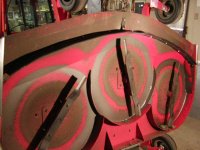
Attached is pic of underside of my 7' First Choice finish mower after using 2 years and I have never cleaned the underside of deck. I have no problem with buildup. Most of the welds are on the top side of deck, but so smooth you can not tell it has been welded.
PS: The extra you see there is the leaf mulching attachment I made for it.
PS: The extra you see there is the leaf mulching attachment I made for it.
Attachments
sweettractors
Advertiser
<font color="blue">The FC deck is welded on the rounded front corners as well as at the tapers. </font>
Hi Jim--We understand that--However--that is getting really picky--not many machines are 100% formed??--Ken Sweet
Sweet Farm Equipment Co *Since 1977*
Hi Jim--We understand that--However--that is getting really picky--not many machines are 100% formed??--Ken Sweet
Sweet Farm Equipment Co *Since 1977*
JimMc
Platinum Member
Thanks for posting the picture. You can really tell what's going on much better than by description.
It's actually quite clever how Sicma produces that deck. Most manufacturers would weld the outside and either leave the weld showing (like the LP deck Sicma copied) or grind the outside weld smooth.
The problem with grinding the outside weld is that it is difficult to determine when too much material has been removed, which would cause cracking at the joint in use. By welding the inside and enforcing 100% weld penetration, one simply touches up the outside surface for paint prep with a grinder. This produces a joint that has virtually all the material still intact, but is smooth enough to pass as one piece.
The best of both worlds! A smooth deck that can almost pass for stamped without the huge tooling expense and technology required for deep draw stamping.
It's actually quite clever how Sicma produces that deck. Most manufacturers would weld the outside and either leave the weld showing (like the LP deck Sicma copied) or grind the outside weld smooth.
The problem with grinding the outside weld is that it is difficult to determine when too much material has been removed, which would cause cracking at the joint in use. By welding the inside and enforcing 100% weld penetration, one simply touches up the outside surface for paint prep with a grinder. This produces a joint that has virtually all the material still intact, but is smooth enough to pass as one piece.
The best of both worlds! A smooth deck that can almost pass for stamped without the huge tooling expense and technology required for deep draw stamping.


