Fork attachment build.

   / Fork attachment build. #81  
Awesome work man! was that a grizzly mill I spotted in the pics?

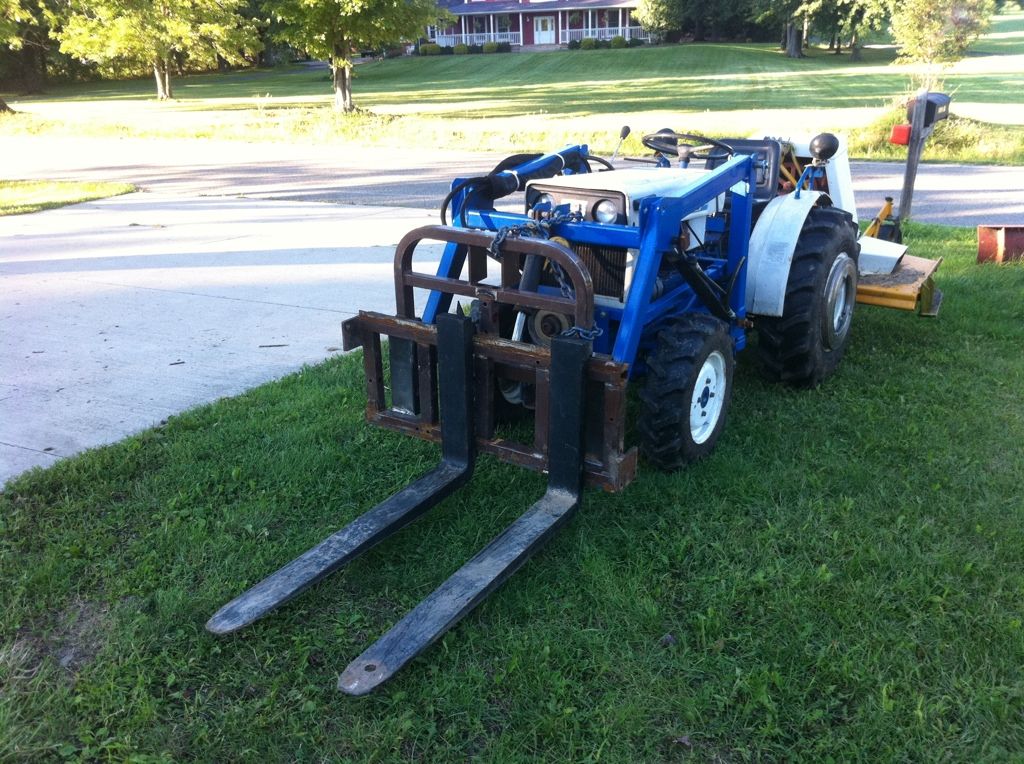
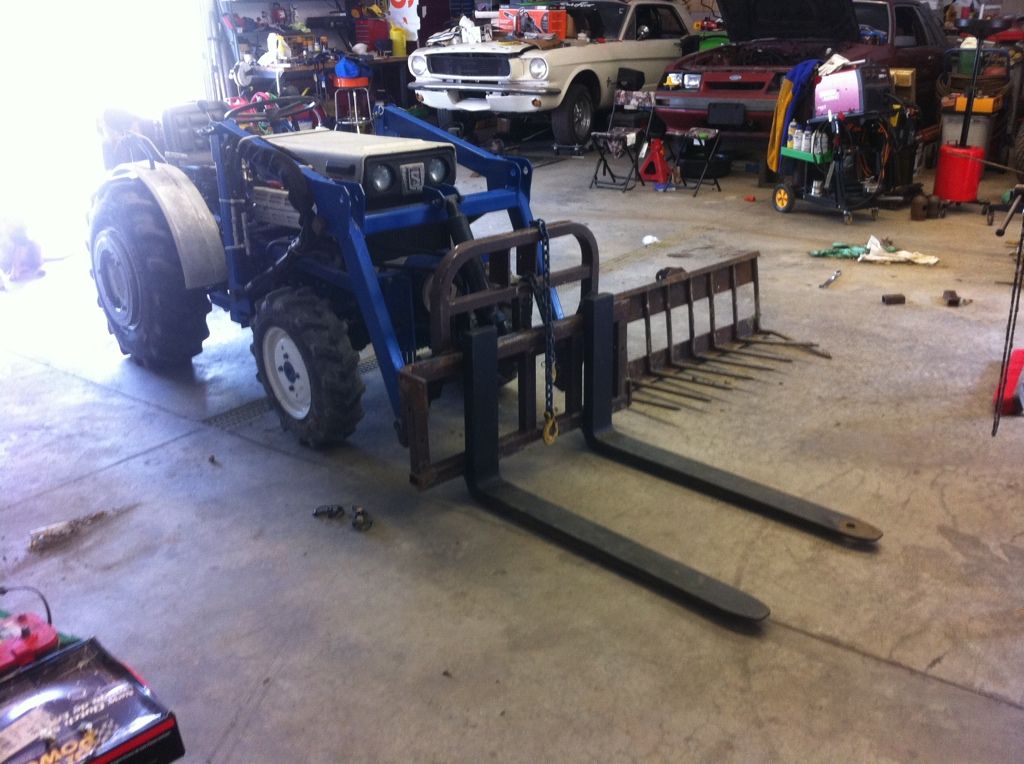
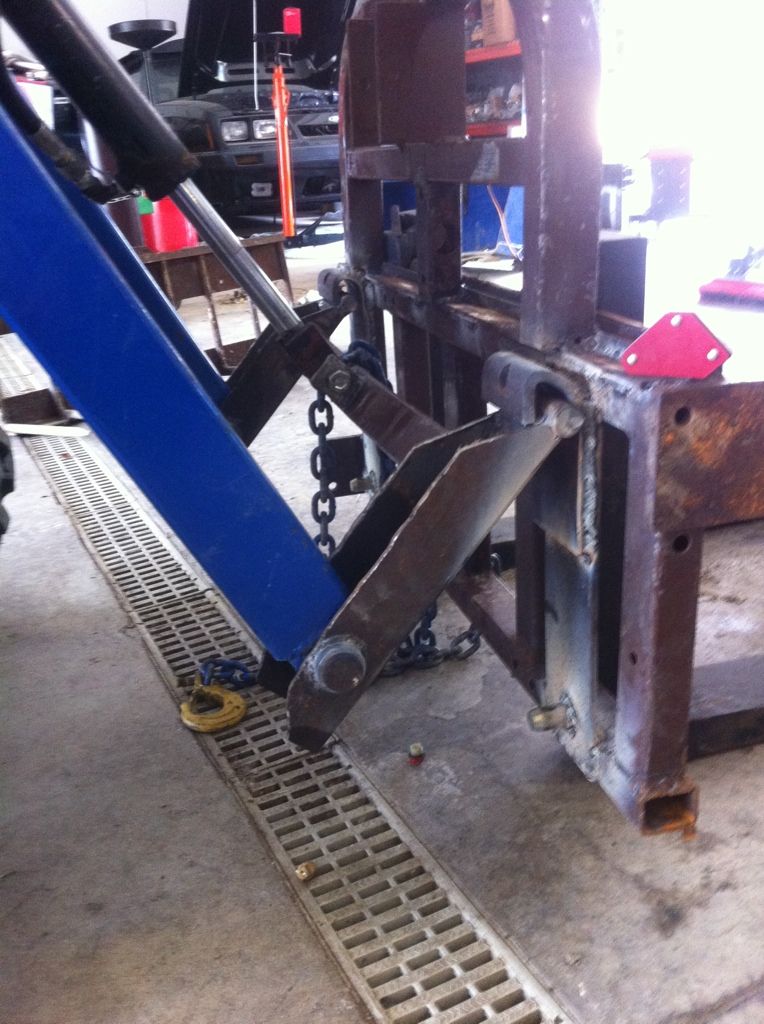
I love welding... I love building projects, I built a whole front end loader, fork attachment, quick attach for the fel...

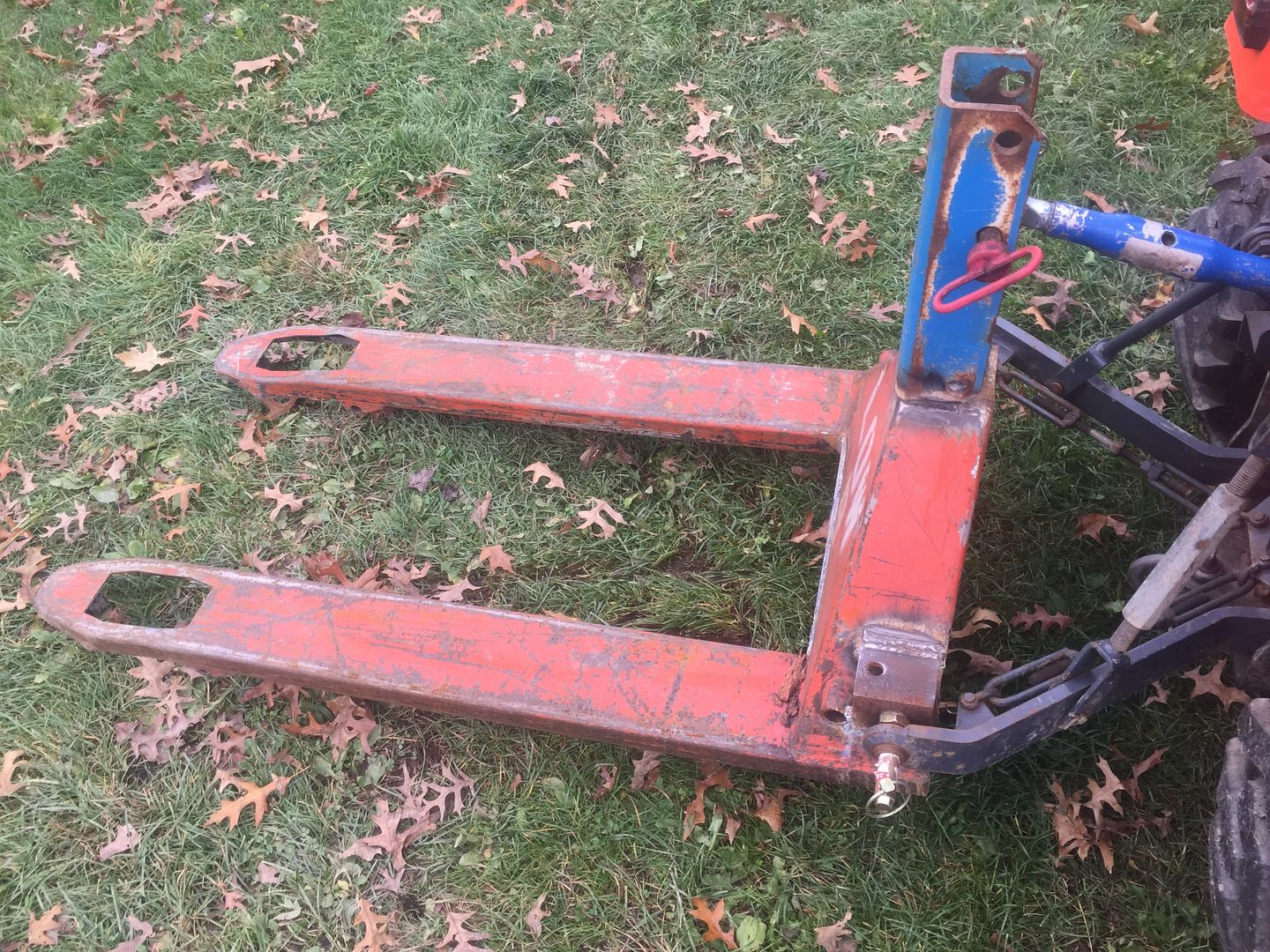
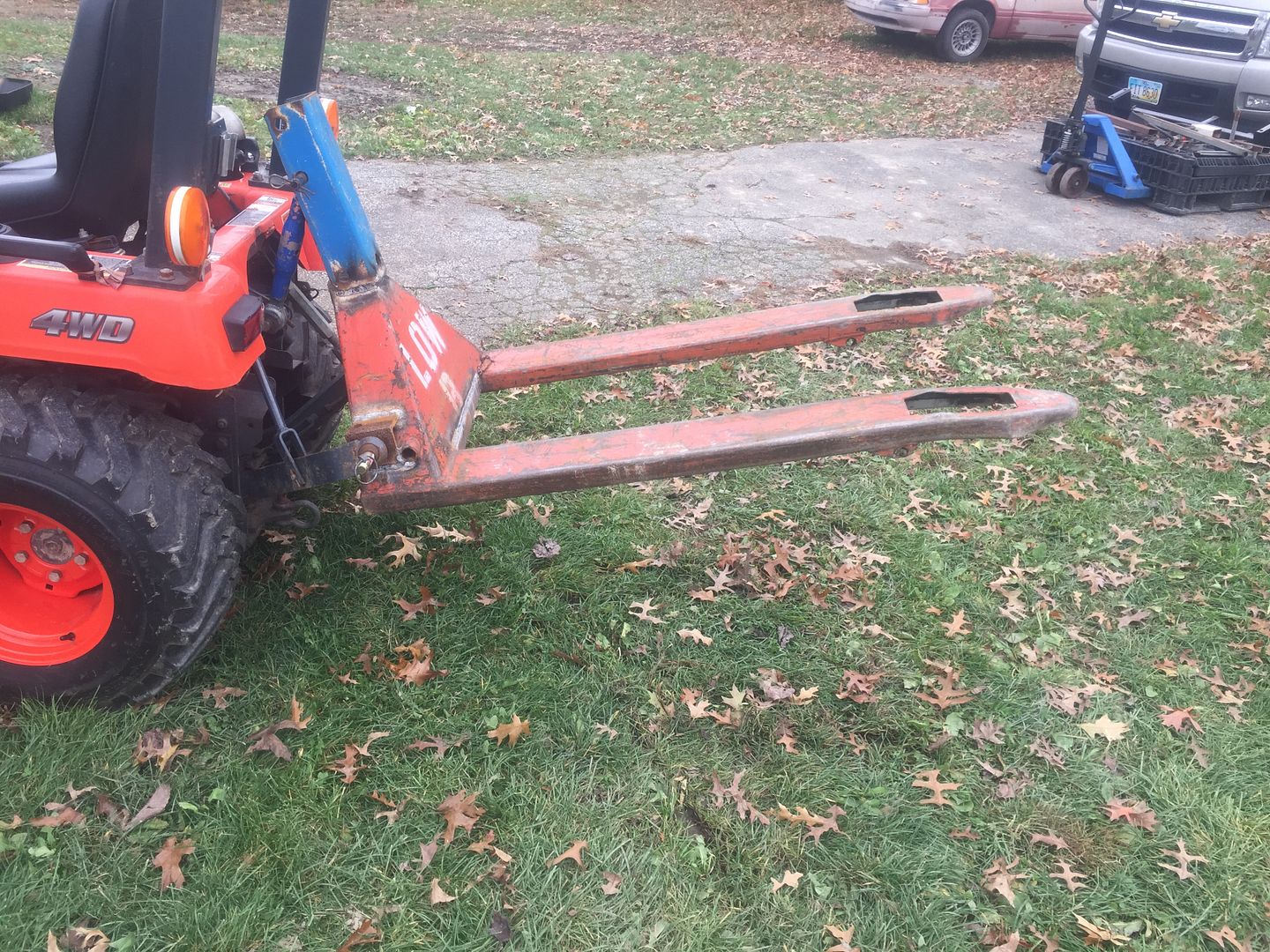
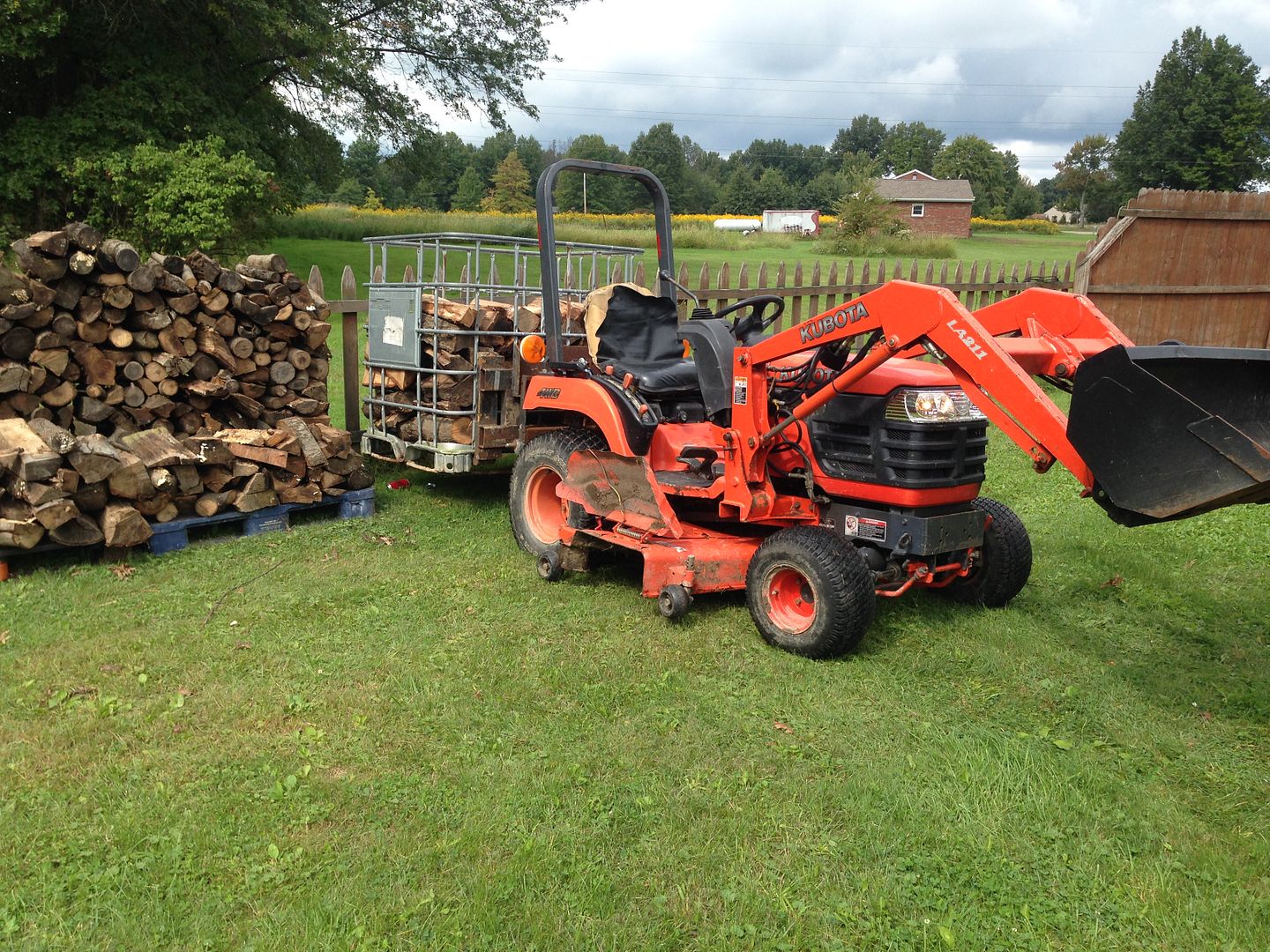
Anyways, I sold that little power house and now have a little kubota BX2230. My fork attachment with forklift 6K lb forks is just too heavy for the Bx's little lift capacity. I made a temporary pallet mover from a old broken pallet jack just to get me out of a bind, but the lack of adjustiblity really sucks,

So not being able to find little forged forks, what are your thoughts on 3"x2" 3/16" wall for my little machine that is rated for 5-600lbs of lift.
What pivot bar did you use for the forks? solid bar or tubing?
 
   / Fork attachment build. #82  
Mine are fixed width at 36" with 1.5 x 3 x 1/8 wall tube for the forks. I've beat the snot out of them with my B3300. They are now bent and this winter i will be replacing both tines but that's what I get for moving 2000 lbs rocks with them. In no way do I miss not having adjustable width. The weight savings of the attachment for outweighs the loss of adjustability. The only thing I would do differently if I were to build another set would be to make them at 32" wide which would fit a wider range of pallets.

My loader has double the capacity of a BX. I have zero doubt that the same 1.5 x 3 x 1/8 tube would be more than sufficient for a little BX.
 
   / Fork attachment build. #83  
Gut feeling says 3x2x3/16 will be fine. But there isn't a whole lot of weight difference between that an 2x4x1/4. Without looking it up, maybe 4# per ft. And maybe 10' total material if that.

Cdn farm boy: there was someone inquiring about building forks out of 1.5x3 awhile ago. Inquiring about how to beef them up without getting thicker. Was that you?

As far as being adjustable, depends on what you will be moving. If only pallets, I see do benefit. But all sorts of other things like logs, lengths of steel, equipment etc, adjustability is nice. Balancing aa 30' log to saw up is easier to do with wide forks
 
   / Fork attachment build. #84  
-------------------------

So not being able to find little forged forks, what are your thoughts on 3"x2" 3/16" wall for my little machine that is rated for 5-600lbs of lift.
-------------------------------------------------
You might consider some flat bar. These are some old Brinly forks that bolted to their 3 point A Frame. I built a frame about 30 years ago to hold them, on a Craftsman garden tractor FEL. Then later added angle iron to use it on the TORO+Loader that can lift 800 pounds. http://www.tractorbynet.com/forums/...ter-put-together-post3204431.html#post3204431

P2240001.JPG


P2240002.JPG


PC040004.JPG


PC040007.JPG


PC040005.JPG


PC040009.JPG


Made some big brush piles with it, "back in the day", here is one from 2006.

P6022156.JPG
 
   / Fork attachment build. #85  
Here are some things to mull over.

Tube size................Weight per ft....................I4
3x2x3/16.................5.59..............................0.98
3x2x1/4...................7.11..............................1.15
4x2x3/16.................6.87..............................1.29
4x2x1/4..................8.81...............................1.54
3x1.5x3/16..............4.96...............................0.48

The chart I used dont list 1/8 wall stuff.

The I4 number represents the stiffness. Or how easily it can be bent.

As you can see comparing the 1.5" stuff to the 2" stuff, you get a lot of strength just from going a little thicker.

The above mentioned 3x1.5x1/8 forks that CDN Farm Boy bent up would have been in the 0.400 range. A 3x2x3/16 fork is about 2.5times stronger.

But even going all the way to 4x2x1/4 which is what alot of commercial clamp on forks are, you only add a little over 3# per ft. Even going with 4x2x3/16 wall would hardly be much weight gain, but 30% stronger.

Never know when you may upgrade to a larger machine;)

And for reference, a set of solid 2x3 bars would only be twice as strong as 2x3x3/16 tube, but would weigh about 4 times more.
 
   / Fork attachment build. #86  
Here are some things to mull over.

Tube size................Weight per ft....................I4
3x2x3/16.................5.59..............................0.98
3x2x1/4...................7.11..............................1.15
4x2x3/16.................6.87..............................1.29
4x2x1/4..................8.81...............................1.54
3x1.5x3/16..............4.96...............................0.48

The chart I used dont list 1/8 wall stuff.

The I4 number represents the stiffness. Or how easily it can be bent.

As you can see comparing the 1.5" stuff to the 2" stuff, you get a lot of strength just from going a little thicker.

The above mentioned 3x1.5x1/8 forks that CDN Farm Boy bent up would have been in the 0.400 range. A 3x2x3/16 fork is about 2.5times stronger.

But even going all the way to 4x2x1/4 which is what alot of commercial clamp on forks are, you only add a little over 3# per ft. Even going with 4x2x3/16 wall would hardly be much weight gain, but 30% stronger.

Never know when you may upgrade to a larger machine;)

And for reference, a set of solid 2x3 bars would only be twice as strong as 2x3x3/16 tube, but would weigh about 4 times more.


good info.. I have some 3" C channel I can use as well as the 2x3x3/16" box tube to make front forks from... Need to read up and see which would be better, as the 6-7' pieces feel about the same weight

When I had my other tractor I built a 2x3x1/4" wall JD style quick attach style cage/frame and used 3/8 thick angle to use as the fork rails. It had well over 2K lbs on it a couple times with no issues, but the forks are forged 6K lb forklift forks and way too heavy for my machine now, I had them on the rear for awhile but the 3pt capacity was greatly diminished. I have since made a set of rear fixed forks from a pallet jacket and it works great on the rear and is light... this got me thinking about making something for the FEL once I do a legit quick attach, but I want them adjustable to make life easier. I don't have a way to weigh them, but the whole pallet jack weighs less than one of the forks....

old setup: (still have them, just too heavy)

0C0597BC-73ED-4292-BF57-E0D6C7FF8A00-6286-00000B80D103D668.jpg


f6aca8c0.jpg


4fe06b27.jpg


995B8D12-7032-48FF-AB2C-4995CCE9194B_zpst83r5vkq.jpg


BE0DDAE7-91EA-4027-BF28-DB04C35B047E_zpsyfrabnlh.jpg


2756F71D-209A-40DA-A64C-F67A143BD7B5_zpsggqemphn.jpg
 
   / Fork attachment build. #87  
Channel iron isnt even going to be close to the same strength as box tube in the weak direction.

C3x4.1# has an I4 of 0.197
C3x5# has an I4 of 0.247
C3x6# has an I4 of 0.305

So 3" tube at 5.59# per ft is over 3 times stronger than 3" channel that weighs a tad more at 6# per ft.
 
   / Fork attachment build. #88  
Gut feeling says 3x2x3/16 will be fine. But there isn't a whole lot of weight difference between that an 2x4x1/4. Without looking it up, maybe 4# per ft. And maybe 10' total material if that.

Cdn farm boy: there was someone inquiring about building forks out of 1.5x3 awhile ago. Inquiring about how to beef them up without getting thicker. Was that you?

As far as being adjustable, depends on what you will be moving. If only pallets, I see do benefit. But all sorts of other things like logs, lengths of steel, equipment etc, adjustability is nice. Balancing aa 30' log to saw up is easier to do with wide forks

Not that I remember..... But it is something I need to figure out. I really like the 1.5" thickness for picking pallets. 2" thick would make it kinda tight on pallets that have 2x3 rails and with only 1.5" thick, I can use full dimension 2x4 runners under lumber etc and still get the forks in.

I've been considering:
double 1.5" square rather than the single 1.5x3
1.5x3 and sliding some 1.25 square on the inside.
Use the 1.5x3 and add an L shaped gusset out of 1/4" on the outside
I have no idea of how to calculate the strengths but the way I see it, any of them are still stronger than what I have now which only failed with abuse.....wait I'll probably abuse the rebuilt ones too......
 
   / Fork attachment build. #89  
If you don't mind me asking, how much does it cost to build a set of forks? I have a possible chance of getting to build two sets of forks. One for my Grandpas L3800 and one for my neighbors DX40.
 
   / Fork attachment build. #90  
If you don't mind me asking, how much does it cost to build a set of forks? I have a possible chance of getting to build two sets of forks. One for my Grandpas L3800 and one for my neighbors DX40.

It all depends on the cost of the steel and how complicated you want to make them. I've got a total of 16' of tube plus the pin brackets I paid a buddy $100 to CNC cut. All-in that makes mine about $150 or so for the materials and a couple hours to weld them up
 
   / Fork attachment build. #91  
I will build them as simple as possible. A trip to the scrap yard would save material cost, but would likely cost me far more than just buying new metal.
 
   / Fork attachment build. #92  
If you don't mind me asking, how much does it cost to build a set of forks? I have a possible chance of getting to build two sets of forks. One for my Grandpas L3800 and one for my neighbors DX40.

Look around on craiglist and local scrap yards, lots of times you can find forks that are in good shape, my first set cost me 75 bucks off of craiglist and the second set was thinner and lighter was welded to a 2x4 box frame that i picked out of the scrapyard. They cost me 43 bucks and some time to cut them apart.... I would do that with larger tractors with higher lifting capacities.
 
   / Fork attachment build. #93  
Not that I remember..... But it is something I need to figure out. I really like the 1.5" thickness for picking pallets. 2" thick would make it kinda tight on pallets that have 2x3 rails and with only 1.5" thick, I can use full dimension 2x4 runners under lumber etc and still get the forks in.

I've been considering:
double 1.5" square rather than the single 1.5x3
1.5x3 and sliding some 1.25 square on the inside.
Use the 1.5x3 and add an L shaped gusset out of 1/4" on the outside
I have no idea of how to calculate the strengths but the way I see it, any of them are still stronger than what I have now which only failed with abuse.....wait I'll probably abuse the rebuilt ones too......

Single 1.5x3x1/8.....I4=.355 and weighs 3.5# per foot

1.5x1.5x1/8 I4=.188 and weighs 2.2# per ft

So doubling the 1.5 square would be .376.......not much gain over the single 3" wide stuff but adding almost a pound per ft.

An L shaped gusset at the heel will really beef that connection up. With a uniform thickness and material for the entire length of the fork, the heel is where the failure point will be. But it is really hard to calculate complex shapes without knowing exact dimensions, especially in such a critical area.

For stress, it is pretty simple to figure. You can look up whatever tube properties you want in many different charts online. Here is one, and this one shows 1/8 wall also. (There are a few differences between differing charts, so some of the I4# I mentioned earlier might be slightly different from one to the next).

Here is the chart http://www.cim.mcgill.ca/~paul/HollowStruct.pdf

Look at the specs under the Y-Y colum. That is the weak direction of the tube. And the two numbers you need are the I (moment of inertia) and the S (section modulus). Moment of inertia denotes how stiff the tube is, and used in calculating deflection. Good for comparison of different sizes. The section modulus is used for calculating stress.

Stress = (weight x Length)/Section modulus

Since HSS tube is 50ksi steel, you dont want the stress to exceed that. So you can rewrite the formula solving for weight if you want.

(50,000 x S)/L = Weight.

Using the 3x1.5x1/8 tube 42" forks.....(50,000 x .474)/42 = 564# max at the tip of a single fork before it will fail.


Obviously this is a static condition. A load bouncing around must be factored as well. Even loads like on a pallet, the max capacity would be doubled. Again in a static condition.
 
   / Fork attachment build. #94  
Thanks for that information, its a huge help. I've heard some of you talking about the different numbers for a while now in different threads but never knew how to apply them.
 

Tractor & Equipment Auctions

2009 CAROLINA  16FT EQUIPMENT TRAILER (A58018)
2009 CAROLINA...
2013 Felling Trailers T/A Side Dump Flatbed Trailer (A56857)
2013 Felling...
iDrive TDS-2010H ProJack M2 Electric Trailer Dolly (A59228)
iDrive TDS-2010H...
500BBL WHEELED FRAC TANK (A58214)
500BBL WHEELED...
2019 Dodge Charger Sedan (A59231)
2019 Dodge Charger...
Adams 5T Pull-Type Fertilizer Spreader (A56438)
Adams 5T Pull-Type...
 
Top