Furnace options

   / Furnace options #1  

Torvy

Super Member
Joined
Jul 21, 2021
Messages
7,598
Location
North East Texas
Tractor
TYM T574H
So we are about a year out from moving onto our land. We have NG pipelines on the property, but apparently that does not mean we can get access to NG. We are thinking the next best option in East Texas will be LP. We had fuel oil as a kid up north. Most of my adult life we have had NG, except a few years in Vegas with electric.

Any suggestions on the best way to heat the house? A/C is more important here but it does get below freezing once in a while.

We love our variable speed Trane we put in a few years ago in the city. That change alone saved us over $100 a month. Can those run on LP?
House will be about 2000 SF.
 
   / Furnace options #3  
1 - 80% AFUE (non condensing)
2 - 90% AFUE or higher (condensing)

1 - Fixed speed blower
2 - Variable speed constant torque (AKA X-13) blower
3 - Variable speed constant airflow (AKA variable speed) blower

1 - Single stage gas valve
2- Two stage gas valve
3 - Fully modulating gas valve

Above are pretty much your options when it comes to a gas furnaces. Pricing is lowest at 1, moves up in price when you go to #2 and #3. AFUE% over 90 can run from 90% up to 97% to 98% which also increases furnace price. I can't think of any line of residential furnace that will not run either on NG or LP (as mentioned, generally comes with a LP kit which adjusts the pressure and a different piston).

2,000 square feet tells you something, but the because this is new contruction, are you planning on having a load done on the house with the various insulation factors (which can make a huge difference in load capacities needed)?

Anyone can ballpark it for 3.5 ton but depending on how well it's insulated it could bring that size down easily.

How many floor levels?

Are you planning on one system, two systems or zoning?

One thing to consider is to be proactive in the building of the house to ensure you have more than enough space for your HVAC equipment along with ductwork, particularly 10-20 years after the house is built and you need to access your equipment.

If going with ductwork, the more hard metal pipe that is insulated by being wrapped (vs being lined), the better IMO, but that also will raise the price.

Using 3.5 ton for an example (purely a guess given the size on how guys "ball park" it), if on LP, a 2 stage will offer you more comfort on the heating side because at 3.5 ton, most furnace sizes will be in the 80-100k BTU range. A two stage gas valve (not a timed gas valve that automatically goes into 2nd stage if heating isn't met within a certain time frame irregardless of inside temp) will give you a low fire and high fire BTU rate, generally without the furnace having to be on second stage (high fire) rate.

One other thing to think about if going with a AC unit is to dual fuel it, using a heat pump outdoor unit with coil, and use a furnace for "back up" heat. This way, when you do need heat when it's less than 65F outside air, you can run your heat pump for heat down to a certain temperature (say 20F or 30F, and then your gas furnace comes on). This way, you get the best of both worlds, using electric for heat until it gets "very cold" and then you use your furnace to make it more comfortable on the heating side. If on LP, your burning a lot of fuel anytime that gas furnace comes on for heat, so why have it (gas furnace) running the majority of the time when it's 30F-60F outside and the heat pump can maintain the heat?

Also note, if you wait until January 1st 2023, 15 SEER will be the minimum SEER rating in the US, and unlike heat pumps, it will be illegal to install exisiting AC inventory after that date. 14 SEER Heat pumps will be allowed to use existing inventory after the January 1st date, and we're still wondering exactly how the government/local government is going to enforce that LOL
 
Last edited:
   / Furnace options #4  
Why not a heat pump or mini splits? Seems like an ideal application in your area. Forget the gas installation costs, and you need the electric supply anyway.
 
   / Furnace options #5  
We're total electric; a few years back we replaced our 40 year old electric unit with a heat pump. No major complaints, but I run it on auxiliary most of the Winter (electric resistance heat instead of heat pump heat) because the heat pump seems to run almost continuously during the colder weather and doesn't put out the heat. In any case, being built total electric, the electric company gave us a break on rates, so that has not been a problem, at least since we added the 8" of insulation in the attic.
 
   / Furnace options #6  
Why not a heat pump or mini splits? Seems like an ideal application in your area. Forget the gas installation costs, and you need the electric supply anyway.
1 - Why I mentioned dual fuel. Best of both worlds with heat pump and gas at a minimal price increase with a gas furnace vs a air handler.

2 - Although I'm very pro mini split for certain applications, at 2000 square feet, you're probably at least looking at 5 indoor heads. In the long run, with service and maintence taken into account over the years along with the fact of the pricing to ensure that you have enough heat for the possible low temps using the correct mini split equipment, most likely cheaper doing a convention split system with ductwork.
 
   / Furnace options #7  
Is geothermal an option down in Texas. The ac side of geothermal works well and saves in really hot weather. I did some research when we put geo in and NG was usually a good choice. We had LP before and it depends on the price of LP but it can get pricey. Of course heating in Texas will be less than Illinois.
 
   / Furnace options
  • Thread Starter
#8  
We will definitely have gas. I am a convert to a gas cook top. Same with water heater. Gas is way more effective than electricity and relatively cheap here in Texas.
The house will essentially be a 40x50 rectangle. One story. We are still in the design phase, haven't finalized choosing a builder.
Avg. Lows are above freezing. Excluding the 2021 anomaly, the record low is 11. It got to -3 back in Feb. In Texas, even North Texas AC is way more important than heat. Where I grew up, the lows in winter were about 30 degrees lower.

Doesn't a heat pump need open area to be buried? We will not have much open land at all. Trees and more trees.

I prefer a well insulated house to limit sticker shock in summer.
 
   / Furnace options #9  
Doesn't a heat pump need open area to be buried? We will not have much open land at all. Trees and more trees.
I would guess you're refering to a geothermal system?

A heat pump looks EXACTLY like your AC unit, except when you look inside the unit, it has a reversing valve whereas an AC unit does not.
 
   / Furnace options #10  
I thought I saw where they can do geothermal in a small area by going deep like a well.
 
   / Furnace options #12  
The house will essentially be a 40x50 rectangle. One story. We are still in the design phase, haven't finalized choosing a builder.


Doesn't a heat pump need open area to be buried? We will not have much open land at all. Trees and more trees.
If you are in or West of Lamar,Delta,Hopkins.Rains or Van Zandt,I might put you on to a builder that can be trusted. If you are acting as your own GC I can only say make sure you know what you are letting yourself in for. Are you going with Barndminom or conventional?

To answer your question about trees. That's not a problem with air to air heat pump but must be factored into desighn of geo. Regardless of type,brand,fuel,SEER or wind direction,the installer is more important than equipment. Choose carfully. Opertunity for suplimental solar heat is wide open. Something simple as windows with correct depth soffit to shade them in Summer add's an amazing amount of heat to living space. Passive solar heated water circulation can handle 50% of hot water and comfort heating.
There is some fine soil in NE Tx if you injoy gardening.
 
   / Furnace options
  • Thread Starter
#13  
NE of Van Zandt. We are hiring a GC. We will be working until it is ready, so less time to handle details.

I will have to learn more about the soil. It is sandy loam and it grows trees well. We will likely have a garden. I grew up about where north of Dallas and west of Minneapolis meets. The soil there will grow anything, but the growing season is much different. It may take a year or two to figure out the differences.

@Sigarms. Yes, in my head those were the same. I don't think we will deal with geo. I appreciate your expertise. I love the variable speed on our AC and other than that, we will try to balance up-front cost and efficiency.
 
   / Furnace options #14  
We will definitely have gas. I am a convert to a gas cook top. Same with water heater. Gas is way more effective than electricity and relatively cheap here in Texas.
I used to think gas was the ideal option for the kitchen stove. Then we got an induction stovetop. The control of gas with the simplicity of electricity. Wouldn't have anything else now.
 
   / Furnace options
  • Thread Starter
#15  
I used to think gas was the ideal option for the kitchen stove. Then we got an induction stovetop. The control of gas with the simplicity of electricity. Wouldn't have anything else now.
Maybe, but I use the flames to char peppers and similar techniques that don't work on induction. Gas also works when the power is out.
 
   / Furnace options #16  
@Sigarms. Yes, in my head those were the same. I don't think we will deal with geo. I appreciate your expertise. I love the variable speed on our AC and other than that, we will try to balance up-front cost and efficiency.
I assume you mean the blower motor in the gas furnace.

Keep in mind, you could ask for a variable speed AC, which would mean you would get the mac daddy variable speed compressor in the outdoor unit.

In the good old days, blower motors were simple. PSC (fixed speed), X-13 (multi tap which would allow lower air flow in cooling for better dehumidification, and variable speed that could adjust the airflow continuously and in generally always used with mutli stage compressor in the outdoor unit.

Reason why I mention this is manufacturers I find use decieving techniques by what they call their blower motors now. A lot of manufacturers call their indoor blowers "variable speed", when it's really a fixed speed constant torque motor (X-13).

Today's "new" terms...

Varible speed constant airflow ECM = ("True") Variable speed

Variable speed constant torque ECM = old X-13 (better deumid over fixed speed as it can reduce the CFM's by a certain percentage)

Fixed speeds constant torque ECM = the upgraded old single speed PSC motor that has been discontinued due to government regulations in gas furnaces only (oil furnaces can still use a PSC blower as well as air handlers).

I have absolutely no doubt that customers today think they may have a variable speed blower motor in their indoor blower (gas furnace or air handler) when they really have a "variable speed" constant torque motor because the contractor didn't explain the differences and just used the term "varible speed" blower.

If I were building, ensure you insulate well. Insulating the house to lower the load for cooling and heating is the best investment you can make in your home IMO. If using a GC and you don't have direct contact with some of the subs (such as HVAC and plumbing) be very speciffic on what you want. What ever you do, don't spend good money on a HVAC system and good ductwork only to have a $35 Dico thermostat put on the wall ;)

I just can't believe some houses today with all the upgrades homeowners go with and money spent on to have the absolute cheapest made thermostat put up on the wall.
 
Last edited:
   / Furnace options #17  
I assume you mean the blower motor in the gas furnace.

Keep in mind, you could ask for a variable speed AC, which would mean you would get the mac daddy variable speed compressor in the outdoor unit.

In the good old days, blower motors were simple. PSC (fixed speed), X-13 (multi tap which would allow lower air flow in cooling for better dehumidification, and variable speed that could adjust the airflow continuously and in generally always used with mutli stage compressor in the outdoor unit.

Reason why I mention this is manufacturers I find use decieving techniques by what they call their blower motors now. A lot of manufacturers call their indoor blowers "variable speed", when it's really a fixed speed constant torque motor (X-13).

Today's "new" terms...

Varible speed constant airflow ECM = ("True") Variable speed

Variable speed constant torque ECM = old X-13 (better deumid over fixed speed as it can reduce the CFM's by a certain percentage)

Fixed speeds constant torque ECM = the upgraded old single speed PSC motor that has been discontinued due to government regulations in gas furnaces only (oil furnaces can still use a PSC blower as well as air handlers).

I have absolutely no doubt that customers today think they may have a variable speed blower motor in their indoor blower (gas furnace or air handler) when they really have a "variable speed" constant torque motor because the contractor didn't explain the differences and just used the term "varible speed" blower.

If I were building, ensure you insulate well. Insulating the house to lower the load for coolin

I just can't believe some houses today with all the upgrades homeowners go with and money spent on to have the absolute cheapest made thermostat put up on the wall.
He's given you some great info right there !

I had to use the cheap T. stat on my unit. It's the only t.stat (Controller) that would work with my system..

Don't pay any attention to the cheap trane unit. I'll replace it when it goes out. It's only for the grand kids play room upstairs. Only used when they come for a visit.
 

Attachments

  • 20190522_162317.jpg
    20190522_162317.jpg
    2 MB · Views: 103
   / Furnace options #18  
Don't pay any attention to the cheap trane unit. I'll replace it when it goes out. It's only for the grand kids play room upstairs. Only used when they come for a visit.
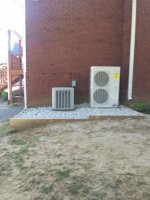
Do pay attention to the way Kenmac has those outdoor units placed outside his home, that is the CORRECT way to sit your unit/units on the side of your home, with lumber and gravel, IMO, even if the house didn't have any grade to deal with.

When I replaced my one outdoor unit below.

I hate dealing with cement pads just due to the weight, but the existing pad was concrete and reused it (harder and harder to find anymore anyways) but I did "box and stone" it. Between lumber and stone and time, it can add onto a job price, but a good contractor should always give the homeowner the choice between the right way of doing it or the cheap way of doing it (putting bricks, rock or dirt trying to level the pad on grade) or let the homeowner do it themselves to reduce the job cost.

C1.png


If anything, even if your house sits flat on the land without any grade to deal with, and you don't have any shrubs around the house, a raised "box and stone" set up will help any possible incidents of nailing your outdoor unit with a riding lawnmower, and it's "natural snow legs" to raise the unit higher for snow (bigger issue up north).

It plane and simply looks better as well IMO.
 
Last edited:
   / Furnace options #19  
One more pitch for geothermal . . . If I were building, I'd definitely go with a geothermal unit. If you have room for a septic system you might have room adjacent for a ground loop -- it doesn't take as much room as you might think. Also, as mentioned, you can go vertical with a vertical loop system that has minimal footprint above-grade.

With Geothermal, you have the efficiency of a heat pump coupled with the nearly constant ground temperature used to exchange heat. Whether you go with gas or not, your AC will still be electric. A standard AC condenser unit has to exchange heat with the outside ambient air temperature. A geothermal unit takes advantage of the much lower ground temperature so your heat-sink ambient temperature might be more like 55 - 60 degrees ground temp instead of 80 - 90+ degrees air temp.

So on AC setting, you're electric either way.

Add to that, you get free hot water all summer, as long as you're on the AC cycle. Some of the heat that would be dumped / exchanged into the ground is used to heat your water.

On Heat cycle, you have the same advantage. Heat pumps are very efficient for heating until it actually gets COLD outside. With geothermal your heat pump doesn't experience the very cold ambient air temp and again takes advantage of the nearly constant and much warmer ground temp as a heat-sink. (Or, in this case, as a source to extract heat from.)

I'm with you about gas cooktops. You could still have gas available for grill, fireplace, whatever . . . You could even use gas for hot water when not getting it free as a by-product of your AC system. Natural Gas is obviously better, because it's cheaper than propane. But neither NG or propane helps you at all with Air Conditioning. Since you mention that AC is the most important in your area, perhaps you should think about the best option for an AC system and then fill in the gaps.

Everyone quotes the greater cost of geothermal's initial installation. I believe with the government and utility credits, the payback in an area that's heavy on the AC side would be pretty quick.

One last reason that would lead me to take a hard look at geothermal. The insane energy policies we're seeing lately that have resulted in importing oil again and limiting oil/gas production in the US have already led to higher prices. (I think it's going to get worse, but that's my opinion.) Propane is going to go higher. This is going to impact electricity rates too. All energy will be more expensive. I think geothermal lets you insulate yourself from these energy fads somewhat.

But since you're main cost will be electricity to operate an AC system, regardless of how you heat, geothermal will result in cheaper AC operation with the added benefit of free hot water which eliminates your only real significant NG or Propane summer load.

Good luck with the new place!
 
Last edited:
   / Furnace options #20  
If anything, even if your house sits flat on the land without any grade to deal with, and you don't have any shrubs around the house, a raised "box and stone" set up will help any possible incidents of nailing your outdoor unit with a riding lawnmower, and it's "natural snow legs" to raise the unit higher for snow (bigger issue up north).

It plane and simply looks better as well IMO.

Hit the unit with a mower?!?

Who could possibly make that mistake?

MoKelly
 

Marketplace Items

2019 KOMATSU D61PXI-24 CRAWLER DOZER (A60429)
2019 KOMATSU...
2025 JMR Tree Boom Mini Skid Steer Attachment (A59228)
2025 JMR Tree Boom...
Freighliner Tender Truck (A61306)
Freighliner Tender...
Zato Hydraulic Demolition Shears Excavator Attachment (A59228)
Zato Hydraulic...
2018 CATERPILLAR 930M WHEEL LOADER (A60429)
2018 CATERPILLAR...
2021 CATERPILLAR 926M WHEEL LOADER (A60429)
2021 CATERPILLAR...
 
Top