Garage project

/ Garage project #41  
I have seen rebar tele thru 4" slabs before. It's just a Garage! Just put down a VB and use 6 Gauge 6 X 6 Flat Remesh on chairs and pour 5-6" of 4000# fiber mix on top. NO expansion joint at perm (the slab will shrink 1/6-1/8"). Spray it with curing compound and cut it into 1/4's a day or 2 after pour. The best thing you can do for the strength (besides the w/c ratio) is to keep it curing for the full 28 days after pour. I might put a 1/2" bar across the door area where I cut it down for the "Door Weep Pocket"
http://www.tractorbynet.com/forums/build-yourself/152236-idea-keep-rain-fron-getting-2.html
 
Last edited:
/ Garage project #42  
Probably because the rebar was set too high in the slab.

It may be "just a garage", but cracked floors that settle in garages suck, too.

TBN guys love their garages. Cracked settled shop/garage floors are unacceptable. :)

I would think in the 1-100 chance that telegraphing did show (hopefully we're talking about the same thing - "shadows" or stains indicating where the rebar is) He could apply a concrete finish on the floor.

Personally, I've never seen this happen on any concrete.

Look at where strength is a must-rebar is used liberally.
 
Last edited:
/ Garage project #43  
Probably because the rebar was set too high in the slab.

It may be "just a garage", but cracked floors that settle in garages suck, too.

nope....on chairs in center of pour. I know for sure because I made them tear out 10,000 sf :eek:
 
/ Garage project #45  
Concrete is strong in compression, poor in tension.
Rebar, or steel, is the opposite.

By combining the two, you develop a product that is superior
and complimentary to the strengths and weaknesses of the individual materials.
 
/ Garage project #46  
Last edited:
/ Garage project #47  
Concrete is strong in compression, poor in tension.
Rebar, or steel, is the opposite.

By combining the two, you develop a product that is superior
and complimentary to the strengths and weaknesses of the individual materials.

He may as well go with a Post-tensioned concrete haunched slab design.

The superstructure could be designed for two (2) load groups. The first load group consists of the
standard AASHTO loads, MS-18, MS-22.5 and HL-93. LFD (Load Factor Design) is used
for MS-18 and MS-22.5 designs; LRFD (Load Resistance Factor Design) is used for HL-93
design. The allowable concrete stresses used for the service conditions are:

Tension in concrete:
0 for 110 % of MS -18 load
0.25 F'c for MS - 22.5 or HL - 93 loads
Compression in concrete:
0.4F'c for MS -18 and MS - 22.5 loads
0.6F'c for HL - 93 load

Now that would be a garage floor!:rolleyes:
 
/ Garage project
  • Thread Starter
#48  
Just got home and found my plumbing rough in approval in the box. Time to lock and load on this floor. :D
 
/ Garage project #49  
I have seen the shadow effect or telegraphing as you guys are calling it in lots of wet concrete but seldom does it show in cured concrete. This is generally caused by overvibrating and the slurry just forms on top of the rebar. I dont believe that it is harmful to the strength of the concrete at least for house slabs as long as your W/C ratio is .45 or less. The best way to assure that you have good concrete is to let the concrete supplier know that you WILL be taking test cylinders of the concrete and it had better meet the spec or he will be breaking it out and replacing it. I have personally seen batch plants use left over concrete as part of the next batch when they know it is going to a house slab and normally isnt tested like it is in heavy construction. You may spec out 3500 or 4000 psi but may only be getting 2500 concrete due to the batch plant operator wanted to safe a few bucks. Get a certified test lab to take the samples and test them if you are at all concerned with strength and cracking. Also the cooler the weather that will delay the set of the concrete some, the stronger the concrete will be when finally cured. Ideal pouring temperature is about 38 F. Hot weather will cause hair line cracks on the surface just about everytime even with a curing compound applied.
 
/ Garage project
  • Thread Starter
#50  
I have seen rebar tele thru 4" slabs before. It's just a Garage! Just put down a VB and use 6 Gauge 6 X 6 Flat Remesh on chairs and pour 5-6" of 4000# fiber mix on top. NO expansion joint at perm (the slab will shrink 1/6-1/8"). Spray it with curing compound and cut it into 1/4's a day or 2 after pour. The best thing you can do for the strength (besides the w/c ratio) is to keep it curing for the full 28 days after pour. I might put a 1/2" bar across the door area where I cut it down for the "Door Weep Pocket"

No expansion joints at the perimeter, as in just turn the VB up and trim it off flush with the mud when dry? I'd really like that for two reasons, nice plastic covering so the brick doesn't get spattered while pouring and no big nasty expansion joint beside the wall forever. Will my inspector freak if he sees no expansion joint?
 
/ Garage project #51  
I've never seen it turned up the wall. I think it would be a PITA. Just butt it to the wall. The finishers will want to snap a line on the brick that they will float the mud to. It would be hard to see and get a nice level floor at the walls if they had to fight the VB in that local. You might want to tape some over the wall and ductape it just above the chalkline. If you don't cover it some way, it WILL get mud splashed up on it.
I am unaware of any code section (IRC) that would require a expansion joint it in that location. It's done that way 99% of the time here. I've inspected 1000's of them done that way. But. it's always best to ask YOUR Inspector about the lack of a expansion joint if you're concerned about it. WDO
 
/ Garage project
  • Thread Starter
#52  
Cool, I will. I was thinking the concrete might bond to the brickwork around the sides without some barrier.
 
/ Garage project #53  
It will bond to the brick & block in some spots.

I'll digress to the building inspector, but leave you with this. I do install perimeter expansion joint in a garage. It's really almost invisible and what it will do is expand slighty when the concrete shrinks during drying phase.

This will keep you from having an open crack next to your block walls. That crack is a great place for bugs, crickets, spiders to hide. Once the white foam has been troweled over, you can't even see it. It's also a great "guide" for your concrete guys to follow. Much easier than a chalk line.
 
/ Garage project #55  
Using no joint will allow the slab to "tooth" into the wall. It acts somewhat like rodding the slab to the wall. The 1/16"-1/8" crack is easily sealed up with a fine bead of NP1 or other moisture-curing polyurethane sealant.

http://www.buildingsystems.basf.com/documents/np1_tdg.PDF

Please excuse me for seeming to be a stick in the "mud" so to speak :D, but I wouldn't think the slab poured against the wall is in any way a substitute for rods. There's really no comparison there. Rods are much more of a binding, permanent attachment that won't allow the slab to sink against the walls where compaction may be questionable.

You are right in that there is no requirement for perimeter expansion joint.

The reason I do it is to "pre-seal" the conrete to the wall rather than have to caulk the joint later (one less trip back to the jobsite) and I find the top edge of the expansion foam to be very easy to follow compared to a chalk line which gets "fuzzy" in the heat of battle. :D
EJ also allows my rods to "float" in and out of the walls. If I didn't use EJ, the slab might stick to the walls as you pointed out. This might defeat the sliding action of my rods.

I appreciate your opinions and think your ways would work, too. I guess there's 2 ways (or more) to skin a cat in almost all phases of construction. :)

I don't want to beat a dead horse, but simply share my methods & reasoning.
 
/ Garage project
  • Thread Starter
#56  
2 hours with a jumping jack this afternoon....holy crap.:eek: 2 more tomorrow morning will have everything that was disturbed banged in good.

(Note to self: wear gloves tomorrow.)

I have a few spots I'm concerned about compaction on the perimeter. In those spots I have stacked brick from the footing up to near slab grade.
 
/ Garage project #57  
In the past, I have also dug a couple trenches from the back to the front of the garage and poured concrete in them, then brought 12" solid block up to the bottom of poured concrete height. Kind of like a supporting wall in the middle of the garage. Then I span rods across the supporting wall all the way over to the perimeter walls and drill them in. I did this for a guy who parked a couple Mack RM series tandem dumps inside and needed a really heavy built floor.
It has never cracked. If it did, I'd never hear the end of it since I borrow a 15 ton backhoe trailer from him all the time. :D
 
/ Garage project
  • Thread Starter
#58  
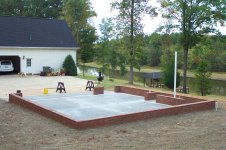
She's out of the ground and ready for wood. Time for the fun part.
 

Attachments

  • DCP_2512.jpg
    DCP_2512.jpg
    448.5 KB · Views: 363
/ Garage project
  • Thread Starter
#60  
Nope I'm in pretty good shape on that one, not even in a flood zone. I live on the headwaters of a reservoir and the COE have shown they will not let the water get too high as to threaten the dam. They'll open all the gates tell the folks downstream to clear out as they did when we had the 500 yr flood a couple of years ago.
 

Marketplace Items

2025 Pabreak Auger Bits and Plate Skid Steer Attachment (A61567)
2025 Pabreak Auger...
832786 (A61166)
832786 (A61166)
Patterson water pump (A59230)
Patterson water...
2017 Nissan Altima 4 door (A63118)
2017 Nissan Altima...
Toro Greensmaster 3150-Q Riding Mower (A56859)
Toro Greensmaster...
2004 International 4400 Flatbed-Dump (A62613)
2004 International...
 
Top