Flatrockcorner
New member
- Joined
- Sep 17, 2019
- Messages
- 12
- Tractor
- Massey Ferguson GC1725M
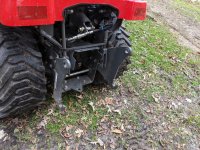
Just curious how you guys tied up or stowaway the hydraulic lines when you don't have the backhoe on the tractor?



Speaking of backhoe lines anybody have any good information on how they connect to FEL "BP" port and "P" port of 3PH control... Think I am getting handle on how to do power beyond with same lines as BH but have a idea that the diagram in shop manual has some errors...
Dale
Here is the information I think you are looking for in the thread of the link listed below, Post #9, #12, & #14 especially.
https://www.tractorbynet.com/forums...89305-can-hydraulics-backhoe-used-adding.html
This is the way I understand the flow of hydraulics from the FEL to the BH to the 3 point hitch:
The hydraulic supply line from the FEL Power Beyond (PB) port has a male coupler end located at the rear of the tractor, and is called "the Pressure Hose (1)" in the MF Backhoe Manual, which connects to the female coupler end coming from the backhoe's Pressure Port (P) valve assembly.
The male coupler end of the hose coming from the backhoe's Power Beyond (PB) port valve assembly connects to the female coupler end of the hose called "the Return Line (2)" in the MF Backhoe Manual, and is located at the back of the tractor and then goes to the Pressure Port (P) of the tractor's "3 point hitch" valve assembly.
The couplers in red above connect together when the Backhoe is removed.
The male coupler end of the hose coming from the backhoe's Return (T) Port valve assembly connects to the female coupler end (this hose coupler end remains loose when the backhoe is removed) of the hose called "direct return to the transmission sump (3)" in the MF Backhoe Manual, and goes to the "transmission sump tank".
I have been thinking about these hydraulic flows/connections for about 11 years now and I still do not have a real good grasp of it.
I hope this helps you with our tractors hydraulics flow...
KC
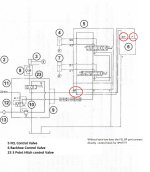
I am pretty much in agreement with your description, but the two things the elude me is what connection is used on control valve body of 3PH as the "P" (from BP of BH) port for 3PH..
Graphic provided is what I believe to be a "correct" copy of partial hydraulic system as I believe the one in shop manual has at least 3 errors in way its drawn...
View attachment 644707
Dale
All I know is what I have learned over the years and am still learning about tractor hydraulics.
The main flow of these valve assemblies is:
Hydraulic flow into the valve connects to the "P" port,
and hydraulic flow out of the valve connects to the "PB" port,
and the hydraulic so called over pressure flow back to the tank from the "T" port of the valve.
Our tractor valves appear to be an "Open Center" valve and each valve has a power beyond port to flow to the next valve.
This is why it's a must to connect the 2 hoses from the backhoe when it's removed, to complete the flow of hydraulic fluid to the 3 point hitch.
I'm not sure if I answered your post above, but I'm sure if I was to read my post above 10 years ago it would of been way over my knowledge back then about hydraulics.
Back then it was more important and hard enough to figure out all of the tractor levers.
KC
View attachment 644732

I was thinking in back to possibly power a log splitter mounted on 3PH.... I know it will be slow, but so am I (because I'm old) and I don't do that much splitting....
Dale
A while ago I was thinking like you are about a 3 point mounted log splitter, PTO and hydraulic.
Heck I even thought of a standard gas power log splitter towed behind the tractor or mounted to a modified "3 point carry-all" (wood platform with log splitter strapped down to it).
But in reality, I only have 3 acres of wooded land, and now I usually:
1). skid the trees (cut to about 16') to the outside area of my woodshed for processing.
2). cut the logs to 9' and either skid the logs or use my bucket mounted brush forks to transport the logs to the outside of the woodshed.
3). and after 11 years we only had 1 nasty winter that toppled over 50 trees.
I have learned to hate handling wood over and over especially after our 1 nasty winter and splitting all of that wood in about 6 locations (my neighbor towed his gas powered log splitter with his UTV to these 6 locations) throughout the property.
My current system is to cut the logs (outside of the woodshed) into 18" rounds, load them on the wooden platform on top of the bucket mounted brush forks, drive into the woodshed and dump the load.
We will stack the rounds inside the woodshed and work our way out, and the woodshed can hold about 20 cords.
In the summer we get all of the last winter downfall trees cut into 18" rounds and into the woodshed and during the winter I'll use the 7 ton electric wood splitter as needed to split wood and kindling for 2 garden wagons (this process is done in the woodshed and the loaded wagons are pulled into the house and staged next to the wood burning stove).
Oh I forgot to mention the best part of this "on demand splitting", I am sitting down on a 3 gallon bucket with a cushioned bucket lid doing the wood splitting...
This splitting on demand has worked well for me because for the past 4 years, and being old, it extends the manual work required out to many more days; of about 10 minutes + - to fill 2 wagon loads of wood when required (usually just 1 wagon load a day after late Dec. and Jan.).
Everyone has to find out what works for them, and for me I seem to always make little adjustments when I find an easier and more efficient way.
KC
Sorry to be off topic...