Geothermal heat pump install with crawlspace encapsulation

   / Geothermal heat pump install with crawlspace encapsulation #1  

Country Geek

Gold Member
Joined
Jun 6, 2014
Messages
307
Location
Apex, NC
Tractor
Still Looking
I had started and participated in a thread or two here recently about geothermal heat pumps, trying to decide if one is right for me. I've decided to pull the trigger and I'll follow the install on this thread.

Background: I'm replacing a dual-fuel air-source heat pump. The backup furnace is propane. When I built my house propane was $1 a gallon. Now as we all know it's much more, and also much more volatile. Plus, the local market here is quickly evolving into a duopoly as the two big players (Amerigas and Ferrellgas) are systematically buying up all the mom-n-pops. So I just don't think conditions are favorable for propane heating any more. Last January, during the polar vortex, one month of propane cost me $850. And that's at a significant discount because I had signed a contract in the fall and was getting a commercial rate, plus I own my tank so was also getting a favorable rate for that.

My system is also aging and in need of replacement. The refrigerant it uses is being phased out, and the system is in bad shape because it's located in a crawlspace and 15 years of humidity under there plus critters messing with the ducts has taken its toll. To protect against the latter I'm also having my crawlspace encapsulated, which I'll discuss in another post.

I spent some time deciding on a system type. I first got a quote for a solar-assisted air-source heat pump. This is a regular heat pump system plus solar panels through which refrigerant circulates, making the heat pump more efficient. The research I did made me think this was more a gimmick to make a regular heat pump eligible for energy efficiency credits, than a real efficient system. I settled on geothermal because it's by far the most efficient plus I have the land to do a trench system, reducing cost vs wells.

Cost was a factor and here tax credits are a big help. There is a 30% federal tax credit on a geothermal installation. Plus the state of North Carolina has a 35% credit so in the end that works out to over a 50% discount on the system. I say 50% discount, not the 65% discount that would seem apparent because:

  • The state tax reduction also reduces your state income tax deduction on your federal taxes, so for all practical purposes you pay federal income tax on the state tax credit
  • The NC credit is capped at $10,500

I did a lot of doodling around in this spreadsheet: http://www.eia.gov/tools/faqs/heatcalc.xls. Putting in local values and playing around, plus the fact that I have the land to do it, a geothermal system looked like a no-brainer.

I'll be putting in a 5 ton ClimateMaster Tranquility with gas backup. It may sound funny to say I'm getting the gas backup after what I said above, but all research I've done shows that geothermal systems around here almost never need backup heat. The gas backup is just for peace of mind because I can run it off my 5500W generator in the event of an extended power outage (which ice storms out here can cause), or if a problem develops with the geothermal system. The gas backup will be manually controlled, not on a thermostat, so I can turn it on and off as I want. I expect to run it very seldom, but who knows, if the price of propane crashes, I could run it more. I will have 7 trenches, 150 feet each.

The trenches will be in my pasture. While the trenches are being installed and the grass regrown, the horse will be living in the training round pen and her stall. It's an inconvenience but she's old and doesn't need a lot of running room any more so she'll be fine.

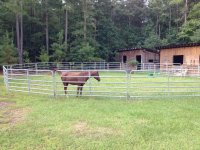
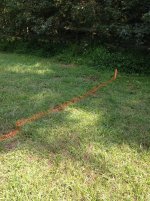
Once this project starts my pasture will be completely torn up. So I've attached a picture of what it looks like now, because it won't look this good again for a long time! The pasture also has a french drain through it that will need to be avoided by the trenches, it's marked with the orange spray paint. Finally, the horse in her temporary lodging.
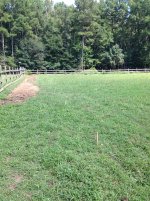
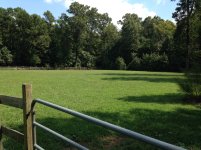
Photo Sep 18, 1 08 11 PM.jpgPhoto Sep 18, 1 06 33 PM.jpg
Photo Sep 18, 1 09 28 PM.jpg
Photo Sep 18, 4 34 30 PM.jpg
 
   / Geothermal heat pump install with crawlspace encapsulation
  • Thread Starter
#2  
I mentioned in the start post that I will also be doing crawlspace encapsulation.

For decades the conventional wisdom and the building code in the southeast was that you build on a crawlspace with vents that you open in the summer and close in the winter. After a 20+ year study by our state university, that conventional wisdom has been debunked.

The main problem with the conventional wisdom is that in the summer the open vents draw in humid air, which condenses on surfaces in the crawlspace. Especially any HVAC equipment down there! This causes rust and water damage. It also encourages mold and mildew. Because of this, many crawlspaces around here, including mine, are not places you want to go, or to store anything you value that can't be wet (like tools, etc).

Another problem I have in the country is critters. In the winter the raccoons, possums, mice, etc, go under there to stay warm, aided by the fact that the larger critters have pulled off crawlspace vents. These critters then pull down the fiberglass insulation to nest in, damage the ductwork, etc. The ductwork damage is especially a problem because it not only reduces the HVAC effectiveness but it also draws in odors from the crawlspace... which can be bad because of the aformentioned critters, not to mention the mold and mildew.

The answer to this, and the new conventional wisdom down here, is crawlspace encapsulation. Basically the crawlspace becomes part of the conditioned space in the house. All the fiberglass insulation is removed from the subfloor and instead the exterior crawlspace walls are insulated. All vents and openings are sealed up. The floor is completely covered with 20 mil plastic that also goes up the walls and piers to make good, sealed barrier. Two duct openings are made so that the crawlspace is conditioned like the rest of the house, and/or a dehumidifier is added. There may be other steps I'm not remembering right now.

Since I'm having my HVAC redone, I'll do this at the same time. The HVAC contractor will remove the old equipment, the encapsulation contractor will do their thing, then the new HVAC equipment will be added.

There is much more info about this process at: http://crawlspaces.org/
 
   / Geothermal heat pump install with crawlspace encapsulation #3  
I would question the cost and complexity of the gas backup. If properly sized, with a geo thermal, you should never need backup. In my home, in colder PA, I have never had the backup heat on, except to test it. Think of it more as "emergency heat". I would save the money and use some of it to buy a bigger generator, so that you can operate the geo system during a power loss. I can easily run my 5 tons worth of heat pumps (2 geo, 1 air) with a 10 KW. I had an 8KW before and it could handle the load as well. You did not mention if you use propane for other needs, but if not I would keep it simple. Another backups to consider is a wood stove. One thing to consider is if you install a gas furnace with a coil on top, the furnace will see dust and moisture, and without some run time to clean and dry the heat exchanger, it could rust out and leave you stranded in some years.

Just my thoughts.

Paul
 
   / Geothermal heat pump install with crawlspace encapsulation #4  
Thanks for sharing the crawlspace findings. I've often wondered about these very points.

We also have a Tranquility geothermal unit, and very happy with it. I look forward to your progress reports.
 
   / Geothermal heat pump install with crawlspace encapsulation #5  
The 3 ton geo that I had was on a 30 amp circuit! It took 23 amps for unit and 7 amps for the water pump.
I measured the temp coming out of a register on heat and the room was 70* and the air coming out was 90*.
They are VERY efficient depending on ground water temp. (my ground water temp 65*)
 
   / Geothermal heat pump install with crawlspace encapsulation #6  
My crawl space is sealed. The exterior walls are insulated concrete forms (styrofoam inside and out with concrete between). Plasitic on the ground is covered with about one inch of concrete. it works very well. A key point I have an air to air Heat exchanger and I modifed it to put more air in the house than is pulled out. This eliminated some mold smell in the crawl space by providing a slight positive pressure.
 
   / Geothermal heat pump install with crawlspace encapsulation #7  
We have a geothermal closed loop with a WaterFurnace. It has the auxiliary heat option. Auxiliary heat rarely kicks in but last winter with wind chills of -30 the auxiliary heat kept of with the temperatures. The closed loop field is under our horse pasture about 50 yards from the house. For backup we use a pellet stove that we can run off a portable generator. We only use the pellet stove for backup heat. We also have the de-superheater option. Just some thoughts. Sounds like you have an excellent plan going. Geothermal is nice.
 
   / Geothermal heat pump install with crawlspace encapsulation
  • Thread Starter
#8  
Thanks for you feedback. Here are my thoughts on it:

I would question the cost and complexity of the gas backup. If properly sized, with a geo thermal, you should never need backup. In my home, in colder PA, I have never had the backup heat on, except to test it. Think of it more as "emergency heat".

That's how I'm thinking of it. Also my house has high heat loss, with very large windows and high ceilings and the Climatemaster rep who did the calculation figured I might need the aux heat when the outside temp gets down to 20 or so.

I would save the money and use some of it to buy a bigger generator, so that you can operate the geo system during a power loss.

Well my house is already wired with a generator sub panel that is designed to be powered by a 5kw generator. The existing gas furnace is on that panel and the new one will be as well. So a lot of the pieces are already in place.

I can easily run my 5 tons worth of heat pumps (2 geo, 1 air) with a 10 KW.

I did discuss several options with my installer including a split system or type of system where a generator could power the geo heat pump. He was leery if that because of the startup demand from the compressor plus the relatively dirty power from a generator, plus the preponderance of circuit boards in modern units, he thought I would need a soft start kit and some extra voltage regulation to safely run my heat pump with a generator.

Another backups to consider is a wood stove.

I had thought of that because I like the idea. But the cost delta for adding gas backup was less than the installed cost of a wood stove. And a wood stove would take up a lot of space inside for something I might need one or twice a year, not to mention being more work.

One thing to consider is if you install a gas furnace with a coil on top, the furnace will see dust and moisture, and without some run time to clean and dry the heat exchanger, it could rust out and leave you stranded in some years.

Good point. I'll make sure to run the furnace at least a couple of times every winter.
 
   / Geothermal heat pump install with crawlspace encapsulation #9  
I would also skip the gas backup. We have a strip heater backup on our Climate Master system (a bit north of you in VA) and the only times I saw it kick on was when the power had been off for about 6 hours and the house got super cold, or briefly in the morning when it was super cold outside and we had turned the temperature down overnight. We have the controller set to automatically kick on the backup heat whenever the incoming air temp is appreciably colder than the set temp (I forget the spread, but it's probably on the order of 10-12 deg F).

I do think it's good to have a backup system, but definitely didn't see the point in springing for a gas system and our HVAC guy said the same thing. Given how rarely the strip heaters kick on, I think that was a good decision.

A side consideration for us was whether or not we really needed propane for anything, and we were able to avoid it all together. I suppose if you already have it, that's a different story. But still, I would really have a hard time springing for the extra cost / complexity of a gas furnace, especially even further south!! Our fireplace can put a big dent in heating requirements when we get it cranking, and I sort of count on that as the real backup.
 
   / Geothermal heat pump install with crawlspace encapsulation #10  
I did discuss several options with my installer including a split system or type of system where a generator could power the geo heat pump. He was leery if that because of the startup demand from the compressor plus the relatively dirty power from a generator, plus the preponderance of circuit boards in modern units, he thought I would need a soft start kit and some extra voltage regulation to safely run my heat pump with a generator.

We just put the Climate Master soft-start module on our geo unit today, precisely so that I could run easier on generator power (our particular Climate Master unit has about a 125 amp startup requirement, and it was noticeable even when running off the grid). With the soft-start kit, there isn't even a light flicker anymore. The kit was about $300 if I remember right.
 
   / Geothermal heat pump install with crawlspace encapsulation #11  
Another possibility is to go with PEX Tubing Radiant Floor Heat System Install Options. That cuts all the noise of forced air heating and you can run the geothermal pipe to the floor heating in the winter and have a cut off in the summer to use for the A/C.
 
   / Geothermal heat pump install with crawlspace encapsulation #12  
We're in Southside VA, probably 75 miles north of you as the crow flies. We have a Bosch system. To say that we are very pleased is an understatement. The aux heat has never come on. Our electric bill for a 3300 sq ft all electric house has never been over $125 in the winter with the thermostat set at 73. Summer's bill never over $100 with thermostat set at 73. And the de-superheater is an extra plus. You'll enjoy it!
 
   / Geothermal heat pump install with crawlspace encapsulation #13  
I'd look into foam insulation. It's been my experience that critters can gnaw and burrow their way into just about anything. The salesmen claim they won't bother it but claims and reality may not be the same as reality doesn't get paid on commission.
We had our 7 ton Water Furnace installed in May so no real experience except that we traded a $45 propane for hot water bill into a $30 increase in electric which included some new to us central air. The Buffalo area is somewhere that air conditioning isn't mandatory but it came with the system . I'm getting too old to wrestle with making 20+ cords of wood so the geo system sounded like the ticket for me as opposed to a new oil system ($$$$). I'm keeping my central wood for a backup.
 
   / Geothermal heat pump install with crawlspace encapsulation #14  
Wow, what a timely post, Geek and others! My Carrier Puron two stage heat pump is now 11 years old, and I've been researching geothermal many years. Just yesterday, after cutting wood and came inside to rest, I noticed wetness at the edges of our oak hardwood floors about 12' from where the inside heat pump unit is located! I knew right away what it was - condensate was backing up and had been leaking for at least a couple days!! So, my geothermal research has just gone into turbo mode!

A question I haven't been able to find an answer to: with geothermal, I'm thinking Water Furnace, Bosch, would there be this inside the house condensate issue? My house is also crawl space.

Looking forward to your progress Geek!
 
   / Geothermal heat pump install with crawlspace encapsulation #15  
would there be this inside the house condensate issue?

There will always be a condensate drain at the air handler or unified geo unit, wherever it is located. When cooling the coil causes moisture to condense from the air, and this needs to be drained. Doen not matter what the technology is.

Paul
 
   / Geothermal heat pump install with crawlspace encapsulation #16  
Thanks Paul. That's what I thought. This is about the sixth time we've had this problem! A house we rent just leaked from ceiling in garage two weeks ago, water pouring all over! Our house has had condensate dripping issues five times! Something needs to be done by designers to FIX this kind of poor design! My hardwood floor will probably have to be replaced! Oh me.
 
   / Geothermal heat pump install with crawlspace encapsulation #17  
Just a thought , can the condensate drain be rerun in a larger size ? I have had to clear the condensate drain on my Waterfurnace several times. On my unit there is an indicator that shows when the condensate drain is plugged, so any damage caused is minor. Probably a tad cheaper than another complete unit.
 
   / Geothermal heat pump install with crawlspace encapsulation #18  
Heheheheheeee, right dox, reckon a bigger pipe wouldn't set me back like a geothermal. But, I just have not had good success with heat pumps after my very first one that lasted from 1980 until 2003! It was lp heat and electric cool, but like others said, wow!, gas has gone sky high! I have no LP now at me house, and glad to be shed of it. The drain pipe under my house is about 12' long and has been bowed down in center since it was installed. I had been meaning to tie it up to a gentle slope since it was first done in '80 - well, I tied it up last night! Funny thing though, it seemed to be draining all along. There was water at my outside drain pipe.

Back to ye olde geothermal - I still want one! Maybe I even need one:confused2:

Oh, and if I do, I'm gonna make installer use about a 12" culvert for condensate drain :raincloud:
 
   / Geothermal heat pump install with crawlspace encapsulation #19  
I had started and participated in a thread or two here recently about geothermal heat pumps, trying to decide if one is right for me. I've decided to pull the trigger and I'll follow the install on this thread.

Background: I'm replacing a dual-fuel air-source heat pump. The backup furnace is propane. When I built my house propane was $1 a gallon. Now as we all know it's much more, and also much more volatile. Plus, the local market here is quickly evolving into a duopoly as the two big players (Amerigas and Ferrellgas) are systematically buying up all the mom-n-pops. So I just don't think conditions are favorable for propane heating any more. Last January, during the polar vortex, one month of propane cost me $850. And that's at a significant discount because I had signed a contract in the fall and was getting a commercial rate, plus I own my tank so was also getting a favorable rate for that.

My system is also aging and in need of replacement. The refrigerant it uses is being phased out, and the system is in bad shape because it's located in a crawlspace and 15 years of humidity under there plus critters messing with the ducts has taken its toll. To protect against the latter I'm also having my crawlspace encapsulated, which I'll discuss in another post.

I spent some time deciding on a system type. I first got a quote for a solar-assisted air-source heat pump. This is a regular heat pump system plus solar panels through which refrigerant circulates, making the heat pump more efficient. The research I did made me think this was more a gimmick to make a regular heat pump eligible for energy efficiency credits, than a real efficient system. I settled on geothermal because it's by far the most efficient plus I have the land to do a trench system, reducing cost vs wells.

Cost was a factor and here tax credits are a big help. There is a 30% federal tax credit on a geothermal installation. Plus the state of North Carolina has a 35% credit so in the end that works out to over a 50% discount on the system. I say 50% discount, not the 65% discount that would seem apparent because:

  • The state tax reduction also reduces your state income tax deduction on your federal taxes, so for all practical purposes you pay federal income tax on the state tax credit
  • The NC credit is capped at $10,500

I did a lot of doodling around in this spreadsheet: http://www.eia.gov/tools/faqs/heatcalc.xls. Putting in local values and playing around, plus the fact that I have the land to do it, a geothermal system looked like a no-brainer.

I'll be putting in a 5 ton ClimateMaster Tranquility with gas backup. It may sound funny to say I'm getting the gas backup after what I said above, but all research I've done shows that geothermal systems around here almost never need backup heat. The gas backup is just for peace of mind because I can run it off my 5500W generator in the event of an extended power outage (which ice storms out here can cause), or if a problem develops with the geothermal system. The gas backup will be manually controlled, not on a thermostat, so I can turn it on and off as I want. I expect to run it very seldom, but who knows, if the price of propane crashes, I could run it more. I will have 7 trenches, 150 feet each.

The trenches will be in my pasture. While the trenches are being installed and the grass regrown, the horse will be living in the training round pen and her stall. It's an inconvenience but she's old and doesn't need a lot of running room any more so she'll be fine.

Once this project starts my pasture will be completely torn up. So I've attached a picture of what it looks like now, because it won't look this good again for a long time! The pasture also has a french drain through it that will need to be avoided by the trenches, it's marked with the orange spray paint. Finally, the horse in her temporary lodging.
View attachment 390989View attachment 390991
View attachment 390988
View attachment 390990

This sounds just like our situation a few years ago. We purchased a home and replaced the propane furnace with Geothermal and a propane backup furnace. We were able to take advantage of Federal and State rebates that provided a significant savings. We wanted the propane backup due to the possibility of extended periods of power outages after harsh winter storms. The propane backup furnace would require little power to run from a generator and would keep the house nice and warm.

We ended up with a Bosch 3 ton unit with three 300ft horizontal runs. The cost savings over propane was enormous. Went from an average of $300 per month (averaged over 12 months) for propane costs to an additional $50 to $75 per month on the electric bill to run the Geo. It helps that we also get to use a lower priced electric meter for the Geo system. Electric rate is nearly half that of normal electric. The Geo does an amazing job of keeping the house at 70 all year long. It is quiet and does not have any of the hot or cold spots throughout the house as with a traditional system. We have not needed to run the backup propane heater nor has the geo not been able to keep up with any of the cold windy winter nights. We even had a -25F night that it had no problem with.

By the way, our horizontal feild was installed using a boring machine. This leaves a very small part of the yard disturbed and only takes a day to install the feild. The boring machine was also capable of running the feild at a depth of 15 feet which would be cost prohibitive if you were trenching yet provides a more stable ground temprature deeper down. Very slick way to run the feilds and costs less than wells too. You could consider this option and not have to move the horse or worry about the french drain.
 
   / Geothermal heat pump install with crawlspace encapsulation
  • Thread Starter
#20  
That's cool about the boring. Not sure why no one seems to offer it as an option here except that our soil can be rocky and have voids, etc... maybe they need to dig a trench to see what their getting and/or remove rock and other obstructions?
 

Marketplace Items

2019 DRAGON ESP 150BBL ALUMINUM (A58214)
2019 DRAGON ESP...
Kubota L4701 (A53317)
PICKUP TOOLBOX (A58214)
PICKUP TOOLBOX...
ENCLOSED DRIVING SIMULATOR TRAILER (A58214)
ENCLOSED DRIVING...
2019 Allmand Night-Lite V-Series 7 kW S/A Towable Light Tower (A55973)
2019 Allmand...
SWICT 84" SKID STEER BUCKET (A60430)
SWICT 84" SKID...
 
Top