Geothermal heat pump install with crawlspace encapsulation

   / Geothermal heat pump install with crawlspace encapsulation #21  
They bore all the time running fiber all around Atlanta. Somehow those machines get around rock. Probably boring costs more than digging as deep as the backhoe will go and then running slinky coils. I suspect that up where it is cold going 7-8 deeper than a basic backhoe will go makes the geothermal more efficient.

Now I am curious how they get the bored lines to bond with the earth. When they do slinky loops they back fill with dirt, water to settle, backfill some more and water, and then keep adding. That said I have some trench areas that sunk 6 or more inches over the past 17 years. I guess that means my efficiency should be going up as the earth is tighter to the coils.
 
   / Geothermal heat pump install with crawlspace encapsulation #22  
They use grout and pump it in as they pull the new lines through the bore hole. That provides good thermal contact with the earth. There is no settling with boring.
 
   / Geothermal heat pump install with crawlspace encapsulation #23  
We have reversible Waterfurnace geothermal with floor heating and high pressure fan coil for AC installed since 2004. We have two propane fireplaces as heat backup and sometime for ambiance. So far our geo works very well but if I build our house today I would use mini-split units and I would invest saved money in PV panels and there would be money left to buy a tractor stuff. The modern mini splits are very quiet inside and outside as well, phenomenally efficient, easy and fast to install and replace, they are way cheaper than Geo and you get a zone for every room in the house and redundant sources of heat and AC as well. We have one in my shop office and one in a guest room for about two years. They are Fujitsu Halcyon but there are other brands that are as good or perhaps even better. Another advantage is that you can get by with much smaller generator because all modern one have "soft" start and you can turn some completely off during outage while maintaining comfort in at least in some areas.
 
   / Geothermal heat pump install with crawlspace encapsulation #24  
They bore all the time running fiber all around Atlanta. Somehow those machines get around rock. Probably boring costs more than digging as deep as the backhoe will go and then running slinky coils. I suspect that up where it is cold going 7-8 deeper than a basic backhoe will go makes the geothermal more efficient. Now I am curious how they get the bored lines to bond with the earth. When they do slinky loops they back fill with dirt, water to settle, backfill some more and water, and then keep adding. That said I have some trench areas that sunk 6 or more inches over the past 17 years. I guess that means my efficiency should be going up as the earth is tighter to the coils.

Your 6 inches of settling is about right as your pipes are probably around 6 feet deep. A general rule of thumb for my area is to expect an inch of settling per foot of fill. Really has to be filled right to not be close to this.

Been some good reading on a geo system for me.
 
   / Geothermal heat pump install with crawlspace encapsulation #25  
Very Timely. Who are you getting to do the install, I live just north of you in Chapel Hill.

Ken
 
   / Geothermal heat pump install with crawlspace encapsulation #27  
I was assuming some sort of grout process. I need to search out some videos on that process.
 
   / Geothermal heat pump install with crawlspace encapsulation #28  
Your 6 inches of settling is about right as your pipes are probably around 6 feet deep. A general rule of thumb for my area is to expect an inch of settling per foot of fill. Really has to be filled right to not be close to this.

Been some good reading on a geo system for me.

Ours was installed in 1998, and we've had about 6 inches of settling, also. I've done some backfilling and the trenches are mostly smooth now, and of course the pasture has grown back, but I'd still like to do it once more - maybe a good excuse for a box blade.
 
   / Geothermal heat pump install with crawlspace encapsulation #29  
I have added once for settling, and needs it again.

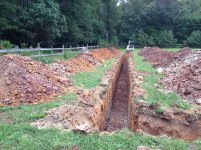
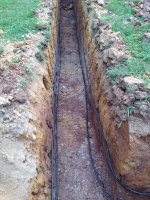
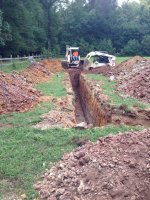
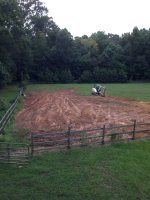
added some pics, because TBN loves pics.... :)
 

Attachments

  • 20120204_MD_Geo_.jpg
    20120204_MD_Geo_.jpg
    117.8 KB · Views: 165
  • 20120108_MD_Geo_12-43-59.jpg
    20120108_MD_Geo_12-43-59.jpg
    149.2 KB · Views: 178
  • 20111218_MD_Geo__3103.jpg
    20111218_MD_Geo__3103.jpg
    163.7 KB · Views: 202
   / Geothermal heat pump install with crawlspace encapsulation
  • Thread Starter
#30  
   / Geothermal heat pump install with crawlspace encapsulation
  • Thread Starter
#31  
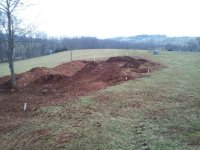
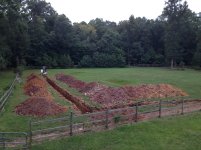
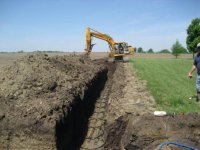
Digging has started. 7 trenches, 150 feet long, three feet wide by six feet deep.

When you say that the trenches are three feet wide, it seems like that's not that much... they shouldn't take up too much space, right? Well they don't. It's the spoil piles that take up all the space! In my case the trenches are being dug, piped, and filled one at at time, so the spoil piles won't become a major hindrance to progress.

The mainfold trench and the first geo trench are dug. The first geo trench makes a 90 degree turn to avoid areas pasture which are the result of an unfortunate decision made 15 years ago to bury stumps from clearing in a pit in the pasture. I agreed to that when we were building, and I shouldn't have.

Photo Sep 23, 7 56 40 AM.jpgPhoto Sep 23, 7 34 41 AM.jpg
 
   / Geothermal heat pump install with crawlspace encapsulation #32  
are they installing slinkies?
 
   / Geothermal heat pump install with crawlspace encapsulation
  • Thread Starter
#33  
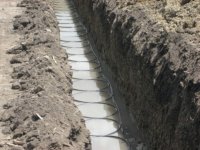
The first trench is done. In previous pictures there were spill piles on both sides of the trench. I talked to the installer and he explained to me that I had two layers of soil, a more sandy type of clay soil on top and more chunky clay underneath. He had made the sandy soil pile on one side and the chunky clay pile on the other side because when he filled it he wanted to reverse the soil, so the more sandy type soil is what's in contact with the tubing... that would give it better contact and therefore better thermal conductivity with the ground.

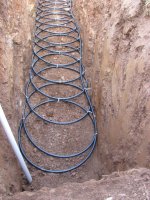
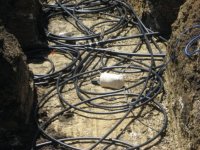
This is a two layer trench... one layer of tubes at six feet, and one at four feet. (this should answer BuckyeFarmer's question, it's not a slinky system).

10708501_10152229788166184_2701807393053887562_o.jpg

Here they are filling in the trench... one Bobcat dumps the fill soil in, and the other one tamps it down.

1912078_10152231565566184_1421878202300345189_o.jpg

This is the finished product. Just one trench with six more to go, look at all that grass wiped out! It's not just the width of the trench obviously, but also the spill piles, and the maneuvering that the equipment had to do. This is the first of seven trenches so when it's done there will be very little grass left in this pasture, so it will need to be reseeded, which I already knew but it's something to see the actual results

10658685_10152230446281184_1849603538122362058_o.jpg
 
   / Geothermal heat pump install with crawlspace encapsulation #34  
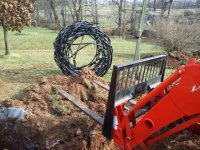
I bet that is taking forever with that mini. In good soil we've put in 14 slinkies in one day. 3/4" 700' coils at 125 feet long. geo.jpg geo2.jpggeo3.jpg
 
   / Geothermal heat pump install with crawlspace encapsulation
  • Thread Starter
#35  
I bet that is taking forever with that mini. In good soil we've put in 14 slinkies in one day. 3/4" 700' coils at 125 feet long.

I suspect my North Carolina Clay wouldn't qualify as "good soil." But yeah, it's going to take several days to get all the trenches in.
 
   / Geothermal heat pump install with crawlspace encapsulation #36  
Why did you go with a straight run over the slinky?

Looks to me the slinky system would let you use a shorter trench for the same contact area.
 
   / Geothermal heat pump install with crawlspace encapsulation #37  
It is interesting to read about contact area of the geo field pipes. Contact area is nearly the same in any configuration. The big variable is the amount of area between pipes. The heat flow through soil is relatively poor. For most soils it is about 1 deg F/foot/BTU. If pipes are closer together, like in a slinky, the soil around the pipes will chill (or heat) more due to the pipe density and given heat flow. This results in a lower overall efficiency due to the chilling of the soil. One or two pipes in a trench, with trenches 8' apart is ideal, but impractical in some installations. It is documented, and I have also seen up to 20 deg swing in the trench (pipe) temps over seasonal changes. Some of that is ground/depth effects and the rest is low heat flow. My system reaches its lowest efficiency around march, when the incoming water temps are in the upper 20's. Last year was interesting as we had a good layer of snow from December onwards. The snow provided some insulation from the surface temps, and even though it was a much colder winter than usual, the incoming water temps were about 5 deg F warmer than other winters.

paul
 
   / Geothermal heat pump install with crawlspace encapsulation #38  
Very interesting post I will be following it closely as I may install the same type system. Thanks for posting.
 
   / Geothermal heat pump install with crawlspace encapsulation #40  
Why did you go with a straight run over the slinky?

Looks to me the slinky system would let you use a shorter trench for the same contact area.
It's silly. While it is better to have the pipe spread out if you dig 7 trenches 3' wide x 150' long and you only have 600 feet of pipe?? Why not fill that trench with pipe? You can do a slinky that's 110' long with 600' of pipe and you could get by with 5 trenches in 1 day (picture your hand with 5 fingers spanning out from a header pit. That gives plenty of separation for efficiency. People overthink pipe separation. Geo wells have the supply and return pipes in the same well that touch). Pipe is dirt cheap. Them digging all week with excavation costs and labor is not cheap.

The benefit of the 2 pipe systems is doing them with a trencher for speed, not using a 3' bucket and tearing up the whole pasture.

If you calculate the degree heating days, do a manual J on the house, and know your soil thermal conductivity it's super easy deciding what loop to go with. For loops the more moist the soil the more efficient.

I have slinkies and my loop wasn't below 45 degrees last year even with a few weeks of cold weather at 0 degrees Fahrenheit.

I know a heck of a lot of slinkies that are put in up in Montana and South Dakota using only 800' per ton with a trench around 140' long.

All loops work if designed properly, 2 pipe, 4 pipe, trenching, slinkies, wells, pond loop etc. It just depends on what you want and what you have to work with. Geo wells are by far the most expensive at around $2000 per whole around here, but if you have a small yard that's what you get. You can hire an excavator to dig all day long for $2000 and do 5 tons leisurely. Some around here trench for speed and to get around obstacles better and less ground disturbance.
 

Tractor & Equipment Auctions

bad boy zero turn 72 (A56859)
bad boy zero turn...
2008 CATERPILLAR 420E BACKHOE (A59823)
2008 CATERPILLAR...
HYDRAULIC TILTING BUCKET FOR MINI EXCAVATOR (A58214)
HYDRAULIC TILTING...
TAYLOR WAY 962 48" HYD TILLER (A57192)
TAYLOR WAY 962 48"...
500 BBL FRAC TANK (A58214)
500 BBL FRAC TANK...
Michelin CARGOXBIB High Floatation Tires (SET OF 4) (A56438)
Michelin CARGOXBIB...
 
Top