Tractor Sizing GUIDE: Shopping/Sizing A Tractor (Development version)

   / GUIDE: Shopping/Sizing A Tractor (Development version) #1  

jeff9366

Super Star Member
Joined
Jan 14, 2011
Messages
12,787
Location
Alachua County, North-Central Florida
Tractor
Kubota Tractor Loader L3560 HST+ ~~~~~~~~~~~~~ 3,700 pounds bare tractor, 5,400 pounds operating weight, 37 horsepower
GUIDE: Shopping/Sizing A Tractor (development version)

I have been revising this screed for three days.
I seek outside criticism and input.
FIRE AWAY!


The best way to shop for tractors is to determine your tasks first, then determine how much bare tractor weight you need to SAFELY accomplish as many of your tasks as possible. Bare tractor weight is a tractor specification easily found in sales brochures and web sites.

Hillside work demands more tractor weight than flat land work. Heavier tractors have greater wheel spread making them more stable. Heavier tractors have larger wheels and tires better able to bridge holes and ruts without the tractor rolling over. Larger wheels and tires provide a much smoother ride over rough ground. Heavier tractors have greater inertia to resist rollovers when moving heavy loads in the FEL, the most hazardous of routine tractor tasks, especially hazardous on sloped land.

For most tasks greater tractor chassis weight is far more important than tractor horsepower. This tractor fundamental is difficult for people new to tractors to comprehend.

Shop your weight range within tractor brands. Budget will eliminate some choices.

Tractors under 3,000 pounds bare weight are offered in one basic configuration. Tractors over 3,000 pounds bare weight are generally offered in a utilitarian configuration and a deluxe configuration, on a common chassis. Deluxe kit enhances productivity and operating comfort ~~~ but you have to pay.

I like to spreadsheet tractor and implement specs, often a revealing exercise. I have a column for cost per pound.

It takes a 50% increase in tractor weight before you notice a significant tractor capability increase. It takes a 100% increase in tractor weight to elicit MY-OH-MY!

Selling a used tractor is easy. Selling multiple light implements in order to buy heavier, wider, implements for a heavier tractor is a pain and often a big hit in depreciation. ((Ask me how I know.)) Many who buy too light tractors buy too light implements.

A quality dealer, reasonably close, is a priority for me; less so for others, well experienced with tractors, who do their own maintenance. For most new to tractors a quality dealer, reasonably close, available for coaching, is essential. My kubota dealer is six miles away.

Horsepower is a primary consideration only operating PTO powered implements.

BUY ENOUGH TRACTOR.
 
Last edited:
   / GUIDE: Shopping/Sizing A Tractor (Development version) #2  
Re: GUIDE: Shopping/Sizing A Tractor (development version)

Excellent guide Jeff. My only input is that there are some deluxe tractors under 3000lbs bare tractor weight; the Kubota B 50 series and Yanmar YT235 to name a few.

Thank you for working up this excellent guide.
 
   / GUIDE: Shopping/Sizing A Tractor (Development version) #3  
Very good summary Jeff. I am right in the middle of this process trying to figure out how much I need, vs. budget, vs. how much I want. Those three items seem to not get along very well in my life. Maybe the spreadsheet will work. I frequently find your in put very helpful.
 
   / GUIDE: Shopping/Sizing A Tractor (Development version) #4  
Re: GUIDE: Shopping/Sizing A Tractor (development version)

I make spreadsheets for everything. Quite enlightening! Got one going now for my future tractor & implements.
 
Last edited:
   / GUIDE: Shopping/Sizing A Tractor (Development version)
  • Thread Starter
#5  
Re: GUIDE: Shopping/Sizing A Tractor (development version)

My only input is that there are some deluxe tractors under 3000lbs bare tractor weight; the Kubota B 50 series and Yanmar YT235 to name two.


Tractorable
DRAFT REVISION

Tractors under 3,000 pounds bare weight are offered in one configuration. Most, such as the high volume Kubota standard L series, are prosaically equipped to hit competitive price points. Others, such as the Yanmar YT235 and Kubota B2650/B3350 series, are better adorned. Most tractors under 3,000 pounds bare weight are used in residential applications on one to five fairly flat acres. These "residential tractors" fit in a typical garage.

Tractors over 3,000 pounds bare weight are generally offered in a utilitarian configuration and a deluxe configuration, on a common chassis. Deluxe kit enhances productivity and operating comfort ~~~ but you have to pay. Many are too tall to fit in a typical garage, even with ROPS folded down.
 
Last edited:
   / GUIDE: Shopping/Sizing A Tractor (Development version)
  • Thread Starter
#6  
My thinking is to keep this guide to less than one page, so personalized recommendations relative to specific tasks and situations can be inserted toward the bottom of the page.

"In my opinion neither Kubota L2501 nor L3901, both with a bare tractor weight of 2,600 pounds, has enough weight to accomplish your hillside tasks SAFELY. You need a tractor of whatever brand with a bare tractor weight of 3,500 to 4,000 pounds.
In Kubota this would be the utilitarian MX series or the superbly outfitted 'Grand L' series. Same heavy chassis; different kit.

MORE: tractor for hillside site:tractorbynet.com - Google Search"
 
   / GUIDE: Shopping/Sizing A Tractor (Development version) #7  
As usual, your thread makes sense. I wish the manufacturers would settle on common terminology for frame size. That more or less also correlates to weight and tire size. Here is how I would state it...

Acreage............. Kubota ..........Deere ......Frame Size
1-3 acres ..............BX................1xxx.......SCUT
3-5 acres,..............B01..............2xxx ......Small Frame CUT
5-10 acres.......... L3X01............3xxx ......Mid Frame CUT
10 acres+........ L Grand 60........4xxx ......Large Frame CUT
 
   / GUIDE: Shopping/Sizing A Tractor (Development version)
  • Thread Starter
#8  
I do not comprehend BO1 and L3X01.

I like your categories but I would substitute Light Chassis, Medium Chassis and Heavy Chassis for Small/Mid/Large Frame to keep consumers focused on researchable WEIGHT.

WEIGHT is easy to determine and shop. Your Small/Mid/Large Frame descriptors rarely appear in tractor specifications.

I like your inclusion of Deere models. Deere's tiers are clearly more understandable to the inexperienced, relative to Kubota's nomenclature. It is all I can do to keep current with Kubota ~~~~~~
 
Last edited:
   / GUIDE: Shopping/Sizing A Tractor (Development version) #9  
I agree that Deere's nomenclature is easier to follow. I was using Kubota B2601 vs L 3301 for small vs mid chassis example. Weight is a good differentiator, but the diameter of the wheels and tires also makes a big difference. That also seems to correlate with chassis size. Are you thinking about creating a master guide spreadsheet?
 
   / GUIDE: Shopping/Sizing A Tractor (Development version) #10  
I like it..

The only think I would say on the dealer quality and local is that it is especially important if you use your tractor to make a living. If you do not it is less important IMO.
 
   / GUIDE: Shopping/Sizing A Tractor (Development version) #11  
I made up something like this just goofing around the other day. Were you thinking like this? Not sure how to attach a spreadsheet.

Tractor Comparisons.jpg
 
   / GUIDE: Shopping/Sizing A Tractor (Development version) #12  
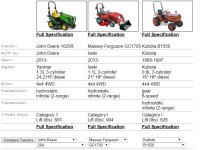
Tractor Data Compare tool. Pretty cool! It doesn't have a lot of the data you have above though. Wish it did. Yours is great.

Compare Tractors - TractorData.com


Don't you just loves Technology!
 

Attachments

  • compare.JPG
    compare.JPG
    87.8 KB · Views: 374
   / GUIDE: Shopping/Sizing A Tractor (Development version)
  • Thread Starter
#13  
I agree that Deere's nomenclature is easier to follow. I was using Kubota B2601 vs L 3301 for small vs mid chassis example. Weight is a good differentiator, but the diameter of the wheels and tires also makes a big difference. That also seems to correlate with chassis size.

Are you thinking about creating a master guide spreadsheet?

I comprehend NOW. Probably obscure for others.

Wheel diameter will more-or-less correlate with chassis weight. That is why I intend to insert personalized recommendations beneath the introductory paragraphs.

My thought is to encourage newbies to focus on researchable WEIGHT first, so when Newbies visit dealers they do not flounder around but look at fairly specific models by weight. So many newbies start with an open (blank?) mind but become more confused after succeeding dealer visits ~~~~~ finally finding T-B-N in the search for clarity, "truth" and The Holy Grail.

No master guide spreadsheet. I have pretty much attained tractor and implement nirvana, so not too motivated in that direction. The T-B-N writing I do now reduces my tractor operating time.

When I worked I was a spreadsheet animal. I started sales analysis with Lotus 1-2-3 in DOS. After twelve years of retirement my wife handles all technology issues.
 
Last edited:
   / GUIDE: Shopping/Sizing A Tractor (Development version)
  • Thread Starter
#14  
I like it..

The only think I would say on the dealer quality and local is that it is especially important if you use your tractor to make a living. If you do not it is less important IMO.


I agree. However my intended audience is tractor newbies.

Commercial operators would have experience with tractors and tractor foibles.
 
Last edited:
   / GUIDE: Shopping/Sizing A Tractor (Development version)
  • Thread Starter
#15  
I made up something like this just goofing around the other day. Were you thinking like this? Not sure how to attach a spreadsheet.

Excellent work. I like the color.

Under DIMENSIONS I suggest a calculation for tractor pounds per gross engine horsepower.

I would show width as WIDTH/R1 TIRES.

NICETIES: I would describe non-turnbuckle stabilizers as telescoping or rigid/pinned. (Just me.)

As you have data for Gear and HST it would be interesting to see drawbar HP comparisons between the two transmissions.
In factory brochures some models seem to be more efficient at converting gross horsepower to real work.

(However, as a retired sales manager and occasional marketer I am skeptical of published data which cannot be cross checked, at least with experience of TBN regular contributors.) ((I am aware of the Nebraska state tractor tests but seldom visit there.))
 
Last edited:
   / GUIDE: Shopping/Sizing A Tractor (Development version) #16  
This will be of great help to those just entering the "field". A suggestion - a page of terminology & explanations for the newbie. A statement of who should buy new and who can buy used - and why. Remember - enlightenment should never offend anybody.
 
   / GUIDE: Shopping/Sizing A Tractor (Development version) #17  
I agree. However my intended audience is tractor newbies.

Commercial operators would already have experience with tractors and tractor foibles.

I understand the audiance but when newbs come on here asking tractor buying advice too many guys repeatedly tell them the dealer proximity should determine the tractor choice. This unessasarily limits there choices.
 
   / GUIDE: Shopping/Sizing A Tractor (Development version)
  • Thread Starter
#18  
A suggestion - a page of terminology & explanations for the newbie. A statement of who should buy new and who can buy used - and why. Remember - enlightenment should never offend anybody.

Your suggested information can be inserted as focused, personalized recommendations beneath the introductory paragraphs.

Shop your weight range within tractor brands. Budget will eliminate some choices. This covers new vs. used.

I want to focus on researchable bare tractor weight and SAFETY.
I just want to direct the discussion. Relative to tractor selection for newbies no one says START HERE, with bare tractor weight.

Everyone can still contribute. I feel the diversity of recommendations is the strength of
T-B-N.

I considered a paragraph on small front wheels/large real wheels and inherent tractor instability, especially on slopes, but decided it was too verbose. Instead, if appropriate, I will insert inherent instability discussion, which blindsides newbies, beneath the introductory paragraphs.
 
Last edited:
   / GUIDE: Shopping/Sizing A Tractor (Development version)
  • Thread Starter
#19  
I understand the audiance but when newbs come on here asking tractor buying advice too many guys repeatedly tell them dealer proximity should determine tractor choice. This unessasarily limits their choices.

Only if newbs follow proffered advice.

I feel the diversity of recommendations is the strength of T-B-N.


"A quality dealer, reasonably close, is a priority for me; less so for others, well experienced with tractors, who do their own maintenance. For most new to tractors a quality dealer, reasonably close, available for coaching, is essential. My kubota dealer is six miles away."

I tried to be tactful with this issue. I will consider alternative verbiage if you offer it.
 
   / GUIDE: Shopping/Sizing A Tractor (Development version) #20  
Yes, it probably makes sense to keep it fact based and non-disputable otherwise everyone will have an opinion of it's accuracy and start disagreeing with it and confusing Newbs.

I think you have a great approach.... keep it fact based and let the TBN community fill in the gaps with experience.
 

Tractor & Equipment Auctions

2016 Ford Taurus AWD Sedan (A59231)
2016 Ford Taurus...
2018 FREIGHTLINER CASCADIA TANDEM AXLE SLEEPER (A59905)
2018 FREIGHTLINER...
2017 FORD EXPLORER (A59823)
2017 FORD EXPLORER...
2020 CHEVROLET SILVERADO CREW CAB TRUCK (A59823)
2020 CHEVROLET...
2018 Husqvarna 21in. Push Mower (A59231)
2018 Husqvarna...
JOHN DEERE 310K (A58214)
JOHN DEERE 310K...
 
Top