Mtsoxfan
Veteran Member
Don't get me wrong, it feels like some farmers can use a hand up. It's the giving our money to the gov, and letting them decide who should get. It's a well known fact that there is a lot of back scratching going on.

Did your farm and campground have electricity? Then you were probably getting help from Rural Electrification. Did they have telephone? Then you were probably getting help from Universal Service. Did they have roads going to them? Then you were probably getting help from federal highway funds.Guess I have it all wrong, ran my campground and farm without help until I retired. Still running the farm but the only government funds was a 2500 ppp loan during covid .
No tax breaks, got charged extra for being a business. Nothing tax free just extra fees and inspections because we were a business. Now it's just a hobby farm with my critters feeding us.
Most "farmers" here have full time jobs to be afford having the farm.

You have point....Did your farm and campground have electricity? Then you were probably getting help from Rural Electrification. Did they have telephone? Then you were probably getting help from Universal Service. Did they have roads going to them? Then you were probably getting help from federal highway funds.
My point is these programs are set up so the people being helped by them are unaware.
Interesting links…Almost all of rural America would be uninhabitable without aid from the federal government.
Look up your state here and see what percent of births are paid for by Medicaid:

Births Financed by Medicaid by Metropolitan Status | KFF State Health Facts
State level data on Births Financed by Medicaid by Metropolitan Status from KFF, the leading health policy organization in the U.S.www.kff.org
Look up your county here and see what percent of personal income is transfer payments from the federal government:
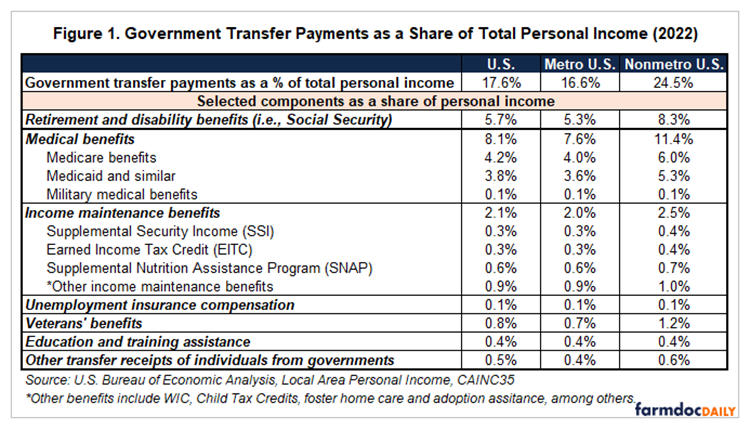
The Contributions of Government Transfer Payments to Personal Income - farmdoc daily
Mark White - Mark White - Contributions to personal income vary widely. Many working-age Americans rely heavily on the income earned from wage and salary jobs. Other Americans — particularly many older Americans — rely more on government transfer payments. This farmdoc daily article shows how...farmdocdaily.illinois.edu
Look up your state here and see how much of state and local budgets come from federal aid:
Which states rely the most on federal aid? | USAFacts
A fifth of state and local government revenues come from federal funding.usafacts.org
This could be changing???A lot of it, such as the farm programs started out as something good but outlived it's usefulness. The problem is that once a program is started it doesn't end.
Electrical coops and local phone companies are both subsidized by the federal government.You have point....
Elecric -- Crawford EMC small membership coop for out county.
Phone - Steelville Tel total of 2400 members
Road all gravel, graded at least once a year by the county's only grader in the southern half. I know all 5 workers and their boss. I donated a lot of clay/rock for road restoration after flash floods in the area to help local folks.


 farm.ewg.org
Yes, as we throw out the proverbial baby with the bathwater.This could be changing???
Handy I did learn my county receive mostly food assistance and has a couple of times in the last 10 years received Livestock Forage Disaster PaymentsYou can see what the different farm subsidies are for and if you pick your state and county. You can see who the recipients are by drilling down and looking on the left hand column.
EWG's Farm Subsidy Database
EWG's Farm Subsidy Database put the issue on the map and is driving reform. Just ten percent of America's largest and richest farms collect almost three-fourths of federal farm subsidies; cash payments that often harm the environment.

And I think without meaning to you are making my point.Electrical coops and local phone companies are both subsidized by the federal government.
Note that the links I provided earlier about federal aid to the states doesn't include farm subsidies.You can see what the different farm subsidies are for and if you pick your state and county. You can see who the recipients are by drilling down and looking on the left hand column.
EWG's Farm Subsidy Database
EWG's Farm Subsidy Database put the issue on the map and is driving reform. Just ten percent of America's largest and richest farms collect almost three-fourths of federal farm subsidies; cash payments that often harm the environment.
This page breaks down the payment for deliveries by source: Medicare, private insurance, self-pay.Those medicaid statistics are highly suspect. They don't say what they mean by "funded". Does that mean that medicaid paid all the medical bills? I'm sure that's what you are thinking as your blood boils thinking about all those layabouts without jobs, crapping out kid after kid after kid on public funds, right? I'm sure that's what's intended, and once again people are being led around by the nose.
I seriously doubt that's what it actually shows, especially considering that less than 19% of the US population receives Medicaid. If you assume half of those are women, then it's only 9%. It probably means that medicaid money funded some aspect of the delivery. Maybe it's even broader and Medicaid funded some aspect of pre-natal care as well as labor and delivery?
Does anyone realize that medical residencies (final stage of medical training for doctors) are funded by medicaid? So if any medical resident is involved in any aspect of pre-natal, labor, and delivery, then Medicaid has "funded" the birth. My son recently finished his residency in OBGYN, and guess what? Every single mom that comes through the hospital is seen by a resident. So for that hospital, which is a really big one, it's 100% of the births.
So no, Medicaid isn't paying people to have babies. The study probably shows how much of pre-natal, labor, and delivery is handled by residents. In any teaching hospital, it's 100%.

That’s really interesting. They are still surviving even with the road blocked off?We have friends that are 7 miles from paved road and have phone service… the small community deep in the redwoods has no other utilities, the road through was blocked by the park service and no over the air TV and sketchy AM radio… old lumber community going way back.
Yet they got phone service under a rural plan 30+ years back…
Now the phone company wants to end that service…
What the government provides it can take away.
Not exclusively farm programs. Everyone in rural locations get them. They work so well that when I moved from the most populist area of my state to the very rural area I grew up in, my internet service went from $50 to $160. I declined their help!Did your farm and campground have electricity? Then you were probably getting help from Rural Electrification. Did they have telephone? Then you were probably getting help from Universal Service. Did they have roads going to them? Then you were probably getting help from federal highway funds.
My point is these programs are set up so the people being helped by them are unaware.


The local coops, (electric, phone, and propane), where I am were started with Federal Assistance. But are now self-sufficient.Electrical coops and local phone companies are both subsidized by the federal government.


