
k0ua
Epic Contributor
I agree, rear ballast 800 to 1000 would be safer.


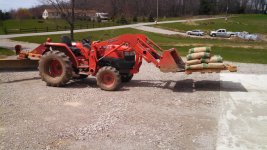





Your tires have taken a beating driving that far for every use.
Buck19Delta: That is VERY cool. I have ideas now in my head to do something similar. G

My FEL has a max capacity of #1130. So here is the plan, tires get fluid and give me #660. Then off the Heavy Hitch I can get around 650-700. Total around #1300 of ballast. The other thing is I rarely am lifting to capacity. Most commonly firewood, mulch, and the like. This has been a helpful discussion. Thanks.

Something not already mentioned is that loading the rear tires does nothing to take weight off the front axle. Adding weight to the rear tires is primarily intended to increase traction. Yes, it helps keep the rear tires on the ground during loader operations, but what it's really doing is allowing you to more heavily load the front axle, which isn't necessarily a good thing. Weight behind the rear axle is the only way to take weight off the front axle during loader operations...so that realistically means it needs to be on the 3pt.
I can't recall how Kubota specs counterweight, but it should give you some figures in the FEL manual...worth checking. If you aren't worried about size/length issues, the more weight on the 3pt, the better (generally). I built a 1,400lb counterweight for my LS and it made all the difference in the world. A little too heavy is better than a little too light as far as I'm concerned.
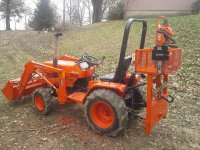
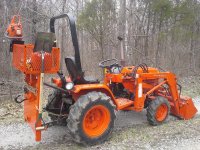
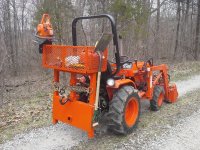
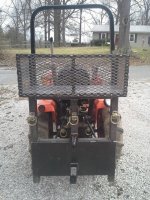
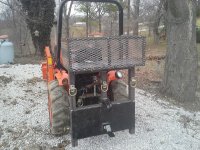
i have been using a small kubota b1750 sub compact tractor ( 20 hp ) for a while. i drive it two miles from my house, to my 15 acres for doing work on it. i needed a way to haul tools with me, chainsaw, oil, fuel, water, oil, nails, and other assorted stuff i needed, i made up a combination counterweight / tool carrier / logging hitch. i love the **** thing. its great. i can carry a cooler, chainsaw, chains, tools, etc... plus its a counterweight. ( it weights 250 empty), but i could have easily doubled or tripled that with adding lead or concrete and filled the tubing. i just bought a like new, 2014 kubota L3901, ( with 29 hours on it)... and im finding my tool rack does not quite fit the bigger tractor, so im about to start building a larger one, that sets back approx 6 inches more ( to prevent accidently hitting the tail lights)... ill make it a foot wider, and probably build a winch mount into it, and add a 3000-5000 elec winch, to do my logging stuff. anyway heres my logging hitch / counterweight / tool carrier i have now.... the new one will weigh at least 500lbs... possibly even more. iv learned a few things while using this one, that i will implement in the new one. i cannot state how much i love this thing. if fencing, you can add a receiver hitch barbed wire carrier......or any kind of receiver hitch type tool / carrier etc. my next one will be a bit wider.. and have a lot more weight to it. probably put a blade and a 45* angle on the bottom 4 inches, to allow it to dig into the ground when im winching something from the rear... and use a electric winch..... if i was going to be using it a lot, ifd get the pto driven winch.
View attachment 446442View attachment 446443View attachment 446444View attachment 446448View attachment 446445View attachment 446446View attachment 446447
Something not already mentioned is that loading the rear tires does nothing to take weight off the front axle. Adding weight to the rear tires is primarily intended to increase traction. Yes, it helps keep the rear tires on the ground during loader operations, but what it's really doing is allowing you to more heavily load the front axle, which isn't necessarily a good thing. Weight behind the rear axle is the only way to take weight off the front axle during loader operations...so that realistically means it needs to be on the 3pt.
I can't recall how Kubota specs counterweight, but it should give you some figures in the FEL manual...worth checking. If you aren't worried about size/length issues, the more weight on the 3pt, the better (generally). I built a 1,400lb counterweight for my LS and it made all the difference in the world. A little too heavy is better than a little too light as far as I'm concerned.

