Insulate Well Tank?

   / Insulate Well Tank? #1  

josephny

Silver Member
Joined
Jul 31, 2009
Messages
129
I'm having a hard time figuring this out.

I have a 12' x 18' well house with a 5 pitch roof.

The structure has a single 2' x 3' double pane window.

Roof rafters have 6" of open cell foam.

Walls have 3.5" of closed cell.

6" slab on grade has 2" of closed cell on top of it.

Well head is inside structure, coming up through concrete and feeds a 100 gallon galvanized (non-bladder) pressure tank (through a few feet of pipe with pressure switch).

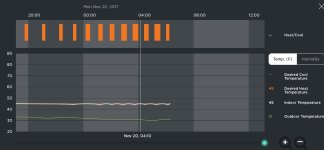
I have a 500 watt, 220v heater for the structure, connected to an Ecobee thermostat (so I can monitor and record the inside and outside temp, as well as control the heater).

Now that it's cold here in NY (this is the first season with this setup), I'm surprised at how much energy it is taking to maintain 45* F inside this structure.

I've attached the data -- outside temp just above 30*F, setpoint at 45, looks like about 50% on/off.

I'm trying to figure out where the heat loss is and the only thing I can come up with (other than simply insufficient insulation, which would be surprising), is the pressure tank and piping.

I think the water temp is between 40 and 45.

Could the tank be the culprit -- sapping the heat?

If so, should I insulate the tank? Wouldn't that be weird considering the heat source (other than the well water's temperature) would be coming from outside the insulated tank?

Thank you,

Joe
wellhouse.jpg
 
   / Insulate Well Tank? #2  
You don't say how high the walls are. But that is 216 sq. ft. You are only using a 500 watt or 0.5 kw heater or 1700 btu/hr.
If your electricity is $0.16 per KW, your cost is roughly $0.08 per hour of operating time.
Also that 2x3 window is a large heat loss, cut a piece of foam board and seal that window tightly if you were to check the glass
temperature you would be surprised how cold it will be.
 
   / Insulate Well Tank?
  • Thread Starter
#3  
You don't say how high the walls are. But that is 216 sq. ft. You are only using a 500 watt or 0.5 kw heater or 1700 btu/hr.
If your electricity is $0.16 per KW, your cost is roughly $0.08 per hour of operating time.
Also that 2x3 window is a large heat loss, cut a piece of foam board and seal that window tightly if you were to check the glass
temperature you would be surprised how cold it will be.

Side walls are 8' tall (peak is about 10.5').

That's great advice about the window -- I'll do that.

Yea, 500 watts (1700 BTU/hr) isn't much, but I figured that so many people talk about using a single 100 watt light bulb, that I'd be okay.

Thanks!
 
   / Insulate Well Tank? #5  
We keep stock waters thawed with 60 - 70 watt light bulbs, but the area being heated is only 1 to 1 1/2 ft by 2 to 4 ft and 2 ft high so just a few cubic feet 4 to 8 with no
drafts or air infiltration. A lot of well houses are only 6 x 6 or so with flat or single slope roofs and many of those are 80% below grade. If your tank is in a corner and your heater is also,
where is your interior temperature sensor? There can be considerable temperature stratification in a room that size, even at 45 degrees I would not be surprised to see a 5 to 8 degree difference in temp in that room depending on location. Good luck keeping your water flowing this winter.

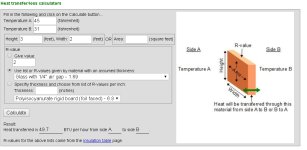
That looks like a good calculator, handy to have
 
Last edited:
   / Insulate Well Tank? #6  
Why 45 degrees? There are considerable amounts of time the temp is above freezing but lower than 45 degrees. In any case, the water coming up from the well is propably > 45 degrees so it is helping to heat the well house. Short excursions below below freezing isn't going to freeze a 100 gallon tank. If the lines are insulated and traced they aren't going to freeze either. I'd lower that T-stat 5~8 degrees.
 
   / Insulate Well Tank?
  • Thread Starter
#7  
We keep stock waters thawed with 60 - 70 watt light bulbs, but the area being heated is only 1 to 1 1/2 ft by 2 to 4 ft and 2 ft high so just a few cubic feet 4 to 8 with no
drafts or air infiltration. A lot of well houses are only 6 x 6 or so with flat or single slope roofs and many of those are 80% below grade. If your tank is in a corner and your heater is also,
where is your interior temperature sensor? There can be considerable temperature stratification in a room that size, even at 45 degrees I would not be surprised to see a 5 to 8 degree difference in temp in that room depending on location. Good luck keeping your water flowing this winter.

That looks like a good calculator, handy to have

Yeah, it is a big well house. Originally built in the 1930's, so I figured might as well keep the same size.

Heater is at ground level near midpoint of 1 of the 18' walls.

Tank is in opposite/diagonal corner.

Tstat is about 8' down the same wall as the heater, towards the same 12' wall that the tank is on; and about 5' off the floor.

5-8* is more than I would have guessed (I'm absolutely not a pro, so I'm not implying any validity to my guess).

Think I should change anything?

Thanks!
 
   / Insulate Well Tank? #8  
At this time you are not having any problem keeping it at temperature.
If you are concerned about the amount of heat being used and the possibility of not being
able to keep above freezing you could get 3-4 sheets of foam board and box in the corner
were the water tank and piping is, move the heater and t-stat into that corner and reduce
the area you are keeping at temperature to just a few cubic feet.
If you need to keep the entire room above freezing because of other items stored in it,
you are on the right track and until your heater is on 100% and not maintaining you are
good, you could always add a heat lamp in the corner with the tank and piping.
 
   / Insulate Well Tank? #9  
That 1930's well house is gigantic compared to most built today. Most I inspect now-a-days are 4x6 up to 6x8. And Yes, they are being heated by a couple 100 watt light bulbs.

Example - my electricity costs 6.5 cents per Kw here. I have an completely insulated, sheathed Tough Shed - 10' x16' where I store my motorcycle. I have a small 1200 watt electric heater in the shed. Its set to keep the shed at 48 degrees during the winter. On our coldest month it will add $19.00 to my overall electric bill.

You are heating a lot of dead air. Seal off the window and figure a way to decrease the size of the heated area by hanging a sheet(s) of clear roll plastic. All you really need to heat is the well head, plumbing and pressure tank.
 
   / Insulate Well Tank?
  • Thread Starter
#10  
Why 45 degrees? There are considerable amounts of time the temp is above freezing but lower than 45 degrees. In any case, the water coming up from the well is propably > 45 degrees so it is helping to heat the well house. Short excursions below below freezing isn't going to freeze a 100 gallon tank. If the lines are insulated and traced they aren't going to freeze either. I'd lower that T-stat 5~8 degrees.

The lines are not insulated or traced. I thought I wouldn't need that if the entire well house is insulated.

If the water is >45*, does that mean that the tank and lines are not a source of heat loss is the temp inside the well house is 45?

Should I lower the tstat to 40, to keep that extra buffer for heat stratification?
 
   / Insulate Well Tank? #11  
Building Science has two major sources of heat loss. The ceiling and drafts. The door will need good weather stripping and a threshold with a sweep. The building needs building paper or plastic or something else to cut the drafts. Then caulk the window and other cracks. For the lid I’d make a flat ceiling as low as I could- say just above the window. Their is no need to heat a little vaulted ceiling. In the lid I’d add R50.

With all this research you’ve done I’d figure your ground water temp. It’s obviously above 32°f. But that large tank is a nice heat sink- don’t fight it so much by bringing everything to 45°f. Go for something like 38°. Their is no need to overheat the place.

Btw- fiberglass insulation has about zero R value with any air movement or moisture on it. Skip that and use cellulose or Roxul for this little job.
 
   / Insulate Well Tank? #12  
While snowbirding from Wisconsin I insulated a room around the pressure tank, sump pumps, water softener and canned goods that was 12x8 with 8'walls. It was in the corner of an semi above ground basement. I used 6" insulation all the way around with no windows. The heat was shot off in the house and I left for 5 months at a time.

I used 2 milk house heaters in different circuits and set one at 750 watts and the other 1500 if I recall. The 1500 was set at 45 deg and the 750 watt was set at 35 deg. I tried a light bulb in other applications but they burn out to fast.

I would get a Johnson Control plug in controller and set the temp down to 35 deg. But, it won't freeze until below 32 deg for a few hours anyway.

That controller is the only thing I could find at the time that goes that low and is digital for accuracy, but there may be other things that will work. A light bulb will not work for long in NY. I would try to get the controlled space smaller unless you need the whole space heated and then super insulate it.
 
   / Insulate Well Tank? #13  
Box in the well head and the pressure tank and insulate the daylights out of the box. Heat with small lightbulb.
 
   / Insulate Well Tank? #14  
Yeah, it is a big well house. Originally built in the 1930's, so I figured might as well keep the same size.

Heater is at ground level near midpoint of 1 of the 18' walls.

Tank is in opposite/diagonal corner.

Tstat is about 8' down the same wall as the heater, towards the same 12' wall that the tank is on; and about 5' off the floor.

5-8* is more than I would have guessed (I'm absolutely not a pro, so I'm not implying any validity to my guess).

Think I should change anything?

Thanks!

Maybe. Is this for a submersible pump? If so, I would extend the casing above ground, install a pitless adapter, and put the tank in the basement of your house. If you don't have a basement, use a direct burial tank.

For the record, I've never seen a pressure tank freeze. The lines to and from should have a heat tape on them for the winter. If this is done properly, you should not have a freezeup.
 
   / Insulate Well Tank? #15  
That 1930's well house is gigantic compared to most built today.

You are heating a lot of dead air. Seal off the window and figure a way to decrease the size of the heated area by hanging a sheet(s) of clear roll plastic. All you really need to heat is the well head, plumbing and pressure tank.

And later someone asked if you're using a submersible pump, which I kinda doubt or you wouldn't be going through these gyrations. Also remember that it will get a lot colder in N.Y. come real wintertime.
Gotta love N.Y.. Someone in Washington is paying .065 per KWH in electricity; you're getting hydropower from Niagara Falls, a plant pretty much paid for in the 1960s, for 15 cents per KWH. I believe that same hydropower is sold for less in the big apple.
 
   / Insulate Well Tank? #16  
Box in the well head and the pressure tank and insulate the daylights out of the box. Heat with small lightbulb.

That is what I did. We have a big fake rock covering the well and pressure tank. I bought a couple of sheets of 2 inch thick rigid insulation, lag bolts and washers. The box is roughly 2.5'x2.5'x3' or some such. Just screwed the lag bolts with washer in to the rigid insulation to hold it all together. Though about using glue but worried what the glue would do to the foam so just used the bolts. Built a cover that fits over the top of the box and pushed an instant read thermometer through the top. The fake rocks fits over the insulated box.

I have a heat tape running around the pressure tank and pipes but also have 5-6 CFLs running in the box during winter. CFLs don't give off much heat but if one or two burn out it is not that big of a deal. Wattage with all of the bulbs running is about 100 or so.

A couple of weeks ago I went out to turn on a couple of the lights since we have started to get below freezing. The temp in the box was 60 or so without any lights running and the out side temp was 40 or so. With the lights running and temps in the 20-30's, I don't think I have seen at least 50 in the box and usually higher.

Later,
Dan
 
   / Insulate Well Tank? #17  
My hand dug well is 12' deep and consists of a 3' culvert with a 4x4x2 foot insulated box on top. I have a 100 watt light bulb in the well and also a 250 watt heat lamp. After years of using the 250 watt lamp, I discovered that a 100 watt bulb was enough.

I have a Honeywell "Winter Watchman" wired up, that will turn on an outside light and let me know if my bulb burned out and the temperature is dropping. I then turn on the other bulb. 2 years ago, I removed my water storage tank that was attached to the house and moved my jet pump out to the well. It is so much easier and cheaper to push water to the house then it is to suck water from the well to the house.
 
   / Insulate Well Tank? #18  
Why 45 degrees? There are considerable amounts of time the temp is above freezing but lower than 45 degrees. In any case, the water coming up from the well is propably > 45 degrees so it is helping to heat the well house. Short excursions below below freezing isn't going to freeze a 100 gallon tank. If the lines are insulated and traced they aren't going to freeze either. I'd lower that T-stat 5~8 degrees.

My thought exactlyi. All that is needed is to keep that well house at or slightly above freezing. Any heating above that is just waste energy.

Someone else suggested moving tank, etc to the house. Excellent suggestion. In this dayi and age I do not undersand people installing well houses/pits.
 
   / Insulate Well Tank?
  • Thread Starter
#19  
Thank you all so much!

Pump is down into the well, I believe about 150’.

Well head is about 200’ from the house and the house doesn’t have room for the tank.

Here’s a summary, as best I understand:

1) Setpoint temperature can and should be set much closer to 32 – 38 degrees would be good. This will prevent freezing, save energy and save wear on the heater.
a. The problem with this is the Ecobee only goes down to 45 and I am 100 miles away during the Winter so remote monitoring is a very useful thing.
2) Foam board should be put over the window as this is a source of heat loss.
3) Any drafts should be identified and eliminated. Around window and door frames, as well as the use of a sweep for the bottom, is a likely source.
4) Move heater closer to tank and piping and enclose that area (like a closet) so as to heat only that area.

I’ve got to get cracking on this as the real Winter will be here soon.

Thank you!
 
   / Insulate Well Tank? #20  
With those modifications you should notice a substantial change in electric consumption. And with your Ecobee - if you see a BRUTAL wx front moving your way you can always temporarily kick the temps up a few degrees.
 

Tractor & Equipment Auctions

CATERPILLAR 108" WHEEL LOADER RAKE (A52707)
CATERPILLAR 108"...
7-Gang Reel Mower Pull-Behind Tractor Attachment (A59228)
7-Gang Reel Mower...
2005 TerraGator 8104 (A55302)
2005 TerraGator...
2013 ORTEQ ENERGY GN182 GOOSENECK HOSE TRAILER (A58214)
2013 ORTEQ ENERGY...
2007 KOMATSU GALEO D39PX-21 CRAWER DOZER (A60429)
2007 KOMATSU GALEO...
2014 FORD F-150 STX EXT CAB TRUCK (A60430)
2014 FORD F-150...
 
Top