lift capacity numbers

/ lift capacity numbers #1  

1930

Platinum Member
Joined
Sep 9, 2018
Messages
933
Location
Brandon/Ocala Florida
Tractor
Kubota B6100E Kubota L 2501 Kubota T1460
Ive already purchased a new tractor, just waiting to go pick it up, its an L2501 Kubota. I bought it cause I already own a B series Kubota and its been a great tractor for as old as it is, I also bought it cause I like Orange and I know kubota is a good tractor that people on this forum and others strongly recommend.

Id like to understand what some of the numbers mean as far as lift capacity of the front loader, does that mean if I were to hang an object off it of a specific weight and it matched the lift capacity than that is what the tractor is capable of lifting? I.E thats all the wight that should be put in the bucket

If not than where is that number taken from exactly.

Im trying to read and understand what I can on the internet.

Seems like if Im understanding correctly that a rear PTO has a tremendous amount of lifting capacity as well?

Is that typically true.

Anything you would be willing to add to this would be great, one less question I might have later.

Thanks
 
/ lift capacity numbers #2  
Ive already purchased a new tractor, just waiting to go pick it up, its an L2501 Kubota. I bought it cause I already own a B series Kubota and its been a great tractor for as old as it is, I also bought it cause I like Orange and I know kubota is a good tractor that people on this forum and others strongly recommend.

Id like to understand what some of the numbers mean as far as lift capacity of the front loader, does that mean if I were to hang an object off it of a specific weight and it matched the lift capacity than that is what the tractor is capable of lifting? I.E thats all the wight that should be put in the bucket

If not than where is that number taken from exactly.

Im trying to read and understand what I can on the internet.

Seems like if Im understanding correctly that a rear PTO has a tremendous amount of lifting capacity as well?

Is that typically true.

Anything you would be willing to add to this would be great, one less question I might have later.

Thanks
Yes, your 3pt hitch can lift a lot of weight. Most manufacturers will give you the lift capacity at a certain distance from your 3pth hitch. You will want to make sure you have enough ballast and counter weight though so you don't lift your front wheels off the ground.
As far as your loader, most lift capacities are given at the pins, a distance from the pins and also breakout force, to a specified height. Your FEL will lift the specified weight at the specified distance minus the weight of your bucket and quick hitch or forks, etc. In many cases you can pick up more than specified especially if you curl your bucket. The problem is you need to make sure you have ballast or weight on the back of your tractor and your tires and front axle may not be rated for those higher weights. You are putting a lot of stress on your tractor lifting more than what it is rated for, be careful.
 
/ lift capacity numbers #3  
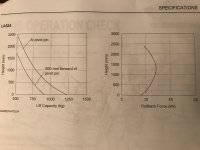
The owner's manual for the front loader will have a lift curve in it similar to this:

IMG_8072 (1).jpg

Out back, the PTO is the part that rotates and turns machinery -- the "3-point" is the part that lifts stuff. Should be good specs for that in the owner's manual too.
 
/ lift capacity numbers
  • Thread Starter
#4  
The owner's manual for the front loader will have a lift curve in it similar to this:

View attachment 596622

Out back, the PTO is the part that rotates and turns machinery -- the "3-point" is the part that lifts stuff. Should be good specs for that in the owner's manual too.

It does have something similar to that. I'll post a pict. this evening, I don't have the manual with me.
 
/ lift capacity numbers #5  
If the loader won't lift it, it is too heavy. If the 3 pt won't lift it, it is too heavy. If the the pto won't turn it, it is too big. You will soon find out what it can and cannot do. Enjoy your new tractor.
Bill
 
/ lift capacity numbers #6  
What s219 says. My FEL on the M6040 has two positions - one for high lift, the other for heavy lift. I've found that the heavy lift chart is much more useful when determining lift capacity. I have my FEL set in the "heavy lift" position.

The center of my grapple is 12" forward of the lift pins and I seldom do a "high lift" with a heavy load. I HAVE lifted a heavy rock to a height of three feet - that's it.

You will be surprised how much your FEL can lift if you aren't way out forward of the lift pins and aren't lifting to some unGodly height.

When I lift a heavy rock or large chunk of pine log - I'm "knuckle dragging" to its new location.

My 3-point - - I don't really care. It easily lifts my heaviest implement - 1100# rear blade. I don't use the 3-point for routine lifting.
 
/ lift capacity numbers
  • Thread Starter
#7  
So many questions I have. Thanks to anyone taking the time. Your time is not wasted cause it helps me to be a better safer operator.

I wondering what you guys can suggest to me so that I can stack my logs/ trees that I have cut down.

I trying not to cut them into small easily manageable sizes cause at this point I don't see the point.

I'm just trying to stack everything and then later I'll decide what to do wether it be haul them off to the dump or let them sit and rot or maybe burn.

It's tough right now to get a grappler, means another 2000 plus.

Maybe the backhoe will do it?

I don't have a manual for that yet so I don't know what it's capable of lifting

Im wondering what you think of a set of tongs hanging off my bucket might work like?

Prob. with bucket is that there little reach so maybe remove the backhoe bucket and figure out a way to hang the tongs from that point?

It's 85% pine the rest oak
 
/ lift capacity numbers
  • Thread Starter
#9  
Last edited:
/ lift capacity numbers #10  
"A man has got to know his limitations" First you have to know how heavy your trees will be and how high you will be stacking them. There are many timber weight calculation web sites. Find one and determine the weight of the timber you will be dealing with.

Go to the dealership and get an FEL Operator's Manual for the model you are considering. Look at the weight lift chart. Will it lift that weight to the height you need? Don't be shy - you will be spending big bucks. There is NO KNOWN WAY to increase lift capacity other than a bigger tractor/larger FEL.

My M6040 with grapple will lift 1500 pounds to a height of 80 inches. This info I just got off my heavy lift weight chart. Under this heavy lift situation - I dam well better be on HARD ground or asphalt or concrete.

OR - I can, with the same grapple, lift 3200 pounds to a height of 6" off the ground. A scenario much more in tune with what I do.

Remember - the further "out" from the lift pins to the center of the load - the less the FEL will lift. To any height.

Again - AFTER you have purchased a tractor - looked at the weight lift charts - it's just a tad late to realize it won't do what you want/need.

I think you just might be asking more of a tractor than it is capable of doing. It's very likely that you might have to chunk up those trees so you can lift/move them with something less than a large tractor.
 
/ lift capacity numbers
  • Thread Starter
#11  
I have a copy I got on line of the fel. It has a lot of specs just don't understand how to read them.

I'll post some pages this evening when I'm home.

I want to work within the tractor limitations
 
/ lift capacity numbers #13  

Using the backhoe for lifting and transporting logs will work if the size is right. The backhoe痴 lift capacities are typically much less than the FEL. Keep the log close to the back of the tractor to keep the weight close. Don稚 lift it higher than you have to. Watch out for obstacles in your path that the log could catch on (especially as it is now behind your field of view on the backhoe). As you can see it isn稚 the best setup but for a small log it should work. Yes and you will need a thumb. Probably cheaper to just get pallet forks.

The best thing to use if you dont have a grapple is pallet forks. Space them apart as wide as they will go before picking up a log. Make sure the log is balanced well, and go slow.
 
/ lift capacity numbers #14  
The best thing to use if you dont have a grapple is pallet forks. Space them apart as wide as they will go before picking up a log. Make sure the log is balanced well, and go slow.

:thumbsup:

Pallet forks and their frame that take the place of the bucket will weigh about 250lbs, however you've lost the weight of the bucket and they will get the logs very close to the pins so you can use most of the full FEL rating unlike hanging something off the front of the bucket out and away from the pins.

From TractorData for L2501:

Loader:
Loader type: Kubota LA525
Height (to pin): 94.3 inches [239 cm]
Lift to full height (at pin): 1131 lbs [513 kg]
Lift to 1.5m (at pin): 1490 lbs [675 kg]
Lift to 1.5m (at 500mm): 1182 lbs [536 kg]

Note that the "at 500mm" rating means this is the weight that the loader (or tractor*) can lift when the load is 500mm (20") out in front of the pins. This is the rating that may be typical for a loaded bucket that is out in front of the pins.

*: For the most part it's the setting of the hydraulic relief valve in the tractor that limits the loader's maximum lift. If you have more pressure you can lift more....or break something.
 
Last edited:
/ lift capacity numbers #15  
I have a copy I got on line of the fel. It has a lot of specs just don't understand how to read them.

I'll post some pages this evening when I'm home.

I want to work within the tractor limitations

Yes, it would help if you post the pages. BTW, if this is your first time posting pictures to TBN you may need some help with that. Don't be afraid to ask.

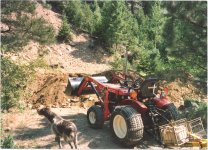
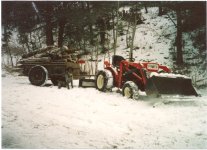
We did a lot of forest work and got in all of our firewood for many years with a little tractor and FEL about the size of the B6100 because that is what fit the terrain best. So it can be done. We found that the limiting factor was not the FEL lift - there was plenty of lift. The limit was stability. Our little Yanmar got really unstable side to side even with a heavy box blade and weight on the 3pt. We fixed that by going to wide turf tires and also widening the way the wheels mounted to the axles to get it as wide as it would go.

For lifting, you always want to lift as close to the front of the tractor as you can. Sometimes that means replacing the bucket with something else, or cutting down the sides of the bucket so that logs can be carried closer to the front arms of the loader. If you can get the load close to the bottom of the loader arms where the bucket fits, but without the bucket itself - then it will lift twice as much and be more stable as well.
luck, rScotty
 

Attachments

  • YM165D_dirt work.jpg
    YM165D_dirt work.jpg
    89.5 KB · Views: 128
  • YM165D_firewood & snow.jpg
    YM165D_firewood & snow.jpg
    79.9 KB · Views: 107
/ lift capacity numbers #16  
I have a copy I got on line of the fel. It has a lot of specs just don't understand how to read them.

I'll post some pages this evening when I'm home.

I want to work within the tractor limitations


One other thing to consider -although an un common scenario...

If you mount a heavy weight on the back of your 3 point and have grabbed a bunch of logs with the FEL AND left it up in the air-

AND then

Stack more wood on it , there is no pressure relief other than blowing a hose or seal...

The relief valve is not in circuit when the FEL joystick is centered. It only comes into play when the pump is supplying pressure to the cylinders.

Another way this can happen ... I popped a lift cylinder hose on my tractor when digging one time.
had pried into some concrete like white clay that was partially frozen and left the joystick centered while driving forward in 4x4
made one heck of a boom and lost quite a bit of oil to, just something to keep in mind.

As others have said -if it won't lift it , it is to heavy.

ps for lifting /stacking


Clamp or chain on Forks will get you started or a quick attach set of pallet forks , I usually stick with the grapple most of the time

Chain on forks in link and last pic - were under $250 all in and rated for 3000lbs. https://www.tractorbynet.com/forums...let-forks-debris-forks-branch-removal-001-jpg
 

Attachments

  • 100_8594.JPG
    100_8594.JPG
    1.4 MB · Views: 207
  • pallet fork mod 4 .jpg
    pallet fork mod 4 .jpg
    624.9 KB · Views: 124
  • 100_2231.jpg
    100_2231.jpg
    646.6 KB · Views: 180
Last edited:
/ lift capacity numbers #17  
I wondering what you guys can suggest to me so that I can stack my logs/ trees that I have cut down.

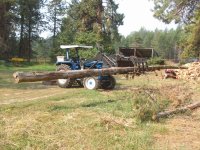
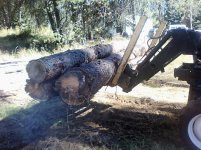
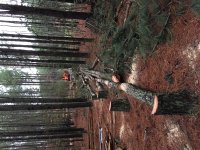
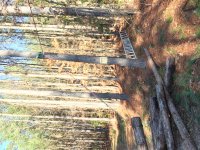
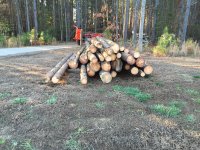
I have acres of pines about 60-70' tall. When I need to clear an area, I drop the trees, limb them, then use a rope and fairlead (pulley mounted up in another tree) to get the logs out of the woods. I normally drag the trees out whole so they are laying across my driveway, but sometimes I buck them beforehand. I generally buck them into 8-16' sections and lift them with clamp-on forks on my front loader. Drive them over to a pile and dump them. For skinny trees I might buck into 16' sections since they are light and won't twist the loader around. If I have to drive through my 16', gate I cut the logs to 15', don't ask why....

IMG_6429.JPG

IMG_6443.JPG

IMG_6446.JPG
 
/ lift capacity numbers
  • Thread Starter
#18  
Using the backhoe for lifting and transporting logs will work if the size is right. The backhoe痴 lift capacities are typically much less than the FEL. Keep the log close to the back of the tractor to keep the weight close. Don稚 lift it higher than you have to. Watch out for obstacles in your path that the log could catch on (especially as it is now behind your field of view on the backhoe). As you can see it isn稚 the best setup but for a small log it should work. Yes and you will need a thumb. Probably cheaper to just get pallet forks.

The best thing to use if you dont have a grapple is pallet forks. Space them apart as wide as they will go before picking up a log. Make sure the log is balanced well, and go slow.
There is a pallet fork/grapple combo avail for a little over 2000 dollars, forget who is offer that, its on E-bay. I just bought the tractor, close to 30,000 dollars, I need to not spend more money right now, I need to work with what I have for the time being but it is on my list.

:thumbsup:

Pallet forks and their frame that take the place of the bucket will weigh about 250lbs, however you've lost the weight of the bucket and they will get the logs very close to the pins so you can use most of the full FEL rating unlike hanging something off the front of the bucket out and away from the pins.

From TractorData for L2501:

Loader:
Loader type: Kubota LA525
Height (to pin): 94.3 inches [239 cm]
Lift to full height (at pin): 1131 lbs [513 kg]
Lift to 1.5m (at pin): 1490 lbs [675 kg]
Lift to 1.5m (at 500mm): 1182 lbs [536 kg]

Note that the "at 500mm" rating means this is the weight that the loader (or tractor*) can lift when the load is 500mm (20") out in front of the pins. This is the rating that may be typical for a loaded bucket that is out in front of the pins.

*: For the most part it's the setting of the hydraulic relief valve in the tractor that limits the loader's maximum lift. If you have more pressure you can lift more....or break something.
I was wondering if the relief valve just wouldnt allow it to overlift?

Yes, it would help if you post the pages. BTW, if this is your first time posting pictures to TBN you may need some help with that. Don't be afraid to ask.

We did a lot of forest work and got in all of our firewood for many years with a little tractor and FEL about the size of the B6100 because that is what fit the terrain best. So it can be done. We found that the limiting factor was not the FEL lift - there was plenty of lift. The limit was stability. Our little Yanmar got really unstable side to side even with a heavy box blade and weight on the 3pt. We fixed that by going to wide turf tires and also widening the way the wheels mounted to the axles to get it as wide as it would go.

For lifting, you always want to lift as close to the front of the tractor as you can. Sometimes that means replacing the bucket with something else, or cutting down the sides of the bucket so that logs can be carried closer to the front arms of the loader. If you can get the load close to the bottom of the loader arms where the bucket fits, but without the bucket itself - then it will lift twice as much and be more stable as well.
luck, rScotty
Id like to have a second bucket I could cut out
One other thing to consider -although an un common scenario...

If you mount a heavy weight on the back of your 3 point and have grabbed a bunch of logs with the FEL AND left it up in the air-

AND then

Stack more wood on it , there is no pressure relief other than blowing a hose or seal...

The relief valve is not in circuit when the FEL joystick is centered. It only comes into play when the pump is supplying pressure to the cylinders.

Another way this can happen ... I popped a lift cylinder hose on my tractor when digging one time.
had pried into some concrete like white clay that was partially frozen and left the joystick centered while driving forward in 4x4
made one heck of a boom and lost quite a bit of oil to, just something to keep in mind.

As others have said -if it won't lift it , it is to heavy.

ps for lifting /stacking


Clamp or chain on Forks will get you started or a quick attach set of pallet forks , I usually stick with the grapple most of the time
Very good information, thanks for that

I have acres of pines about 60-70' tall. When I need to clear an area, I drop the trees, limb them, then use a rope and fairlead (pulley mounted up in another tree) to get the logs out of the woods. I normally drag the trees out whole so they are laying across my driveway, but sometimes I buck them beforehand. I generally buck them into 8-16' sections and lift them with clamp-on forks on my front loader. Drive them over to a pile and dump them. For skinny trees I might buck into 16' sections since they are light and won't twist the loader around. If I have to drive through my 16', gate I cut the logs to 15', don't ask why....

View attachment 596704

View attachment 596703

View attachment 596702

Clamp on front end loader forks, Ill have to google that, thanks
 
/ lift capacity numbers
  • Thread Starter
#19  
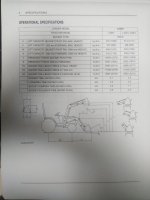
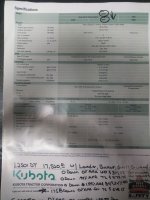
Heres the specs I mentioned
 

Attachments

  • 009.jpg
    009.jpg
    2.7 MB · Views: 127
  • 010.jpg
    010.jpg
    3 MB · Views: 141
/ lift capacity numbers #20  
Generally lift capacity will be at a specified distance from the axis.
On a FEL bucket that would be the loaded center and the axis should be the front axle.
Next the factory will have set the relief valve to kick out at that load limit.
The farther away from the bucket C of G the less U will safely be able to lift.

Now all that can be negated if U have rear ballast to counter act but relief valve will cancel the added capacity.

LOL, confused yet?

The 'work around' is lots of rear ballast and tweak the relief valve and watch your front tires squat.
 

Marketplace Items

4022CFL (A59228)
4022CFL (A59228)
2012 TROXELL 140BBL TRI AXLE VACUUM TRAILER (A60736)
2012 TROXELL...
TPL MECHANICS BODY LUBE SKID (A60429)
TPL MECHANICS BODY...
New/Unused Agrotk YC-32G Sawmill (A61166)
New/Unused Agrotk...
John Deere 24in Digging Tooth Bucket Excavator Attachment (A60352)
John Deere 24in...
Box of Transport Ratchet Straps (A59230)
Box of Transport...
 
Top