I live in a relatively flat wooded area. I moved here late last summer. So far this year I've had 2 lighting strikes on trees in my yard. Would a lightning rod save the house? Or just make sure it is the house that gets hit? I was considering getting a standing seam metal roof for the place. Would that change the equation?
You are using an out of date browser. It may not display this or other websites correctly.
You should upgrade or use an alternative browser.
You should upgrade or use an alternative browser.
Lightning rod?
- Thread starter Groo
- Start date
- Views: 6275
More options
Who Replied?
/ Lightning rod?
#1
ctrider
Member
They simply provide a controlled path (in theory) to ground when a strike occurs, provided they are installed and connected correctly.

PILOON
Super Star Member
My house is on a site that lightening caused the previous one to burn down and it was actually in what I'd call a hollow or valley.
Less that 100 yards in either direction the trees and terrain are much higher by 3-400 ft or more.
Since lightning never strikes twice, LOL, I feel safe.
Later careful inspection proved that the electrical ground was improperly done. (the electrician had simply laid the one ground rod under a moss covered section of bedrock.)
Theory is that the strike followed the hydro line and due to inferior ground the wires heated up to the point of ignition.
I have 2ea 9 foot rods driven in with an impact breaker (Kango)
Less that 100 yards in either direction the trees and terrain are much higher by 3-400 ft or more.
Since lightning never strikes twice, LOL, I feel safe.
Later careful inspection proved that the electrical ground was improperly done. (the electrician had simply laid the one ground rod under a moss covered section of bedrock.)
Theory is that the strike followed the hydro line and due to inferior ground the wires heated up to the point of ignition.
I have 2ea 9 foot rods driven in with an impact breaker (Kango)
reb
Veteran Member
As a devout DIYer, I looked into installing a lightning rod on my house decades ago. I concluded that an improperly installed system was a potential liability in case of a strike. Decided to let the insurance company take care of the situation in case the house got hit.

My house has been hit by lightning 3 times: 2 while previously owned, once with me right there while telling family we were safe. It's not a boom, just an incredibly huge sizzle starting at the chimney and running down the gutters. Phones, TV, garage and well fried.
I have a windmill hoarding hobby (old/vintage water pumping style). Since putting up a few (6 around the property), there has been no activity, not even one less than a 5 second count away (about a mile I believe). The towers are apparently slowly bleeding off the charges or accepting the discharges as they build. Heights are 32 - 36 ft for all of them.
No damage to them either.
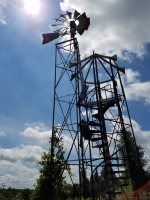
I have a windmill hoarding hobby (old/vintage water pumping style). Since putting up a few (6 around the property), there has been no activity, not even one less than a 5 second count away (about a mile I believe). The towers are apparently slowly bleeding off the charges or accepting the discharges as they build. Heights are 32 - 36 ft for all of them.
No damage to them either.

Industrial Toys
Super Star Member
- Joined
- Feb 25, 2008
- Messages
- 17,407
- Location
- Ontario Canada
- Tractor
- Kubota R510 Wheel Loader + Cab and backhoe, JD 6200 Open Station, Cushman 6150, 4x4, ten foot 56 hp Kubota diesel hydraulic wing mower, Steiner 430 Diesel Max, Kawasaki Diesel Mule, JD 4x2 Electric Gator
My house is next to a tall forested hill. The elevation seems to make no difference as to where the lightning will hit. There is an (extremely) well grounded 80 foot tower radio atop the hill and there has never been evidence that it has been hit.

Fuddy1952
Elite Member
- Joined
- Apr 17, 2018
- Messages
- 4,332
- Location
- South Central Virginia
- Tractor
- 1973 Economy and 2018 John Deere 3038E
I just made these and will put them up probably tomorrow, one on each chimney. I used 3/4" copper pipe that I cut 18" down each side , then cut and hammered then soldered so they're tapered. I put a 1" x1/4" copper pipe hammered on top to hold together while I soldered. Copper everything, plumber strap to chimneys, braided copper cable.
The 100 year old amethyst balls are off of old lightning rods. I have an 8ft copper driven ground rod near the phone and satellite ground rods.
Hard part is I don't enjoy getting on roofs at my age. I'll probably put my extension ladder in my loader bucket which at least starts me out at 7-8ft.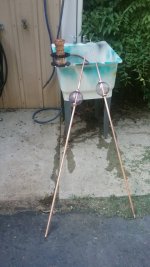
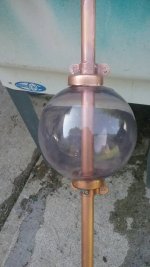
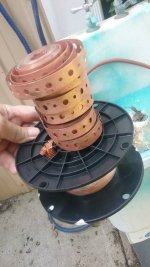
The 100 year old amethyst balls are off of old lightning rods. I have an 8ft copper driven ground rod near the phone and satellite ground rods.
Hard part is I don't enjoy getting on roofs at my age. I'll probably put my extension ladder in my loader bucket which at least starts me out at 7-8ft.
PILOON
Super Star Member
We once were visiting friends and lightening struck nearby.
The bolt actually travelled down his chandelier with a bright blue flash.
Scared the **** out of all of us.
Needless to say the bulb and fixture were toast.
The bolt actually travelled down his chandelier with a bright blue flash.
Scared the **** out of all of us.
Needless to say the bulb and fixture were toast.
Langanobob
Gold Member
- Joined
- Feb 1, 2007
- Messages
- 414
- Location
- Reno, NV
- Tractor
- AC HD6G, Ancient Kubota HK5 Mini Excavator, MF GC1720
...The 100 year old amethyst balls are off of old lightning rods. I have an 8ft copper driven ground rod near the phone and satellite ground rods.
Hard part is I don't enjoy getting on roofs at my age. I'll probably put my extension ladder in my loader bucket which at least starts me out at 7-8ft.View attachment 558963View attachment 558964View attachment 558965
Interesting about the balls. What are they supposed to do, help dissipate the charge?
Lightning rods, like other devices do their primary job by draining static charge to avoid a potential strike. A direct strike often times will fry the rod and the connecting wiring and potentially start a fire on the structure.
paul
paul
skipperbrown
Platinum Member
- Joined
- Apr 1, 2002
- Messages
- 678
- Location
- Pensacola Fl, Birchwood TN
- Tractor
- Kubota b2650, bx2200, L3940 (gone), New Holland FWD TN85, RTV 900
Lightning goes where it wants to go. Lightning carries incredible voltage and amperage. It can vaporize 6 gauge wire. There are engineers that spend a lot of time and money mitigating the effects of lightning strikes. If you read up on cell/radio towers grounding, you will find that the towers get hit all the time, yet rarely have any damage due to the grounding systems utilized. You cannot ward off a strike to your home, but you can reduce the damage through an elaborate grounding system around your home which includes a circular bonded net around your house with numerous ground rods tied together. You will find descriptions and requirements in your local building codes. As an aside, if you don't do the whole system right, you are likely to make the effects of a strike worse. As noted above, a large part of the grounding system's purpose is to bleed off the static atmospheric charge before it grows into a lightning strike.

CobyRupert
Super Member
National Fire Protection Agency standard #780 (NFPA-780) is the standard for accepted lightning protection installations, including grounding of the system.
Free viewing is available on-line.
The appendix provides a risk evaluation to determine if you need a system. (Their evaluation usually results in a "yes").
Trees, or tall buiildings, silos, hills, etc... do provide some degree of protection from direct lightning strikes to nearby lower buildings. They don't protect you from surges coming in on power, phone and cable wires.
On one hand: It's true that providing a low resistance conductive path that reaches up into the sky (a lightning rod on top of your building) is inviting lightning. (It's an easier path for lightning than jumping all the way to ground through air/rain, or through wooden tree, etc..)
On the other hand: If installed properly, it may control the lightning (i.e. keep it in the conductors and distribute it into the ground without raising the voltages on your building structures or your electrical system to the point where things burn or fry.
It's not just the lightning rods that are important, it's also the down conductors and the ground electrode 'system' (example: ground rods, or a loop, or bonded with water pipes, etc..).
Think of the (buried) ground electrode system as having similar function to a perforated drain pipe. The more you have in contact with the ground over a wider area, the less "pressure" (voltage) the system experiences during a strike, and the less likely it will jump off or saturate the soils ability to absorb charges and (flood) "raise the ground voltage" (which should be zero, and which all the "grounded" and plugged in things in your house are connected to) to a level that exceeds their insulation ratings (= fry).
Also, don't put lightning system down conductors (from roof to ground) in a ferrous (steel) metal conduit, unless the ends of the conduits are bonded to the conductor. Otherwise the conduit acts like a choke, not letting the lightning's current through, and it will find other paths.
Some lightning bolts are just too powerful, so there is no one solution that reduces your risk to zero. Surge protection is also another avenue.
Free viewing is available on-line.
The appendix provides a risk evaluation to determine if you need a system. (Their evaluation usually results in a "yes").
Trees, or tall buiildings, silos, hills, etc... do provide some degree of protection from direct lightning strikes to nearby lower buildings. They don't protect you from surges coming in on power, phone and cable wires.
On one hand: It's true that providing a low resistance conductive path that reaches up into the sky (a lightning rod on top of your building) is inviting lightning. (It's an easier path for lightning than jumping all the way to ground through air/rain, or through wooden tree, etc..)
On the other hand: If installed properly, it may control the lightning (i.e. keep it in the conductors and distribute it into the ground without raising the voltages on your building structures or your electrical system to the point where things burn or fry.
It's not just the lightning rods that are important, it's also the down conductors and the ground electrode 'system' (example: ground rods, or a loop, or bonded with water pipes, etc..).
Think of the (buried) ground electrode system as having similar function to a perforated drain pipe. The more you have in contact with the ground over a wider area, the less "pressure" (voltage) the system experiences during a strike, and the less likely it will jump off or saturate the soils ability to absorb charges and (flood) "raise the ground voltage" (which should be zero, and which all the "grounded" and plugged in things in your house are connected to) to a level that exceeds their insulation ratings (= fry).
Also, don't put lightning system down conductors (from roof to ground) in a ferrous (steel) metal conduit, unless the ends of the conduits are bonded to the conductor. Otherwise the conduit acts like a choke, not letting the lightning's current through, and it will find other paths.
Some lightning bolts are just too powerful, so there is no one solution that reduces your risk to zero. Surge protection is also another avenue.
cqaigy2
Super Member
We're pretty lucky in this location, as lighting is relatively rare. More common in some locations, one being my ex-BIL's place, is from high tension lines striking lower voltage lines used to carry power to the house. He said during one storm, he saw arcing across the outlets and his wiring and appliances were the worst for it. Apparently it happened before.
Fuddy1952
Elite Member
- Joined
- Apr 17, 2018
- Messages
- 4,332
- Location
- South Central Virginia
- Tractor
- 1973 Economy and 2018 John Deere 3038E
This was a great explanation by Paul, techman a few weeks ago. The purpose of lightning rods are not to attract lightning nor provide a path to ground but rather have a high grounded conductive area.
My large two story + cupola metal garage is grounded...never been hit.
Where I grew up there were two houses and barn always getting hit, until lightning rods put up in late 1950s...never hit afterwards. Here's from Paul...
"One big point being missed here. The purpose of a lightning rod, and similar devices, is not to aid in a direct hit. Rods and wire will be fried by a direct hit. The purpose of a lightning rod is to discharge static charge in a radius of the rod. By doing so it greatly reduces the likelihood of a strike in the surrounding area. During a storm, when lightning is likely to hit there is a voltage gradient (build up from the ground) of a few hundred volts per meter of elevation. The lightning rod discharges, or drains, this static charge build-up making it less likely that a strike will occur in that area. A good example of this protection are high-tension power lines. You will always see two small ground wires on either side, near the top. These are static drain wires and they create a curved field over the power lines with a lower static potential than other areas during a storm. This is why, believe it or not, why high tension power towers and lines are rarely hit by lightning. I live on top of a hill, in front of power towers, and we have never had a strike near the house. The hits are to trees hundreds of feet from the house, despite the fact that the power towers are quite a bit higher and metal. Another example is in Florida where tall light poles have an array of smaller wires in the shape of a fan on top of the lights. These wires, pointing upwards are likewise used to drain static fields to greatly reduce the chance of a strike in the area. A strike can hit a light or power line, but it is rare compared to not having ground drain devices."
paul
My large two story + cupola metal garage is grounded...never been hit.
Where I grew up there were two houses and barn always getting hit, until lightning rods put up in late 1950s...never hit afterwards. Here's from Paul...
"One big point being missed here. The purpose of a lightning rod, and similar devices, is not to aid in a direct hit. Rods and wire will be fried by a direct hit. The purpose of a lightning rod is to discharge static charge in a radius of the rod. By doing so it greatly reduces the likelihood of a strike in the surrounding area. During a storm, when lightning is likely to hit there is a voltage gradient (build up from the ground) of a few hundred volts per meter of elevation. The lightning rod discharges, or drains, this static charge build-up making it less likely that a strike will occur in that area. A good example of this protection are high-tension power lines. You will always see two small ground wires on either side, near the top. These are static drain wires and they create a curved field over the power lines with a lower static potential than other areas during a storm. This is why, believe it or not, why high tension power towers and lines are rarely hit by lightning. I live on top of a hill, in front of power towers, and we have never had a strike near the house. The hits are to trees hundreds of feet from the house, despite the fact that the power towers are quite a bit higher and metal. Another example is in Florida where tall light poles have an array of smaller wires in the shape of a fan on top of the lights. These wires, pointing upwards are likewise used to drain static fields to greatly reduce the chance of a strike in the area. A strike can hit a light or power line, but it is rare compared to not having ground drain devices."
paul
Industrial Toys
Super Star Member
- Joined
- Feb 25, 2008
- Messages
- 17,407
- Location
- Ontario Canada
- Tractor
- Kubota R510 Wheel Loader + Cab and backhoe, JD 6200 Open Station, Cushman 6150, 4x4, ten foot 56 hp Kubota diesel hydraulic wing mower, Steiner 430 Diesel Max, Kawasaki Diesel Mule, JD 4x2 Electric Gator
Well, I don't mind saying I'm confused.
So rods dissipate the charge, yet high sky scapers and towers get hit all the time.
A hit can melt a 6 AWG cable, yet grounding systems take hits all the time without damage.
And what of steel roof buildings that are not grounded intentionally and probably only have electrical grounds nearby that never seem to get destroyed if the roof were to get hit and the charge jumps to the nearest electrical line.
So rods dissipate the charge, yet high sky scapers and towers get hit all the time.
A hit can melt a 6 AWG cable, yet grounding systems take hits all the time without damage.
And what of steel roof buildings that are not grounded intentionally and probably only have electrical grounds nearby that never seem to get destroyed if the roof were to get hit and the charge jumps to the nearest electrical line.

buckeyefarmer
Epic Contributor
Physicsclassroom.com and pwg.gsfc.nasa.gov both claim the purpose of a lightning rod is to safely channel the strike to ground. Physicsclassroom say current researchers claim the lighning dissipation theory (it prevents a strike) is inaccurate.
TractorNH
Platinum Member
- Joined
- Apr 11, 2018
- Messages
- 641
- Location
- Southern NH
- Tractor
- Mahindra 2655 HST Cab, Deere 350C Dozer, Case 580CK TLB
Growing up my grandparents lived on top of the tallest hill in town, the town water tower was right near their house too. They had lightning rods on their house and garage and they frequently had hits but no damage. They were usually hit at least once per year but usually a few times. Their system was professionally installed probably in the 1950's. The stranded copper wire was about 1" around, looked like a big copper aircraft cable and it ran down to ground at each end of the house and each end of the garage. It ran along the ridge of the roof and there were several rods on the ridge. I remember noticing one time the cable looked like it was loose where it was attached running down the side of the house and was told it was supposed to be because the cable would jump when hit and current would damage it if it couldn't move. The systems are desinged to disappate a crazy amount of energy.
I remember being in the house when it was hit once, sounded like someone touched off a shotgun indoors. You certainly KNOW when the house takes a hit. When the metal water tower would be hit it sounded like a giant gong.
I remember being in the house when it was hit once, sounded like someone touched off a shotgun indoors. You certainly KNOW when the house takes a hit. When the metal water tower would be hit it sounded like a giant gong.
CobyRupert
Super Member
Yes, grounded systems do drain and prevent static charge buildup, and all things connected are equalized (to ground); but I don't understand how that would prevent a lightning strike. It's the cloud that gets charged up to a huge differential (as compared to the earth), and once the rain drops and anything else conductive provides short enough gaps that the arc(s) can jump to ground: boom!
Here are some similar links:


- Replies
- 473
- Views
- 29K
