Loader Lift Capacity vs Curl Capacity

   / Loader Lift Capacity vs Curl Capacity #1  

Hilbilly

Veteran Member
Joined
Dec 21, 2014
Messages
1,243
Location
Barriere, BC
Tractor
Kubota Grand L6060HSTCC
The LA 1055 loader on my Kubota is rated to lift 1784 lbs (500 mm forward of the pins) and the rated breakout force is 3171 lbs (500 mm forward of the pins), yet the loader will easily lift a load that it will not curl. Today I was moving some large pallets of sand and could lift them easily with the tractor running at 1400 rpm but the loader would not curl the load even at full rpm. Seems to me something is not right.

Do other experience the same thing?

I recall the loader on my 2 previous Masseys would curl more than they would lift.
 
   / Loader Lift Capacity vs Curl Capacity #2  
Everything seems to be built with very modest pressure relief settings. My JD 6200 and Kubota Wheel Loader are the same. I know a guy (that can fix things he breaks) that overrides all his relief valves. If he tells his loader to do something, it does it! BUT, he has older more overbuilt equipment.
 
   / Loader Lift Capacity vs Curl Capacity #3  
My tractor is the same way. I can lift up to 1500lbs but lose the ability to curl at much lower weights.
 
   / Loader Lift Capacity vs Curl Capacity #4  
Mine will curl more than it will lift especially when you start to lift higher.
 
   / Loader Lift Capacity vs Curl Capacity #5  
I can lift the rear wheels of my machine off the ground with lift or curl, so I don't know what the limits actually are.
 
   / Loader Lift Capacity vs Curl Capacity #6  
If you will think about how a hydraulic cylinder is built You will understand why a double acting cylinder will NOT have the same force after it develops the same pressure both ways. It is because of the rod in the way, taking up space on the rod side of the cylinder. Therefore there is less surface area for the fluid to push against. The cap side of the cylinder has X amount of surface area. The rod side of that same cylinder has X-R where R is the surface area taken up by the Rod. Sure the developed pressure pushes on the sides of the rod, but that does not do useful work.

So that is why ANY hydraulic double acting cylinder has much more force one direction than the other direction. Also the amount of fluid needed to fill up the cylinder for a given flow rate is less one direction (filling up of rod side) than the other direction (cap side) because there again you have that rod in the way. Also for a given flow rate, the cylinder will fill much more quickly on the rod side than the cap side.

Once you have this triad of surface area, fill volume and fill rate understood, you won't have any more questions. :)

Once you understand that open center (like 99 percent of our tractors have) system pumps DON"T make pressure either, but instead make flow, you won't have any more question about pumps or relief valves either. :) Understanding this will also help you understand why there is some heat generated in hydraulics system components like valves, and hoses, and why a gauge will show some pressure even when the fluid flow is not being directed to any cylinder or motor. Because there is resistance to the flow of the fluid going thru the plumbing and valves. And that resistance builds some heat. And it also develops some pressure. No where near full relief valve pressure, but a small amount.
 
   / Loader Lift Capacity vs Curl Capacity #7  
Extension is stronger than retraction, and it doesn't matter which end goes where.

And that's how the fight started.

:)

Bruce
 
   / Loader Lift Capacity vs Curl Capacity #8  
Extension is stronger than retraction, and it doesn't matter which end goes where.

And that's how the fight started.

:)

Bruce

And that is because of that pesky rod, always in the way. Always reducing your surface area for the fluid flow to push against. :) And always taking up space so the cylinder fills up quicker too. Same problem.. :)
 
   / Loader Lift Capacity vs Curl Capacity #9  
I notice that the curl cyls are larger dia but shorter than the lift ones. More curl than lift even at rhe bottom of travel.
 
   / Loader Lift Capacity vs Curl Capacity #10  
If you will think about how a hydraulic cylinder is built You will understand why a double acting cylinder will NOT have the same force after it develops the same pressure both ways. It is because of the rod in the way, taking up space on the rod side of the cylinder. Therefore there is less surface area for the fluid to push against. The cap side of the cylinder has X amount of surface area. The rod side of that same cylinder has X-R where R is the surface area taken up by the Rod. Sure the developed pressure pushes on the sides of the rod, but that does not do useful work.

So that is why ANY hydraulic double acting cylinder has much more force one direction than the other direction. Also the amount of fluid needed to fill up the cylinder for a given flow rate is less one direction (filling up of rod side) than the other direction (cap side) because there again you have that rod in the way. Also for a given flow rate, the cylinder will fill much more quickly on the rod side than the cap side.

Once you have this triad of surface area, fill volume and fill rate understood, you won't have any more questions. :)

Once you understand that open center (like 99 percent of our tractors have) system pumps DON"T make pressure either, but instead make flow, you won't have any more question about pumps or relief valves either. :) Understanding this will also help you understand why there is some heat generated in hydraulics system components like valves, and hoses, and why a gauge will show some pressure even when the fluid flow is not being directed to any cylinder or motor. Because there is resistance to the flow of the fluid going thru the plumbing and valves. And that resistance builds some heat. And it also develops some pressure. No where near full relief valve pressure, but a small amount.

It's not the cylinder, it's the piston. The piston has more surface area on the extend side than it does on the retract side because the piston rod takes up surface area on the piston face on the rod side of the piston.
 
   / Loader Lift Capacity vs Curl Capacity #11  
It's not the cylinder, it's the piston. The piston has more surface area on the extend side than it does on the retract side because the piston rod takes up surface area on the piston face on the rod side of the piston.

You are correct sir.
 
   / Loader Lift Capacity vs Curl Capacity #12  
I can lift & curl some pretty heavy loads with the M6040. 3000# is about the max limit. This is because I have a grapple on the FEL which places the load closer to the bucket pivot pins and I never lift a really heavy load more than 12". Really heavy loads will leave "knuckle drag marks" as I move the load around.

The higher I lift - the lighter the load.

I use timber weight charts to estimate log weights.

I have large rock weight charts also. They are more like an estimate. If a rock is too large/heavy - chain it up and drag it.
 
   / Loader Lift Capacity vs Curl Capacity #13  
If you notice on many wheel loaders and TLB's (at least the big ones) the curl cylinder(s) are leveraged in such a way that the curl function is performed when the cylinder extends and the dump function is performed when the cylinder retracts. This provides three distinct advantages:

#1 the cylinder delivers more force extending than retracting therefore provides more force to curl the bucket. (strength)
#2 the cylinder delivers more speed retracting than extending due to a smaller piston area therefore dumping the bucket faster. (efficiency)
#3 the opportunity to bend a cylinder rod when backdragging is all but eliminated because the cylinder is retracted when the bucket lip is pointed to the ground. (durability)
 
   / Loader Lift Capacity vs Curl Capacity #14  
I think people might have missed something in the OP’s post, he was lifting pallets with forks. I have found the same thing with my tractor, it is because a lot of the weight is so much further forward on the forks than if curling something in the bucket.
 
   / Loader Lift Capacity vs Curl Capacity #15  
I think people might have missed something in the OP’s post, he was lifting pallets with forks. I have found the same thing with my tractor, it is because a lot of the weight is so much further forward on the forks than if curling something in the bucket.

Good point.
 
   / Loader Lift Capacity vs Curl Capacity
  • Thread Starter
#16  
I think some of you missed the issue, which was does your tractor lift more or curl more (lets say at ground level). As I recall, my Massey's both curled more than they would lift but this tractor is the reverse.

I am aware of hydraulic cylinders have more power and speed in one direction over the other but that is not relevant to this question, since there are 2 different cylinders being referred to and both are being used in one direction.

As dodge man pointed out, I was using pallet forks for this operation but I have the same experience when digging into piles of material using the bucket. The curl function is weaker than the lift function. I see some of you have the same experience with your tractors and some are the reverse. What I really find odd is that 4570man says his Kubota will curl more than it will lift and my Kubota is the reverse.

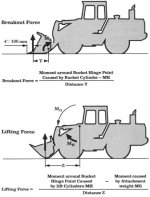
Any one have a link to source that gives a definition of "breakout force"? I have looked and can't find a definitive description or how it is calculated. I chased this once before and I thought I found a source that indicated "breakout force" was the maximum weight (at the bucket edge) that could be curled at ground level.
 
   / Loader Lift Capacity vs Curl Capacity
  • Thread Starter
#17  
I found it and it clearly shows that the "breakout force" is the curl function. According to the Kubota spec sheet for my loader I should be able to curl 75% (3171 lbs / 1784 lbs) more weight than I can lift, which is not the case.
Breakout force.jpg
 
   / Loader Lift Capacity vs Curl Capacity #18  
Great topic. Keep in mind a couple things. 1. Linkages change applied loading (force/angle). 2. With the cylinder link system it will not be a linear function. As your cylinder rod end changes angle to the linked arm, the applied force to the end of the linked arm changes but the force created by the cylinder would not change. Ideal is like a fork truck. Straight lift. Loader arms for CUTs are no where near that. As for curl vs lift. Curl should be more. However, add 42 inches of fork (whatever center of load distance is) and the curl force required will change quickly. A 1000lb load at 21in from hinge point with a 9in distance for cylinder mount will need 2300lbs to lift (curl) force. If the cylinder angle is not 90deg to that link (and/or link to fork) then the force required increase (which is likely the case). As those angles change, the lift force changes (because the pressure does not change). Fun project is to take those link measurements and cylinder angles on your tractor and graph them in excel using the cylinder pressure. You'll see those cylinder forces (capacities) throughout the range of motion.
 
   / Loader Lift Capacity vs Curl Capacity
  • Thread Starter
#19  
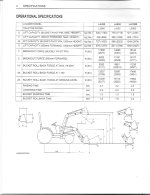
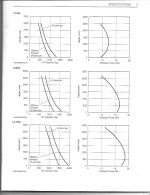
Here are 2 pages out of the Kubota Operator's Manual for my loader.
LA1055-1.jpegLA1055-2.jpeg

The graphs on page 5 show the lift and rollback capacities at different heights. I assume the rollback graph is at the pins. If that is correct, then the rollback capacity at ground level is less than the lift capacity. However this reverses quickly and at 500 mm above the ground the rollback capacity is more than the lift capacity. From what I can determine, the loader specs listed in the tractor brochure show the lift capacity at maximum height (not at ground level, where the capacity is much higher). However the breakout (rollback force) listed in the brochure is for the capacity 500 mm forward of the pins and it does not appear to show that information on the graph, in the Operator's Manual. Looking at the drop in capacity from the pin location, to the 500 mm location for the lift capacities and assuming the drop would be about the same for the rollback capacity, then it appears the brochure is listing the rollback (breakout force) at ground level.

The brochure appears to show lift and rollback capacities at different locations, which just adds to the confusion.
 
   / Loader Lift Capacity vs Curl Capacity #20  
Well.....what you are looking at according to the image is the force with the bucket bottom level? Maybe that is the definition of rollback force. What's really going on is your cylinder for your bucket is changing angle to the bucket if keeping the bucket bottom level as the arms raise, thus the force changes. Let's change the terminology for a second. Change it from force to moment about the pin (torque if you prefer to think of it that way). It does not matter the height of your loader arms. That does not have any effect on the moment about the pin. If your bucket remained in the same rotation relative to the arm (curl cylinder was same extension), then the available moment about the pin would be exactly the same. Look at the images on the right. The curl cylinder when loader in up position vs. down position. you can see it swings thru the "perpendicular to" angle. This angle is your maximum force applied at the cylinder connection (but may be different angle than max breakout force depending on some geometry). As stated in earlier post, this is not linear. So cylinder/linkage designers design for an "ideal condition" location and then realize that force will be reduced as the cylinder swings thru the arc.
 

Tractor & Equipment Auctions

Bobcat E42 (A60462)
Bobcat E42 (A60462)
2014 Glasstream 360 SCX Twin 400R Mercury's with Triple Axle Aluminum Trailer (A59231)
2014 Glasstream...
2020 Caterpillar D5K2 LGP Crawler Tractor Dozer (A56857)
2020 Caterpillar...
Michelin CARGOXBIB High Floatation Tires (SET OF 4) (A56438)
Michelin CARGOXBIB...
500 BBL FRAC TANK (A58214)
500 BBL FRAC TANK...
2018 INTERNATIONAL LT625 TANDEM AXLE SLEEPER (A59904)
2018 INTERNATIONAL...
 
Top