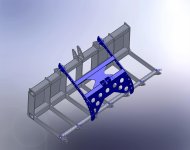
Loader pin root grapple

   / Loader pin root grapple #21  
I'm leaning toward A36 steel for the tines because I'm in Florida and the only rocks I ever see had to be purchased or I have to drive somewhere else to see them.

Plenty of rocks here....I gotta go buy my sand!
 
   / Loader pin root grapple #22  
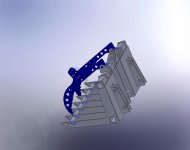
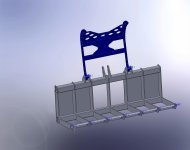
if you can get me the 3-D files in Solidworks I can get you a weight... if you can get the cubic inches multiply it by
.2833 an you now have pounds... based on 3RRL's great bucket grapple I took it one more level and designed a 60" root grapple in hopes of more capacity (lighter) but it actually weights 5#'s more... this is 295#'s without hoses and cylinder...
 

Attachments

  • 60 root grapple 1.jpg
    60 root grapple 1.jpg
    97.5 KB · Views: 289
  • 60 root grapple 2.jpg
    60 root grapple 2.jpg
    73.3 KB · Views: 204
  • 60 root grapple 4.jpg
    60 root grapple 4.jpg
    47.3 KB · Views: 204
  • 60 root grapple 5.jpg
    60 root grapple 5.jpg
    79.3 KB · Views: 219
   / Loader pin root grapple #23  
if you can get me the 3-D files in Solidworks I can get you a weight... if you can get the cubic inches multiply it by
.2833 an you now have pounds... based on 3RRL's great bucket grapple I took it one more level and designed a 60" root grapple in hopes of more capacity (lighter) but it actually weights 5#'s more... this is 295#'s without hoses and cylinder...

Nice modeling!
 
   / Loader pin root grapple
  • Thread Starter
#24  
All -

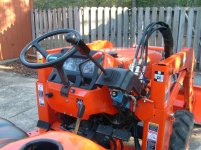
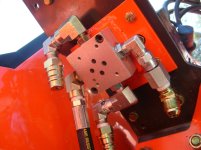
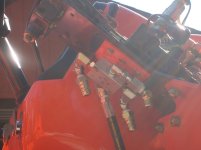
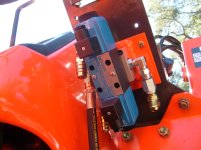
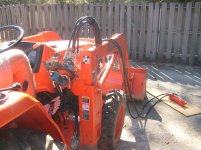
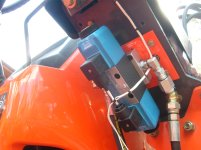
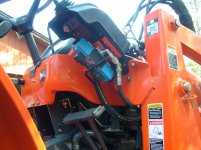
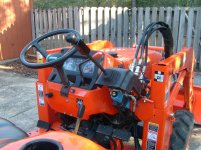
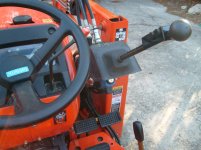
Progress on the rake/grapple has been slow lately, but I now have the tractor plumbed with an electric valve to power the grapple. Mrs3RRL did a great job of documenting her and Rob's work on their grapples, so I won't bore you with every detail. However, the valve installation went so well that I thought you might want to see how I did it.

After looking around for a place to put the valve, I decided that under the plate that holds the loader valves might be the best location. I didn't really want it under the frame because I figured I'd just tear it off on a stump or something. It ended up out of the way and still somewhat protected from the weather.

Here's the finished work. The A and B ports have QD male couplers on them, so when I get more time to build a couple of hose plates for the loader arm, you'll see two more hoses coming out of the valve. The good news is that everything is re-plumbed, so I finally got to change the hydraulic fluid this weekend. Read on to see the details.

- Just Gary

P.S. I should probably do something about that unsightly blue on the solenoids. My son attends UF, but orange and blue look different on a tractor.
 

Attachments

  • S7301337.jpg
    S7301337.jpg
    630 KB · Views: 345
   / Loader pin root grapple
  • Thread Starter
#25  
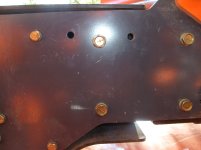
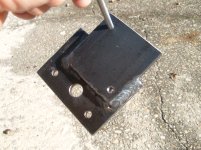
Here's a view of the bottom of the valve plate, plus a closeup shot. Note the two unused holes. I really like modifying things in a completely removeable way if I can, even if I know I won't ever remove it. Plus, using existing holes saves me the work...

All we have to do is dodge the bolts, and then the rest of the space is ours!

- Just Gary
 

Attachments

  • S7301319.jpg
    S7301319.jpg
    414.8 KB · Views: 203
  • S7301318.jpg
    S7301318.jpg
    370.4 KB · Views: 166
   / Loader pin root grapple
  • Thread Starter
#26  
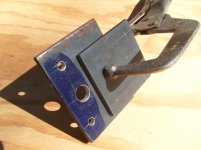
I knew I had that 3" X 1/4" bar of steel here for something. A few measurements, cuts, and holes later, and we're ready to weld the two pieces together. I needed two pieces because the 1/4" thickness didn't clear the bolt heads.

The two holes that hold the new valve's base are threaded 1/4-20. Note in the last photo that I had to mill a little bit away from the second plate to miss the other bolt head.

A note about welding: A few years ago I got frustrated trying to weld something and it dawned on me that all of the spitting and splattering was caused by water in the rods. Where I live, everything is wet all of the time. I took every rod I had and put them on a piece of aluminum foil on the gas grill. I turned on the grill, closed the hood, and let them cook for a few hours. I turned off the grill, let them coast for a while, and then dumped them straight into a large ammo can and closed the lid. Now when I want to weld, I get out what I need for that job and close the lid. Welding is fun again!

A note about milling: I have still not sprung for a real machine, but if I can mill something like this, you can. I use a 1958 ShopSmith model ER (way before the Mark V). By keeping the quill in close to the frame, I can control the spindle and table slop enough to do small jobs. Use high speed and very light feeds. I bolt a cheap chinese cross-slide vise to the table to let me do slots and other simple cuts. Use what you have, and be creative. You may put an eye out, but you'll probably at least survive...

- Just Gary
 

Attachments

  • S7301322.jpg
    S7301322.jpg
    699.5 KB · Views: 157
  • S7301321.jpg
    S7301321.jpg
    534.1 KB · Views: 162
  • S7301317.jpg
    S7301317.jpg
    484 KB · Views: 171
  • S7301316.jpg
    S7301316.jpg
    493.2 KB · Views: 157
   / Loader pin root grapple
  • Thread Starter
#27  
Sorry, but I thought I took a picture of the bolt plate after I installed it, but before I put the valve base on. Anyway, I didn't have any gray paint, so I used the trusty Dupli-Color #1620 "Chevrolet Orange" that I keep around. It matches the original paint incredibly closely.

So here you see the valve base plumbed with QDs on the A and B ports, the P port ready with a hose to go to the Power Beyond output of the existing loader valves, and the T port ready to take the hose that comes from the Power Beyond output.

The last photo shows the valve installed also. Progress!

- Just Gary
 

Attachments

  • S7301323.jpg
    S7301323.jpg
    448.6 KB · Views: 203
  • S7301324.jpg
    S7301324.jpg
    322.4 KB · Views: 176
  • S7301325.jpg
    S7301325.jpg
    395.4 KB · Views: 215
   / Loader pin root grapple
  • Thread Starter
#28  
No leaks!

Actuating the valve with a spare battery demonstrated that everything works (including that cool orange ram) and the transmission didn't blow up. Time to wire it all up and move on with life.

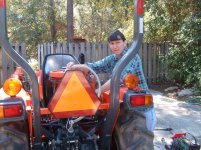
The runt, Ben, is demonstrating that size 14 flip-flops will easily fit on the brake pedal with the valve installed. Honestly, with the hydrostatic transmission, we pretty much use the brake only when the tractor is loaded onto the trailer (yes, plus grade 70 chains).

- Just Gary
 

Attachments

  • S7301329.jpg
    S7301329.jpg
    579.6 KB · Views: 224
  • S7301327.jpg
    S7301327.jpg
    824.2 KB · Views: 274
   / Loader pin root grapple
  • Thread Starter
#29  
It's now time for a quick diversion. We *need* to change the hydraulic oil. A straightforward job, of course, but fairly slow to put back. I usually siphon fuel from a can sitting on the loader arm into the tank, so I figured it ought to work with oil.

It does, but very slowly, and you have to hold the hose just right so it doesn't let a bubble run up and break your siphon.

"Hey, honey! Hold this hose for me while I go get something." "You're not going to take my pictu..." (snap). "Thanks!"

- Just Gary
 

Attachments

  • S7301330.jpg
    S7301330.jpg
    857.3 KB · Views: 289
   / Loader pin root grapple
  • Thread Starter
#30  
Back to the new valve...

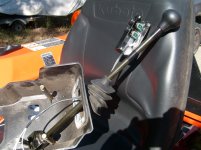
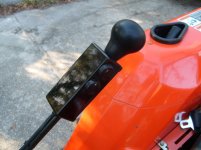
I burned a lot of brain cells wondering how to mount switches on the joystick. The best idea I came up with was a pool ball drilled to mount on a shaft, and mill a cavity in the side for the switches (on a flush-mounting plate). The wires would run through the shaft and come out just above the valves.

Well, what stopped that was the facts that: 1) The existing loader stick has a 1.1" square base, and I don't have any stock over 1"; and 2) The square base has a threaded hole in it for the ball joint for the lift function. Did I mention that the hole is threaded? It's metric. Oh, and 3) I don't actually have a pool ball. Especially not an orange one. Three strikes, I'm out.

But we do have a few small die-cast Bud boxes at work...

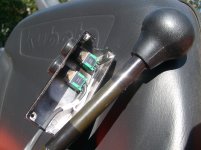
Two "sealed" switches with "sealed" caps and a hank of teflon wire for durability, and we just might have something. The box is drilled on the ends to snug against the shaft, and an extra hole lets the wires out. Some heat shrink tubing will keep it tidy. I didn't seal the box, because the water will get in anyway, and I want it to drain. Look at all of that spare room! What else can I cram into that box?

At first I just tied it all up with braided cord, but then decided to use split loom to cover the exposed wires. It looks better and keeps the wires safer. I tapped off of the "work lights" fuse since I rarely use lights anyway. I brought the return side of the solenoids back to the fuse panel also, and lugged it to the frame where Kubota already had a ground wire.

A note on the "Hirschmann connectors" that plug into the valve solenoids: I didn't see any reason for the connectors to point toward the ends of the valve. I turned the inserts around so that they would point inward, making the installation a little more snag proof. The inserts have cutouts for the wires, but the ones I used (18 gauge) fit over the back of the inserts just fine.

I'll have to get used to having a box on the joystick. The buttons are close enough to be easy to reach, but far enough to stay off of them unless you mean to push them. It's ugly for sure, but it works!

A special thanks to Mr. and Mrs. 3RRL for all of their info on their installations. I know I wouldn't have started this project without seeing theirs first and asking them a bunch of questions!

Regards,

- Just Gary
 

Attachments

  • S7301331.jpg
    S7301331.jpg
    521.1 KB · Views: 194
  • S7301332.jpg
    S7301332.jpg
    537.7 KB · Views: 188
  • S7301333.jpg
    S7301333.jpg
    362.2 KB · Views: 206
  • S7301334.jpg
    S7301334.jpg
    465.8 KB · Views: 174
  • S7301337.jpg
    S7301337.jpg
    630 KB · Views: 196
  • S7301338.jpg
    S7301338.jpg
    595.6 KB · Views: 173
  • S7301336.jpg
    S7301336.jpg
    510.5 KB · Views: 166
  • S7301335.jpg
    S7301335.jpg
    364.3 KB · Views: 222
   / Loader pin root grapple #31  
Nice looking job JG:D
 
   / Loader pin root grapple #32  
Oh man Gary, the hydraulics turned out SWEET !!
I see you the Mrs to help you out too. It's great to see someone else besides us do our tractor projects together. I sent Loretta this link so I'm sure she'll be very happy to see that you mentioned her project in your thread.
When are we going to see your custom grapple mounted?
 
   / Loader pin root grapple
  • Thread Starter
#34  
Wow! By some coincidence, the last post to this thread was exactly a year ago (where did the year go?). I bought a mill last year and have used it for many things unrelated to my tractor. Anyway, I have finally gotten back to this project and have an update.

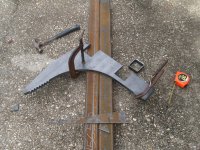
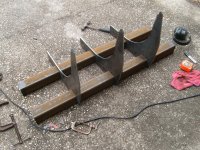
Last month I found someone to plasma cut the parts for me, so I now have everything I need except for the pins. The rake is tacked together, and I'm working on boring the holes for pin bushings in all the parts that need them. I'll tack the grapple together after I get the bushings in place so I can hold it all together with pins while I weld it.

A few changes:

- I decided to go with 1/4" A572 grade 70 plate instead of 3/8" A36. This will save about 33% of the weight while providing about 30% more strength.

- I decided to go with 3/16" wall A500 square tube instead of 1/4" wall for the same reason.

- I changed the angle of the rake slightly to allow less tuck and more rollback.

- I extended the rake braces to nearly the tips of the rake teeth to help keep everything solid, especially with the thinner stock.

- I sloped the braces downward about 10 degrees to help shed dirt as the rake moves through the soil.

I think that since my tractor has limited lift and breakout strength, I should be OK with these changes. After spending a few weeks pushing out Yaupon with my standard bucket, I am confident that this will work fine. Only time will tell, though.

I'll post more pictures of the progress if you are interested.

Regards,

- Just Gary
 

Attachments

  • S7300212.jpg
    S7300212.jpg
    1,002.9 KB · Views: 345
  • S7300213.jpg
    S7300213.jpg
    1 MB · Views: 337
   / Loader pin root grapple
  • Thread Starter
#35  
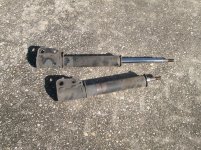
So I was out in the shop boring holes for the pin bushings when the phone rang. When I went over to the corner to answer it, I almost tripped on part of the junk pile. And what did I trip on? Of course! Those two old shock absorbers from the F-150! I kept them rolling around on the floor for about ten years because they have 1" steel rods that I "might use one day..."

Today I cut them open just below the top weld. That turned out to be a great place to cut, since the top will then pop off and let the inner tube and rod slide out. After pouring out the fluid (which does seem to mildly irritate skin, by the way) into a container, I found out that the valve at the bottom of the inner tube just pops off. The result from each one is a 1" pin roughly 15" long, with a ring welded about 5" from one end.

I now have two long pins to use for alignment purposes while I weld up the rest of the grapple. I'm strongly considering using them for the actual pins when I get to that stage. I suspect that they will be strong enough, but maybe you guys know better. Any reason I shouldn't use them as pins for the grapple? Note that I only need them for the grapple and cylinder. I will use the stock Kubota pins from the original bucket to pin the rake to the loader arms.

Regards,

- Just Gary
 

Attachments

  • S7300214.jpg
    S7300214.jpg
    1 MB · Views: 287
  • S7300215.jpg
    S7300215.jpg
    1 MB · Views: 260
   / Loader pin root grapple #36  
I'd say they would work just fine. You might check and make sure the rods are a true one-inch and not 25mm since most automotive stuff is metric now.
 
   / Loader pin root grapple
  • Thread Starter
#37  
mjncad:

Actually, it's not either. The rods from the shocks measure 0.980", while the pins from Kubota measure 0.985" (25mm). The Kubota bushings are 1.015" or so, which gives about 0.020" of clearance. I bored out my bushings to fit those pins (so I can still use them on the loader arm ends).

The DOM tubing I have measures about 1.000" inside (how they do that reliably in a volume production, I don't know), so with the shock pins I would have 0.020" clearance. So, the clearance will be the same as the stock pins and bushings.

I'll have a problem with the grapple cylinder, though. The cylinder ends have 1.020" bushings, so my 0.980" pins fit like socks on a goose. I have some 1" drill rod, but didn't want to deal with hardening it. I'm seriously considering using it for pins and leaving it unhardened. Anybody got any idea how hard the pins should be? I'm thinking that as long as they don't shear, they are hard enough. After all, the bushings aren't hardened.

Regards,

- Just Gary
 
   / Loader pin root grapple #39  
mjncad:

The DOM tubing I have measures about 1.000" inside (how they do that reliably in a volume production, I don't know), so with the shock pins I would have 0.020" clearance. So, the clearance will be the same as the stock pins and bushings.

Regards,

- Just Gary

I wish I knew how they did it too; but that's why it's more expensive than standard tubing. It sure is a pleasure to use.

Based on your measurements, I'd say the shock rods will work quite nicely.
 
   / Loader pin root grapple #40  
mjncad:

Actually, it's not either. The rods from the shocks measure 0.980", while the pins from Kubota measure 0.985" (25mm). The Kubota bushings are 1.015" or so, which gives about 0.020" of clearance. I bored out my bushings to fit those pins (so I can still use them on the loader arm ends).

The DOM tubing I have measures about 1.000" inside (how they do that reliably in a volume production, I don't know), so with the shock pins I would have 0.020" clearance. So, the clearance will be the same as the stock pins and bushings.

I'll have a problem with the grapple cylinder, though. The cylinder ends have 1.020" bushings, so my 0.980" pins fit like socks on a goose. I have some 1" drill rod, but didn't want to deal with hardening it. I'm seriously considering using it for pins and leaving it unhardened. Anybody got any idea how hard the pins should be? I'm thinking that as long as they don't shear, they are hard enough. After all, the bushings aren't hardened.

Regards,

- Just Gary
Gary,

A couple of things- I think Kubota's clearance calculates out to .030 instead of .020 so .040 isn't that much worse. Clearance in general probably affects wear due to the amount of surface contact and, maybe, the way grease distributes itself when lubing. Rust might be an issue on your (unplated) drill rod. As far as shearing 1 inch pins, you have to shear them in two places and even if it was soft A36 steel, that would take over 50,000 lbs. (assuming shear stress is approximately equal to yield stress-36,000 psi. I didn't look it up) So if you are hardening it to resist wear, and the bushings are soft, I'd rather replace the pins than the bushings.

Thanks for the insight on junk shocks. I'll never look at them the same, knowing there's a pearl inside! I bet that shaft is hardened, so that may bite you if you have to drill it.

John
 

Tractor & Equipment Auctions

500 BBL FRAC TANK (A58214)
500 BBL FRAC TANK...
Abaco Machines DVL500 Vacuum Lifter (A59230)
Abaco Machines...
2023 John Deere XUV 825M S4 (A60462)
2023 John Deere...
2016 PETERBILT PB337 FLATBED TRUCK (A52706)
2016 PETERBILT...
2013 Ford Taurus Sedan (A59231)
2013 Ford Taurus...
Meyer 8' Snow Plow w/ Bracket (A55272)
Meyer 8' Snow Plow...
 
Top