WranglerX
Super Member
Sound like a plan... Sounds like splitter would be "sort of stationary" because if having to move two units.... Some pictures of finished unit would be good...



Sound like a plan... Sounds like splitter would be "sort of stationary" because if having to move two units.... Some pictures of finished unit would be good...
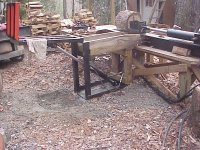
Here is a couple of old pics...before and after I added the lift...I park the tractor about 20' to the right in the pics...you can see the hoses...Sound like a plan... Sounds like splitter would be "sort of stationary" because if having to move two units.... Some pictures of finished unit would be good...

My theory. The filter should be on the return side so it catches all contaminants before they enter the tank. Then you know your pump is always drinking clean oil.Why not put the filter on the output port of the tank? That way you're sure the oil reaching the pump is clean. That's where the filter is on my 20T wood splitter.
Have never had a problem. Might be contingent on the type of oil used?I was under the impression that the return inlet to the tank needed to be below the oil level to keep the oil from foaming. With it coming in at the top of the tank it will free fall thru the air before hitting the oil in the tank.
Correct, it would be low pressure (actually suction or gravity fed) but if clogged it would create a vacuum and collapse the intake hose which generally is very low pressure material not unlike garden hose.I understand but the output port of the tank (ie, before entering the pump) is low pressure, no? It's only once it leaves the pump that it becomes pressurized. At least, that's how I understand it.
Mine, like thousands of others enters from top of tank....I was under the impression that the return inlet to the tank needed to be below the oil level to keep the oil from foaming. With it coming in at the top of the tank it will free fall thru the air before hitting the oil in the tank.
And mine may, I didn't build the tank so don't know for sure.Generally the return pipe enters the top of the tank then extends to near the tank bottom where the fluid is discharged.
Yep, filler cap would be the only source other than parts failure. I've had my splitter 11 years and have never removed the tank cap.What are the most common or likely sources of contaminates ? other than worn parts...?...seems to be the most vulnerable place is the filler cap...(all kinds of scenarios there)...and that would leave only a suction strainer to protect the pump...

Yep, filler cap would be the only source other than parts failure. I've had my splitter 11 years and have never removed the tank cap.
| Every 100 hours or per 1 year |
| Clean spark arrester (optional) |
| Check/adjust maximum load speed* |
| Check/adjust valve clearance* |
| Clean fuel tank and filter* |
| Change hydraulic oil |
| Change hydraulic oil filter |
A suction strainer stops chunks. Chunks destroy pumps abruptly.
Suction strainers do nothing for the fines that slowly destroy your pump, cylinders, motors, etc. A pressure line filter is nice if the pump dies, but are expensive and bulky. They do nothing for any contamination coming from system components,
Only a good return line filter prevents fines and chunks from the system from getting into your tank. Clean oil from the tank into the pump gives you a clean system.
There is always a risk you introduce contamination when filling. A filler with a screen keeps the chunks out. A breather keeps airborne fines out. Clean oil out of a sealed container is actually not that clean. But, a simple gear pump system with a return liner filter, run under no load, will clean itself up rapidly.
On a simple system, there are diffusers you can add to your return line. They do help reduce foaming of the oil.

A filter is a filter its physical orientation probably has no effect on how it operates other than it needs to be between control valve and tank... Use what ever plumbing that is appropriate to locate it in safe area (above top of tank level) ... I would bet a couple of nipples and a 90° elbow would do...One question though, must the filter be vertical? Can it be horizontal? My return line is at the bottom of the tank and the filter would hang low where it my be ripped off if I hit something while moving the splitter.
You answered your own question in regards to changing oil.What? do you mean that in 11 years, you never changed your hydraulic oil in your splitter? Mine ask to change the hydraulic oil every 100 hours or yearly
Every 100 hours or per 1 year Clean spark arrester (optional) Check/adjust maximum load speed* Check/adjust valve clearance* Clean fuel tank and filter* Change hydraulic oil Change hydraulic oil filter
Mine has no filter, just strainer. Might be why they ask that the oil be changed every year or 100 hours. I'll be adding return line filter to it. My splitter flow is 8 gpm so I guess this 15 gpm filter will do the trick. I'm in Canada so my choice of suppliers is limited
One question though, must the filter be vertical? Can it be horizontal? My return line is at the bottom of the tank and the filter would hang low where it my be ripped off if I hit something while moving the splitter.