Making some Battery cables

   / Making some Battery cables #2  
Neat but lots of places make them and hydraulic hoses for the price of the parts.
 
   / Making some Battery cables #3  
IT will work but there are a lot better methods, I prefer crimped on connectors and to seal them heat shrink.... The thing is with solder the cable becomes brittle and will break right where the solder that wicked up the cable ends..

There are very few places in any industry today the uses soldered on terminals...

Dale
 
   / Making some Battery cables #4  
IT will work but there are a lot better methods, I prefer crimped on connectors and to seal them heat shrink.... The thing is with solder the cable becomes brittle and will break right where the solder that wicked up the cable ends..

There are very few places in any industry today the uses soldered on terminals...

Dale
Yup. a proper crimp is as strong as solder & less prone to vibration related fatigue. I put Anderson connectors on mine. Hook up the clamps, then connect the plug. Dont get dangling sparking clamps that way. Plan on mounting an Anderson plug to the grill on my next truck too. Never even have to pop your hood to jump somebody. I'd do it now, but the Tacoma & old beater F250 are likely to get sold or traded in for a newer diesel 3/4 ton within the year.
 
   / Making some Battery cables #5  
Yep, have Andersons on my tractor and vehicles.
My cables have one end Anderson fitted plus a shorter version that allows me to be double end clip.
 
   / Making some Battery cables #6  
IT will work but there are a lot better methods, I prefer crimped on connectors and to seal them heat shrink.... The thing is with solder the cable becomes brittle and will break right where the solder that wicked up the cable ends..

There are very few places in any industry today the uses soldered on terminals...

Dale

Yup. a proper crimp is as strong as solder & less prone to vibration related fatigue. I put Anderson connectors on mine. Hook up the clamps, then connect the plug. Dont get dangling sparking clamps that way. Plan on mounting an Anderson plug to the grill on my next truck too. Never even have to pop your hood to jump somebody. I'd do it now, but the Tacoma & old beater F250 are likely to get sold or traded in for a newer diesel 3/4 ton within the year.

Yep, have Andersons on my tractor and vehicles.
My cables have one end Anderson fitted plus a shorter version that allows me to be double end clip.

A 4th vote for crimping if you can afford it. If I only had to do 2 fittings solder might work. But I've made a bunch of cables for power extension for my winches etc.

I've probably put on a dozen connectors. A decent hydraulic crimp tool runs about $30 to ???. And will mash the cable together like it's one solid piece.

Also I found that buying cable can be tricky. Make sure it is ALL COPPER. Sometimes it is less expensive to buy "jumper cables" (make sure they are all copper!) on sale and replace the clamp ends with Andersen style connectors.
 
   / Making some Battery cables #7  
With the copper terminals shown I use vise grips to crimp THEN fill with solder to prevent corrosion. With vise grips you crimp, adjust, and crimp again until it won't close any tighter. I guarantee you won't pull the cable out.

On my backhoe I purchased some cast bronze terminals that would have been too brittle to crimp so those are soldered on. They were advertised as solder type terminals. Both methods have worked for me but I prefer the soft copper I can crimp first.
 
   / Making some Battery cables #8  
If you ask lead/acid battery professionals they will tell you the best method is tinning (solder) the ends that go into closed end connectors then crimping...

If you are really interested in learning more about battery cables...some of the best information can be found on electric (golf) cart sites...

General consensus is that heat shrink creates an environment for early and rapid corrosion...

General automotive (and tractor) maintenance may require battery cables be replaced or addressed maybe a few times over the lifespan of a machine...Electric L/A battery powered carts often require cable replacement every few years...IMO this makes cart professionals much more aware of the best methods with the least issues...

BTW the most common quality cables used on carts employ 6GA to 2GA (high strand count) welding cable...
 
   / Making some Battery cables #9  
Neat but lots of places make them and hydraulic hoses for the price of the parts.

That's true, but I keep stuff around here, rather than driving 1/2 hour plus to get to a place that will make them for me.
 
   / Making some Battery cables #10  
Yep, have Andersons on my tractor and vehicles.
My cables have one end Anderson fitted plus a shorter version that allows me to be double end clip.
What's an Anderson? Anderson Power Product Connectors

I like to use tinned marine battery cable. I've been getting my ends from Waytek.com

I always use heat shrink - except when I forget to put it on.

I used to always fill the cable end with solder and then stick the cable into the molten solder. I had very good results with that method. Not much damage done to the cable coating.

I've had issues with welding cable losing it's coating. I had to scrap about 400 ft of 2/0. Broke my little heart and hurt my one and only feeling

I have a hydraulic crimper that works very well. I've used it on 3/0 cable

This is the crimper I bought - TMS Crimper-WL-YQK-300 16 Ton Hydraulic Wire Battery Cable Lug Terminal Crimper Crimping Tool 11 Dies - $49.95

TMS Crimper-WL-YQK-3 16 Ton Hydraulic Wire Battery Cable Lug Terminal Crimper Crimping Tool 11 Dies - - Amazon.com
 
   / Making some Battery cables #11  
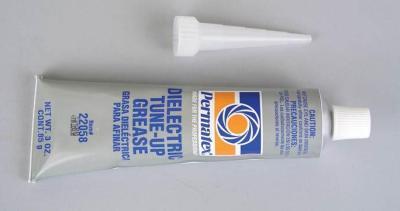
IF you want to prevent corrosion use dielectric grease, it keeps moisture and oxygen out of crimp preventing corrosion.... Yes is supposedly insulative... BUT if you have proper crimp you have solid mechanical connection and that is key.... ALL my electrical work (crimp connections) uses dielectric grease I even use in on battery connections (dry cells too) light bulbs in my vehicles and light bulbs in house....

24503845553_8510134414_o.jpg


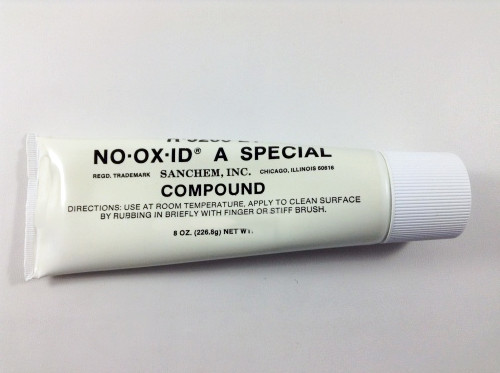
This is also a good corrosion preventative, I have uses it on automotive batteries and never had corrosion problem in life time of battery...Also is pretty much a "standard' in telecom power system for backup batteries in central offices and and cellular sites...

10202_compound__80366.1474298231.500.500.jpg


Dale
 
   / Making some Battery cables #12  
IT will work but there are a lot better methods, I prefer crimped on connectors and to seal them heat shrink.... The thing is with solder the cable becomes brittle and will break right where the solder that wicked up the cable ends..

There are very few places in any industry today the uses soldered on terminals...

Dale

AGREED!
For the reasons discussed above, soldering battery cable terminals is NOT a good idea!
You can buy a manual (hammer type) crimper for under $20.
Crimping is the PROPER way to make battery cables!
 
   / Making some Battery cables #13  
A few years ago I had a EE (electrical engineer) kid who was unemployed help me wire up an all-way blade that was powered with electric actuators. Yes, lots of connections to make. I was soldering them before he showed up and told me he had worked on a satellite as part of his graduate work. He said they crimped its connections because some study had proven that crimps were less prone to failure than soldering was. Soldering is more prone to a cold connection, which will later fail. Go figure.
 
   / Making some Battery cables #14  
Here is an explanation and graphic proof that soldering is indeed the better way to assemble cables...
Granted tractors/ automobiles etc. do not generally employ deep cycle, multi voltage cycle type activity but the same theory applies to standard agricultural or automotive applications...

scroll down to just above half way to see the graphic proof...

http://www.trojanbattery.com/pdf/WP_BatteryCableGuide_0512.pdf
 
   / Making some Battery cables #15  
Here is an explanation and graphic proof that soldering is indeed the better way to assemble cables...
Granted tractors/ automobiles etc. do not generally employ deep cycle, multi voltage cycle type activity but the same theory applies to standard agricultural or automotive applications...

scroll down to just above half way to see the graphic proof...

http://www.trojanbattery.com/pdf/WP_BatteryCableGuide_0512.pdf

Sorry but several billion crimped connections keeping most of the worlds telecommunications systems (local 2 wire dial-up , cellular, fiber optics, satellite and under seas cable) prove the document wrong....

38 years as telecommunication technician and everything from #12 up to 750,000 cm is a crimped connection.... And its a industry standard.....And it pretty hard to solder to a aluminum connector (lug) ....

Dale
 
   / Making some Battery cables #16  
When I was a QA inspector for passenger rail cars we used crimp connectors. But we used them because they are a much simpler way to make the connection. Solder requires heat and time where as a crimp takes seconds. Also when you are using good crimping tools they are repeatable. Those cheap wire stripper/ crimping tools are junk. With the expensive ones they will only allow you to crimp the connector so far. We had to test both new hires as well as certify the crimping tools by having a tech crimp connectors on both ends of a short wire. We would then pull it apart. For each type of connector/ gauge of wire it had to exceed a certain amount of force before the wire pulled out of the connector.
 
   / Making some Battery cables #17  
What crimping tool do you use for small wires? I have a ratcheting crimp tool that does not release until it pops. A pain in the arse if you misjudge the die size - it has a rotating die. I've had it about 30 years or so. I think it is good to about 4 ga.

What is a good, easy to use crimper for 10 ga and below?

I usually use Klein Stake-ons - Crimping and Cutting Tool for Insulated and Non-Insulated Terminals, 9-3/4-Inch Klein Tools 15 - Crimpers - Amazon.com

I will say that none of my soldered connections have ever gone bad. I have had crimped connections corrode over time>>

I sometimes wonder how much direct weather the crimp only crowd's connections are exposed to.

I use liberal amounts of heat shrink, Kopr Kote, Dielectric grease and anti-seize.

Do they make heat shrink tape that works?

I also use the good rubber tape that you can never unwrap, once it's been wrapped.

Do not cheap out on electrical tape. Buy the good stuff only. It's not that much more.

I think a lot of people over heat when they solder. My method of filling the connector and then installing the wire into the connector is messy and can be a PIA, but it seems to avoid that part of the problem
 
Last edited:
   / Making some Battery cables #18  
Sorry but several billion crimped connections keeping most of the worlds telecommunications systems (local 2 wire dial-up , cellular, fiber optics, satellite and under seas cable) prove the document wrong....

38 years as telecommunication technician and everything from #12 up to 750,000 cm is a crimped connection.... And its a industry standard.....And it pretty hard to solder to a aluminum connector (lug) ....

Dale

LoL...hardly...!

The Trojan battery company has over 90 years of experience...

telcoms are hardly known for their quality of hardware...it would be a good trick to solder fiber optic...:laughing:

Also, here are some NASA reqs....go to page 17 https://ntrs.nasa.gov/archive/nasa/casi.ntrs.nasa.gov/19710022895.pdf

There are several other NASA docs that state the same thing...
 
   / Making some Battery cables #19  
When I was a QA inspector for passenger rail cars we used crimp connectors. But we used them because they are a much simpler way to make the connection. Solder requires heat and time where as a crimp takes seconds. Also when you are using good crimping tools they are repeatable. Those cheap wire stripper/ crimping tools are junk. With the expensive ones they will only allow you to crimp the connector so far. We had to test both new hires as well as certify the crimping tools by having a tech crimp connectors on both ends of a short wire. We would then pull it apart. For each type of connector/ gauge of wire it had to exceed a certain amount of force before the wire pulled out of the connector.

That's what I've found. A good solder joint is better electrically and mechanically - but making a good solder joint takes a real master craftsman. But old time master craftsmen enjoy the challenge of soldering.

There's always a chance of getting a less than perfect joint with soldering - but that's part of what makes it enjoyable. A perfect soldered joint is one of the pleasures of mechanical work.

Crimping isn't quite as good electrically or at withstanding vibration as a tapered solder joint, but darn near....and crimping can be done by anyone. Crimping a connection moves the assembly process problem to the tool instead of the user. When I was doing manufacturing engineering I'd specify crimped joints in some places for exactly that reason.
However, the best technicians always preferred soldering those same joints on their R&D prototypes - and so did I.
rScotty
 
   / Making some Battery cables #20  
Here is an explanation and graphic proof that soldering is indeed the better way to assemble cables...
Granted tractors/ automobiles etc. do not generally employ deep cycle, multi voltage cycle type activity but the same theory applies to standard agricultural or automotive applications...

scroll down to just above half way to see the graphic proof...

http://www.trojanbattery.com/pdf/WP_BatteryCableGuide_0512.pdf

The infrared picture below shows a cable with crimped and soldered
connector under a high-rate discharge. Note that the high temperature area
is no longer near the connecting junction but evenly distributed along the
cable and battery terminal.
Did you read crimped AND soldered?
 

Tractor & Equipment Auctions

Metal Transport Rack (A59228)
Metal Transport...
205196 (A52706)
205196 (A52706)
2018 Freightliner M2 106 Cab and Chassis Truck (A59230)
2018 Freightliner...
2018 JLG 742 TELESCOPIC FORKLIFT (A60429)
2018 JLG 742...
2014 Forest River Rockwood Premier Pop Up Trailer (A59231)
2014 Forest River...
PT 1000 Gallon Supply Tank (A57149)
PT 1000 Gallon...
 
Top