Oil & Fuel MF 230 Carburetor Questions

   / MF 230 Carburetor Questions #1  

Sbalak

Member
Joined
Oct 31, 2012
Messages
43
Location
Lunenburg, MA
Tractor
2018 Kioti DK4710SE Cab
I'm pretty sure my tractor is running rich, because I recently replaced some fouled plugs and I also have trouble keeping her running without some choke. I was going to pull the carb and try to clean it out, but I thought I'd start with trying to adjust the mixture. I've looked at it and the partsbook and I can't find a mixture screw. I clearly see the idle set, but the tractor idles nicely at 750rpm with a little choke. Am I missing something? Thanks for your help. Scott
 
   / MF 230 Carburetor Questions #2  
I'm pretty sure my tractor is running rich, because I recently replaced some fouled plugs and I also have trouble keeping her running without some choke. I was going to pull the carb and try to clean it out, but I thought I'd start with trying to adjust the mixture. I've looked at it and the partsbook and I can't find a mixture screw. I clearly see the idle set, but the tractor idles nicely at 750rpm with a little choke. Am I missing something? Thanks for your help. Scott

What does the fouling on the plugs look like? If it wet and oly looking, that's not cuase by an eriched mixture. it's caused by loss o f oil control. Dry, sooty, fluffy deposits are caused by enriched mixtures. Requiring the choke to run generally means too lean a mixture or an air leak downstream of the carbs metering system.

What does your spark look like? It should be FAT AND BLUISH WHITE, the color of lightning. Do you have the right heat range on the plugs, the correct gap, and do you have the correct firing order and intial timing?
 
   / MF 230 Carburetor Questions
  • Thread Starter
#3  
I've got new plugs (AL386) in now with the correct 0.25 gap. Hmmmmm, not good....The old plugs (all 4) were oily & wet, not dry & fluffy. I guess that means I've got an oil leak. I ran the tractor for ~20 minutes this past weekend so the new plugs do have some time on them. I can pull them and see if they also now have oil on them as well. I'm pretty sure the fire order is correct, because she starts right away and runs pretty smooth (with choke). I'll take another look at distributor cap tonight, but I don't think it has a timing adjust (rotate) as it feels pretty fixed. After my post, I did notice that #4 cylinder spark plug wire could be replaced. That'll be next on the list.

When you say downstream, are you thinking head gasket or valve? The oil pressure gauge shows good pressure while running. I purchased the tractor in the summer and I would say that my need for choke is directly correlating with cold temps. I'm wondering if I've got seals that are shrinking in the cold.
 
   / MF 230 Carburetor Questions
  • Thread Starter
#4  
Now I feel like a complete moron...the correct firing order is 1,3,4,2 and mine is setup for 1,2,4,3. I'm amazed it even starts. :) It's tucked in the garage pretty tight so I'll pull it out this weekend, try it out, and I'll post an update. Thanks for the advice! Scott
 
   / MF 230 Carburetor Questions #5  
I've got new plugs (AL386) in now with the correct 0.25 gap. Hmmmmm, not good....The old plugs (all 4) were oily & wet, not dry & fluffy. I guess that means I've got an oil leak. I ran the tractor for ~20 minutes this past weekend so the new plugs do have some time on them. I can pull them and see if they also now have oil on them as well. I'm pretty sure the fire order is correct, because she starts right away and runs pretty smooth (with choke). I'll take another look at distributor cap tonight, but I don't think it has a timing adjust (rotate) as it feels pretty fixed. After my post, I did notice that #4 cylinder spark plug wire could be replaced. That'll be next on the list.

When you say downstream, are you thinking head gasket or valve? The oil pressure gauge shows good pressure while running. I purchased the tractor in the summer and I would say that my need for choke is directly correlating with cold temps. I'm wondering if I've got seals that are shrinking in the cold.

I hope you mean 0.025" spark plug gap!

Downstream means from the throttle plate to the cylinder head. Air leaks can occur at the throttle shaft , the carb to manifold interface, cracks or rust spots in the manifold or at the manifold to cylinder head gasket. To retime the distributor, you best have a timing light. Then you have to loosen the distributor with the engine running and you check the timing with the timing light and adjust by rotating the distributor appropriately. You should also check the advance mechanism for functioning.
 
   / MF 230 Carburetor Questions
  • Thread Starter
#6  
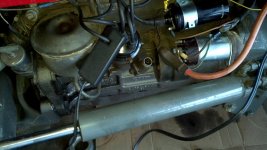
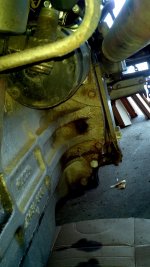
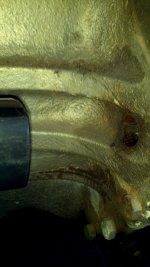
I tried the 1,3,4,2 and she wouldn't start at all. Looking at it 1,3,4,2 is that same as 1,2,4,3 if you go counter-clockwise! :) So I set it back and she's running just like before. Yep, the gap is 0.025 not .25. I finally got my hands on a used timing light (harder to find these days) and I was able to set my timing. I've got her set at 6 degrees on idle and I get to the high twenties on full throttle. I think you're supposed to get to 36, but I was pretty happy with the advance. I took a couple pics just in case somebody else needed to do this on their continental. I'm still needing the choke, so now that I've eliminated timing I'll start looking into cleaning the carb.

There's plug just under the starter right where the engine meets the transmission. Pop off the cover and you can see the degree scale. Mine had a nice white mark at 6 degrees.

Inductive pickup on #1
2013-02-10_16-25-41_554.jpg

Looking down the tractor towards the timing hole
2013-02-10_16-26-08_137.jpg

Timing light close to read the scale
2013-02-10_16-28-59_387.jpg
 
   / MF 230 Carburetor Questions #7  
I believe you'll find the distributor turns CCW and if the firing order is 1-3-4-2( generally the numbers are cast into the block), make sure you have that correct. it looks to me like you have 1-4-3-2 currently. You said you set the timing at 6 degrees. Was that BTDC or ATDC? It should be BTDC.

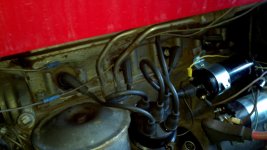
What's the thing that looks like it's attached to the distributor in the first photo? It looks like a connection for a vacuum advance. If it is you need to either connect that to it's vacuum source or plug the engine end of that or it will lean out your mixture.
 
   / MF 230 Carburetor Questions
  • Thread Starter
#8  
It's 6 BTDC. The add-on piece to the distributor is the mechanical tachometer drive. The gear in that unit failed, so I've replaced the mechanical tach with an electronic version that triggers off the coil pulse. I looked for a vacuum hose for the timing advance and couldn't find one so I'm guessing it's a mechanical advance. I don't exactly know how it works, but I know that it's working based on the timing advance I see on full throttle.
 
   / MF 230 Carburetor Questions #9  
I tried the 1,3,4,2 and she wouldn't start at all. Looking at it 1,3,4,2 is that same as 1,2,4,3 if you go counter-clockwise!

The correct firing order for the Continental Z-145 engine is 1-3-4-2 and the distributor rotates counter clockwise. It's important to note that the number one cylinder is at the front of the engine, where the cylinders front to back (not firing order) are 1-2-3-4.

I looked for a vacuum hose for the timing advance and couldn't find one so I'm guessing it's a mechanical advance. I don't exactly know how it works, but I know that it's working based on the timing advance I see on full throttle.

The distributor does use a mechanical advance mechanism, where fly-out weights are attached to small springs known as curve or advance springs. The weights and springs are located beneath the bottom plate that the points and condenser attach to. Problems with the springs can result in timing advance issues, especially if the springs are weak or broken. If new timing advance springs are needed, they can often be purchased at auto parts stores as part of what is called a distributor curve kit which comes with many different springs for different performance characteristics.

The following diagram shows the shaft and internal components of the distributor used on the earlier versions of the Continental Z-145 engine, such as the one on the Massey 135 tractor I'm currently restoring. It's a little different than the distributor on yours, but it should give you a general idea of how it all works. The fly-out weights are part number 19 and the advance springs are part number 20.

xlaxb7.jpg
 
   / MF 230 Carburetor Questions #10  
It's 6 BTDC. The add-on piece to the distributor is the mechanical tachometer drive. The gear in that unit failed, so I've replaced the mechanical tach with an electronic version that triggers off the coil pulse. I looked for a vacuum hose for the timing advance and couldn't find one so I'm guessing it's a mechanical advance. I don't exactly know how it works, but I know that it's working based on the timing advance I see on full throttle.

What about the firing order? The picture looks like you may have it incorrect.
 
   / MF 230 Carburetor Questions #11  
What about the firing order? The picture looks like you may have it incorrect.

I was thinking the same thing. The top of the picture doesn't show all the plugs, but it appears to be wired as 1-4-3-2, where reversing 4 and 3 to make it 1-3-4-2 might correct the firing order.
 
   / MF 230 Carburetor Questions
  • Thread Starter
#12  
Thanks for all the feedback guys. So I pulled off the carb and determined it's a Zenith 13800 carburetor. My understanding that somehow translates to a model 61 or 161. Not sure how that works, but google seems to think so. I guess the previous owner tried to rebuild it as well, because it had the wrong gasket and they also had to patch with gasket paste.

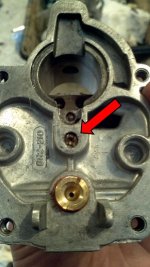
View attachment 309499

I put a red arrow to highlight the gasket paste. When I pulled it off I thought for sure a good cleaning and new gasket would solve my problems choke problems, but no such luck.

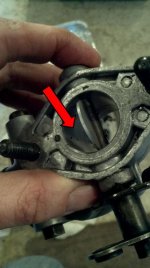
View attachment 309500

I got the primary jet out and verified the float, but I couldn't get the idler jet out. I cleaned it thoroughly and verified it wasn't clogged (carb cleaner drained through it). When I put the carb back on and she fired right up with the choke on, but when I tried to lean it up (no choke) she starts to sputter and will eventually die. The throttle works fine and I can get near full RPM. My understanding of the Zenith 13800 is that there is no mixture adjustment. All documentation I can find says the idle adjustment (green arrow) is the only adjustment. Do you guys agree?

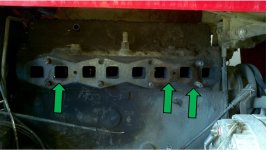
I decided the next step is to check the intake\exhaust manifold for leaks. My gasket finally arrived today and I pulled it off. Sure enough, it appears that I've got some leakage around cylinder 1 for sure, but maybe also on 2 & 4. The gasket itself didn't look that bad, but I'm wondering how tight the manifold was bolted. I was going to clean it up and put it back on with the new gasket. Do you guys know the correct torque ft lbs?

intake_exhaust_manifold.jpg

Here's another pic of the distributor. I've got it setup to 1-3-4-2. (CCW)

2013-03-22_16-47-07_595.jpg
 
   / MF 230 Carburetor Questions
  • Thread Starter
#13  
I found pieces of a copy of the MF230 service manual online and determine the manifold torque spec is 30lbs. I put it all back together and she fired right up....but same as before...would only run with full choke. I've pretty much convinced myself this is a carb problem, but just to make sure I'm not missing something stupid. I tried to run it without the air filter (just in case it was no allowing enough air), but not luck. I also put the timing light back on and verified correct timing and that all 4 plugs are getting spark.

I took the the carb back off and disassembled again. I let the jets soak in carb cleaner for a couple hours and adjusted the float (by 2/32 of an inch....but I'm grasping at straws here). I also filled the lower carb body in carb cleaner fluid and let that sit for a while. There is a tube that doesn't appear to be removable so I figured I'd let all soak. Still no dice. I tried adjusting the idle adjust, but it doesn't seem to have any effect (I have the choke on). My guess is that the choke is enriching the mixture beyond the range which the idle adjustment can have an effect.

Aside from purchasing a new carb I'm all out of ideas. Any suggestions? At this point I'm willing to try just about anything. :) I'm going to pull the carb off again and keep investigating. I've got to be missing something.

Thanks,
scott
 
   / MF 230 Carburetor Questions #14  
First let me say I have no experience with Zenth carbs so my input will be based on general carburetor performance.

What do your plugs look like after running? Are they clean with just a light coating of gray or tan ash?

Just because you can hit rated speed with no load doen't mean your fuel delivery is adequate. Can you get rated speed under load? If you can't, either you lack fuel or your air cleaner is clogged, limiting power. To eliminate the air cleaner, disconnect it from the carb inlet. Unless you are in a very dusty environment, it won't hurt anything. Generally these carbs are of a pressure balanced design so that fuel air ratios are not affected by air filter restriction but power development, being directly proportion to air flow, is.

Do you have a fuel bowl drain on the carb? if you do, open the tank valve(if you have one) open the bowl drain and holding a suitable container uner the carb, verify a CONTINUOUS GUSH OF FUEL, like a cow peein' on a flat rock. If it dribbles or is intermittent, you have a fuel delivery problem.

When your engine stops, does it quit immediately or does it miss a few times and then stop. If it quits immediately, then imediately check for a spark. I mean right now!

You need to sort out whether your problem is fuel related or ignition related.Then you can find the root cause.

Remember that the most important thing about the carburetor is that all the passages must be squeaky clean and to get them that way, you need to soak the carb in real carb cleaner for 24 to 48 hours and then blow out the passages with compressed and run small soft wire or mono fishing line through the drilled passages to make sure you get all the crud out. That includes the passage with the float valve also. A small grain of sand, etc in there can inhibit flow enough to cause your problems. You changed the float setting. Which direction did you move ? To a higher float leve or a lower float level?

If you have a bowl drain, you can make a simple tool to measure the fuel level in the bowl externally without having to open up the carb except to change the fuel float setting. Using a brass fitting that fits the bowl drain outlet, attach a piece of clear tubing. Attach a 90° el to the tubing and another piece of clear tubing to that in such a way that the verticle tube of this the L shaped device is near the carburetor and extends a few inches above the fuel bowl. (Depending on your bowl drain orientation, you may need two els.) When you openthe tank valve, the tube will fill with fuel to the level in the fuel bowl. Since you measure the float level relative a split flange on the carb, you can see if the fuel level is at the correct height.


You say there is noadjstment for the carb. How does it adjust for power enrichment and ambient temperature changes? Does it have additional fuel circuits besides idle, part throttle and full power?
These types of carbs are relatively simple and if they have problems, a thorough cleaning and the proper adjustment are all that is needed to get them to operate properly
 
Last edited:
   / MF 230 Carburetor Questions
  • Thread Starter
#15  
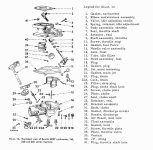
Success!! I'll write this up just in case somebody else runs into this same problem with their Massey 230. First things first. The Zenith carb is a 68x7, not a 60 or 161. I ended up buying a Zenith carb manual and found this sheet.

Zenith 68X7.jpg

Most of this wasn't new info to me except that you should be able to remove #15 Idle Filler. I still have no idea how as I couldn't do it without damaging the tube. I left it in and just sprayed the heck out of it. I decided that my problem had to be relate to the idle jet (#40) as that's the only one I couldn't get out before. No change there. I tried spayed it down and tried to unscrew, but I could tell that the jet was starting to come apart at the screw top.

idle jet.jpg

So I just stuck the carb cleaner straw in and put paper towel around it (to catch blow back) and sprayed for ~15s continuously about 5 times. I had previously soaked this jet, but that wasn't enough. The output of the idle jet is two holes by the throttle body.

idle_outlet.jpg

After a couple of spays I could tell that something had cleared as more and more was getting through. Who would have thought so little could cause me so much trouble.

grime.jpg

I also noticed that a Massey really wants to be warm before you can pull the choke. I'm used to using choke for <30 seconds on other equipment, but this tractor wants to be warm (~3-5 minutes) before I could completely remove it. During that time I was slowly adding and removing choke while listening to the engine to determine if the mixture was better or worse by RPM. I didn't have much luck with the idle adjust (#3). I'd rotate and out without much difference. I think I'll save that for a warmer day.

Victory Pic! Idling nicely with no choke! :)

happiness.jpg
 
   / MF 230 Carburetor Questions
  • Thread Starter
#16  
Jerry...thanks for the feedback. When it died it would sputter. I had my other electrical problems with the tractor, but I think those are all resolved. The carb does have a bowl drain and it was always full. Now that I've pulled this carb off multiple times I could probably do it blindfolded now. :) My hands could use a break from gas and carb cleaner...they're pretty chapped. The plugs are new, but I plan on pulling them and cleaning them. I'm sure I've fowled them during all my rich running.

That is the truth! "all the passages must be squeaky clean". That's my new advice to everybody having carb troubles!
 
   / MF 230 Carburetor Questions #17  
Glad you got the problem solved. With carbs it's almost always crud in a passage, not worn parts. Sometimes throttle shaft seals wear out, some times needles get scored but dirty fuel systems are the major enemy of carbs.
Now go work that machine!
 

Marketplace Items

2017 Ford F-550 (A55973)
2017 Ford F-550...
MARATHON 20KW GENERATOR (A55745)
MARATHON 20KW...
2017 Ford Transit Connect Cargo Van (A59230)
2017 Ford Transit...
Mini Metal Goat Statue (A55853)
Mini Metal Goat...
Rooster Weathervane (A59231)
Rooster...
TOOTHED BUCKET ATTACHMENT FOR MINI EXCAVATOR (A58214)
TOOTHED BUCKET...
 
Top