Need electrical advice

/ Need electrical advice #1  

smalltown

Gold Member
Joined
Jan 23, 2011
Messages
424
Location
Western Maine
Tractor
2011, JD 2520
All that I need to power up my garage is to strip the wires on each end, and connect to my panels. It's all in the ground covered over, otherwise I would sell it for scrap, and buy something else.
I am used to stripping 12-2, 12-3, etc. without problem. My purchase was on the advice of a sales associate at Home Depot. I have UF-B wiring. It's AWG 6 for the three regular conductors and AWG 10 for the ground.
I am coming up through the bottom of the garage sub panel, and wanted to strip enough to run the wires up each side. So I probably need to strip about 18"- 24".

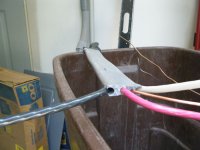
Turns out this stuff is almost impossible to work with. It's flat about 3/8" thick (all the conductors sitting side by side).
The extra that I cut off with a hack saw I am using to practice stripping without nicking the insulation. Three out of four tries I have nicked something. I will only have one shot at the real thing so I need to keep practicing.

I have seen tools for stripping UF cable, but those appear only to be for round UF cable not the my type.

Anybody have any secrets on stripping this beastly cable!!!!!!!!!!!!
 
/ Need electrical advice #2  
No, I don't know of any. And, people who work with UF cable all the time, seem to hate it just as much as you do.

I use a sharp razor knife, and good pair of glasses.

Next time run conduit, (I would not bury any wire without it, cheap insurance), and use thhn wire.
 
/ Need electrical advice
  • Thread Starter
#3  
Thanks Ray yup I ran it inside conduit!
 
/ Need electrical advice #4  
Anybody have any secrets on stripping this beastly cable!!!!!!!!!!!!
I slit the last 3-4" of insulation covering one of the wires so I can grab that single wire with my hand or a pliers. Then hold the cable with my other hand and tear the wire through the UF insulation. I've never done this with #6 wire, might require two people. With #12 it's pretty easy. Repeat for each of the individual wires.
 
/ Need electrical advice #5  
I hate UF. You just have to struggle with it and a sharp utility blade. I also recommend using a 2x4 or something as a work surface to cut against. Harder to do in free air.

If all you have is a minor nick, I would use shrink tubing or tape to cover it. I wouldn't scrap it for anything but major damage.

If you put UF in conduit, then you got bad advice. UF is meant for direct burial, which is why it is so flippin hard to work with. You should have run individual wires, as ray66 noted, but a slight correction - you need THWN wire (the W = wet location) for outside burial. Most wire you will commonly find is rated both THHN/THWN, so it is kind of moot.
 
/ Need electrical advice #6  
UF=underground feed.

I use a utility blade as well and a hefty pair of needle nose pliers to manhandle it. I don't use conduit either.
 
/ Need electrical advice #7  
I slit the last 3-4" of insulation covering one of the wires so I can grab that single wire with my hand or a pliers. Then hold the cable with my other hand and tear the wire through the UF insulation. I've never done this with #6 wire, might require two people. With #12 it's pretty easy. Repeat for each of the individual wires.

That's the best way to do it. Cut the outer sheath just enough to get a steady tear going and then grab the end of a wire and the end of the outer sheath and pull the wire apart from the outer sheath. Beats running the razor blade all the way down the cable while trying (always unsuccessfully) not to cut into the individual wire coatings.
 
/ Need electrical advice #8  
Not to stray off topic, but I never trust advise from a box store employee.

What is the amperage of service you are putting in, and is the wire copper or aluminum.

Back on topic of stripping. I always use a razor knife and caution. I am sure there is a tool made, but do you by chance have a hunting knife with a gut-hook?? or know someone that does?? Its worth a shot.
 
/ Need electrical advice
  • Thread Starter
#9  
Funny you should ask as somewhere around here I have a gut hook knife. It's pretty thick insulation so it might not work, but will see.

I did not think that I needed conduit save for the section where it exited the ground to enter the house, and a small section I had imbedded in the garage frost wall. So I placed it in the trench, and buried it.
Later I was advised that if it was under a walkway (eventhough I buried it deep) that it needed conduit. Begrudgingly I dug it up installed the rest of the conduit reran the cable then buried it once again.

Normally I over investigate something before I start. I guess I just felt comfortable around wire that I didn't :mad:


I appreciate all the replies. I've had my coffee and I'm headed out to practice battling the beast.
 
/ Need electrical advice
  • Thread Starter
#10  
I practiced a few times so I made my decision. Rather then cutting the insulation on the flat side I slowly and carefully sliced away insulation on the edge of the black conductor then pulled the conductor away from the the insulation. Going to the opposite side I freed the red, then the ground lead, and finally the white. Whew it came out unscathed.

Before I cut my wires and snug them down could I ask a little more?
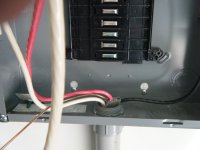
In the photo of the sub panel where I have entered the panel using plastic conduit should I be using a plastic grommet screwed onto the exposed threads as you would with metal conduit?
Lastly (I hope) should I install a ground rod outside of the garage with Number 6 wire?

The second photo is just to show what I have been working with for cable.

Won't be able to finish today as Grampa has got to get ready to go camping with the grandson and the Boy Scout troop, for the weekend, but I am a happy camper getting this far! :jump:

Sub-panel.jpgUF-B.jpg
 
/ Need electrical advice #11  
According to code, yes you should probably have the plastic cap ion them threads.

Now the next issue, and I am afraid the salesman may have given you bad advise..

but for a 100a service, the requirement is 4ga copper, not the 6 that you said he sold you.

I dont know why he wouldnt recommend the 2ga aluminum. WAY cheaper.
 
/ Need electrical advice #12  
For stripping as an electrician I use most a dull banana style knife laid flat on its side. We don't really have that style cable here but it does resemble festoon crane cable. Anyway with dull banana knife you can feel the different layers of insulation so you can glide against the inner jacket. I can pulling the knife towards myself.

By cec code you do need a grommet but by practice most inspection will let it go without because its PVC pipe.

The ground rod may or may not be required but running a # 6 awg bare cable does not need mechanical protection according to Cec. Keep in mind cec is Canadian but typically very close to your code.

For the size of cable your good to 60amps unless you distance is long, say over 100' from the main panel.
 
/ Need electrical advice #13  
For the size of cable your good to 60amps unless you distance is long, say over 100' from the main panel.

I mentioned this because it looks like the box in his pictures says 100a??

Which is fine, as long as you are only feeding it from a 60a breaker in the house, and drop a 60a main in that panel
 
/ Need electrical advice
  • Thread Starter
#14  
LD1 you have a keen eye! Yes I am going to run a 60 AMP breaker in the main panel to feed this one. As I recall this panel was chosen because it was the only panel around this size that came with a main breaker already installed. I thought having a breaker out in the garage a good idea. I am going to affix a label in the main panel to only use a 60 amp breaker.
 
/ Need electrical advice #15  
Ok yes you would need a bushing on the threads for 1-1/4 and larger conduits. The ampacity of the #6 UF cable you installed would be per the 60deg C rating of the wire which is 55A since this is not a standard size breaker or fuse rating you can go to the next larger standard size breaker or fuse so 60A would be max, although you could probably get buy with less. You do have to have a grounding electrode system for a remote building or structure so drive the ground rod and connect to it with a #6 wire. At the remote panel do not connect the grounded conductor (white neural) to the same bar as the bare grounding conductor, you need to install a separate ground bar to connect all of your ground wires to including the #6 from the rod. If you have water at this building you must bond the metal piping also. But I didn't tell you any of this!;)
 
/ Need electrical advice #16  
I practiced a few times so I made my decision. Rather then cutting the insulation on the flat side I slowly and carefully sliced away insulation on the edge of the black conductor then pulled the conductor away from the the insulation. Going to the opposite side I freed the red, then the ground lead, and finally the white. Whew it came out unscathed.

Before I cut my wires and snug them down could I ask a little more?
In the photo of the sub panel where I have entered the panel using plastic conduit should I be using a plastic grommet screwed onto the exposed threads as you would with metal conduit?
Lastly (I hope) should I install a ground rod outside of the garage with Number 6 wire?

The second photo is just to show what I have been working with for cable.

Won't be able to finish today as Grampa has got to get ready to go camping with the grandson and the Boy Scout troop, for the weekend, but I am a happy camper getting this far! :jump:

View attachment 323779View attachment 323780


Yes to the ground rod "required" and no to the plastic end bushing,, The NEC says #4 or larger only and you have#6...

PS.. good job stripping... :)
 
/ Need electrical advice #17  
Yes to the ground rod "required" and no to the plastic end bushing,, The NEC says #4 or larger only and you have#6...

PS.. good job stripping... :)

CeC is #8 awg or large needs bushing regardless of the conduit diameter. So I guess there is differences.
 
/ Need electrical advice #18  
UF cable is rated for direct burial but in my opinion conduit is cheap insurance. I have seen countless failures of direct buried utility service conductors with much thicker insulation than UF. It is about impossible to backfill with out rock impinging on the conductor jacket in this area. This can eventually cause failure.

They make a special tool to strip UF. I run a sharp knife down the sheath along the ground wire and then pull it apart. You can carefully do the same thing to the other conductors.

No matter what UF is a PITA to work with. Its is hard to bend and hard to pull in conduit. It tends fo kink when pushed or pulled. Universally hated.
 
/ Need electrical advice #19  
As long as the breaker in the house is 60 amps, you can leave the shop panel with the 100 amp main breaker and there will be no problem. The 100 amp panel is protected by a 60 amp breaker at the house. so all is well.

You DO have to drive 1 ground rod at the subpanel (shop) even though you have a hard wired ground wire run with feeders (NEC REGS).

As far as stripping UF cables. i do it all the time. As an electrician i cant seem to get away from the crap.

I have found a real easy way to do it. I use a sharp utility knife and insert it between the bare ground wire and the white wire. Then I PUSH it away from me while angling the blade into the bare copper side. i NEVER nick the hots or neutrals doing this. Then i do the same thing on the other side of the ground and the RED wire. After i have separated the ground wires, i make a slit at the end of the White wire side in the area left available after the ground wire was removed. Then i simply peal the White wire out of its sheath.

I do the same on the hot side. After the Red wire is removed, a small slit into the red leader will allow its removal from the outer sheath.The black follows the same way.

These slits are done towards the cut ends of the wires, and always on the inside layers (the inside are the layers that were next to the ground wires. The insulation is thinner there.


For me, ill always use XHHW alum conductors in conduit before i EVER use UF cable. I can always repull the feeders if ever necessary in conduit. UF requires a backhoe if repairs are ever necessary. Also, cost of xhhw AND conduit is cheaper than smaller sized UF . I can run a 100 amp alum feeder in conduit for less $$ than a 40 amp copper without conduit.

I have gotten so i can strip these in very little time, with no resulting damage to other wires.
 

Marketplace Items

TAYLOR POWER SYSTEMS SKIDDED GENERATOR (A60736)
TAYLOR POWER...
2009 Kubota RTV1140 (A57148)
2009 Kubota...
2020 Freightliner M2 106 AWD Altec DC47TR Digger Derrick Truck (A60460)
2020 Freightliner...
1997 STOUGHTON DRYVAN TRAILER (A60736)
1997 STOUGHTON...
2006 Heil Tanker Trailer Heavy Duty 65K GVWR Tank Trailer (A61307)
2006 Heil Tanker...
PALADIN INDUSTRIAL SCREENER (A60736)
PALADIN INDUSTRIAL...
 
Top