New Home Begins

/ New Home Begins #141  
Generally bearing loads on to footings from a traditional house are extremely light and actually don't require a spread footing in most cases depending on soil types. You are better off increasing the bearing loads onto soils that have expansive characteristics and often in those areas a footer is deliberately omitted from even large building designs.

Foundations are a mystery. I was thinking about the compacted crushed stone and the 45* load bearing spread. It seems like that remains true as long as the compacted stone doesn't "loosen-up" over time, and I have no idea if it would or wouldn't.

I also thought about the old hand-stacked natural rock foundations around here. They dug a cellar pit and stacked rocks around the edges, usually capping the stacked rocks where it comes above grade with 6'-8' long cut granite lintels. Some of that was probably for appearance but it would also cut down on the wind and mice coming through the foundation wall.

Some of those old homes are still straight and true, some have sills that have a lot of dips, and floors that go in all directions but level. I assume the major difference is the soils they are built on.
 
/ New Home Begins #142  
As an example...even most poor soils have an allowable bearing capacity of 4,000 psf and that includes a safety factor of 3 meaning the soil won't actually fail until 12,000 psf are placed on it. Most houses with a 16" spread foundation are probably placing less than 1,000 psf of load on the underlying soils. The 45 degree load spread isn't limited to crushed stone but is based on the friction angle of the soil. The soil a few feet under your foundation has no idea an increased load has been placed above it. All this information is primarily off the cuff and based on pre-consolidated soils in my area that were previously compressed by ice 2 miles thick (glaciers).
 
/ New Home Begins #143  
I did some half-hearted reading a while back on foundations under old stone buildings like churches, castles, etc. It is easy to find lots of pictures/drawings of the above ground structures, but not much on foundations.

I ran across some articles by a guy in the UK who is supposed to be a leading expert on restoring these old structures. I was surprised that his advice is to dig out the sod and start laying stones! Of course, ground freezing is probably not common in many parts of England, and those old structures are massive. He was really focused on using lime-based mortars that are plastic enough to not crack with shifting and settling.

In other articles, it sounds like the strategy, especially for castles on rocky hills, was to dig down to solid rock and build up from that. But overall, I didn't find as much detail info as I would have liked.
 
/ New Home Begins #144  
Garages around here are constructed on floating slabs all the time. The floor goes up and down with the freezing cycle and overall the structure doesn't suffer in any way. To prevent it from going up and down you need a foundation below the frost line.
 
/ New Home Begins #145  
dave1949 said:
Maybe you could put in the beginnings of a water garden now, and finish it later. If there is a an area between the house and the stream bed, a water garden somewhere in-between would allow you to move water from the house, through the water garden with an outflow to the stream.

At this point--and it will never be easier, and without spending much, getting the pipes from the french drain and gutters tied together and run to the water garden location might be enough to get the water away from the house for a couple years. I assume you have some natural fall in the grade toward the stream. A rented trenching machine should handle the pipe install.

Of course, it helps if you like water gardens :laughing:
I can't recommend draining the gutters and the basement french drains using the same pipe. You could use the same trench but run separate pipes. Keep the gutter drains completely isolated from the basement drains. Otherwise, think of what will happen of the common drain pipe clogs, The next rain storm you will send all the water from the roof into the basement and flood it. Use separate pipes for certain. Plastic pipe is cheap.

Also, I wouldn't use the cheap black corrugated flexible drain pipes. They are easy for the installers but they more easily cave in and fail than the solid pipes. It would seem to me that the corrugations would also be more likely to collect debris than the smooth solid pipes. Basement drainage is a something you don't want to shortcut. The subs and contractors will try to cut costs everywhere they can; you will have to manage them.

If you can run drain pipes to daylight 200 ft from the house, then I would do it. Somebody with a backhoe could dig that trench in no time assuming he doesn't have to deal with rock.

Obed
 
/ New Home Begins #146  
Could you describe the path a person will take to walk from a car parked in the garage to the kitchen?
 
/ New Home Begins
  • Thread Starter
#147  
Could you describe the path a person will take to walk from a car parked in the garage to the kitchen?

Sorry for the delay as I had a work (real work, not this play, fun stuff :) ) deadline that had me tied up for the weekend.

From the garage, there is a small stairway, approx 3', that leads to the laundry room/pantry. From there to the center great room and the kitchen is directly behind the laundry/pantry. Yes, you do have to go through the great room to get to the kitchen.
 
/ New Home Begins
  • Thread Starter
#148  
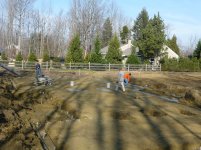
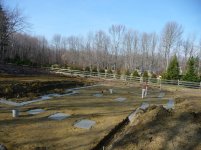
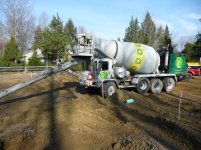
We now have footings!! Forty eight tons of 3/4" stone was brought in and the a good portion has been piled in the basement by the excavator today and will be spread around on Wednesday when the footings have cured sufficiently to drive the tractor over to spread it out. The garage portion of the house will in fact use the gravel foundation method as the architect was OK with that. That gravel will be delivered tomorrow and placed tomorrow or Wednesday.

Great weather for concrete. 60's today and no frost over the next few days.

Basement walls will be installed on Thursday.

P1020049.jpg P1020051.jpg P1020055.jpg P1020056.jpg P1020060.jpg
 
/ New Home Begins #151  
Oh yes, my fiance is already drooling over the prospects of a blank canvas for gardens, especially a pond

Well, there you go. It would be useful to draw out a side profile type of thing that lets you map out the amount of fall/slope you have to work with from the lowest foundation french drain level to the stream bed. Figure on about 3/8" fall per foot of run in your pipes. I think that is a reasonable fall rate, others can chime in.

In any case, that will show how deep your pipes would be at a given distance from the house, which should help find the pond location if you want to try for a daylight gravity drain into the pond. A gravity drain to daylight is worth quite a bit in the scheme of things.
 
/ New Home Begins #152  
tkappeler, Just wondering if you've talked to/heard from your next door neighbor? Hopefully you'll get the tree and fence line situation resolved amicably. Good luck! Stanley
 
/ New Home Begins
  • Thread Starter
#153  
tkappeler, Just wondering if you've talked to/heard from your next door neighbor? Hopefully you'll get the tree and fence line situation resolved amicably. Good luck! Stanley

I have not seen him lately but it is hunting season, so he is gone a lot as well as not one who ever volunteers to come over to the fence to chat when he is out. This is just who he is. I will talk to him and try to make sure all is ok and handled peacefully.

Thanks for asking.
 
/ New Home Begins #154  
A grade of 0.4% is minimum for pipe flow and 1% grade for open channel flow in a ditch is minimum. When grass, etc. is included in an open ditch, a 3% would be better if you have it.
 
/ New Home Begins #155  
I have not seen him lately but it is hunting season, so he is gone a lot as well as not one who ever volunteers to come over to the fence to chat when he is out.

That could work to your advantage in that he leaves you alone and isn't a pest once you move in.
 
/ New Home Begins #156  
Sorry for the delay as I had a work (real work, not this play, fun stuff :) ) deadline that had me tied up for the weekend.
From the garage, there is a small stairway, approx 3', that leads to the laundry room/pantry. From there to the center great room and the kitchen is directly behind the laundry/pantry. Yes, you do have to go through the great room to get to the kitchen.
Tom,
If the basement is only 2 feet in the ground, how do you get from the garage to the laundry room with only 3 feet of steps? I must be missing something.
Obed
 
Last edited:
/ New Home Begins #157  
A grade of 0.4% is minimum for pipe flow and 1% grade for open channel flow in a ditch is minimum. When grass, etc. is included in an open ditch, a 3% would be better if you have it.
1% equates to 1/8" drop per foot. I went with 1/4" (2%) drop per foot (2 1/2" drop in 10 feet) for my foundation and gutter drains.

Obed
 
/ New Home Begins #158  
Tom,
If the basement is only 2 feet in the ground, how do you get from the garage to the laundry room with only 3 feet of steps? I must be missing something.
Obed

He is building the ground up around the house.
 
/ New Home Begins #159  
He is building the ground up around the house.

I hope the OP compacts the crap out of the fill he uses for the garage floor, and does so in 6" - 12" lifts, or as directed by the civil/structural engineer. If he doesn't there is a good chance his garage slab will fail pretty quickly.
 
/ New Home Begins
  • Thread Starter
#160  
I hope the OP compacts the crap out of the fill he uses for the garage floor, and does so in 6" - 12" lifts, or as directed by the civil/structural engineer. If he doesn't there is a good chance his garage slab will fail pretty quickly.

Yes, the excavator brought in nice, clean, compactable fill, brought in a vibratory roller similar to this:

Cat Products CP54B - Google Chrome_2012-12-06_06-33-28.jpg

and rolled it a lot in 8" lifts. He only brought in enough for now to get about 1/2 way there. The goal was to get the footings in. He then dug out the trench for the gravel for the superior walls (poured concrete for the main house portion, stone for the garage). The bottom of stone elevation for the foundation is only 9" above current grade the garage floor is then about 3 foot above that.

The garage floor is a total of about 3 1/2' above the street elevation. This buildup will occur over a 137' length which is pretty gradual. The other benefit of this buildup is that the mound for the septic will be more "disguised" and not a big hump.
 

Marketplace Items

2019 F150 (A61306)
2019 F150 (A61306)
2005 WESTERN STAR DUMP TRUCK (A60430)
2005 WESTERN STAR...
Ryan Greensaire 24 Walk Behind Aerator (A59228)
Ryan Greensaire 24...
2012 POLARIS SPORTSMAN 500 H.O LIMITED EDITION ATV (A60432)
2012 POLARIS...
2022 CATERPILLAR D6XE LGP HIGH TRACK CRAWLER DOZER (A60429)
2022 CATERPILLAR...
500 BBL FRAC TANK (A58214)
500 BBL FRAC TANK...
 
Top