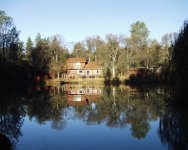
New Pond

   / New Pond #41  
Thanks, fishman, I'll print your message and give it to my brother and see if there's anything he hasn't already gotten from you or some of your co-workers.

Bird
 
   / New Pond #42  
<font color=blue>I heard people eat eels</font color=blue>

I'm one of 'em, Thomas! /w3tcompact/icons/smile.gif

Their meat is melt-in-your-mouth tender and has an excellent flavor. I developed the taste during my scuba-diving days, and now, just by chance, my biggest website client is a sushi producer. Whether it be sushi or a full dinner in a Japanese restaurant (unagi donburi), it is my very favorite choice.

I've seen people gag at the thought of eating snake, but personally I would like to give that a try, too.

HarvSig.gif
 
   / New Pond #43  
Harv,

From your comments I presume that your water clarity problems are not due to suspended silt, but rather to algal blooms. However, I will give you some ideas on both.

Most ponds that stay muddy all of the time have large populations of common carp, buffalo, or bullhead catfish stirring up the bottom, looking for food. The appropriate action here is renovation, either by draining the pond completely, or by eradicating the fish using a chemical called rotenone. Rotenone inhibits a fish's ability to absorb oxygen through the gills, causing death. It must be applied by a licensed applicator.

If these species aren't present, then the muddiness is due to soil type and runoff. Certain types of clay suspend in the water indefinitely. These ponds can be cleared using hay or agricultural gypsum. Break up two bales of good dry hay per surface acre and scatter on the pond every two weeks. for a maximum of 4 applications per year. Don't use more, or the decaying hay may rob the pond of oxygen and kill your fish. Agricultural gypsum should be applied at a rate of approximately 500 lbs per acre/foot of water to clear a muddy pond. To determine how many acre/feet you have in your pond, take the total acreage and multiply by the average depth. For example, if Harv's pond is 2 acres, and averages 7 feet deep, that would be 14 acre/feet (i.e. the water in his pond would cover 14 acres with one foot of water). The next year, considerably less gypsum will be needed, perhaps 10% of the original amount if all goes well.

Vegetation or algal blooms are a different matter. Algae is what gives the pond its green cast. In cases of excess nutrient input, filamentous algae can appear. Algae is not rooted to the bottom, nor does it have leaves, but other submerged plants are often referred to as "algae". The first thing to address is the source of nutrients, if algal growth is excessive. If there are livestock in your pond's watershed, a buffer strip between them and the pond will help tie up some of the nutrients. If no source can be identified, or the source can't be eliminated, you have to treat the pond. There are two possible methods, chemicals or dyes.

The best chemical to reduce algae is copper sulfate, sold at co-ops under the "Bluestone" trademark among others. Apply 2 lbs per surface acre (NOT per acre/foot; e.g. Harv would need 4 lbs). There are no usage restrictions (livestock watering, etc.), and the compound quickly becomes inert. This is the safest aquatic herbicide around, in my opinion. One caution, treat no more than half of the pond at any one time, because the decaying vegetation uses up oxygen. Finish the treatment in 1-2 weeks.

Many dyes are available to reduce sunlight penetration and eliminate algal growth. You can dye your pond whatever color you want. Aquashade is a common one, and can be found at the co-op. The downside to this is that more than one application is needed per year, and it is kind of expensive.

Algae is the first link on the food chain, so reducing or eliminating it will reduce the numbers and growth of any fish in the pond. For many people, that is an acceptable trade-off, because they can use the pond for other forms of recreation.

Hope this information helps. Probably more than you wanted to know.
 
   / New Pond #44  
Thomas,

Get Thou to a Sushi place and try the eel. Its cooked, actually most of the places put a "BBQ" sauce on the eel. Its one of my favorite fishies to eat! :cool: Very good. There is a box meal, I forgot the Japanese name for it, that is a bed of rice with two pieces of eel on top! YUM YUM! :cool: It really is a favorite. But sometimes the meat has very small bones. I once got a eel bone stuck at the top of my tonge. Drove me NUTS but I could not get it out. It did not hurt it just was not "right." The next mornng the bone was gone. Guess it dissolved.

I'm sure this is WAY more information that you EVER wanted to know about eels! :cool:

I'll eat 'em but I don't want to touch a live one! LOL!

Truly Hope This Helps....
Dan McCarty
 
   / New Pond #45  
<font color=blue> Probably more than you wanted to know</font color=blue>

Not at all, FishMan! /w3tcompact/icons/smile.gif

I'm stashing all this information away and will bring printouts with me on my next trip to the property. I'll start taking a hard look at the water, its inhabitants and vegetation. With all the information you have provided, I should be able to make at lease some improvements, no matter what the problems are.

If not, now I know where to get more information. /w3tcompact/icons/wink.gif

Thanks for the brain dump.

HarvSig.gif
 
   / New Pond #46  
Fishman leaves out what is to my mind the best method of controlling algae. Triploid grass carp. It may take somewhat longer but you (or the fish) won't be swimming in copper sulphate. Some states require a permit which is easily obtained. You must stock them large enough to survive the largemouth bass. I used twelve for a pond a little less than an acre and the results were astonishing.
 
   / New Pond #47  
Fishman leaves out what is to my mind the best method of controlling algae. Triploid grass carp. It may take somewhat longer but you (or the fish) won't be swimming in copper sulphate. Some states require a permit which is easily obtained. You must stock them large enough to survive the largemouth bass. I used twelve for a pond a little less than an acre and the results were astonishing.
 
   / New Pond #48  
I think it would be impossible in a normal life time to dig a 12' pond with a tractor and FEL. We recently had a 100'x 70' 15' deep pond put in. The contractor used a huge excavator and the largest JD bull dozer. You would not beleive the mountains of dirt that was hauled form the hole. He then used the dozer to push it back over a 5 acre field.
When the snow melts, I'm going to use my Kubota b7200 with a box blade to smooth the dirt around the pond then plant grasses. I'm thinking of putting in some clover for the deer and some native warm season grasess such as big Blue stem and switch grass.
Good luck on your project. Remember to get at least 3 or 4 estimates. We had prices range from $13,000 t0 $2500.

Van
 
   / New Pond #49  
Shelly,

I'm glad you had such positive results from grass carp in your pond. Biological controls are always preferable to chemical, at least in my estimation.

Actually, triploid grass carp are quite useful in ridding a pond of unwanted rooted aquatic plants. However, they are not effective at ridding a pond of algae. You know, the stuff that makes the water green. In fact, they often create algal blooms because they eat the rooted plants and then. . . well they do what comes natural, and in the process increase the available nutrients in the water. This works in concert with the carp to rid a pond of rooted vegetation. The carp eat the plants, and the increase in algal bloom limits light penetration to the submerged plants, limiting their growth.

Grass carp will snack on mats of filamentous algae, but it is one of their least preferred foods.

And you are right about the permit. Most states require a permit before you can purchase fish from a vendor.

18-33477-tibbsig2.JPG
 
   / New Pond #50  
Fishman, is there a web site, or set of information you are familiar with that will tell me the do's and don'ts of building a pond? I'm having the trees cut now so a 2 1/2 acre pond can be consructed this spring/summer. I have started the paperwork for permits i.e., Army Corps of Engineers; NC Division of Water Quality; Dam Safety; County grading permits, etc. The County has signed off. Waiting on the Army Corps of Engineers and others to give their o.k.

I have found some information, but most seem to say to hire an engineer to design the pond. While I may hire an engineer, I want to learn about this myself. I'll probably learn just enough to be dangerous, but would like to be able to talk to contractors and not sound like the complete idiot that I am.

I have asked several of the people I dealt with on the permits, but no one yet has come up with a good place to get information.

Thanks for any information you can supply.
 
   / New Pond #51  
I would hire for the rough cut. The amount of time to do on your own is OK but if you hit water early and keep getting stuck you will probably settle for a shallow pond that will only become a "frog pond". And, chances are that if you hit water early it will be in sand. Need the clay. Bluer the better. You won't be happy if you stock with fish and they freeze out or you loose them during a drought. I have a firend that put up a windmill and drive a well using a rope and pully at the top of the mill. He just lets the windmill keep the pond full..... Of course, if you hit an arteasan spring your problems are solved.... You could sell the water to the health nuts, buy a big cat and turn the whole property into a pond.
 
   / New Pond #53  
Bob,

A few thoughts on your pond questions, based on our experience with a new 3/4 ac., 12' deep pond which was put in two years ago to replace a smaller century-old livestock pond which was mucked in 'til it was only about 3' deep and had trees growing all over the dam. Having a bunch of water in the yard is a wonderful thing.

As far as engineers, etc. go, we had the good fortune to find a guy who had done about nothing but build ponds since he was 12 years old working for his uncle. Our county extension service representatives came out, met with him, looked at the test holes he dug with his 'hoe, and told me I didn't need any engineer because he knew what he was doing. He worked with no drawings and didn't even use a transit for the first 10 days. Where we are, no permits were required for pond construction; he just came out and got started.

What he did could no way be done with a compact tractor--or any other tractor--in a reasonable time. He used a trackhoe, a D9 dozer, and a sheepsfoot compactor. We are fortunate (as far as ponds go, anyway--not all good for gardens) to have dense clay soil, but he still went down to bedrock--through it by 10' for the dam--and then compacted a foot or two of clay at a time to build back up the sides of the pond. I gather you're thinking about a pond which is fed by the water table, which is a different animal from ours which is all rainwater. The place looked like a bomb went off for a few days, but the whole project, which included lowering the entire pond level by 10' and recontouring about 2 1/2 acres to provide optimal runoff, took 21 days.

I've read through these posts and everything Fishman said is consistent with what I've learned, including the part about grass carp (white Amur) NOT being a satisfactory antidote to algae; in fact, they don't seem to even touch it. They also will come out of the water onto shore--fact--to eat ornamental plants you've put near the water. I put in five 12" Amur based on what I think was a bogus recommendation and they are now more than double that size. They can grow to 60-80 lbs., and are about impossible to catch except bow hunting; not having a bow I'm currently trying to kill them with a .223 varmit gun. Copper sulfate works extremely well to control algae, but I use a pond-store product called Cutrine, another copper product which when diluted and sprayed on algae kills almost on contact without any adverse impact on the water quality, fish, etc. I guess it is "chemicals" in the sense that it is adding something to the water that isn't there, but it is not harmful to anything, so far as I know, but the algae. The only downside I've ever read or heard is that over many years the and/or the dead algae will build up on the bottom and adversely affect the dissolved oxygen levels in the pond.

We had a bad algae bloom last spring, I think in part because I made the mistake of fertilizing the grass in the watershed; of course a lot of that ran into the pond. We swim and boat in the pond and so algae control is pretty important to us. I do this with a bottom aerator which runs two hours morning and night, and with a waterfall. Last summer I added beneficial bacteria a few times, which you can read about Aquamats, which are an engineered fiber "reef." These things are expensive and I've put in half what they recommend but they do seem to be making a difference (and have a one-year money-back guarantee). I also don't hesitate to spray with Cutrine if there is a bloom I want to control in a hurry.

It all seems to be working. This spring we have enough algae on the margin to give the small fry a place to hide, but no nasty filamentous mat on the bottom (at least, not yet; it's still early) and nothing spreading out beyond the shore line.

Good luck!
 
   / New Pond #54  
Paulw and Rmorgan, thanks for the replies. Another question that has come up has to do with the dam overflow pipe.

The person who will be building my pond thinks there is some type of valve available that will go at the bottom of the overflow pipe that will enable you to drain the pond if it ever needs it. He remembers seeing one that had a lever running to the top of the overflow pipe that you could use to open the valve. He did not remember where he saw it, but suggested I research it. I have asked several people at places like Agri-Supply and no one has ever heard about a valve like this. Anyone know what type of valve this and what type of store might carry one?

Also, what type of pipe do most people use for the overflow pipe? Is it plastic (schedule 80 or metal)? I have had both recommended. Also, what size would you recommend, i.e., 4 or 6 inches, or larger?

Thanks.
 
   / New Pond #55  
Bob--

Never heard of the spill pipe drain valve thingamajig, and would think that if the pond builder doesn't know where to get it he doesn't think much of it. I know there is a way to put a valve through the dam at the bottom of the pond to facilitate fire protection if you are well away from hydrants, but that is unrelated to the spill pipe and relatively expensive. If we ever needed to drain the pond (perish the thought), I'd rent a Honda trash pump, fire it up, and either keep it running or let it siphon. Second, our overflow is a 6" PVC back about 10', then connected to flexible plastic drain pipe about 120' with a pretty good slope on it down through a hill; the outlet is probably 30' below grade. It does not go through the dam, but goes well off to the side so that there is no erosion on the side or bottom of the dam. The 6" is apparently well-suited to our 3/4-acre pond; the water has never crested the pipe, although it has gotten about 1/2 way up it and it took about a day to drain back down to the bottom of the pipe (i.e., the normal "full" level). The PVC is a little ugly, of course, but we're fixing that with plants.
 
   / New Pond #56  
Rick, the pond builder likes the valves, he just does not know where to get them any more. He used to know of a supply house that carried them, but they no longer do. No one there seems to know where they used to get the valves from.

In researching this some more, I see one mentioned on the Virginia Tech web site,
<A target="_blank" HREF=http://www.ext.vt.edu/pubs/fisheries/420-011/figure1.html>http://www.ext.vt.edu/pubs/fisheries/420-011/figure1.html</A> however, have not found any links to suppliers. I'm about ready to give up on this and just install a standard overflow pipe.

Thanks to everyone who tried to help.
 
   / New Pond #57  
Thought I would throw my 2 cents in here. If your builder (and he probably already has) has not told you, you need to put a collar on your over flow tubes. Go to a machine shop or make one yourself. They should be about 3'x3' and fit snugly on your drain tube. The hydraulic pressure from water in your pond will force the water along the pipe and will cause your dam to fail. The collar will prevent this from happening. Try to use the thickest gauge metal, galvanized, as you can get, to prevent the collar from rusting out. Sorry to have rambled, no expert, but mr. Murphy has trained me well.
 
   / New Pond #58  
Harv,

What a nice pond you have! Looks like you have your own State Park!

On this website:

<A target="_blank" HREF=http://www.aces.edu/dept/extcomm/publications/anr/ANR-0577/anr577main.html>http://www.aces.edu/dept/extcomm/publications/anr/ANR-0577/anr577main.html</A>

some information is given on "pairing" fish. They recommend catfish and minnows or bass and bluegill.

I found the site to be one of the better sources on pond and fish management.

Buck
 
   / New Pond #59  
and are about impossible to catch except bow hunting; not having a bow I'm currently trying to kill them with a .223 varmit gun

Rick,

This sounds like a great afternoon sport.. Just had a laugh or two reading your post and shooting , very good and too the point.

I grew up in central Pa and ponds were built with some Fed $ for for fire prevention on the farm. I won't be making a pond here - would like to, but the rocks and ledge and seasonal flow make it near impossible to hold water.

Carl
 
   / New Pond #60  
<font color=blue>What a nice pond you have!</font color=blue>

Thanks, Buck. Attached is my current favorite picture of the place. One of those early morning take-your-breath-away scenes.
wink.gif


And thanks for that link, too. I'm compiling a bunch of information about how to get the most out of my pond, and that one helps a lot.
smile.gif
 

Attachments

  • 33-137411-PondView.jpg
    33-137411-PondView.jpg
    83.8 KB · Views: 208

Tractor & Equipment Auctions

2015 TEXAS PRIDE TRAILER  30 FLATBED GOOSENECK TRAILER (A58214)
2015 TEXAS PRIDE...
2023 MADJAX GENESIS 300 ELECTRIC CART (A57192)
2023 MADJAX...
1999 WEST WIND 30FT PINDLE FLATBED DOVETAIL TRAILER (A58216)
1999 WEST WIND...
JLG 15 MVL MANLIFT (A58214)
JLG 15 MVL MANLIFT...
UNUSED FUTURE FT-RT57 - 57" HYD ROTARY TILLER (A52706)
UNUSED FUTURE...
FENCE PANELS (A58214)
 
Top