OP
You are using an out of date browser. It may not display this or other websites correctly.
You should upgrade or use an alternative browser.
You should upgrade or use an alternative browser.
Portable Log Mill
- Thread starter scottbrrtt72
- Start date
- Views: 7113
More options
Who Replied?
/ Portable Log Mill
#21

SPIKER
Elite Member
Scott:
I see what you did with the 2nd cable;
that makes the system WORSE as the flexable cable & pully on the bottom will let the HEAVY side drop
to correct the problem use a hunk of bar saw 2" x 1/4" and drill a bunch of holes in it, move the cable attachment point (single point) twards the motor. that is the heavy side. just tack weld the 1/4" bar in, and space the holes about 1" appart moving form center twards the motor. and use a clevis to attach the cable end from the lift to the 1/4" HOLES moving one hole at a time untill you can get it to lift easly. besure to clean off any burs that have been created by the 2.5" tube gouging into the 2" tube.
Mark M
I see what you did with the 2nd cable;
that makes the system WORSE as the flexable cable & pully on the bottom will let the HEAVY side drop
to correct the problem use a hunk of bar saw 2" x 1/4" and drill a bunch of holes in it, move the cable attachment point (single point) twards the motor. that is the heavy side. just tack weld the 1/4" bar in, and space the holes about 1" appart moving form center twards the motor. and use a clevis to attach the cable end from the lift to the 1/4" HOLES moving one hole at a time untill you can get it to lift easly. besure to clean off any burs that have been created by the 2.5" tube gouging into the 2" tube.
Mark M
mrcaptainbob
Platinum Member
Spiker.....draw a cable from the left side straight up to a pulley at the top. Then draw it fully across to a pulley at the right side and drop it straight down to where you have a winch. Now......take another cable from the right side straight up to a pulley there and then back down that same side to the winch. You'll have two cables to the winch, each of which will be pulling on it's end of the crossbeam. It won't matter if you have 90% weight all on one end with this set up. It will pull it up parallel! Good luck. And great job on that machine, too! What HP engine are you using?
OP
scottbrrtt72
Bronze Member
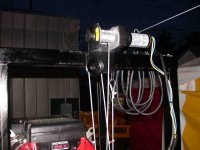
Is there any way you guys could attach a drawing of what your explaining. I think I know what you are saying but I want to make sure it is correct. Also, I have to add other steel (more weight) to this project, like the blade guards, gas tank, etc. This is additional weight which hopefully will not contribute to the binding. Here is a photo of the mill that I was trying to duplicate.
Attachments
OP
scottbrrtt72
Bronze Member
Oh yeah, the engine is a 18 horse power Honda. That should rip through the logs well.

Henro
Super Member
- Joined
- Jul 4, 2003
- Messages
- 5,008
- Location
- Few miles north of Pgh, PA
- Tractor
- Kubota B2910, BX2200, KX41-2V mini EX
<font color="blue"> Pulling from both ends seemed to work well initially. Once I put the motor on it became unbalanced again </font>
Scott,
I am not sure the root problem is unbalance...
Unbalance would act in the direction that you have tried to compensate for with those wheels you have mounted on the sliding part of the assembly.
But from what I think I see in your photos, there is an even greater opportunity for binding pressure to be felt by the sliding sides of the square tubing, on the platform side [at the bottom] and the other side, opposite the platform side [at the top].
So when you put extra weight on the platform you may be causing a bind, regardless of where you put it. If you want to prove this, put the engine in the middle for a test. If you still get the bind it is not from umballance, but rather from the cantilever effect of the weight of the platform and what is it is carrying.
If this is the case, then even pullng upwards with two cables, one at each vertical sliding point, still may not cure the problem. You need enough upward force to overcome the friction of the binding points, which would be as Wharv said, at the top outside, and bottom inside [platform side] of the sliding pieces that the platform is attached to. Your little winch may not have the force to overcome the friction, regardless of how you try to pull upwards.
As others have said, the best solution is to reduce the friction. Even if you don't want to use grease, you might try some just to prove the theory that friction is the problem and to help identify where you need to put compensating rollers or bearings of some type.
You might also try lifting the outside edge of the platform, while the winch is in bind mode, to see if a little lift will cause the platform to unbind. The idea being that a little lift on the outside, would cause pressure to be relieved from the friction point at the top, enabling the winch to do its job. I think, but I'm not certain, that there is a sort of multiplying effect, and that a little lift to unbind something goes a long way toward friction reduction at the bind point.
If all the above seems like nonsense, just forget about it, but do take another look at your assumption that it is the unballance along the platform lenght that is the problem. My gut says it isn't, but like everyone else, we are only looking at pictures... /forums/images/graemlins/smile.gif
Hope I'm not full of hot air here...I think I am seeing what the pictures are showing... /forums/images/graemlins/smile.gif
Scott,
I am not sure the root problem is unbalance...
Unbalance would act in the direction that you have tried to compensate for with those wheels you have mounted on the sliding part of the assembly.
But from what I think I see in your photos, there is an even greater opportunity for binding pressure to be felt by the sliding sides of the square tubing, on the platform side [at the bottom] and the other side, opposite the platform side [at the top].
So when you put extra weight on the platform you may be causing a bind, regardless of where you put it. If you want to prove this, put the engine in the middle for a test. If you still get the bind it is not from umballance, but rather from the cantilever effect of the weight of the platform and what is it is carrying.
If this is the case, then even pullng upwards with two cables, one at each vertical sliding point, still may not cure the problem. You need enough upward force to overcome the friction of the binding points, which would be as Wharv said, at the top outside, and bottom inside [platform side] of the sliding pieces that the platform is attached to. Your little winch may not have the force to overcome the friction, regardless of how you try to pull upwards.
As others have said, the best solution is to reduce the friction. Even if you don't want to use grease, you might try some just to prove the theory that friction is the problem and to help identify where you need to put compensating rollers or bearings of some type.
You might also try lifting the outside edge of the platform, while the winch is in bind mode, to see if a little lift will cause the platform to unbind. The idea being that a little lift on the outside, would cause pressure to be relieved from the friction point at the top, enabling the winch to do its job. I think, but I'm not certain, that there is a sort of multiplying effect, and that a little lift to unbind something goes a long way toward friction reduction at the bind point.
If all the above seems like nonsense, just forget about it, but do take another look at your assumption that it is the unballance along the platform lenght that is the problem. My gut says it isn't, but like everyone else, we are only looking at pictures... /forums/images/graemlins/smile.gif
Hope I'm not full of hot air here...I think I am seeing what the pictures are showing... /forums/images/graemlins/smile.gif
AndyMA
Elite Member
- Joined
- Oct 11, 2000
- Messages
- 3,714
- Location
- Windham County, Conn
- Tractor
- Ford 2120 , Kubota MX5200 , Deere X748SE. 1956 Economy Tractor
Scott
I'm almost afaraid to say this but I have serious questions that the cable lift will ever work to your satisfaction. Have you considered a pair of threaded rods on each side of the carriage which each rotate in a pair of bearing blocks. The portion of the cariage that you are moving has a nut on it and when you turn the rod, the carriage goes up or down depending on which way you rotate. This can apply a lot of very even force and is also very repeatable to set the cuts. Another benefit is that if you ever want to automate it is a simple matter of adding a motor.
If you would like further details I could send you some plans of a mill I have been working on.
Andy
I'm almost afaraid to say this but I have serious questions that the cable lift will ever work to your satisfaction. Have you considered a pair of threaded rods on each side of the carriage which each rotate in a pair of bearing blocks. The portion of the cariage that you are moving has a nut on it and when you turn the rod, the carriage goes up or down depending on which way you rotate. This can apply a lot of very even force and is also very repeatable to set the cuts. Another benefit is that if you ever want to automate it is a simple matter of adding a motor.
If you would like further details I could send you some plans of a mill I have been working on.
Andy
OP
scottbrrtt72
Bronze Member
Henro, your absolutely correct. When the binding occurs in that one corner I can add a little upward pressure (just lifting it up with my hand) and it goes right up. I am almost tempted to weld a handle in the back where the binding occurs. If that’s what it takes to move this, than so be it.
This weekend I will try to round the top of the 2 ½ in tube stock the best I can. This may help in reducing the friction and binding. The problem is I don't have much room to work with. The only way for me to get the sliding section off is to cut the 2" frame at the top.....which I really don't want to do.
I will try grease but I plan on painting this and don't want to do it until then. It would make for a real mess trying to get that off and could cause paint lifting and adhesion problems. At this point I am almost tempted to try it now. I do plan on getting this sandblasted before the painting phase.
Spiker mentioned a product called UHMW, which I don’t know much about. For what I have read it looks like it would be very slippery and could help with this problem. Is it something I put over the 2” frame?
There is a guy that makes these mills (turner mills) and uses a winch to lift the sliding section. He uses pulleys and it works great. His set up is a little different than mine.
Mrcaptianbob, if you could provide a drawing of what you recommend that would be great.
I have to wait till next weekend to try something new.
Thanks for all your support!!
This weekend I will try to round the top of the 2 ½ in tube stock the best I can. This may help in reducing the friction and binding. The problem is I don't have much room to work with. The only way for me to get the sliding section off is to cut the 2" frame at the top.....which I really don't want to do.
I will try grease but I plan on painting this and don't want to do it until then. It would make for a real mess trying to get that off and could cause paint lifting and adhesion problems. At this point I am almost tempted to try it now. I do plan on getting this sandblasted before the painting phase.
Spiker mentioned a product called UHMW, which I don’t know much about. For what I have read it looks like it would be very slippery and could help with this problem. Is it something I put over the 2” frame?
There is a guy that makes these mills (turner mills) and uses a winch to lift the sliding section. He uses pulleys and it works great. His set up is a little different than mine.
Mrcaptianbob, if you could provide a drawing of what you recommend that would be great.
I have to wait till next weekend to try something new.
Thanks for all your support!!
moeh1
Gold Member
Scott,
I second the threaded rod approach if you keep up the frustration level. Attached ( I hope) is one idea. Going back to statics/dynamics class, the top diagram shows the ideal state, and why your modified lift didn't help. You need the net resultant side forces zero'ed out and straight lift if you want all the bind out of the system. By introducing the second cable, you still can bias the lifting to one side. The lower portion is my poor job of one thing you may be able to prototype as an easy test, given the work you have in already. I also thought about MrCaptainBobs approach as well with 2 cables, but with the cable windup on the winch being variable, you can't insure equal travel. So here is one approach. Fix the cable at the top near your outer uprights. Bring them togther at the middle of the bottom with a short piece of chain. Attach your winch cable to the chain, and crank away. If you need to, move left or right a chain link at a time with the attachment point to account for the weight distribution. The only issue here is the amount of total lift you will get out of the system, unless you move the pulley down lower. If you try this, let me know how you make out. A better approach would be to add more pulleys to make the cable runs orthogonal - at 90degree angles only. This makes force reduction alot easier. If the prototype works, this will be better.
By the way,UHMW stands for Ultra High Molecular Weight, it is a high end plastic. You can find it in a lot of woodworking magazines among other places. They use it behind sanders - very slippery, very durable.
I second the threaded rod approach if you keep up the frustration level. Attached ( I hope) is one idea. Going back to statics/dynamics class, the top diagram shows the ideal state, and why your modified lift didn't help. You need the net resultant side forces zero'ed out and straight lift if you want all the bind out of the system. By introducing the second cable, you still can bias the lifting to one side. The lower portion is my poor job of one thing you may be able to prototype as an easy test, given the work you have in already. I also thought about MrCaptainBobs approach as well with 2 cables, but with the cable windup on the winch being variable, you can't insure equal travel. So here is one approach. Fix the cable at the top near your outer uprights. Bring them togther at the middle of the bottom with a short piece of chain. Attach your winch cable to the chain, and crank away. If you need to, move left or right a chain link at a time with the attachment point to account for the weight distribution. The only issue here is the amount of total lift you will get out of the system, unless you move the pulley down lower. If you try this, let me know how you make out. A better approach would be to add more pulleys to make the cable runs orthogonal - at 90degree angles only. This makes force reduction alot easier. If the prototype works, this will be better.
By the way,UHMW stands for Ultra High Molecular Weight, it is a high end plastic. You can find it in a lot of woodworking magazines among other places. They use it behind sanders - very slippery, very durable.
moeh1
Gold Member

ljh2
Gold Member
- Joined
- Jun 5, 2001
- Messages
- 282
- Location
- Western Maryland
- Tractor
- Kubota M6800, Ferris IS4500Z Cat Diesel mower
Scott,
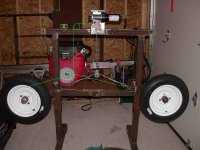
It looks like you are on the right track, but I think you have to get the lifting force centered above the 'center-of-mass', not necessarily centered between the two vertical posts.
I've drawn some suggestions on your photo. (see attached)
Hope this helps.
It looks like you are on the right track, but I think you have to get the lifting force centered above the 'center-of-mass', not necessarily centered between the two vertical posts.
I've drawn some suggestions on your photo. (see attached)
Hope this helps.
Attachments
Chadtoolio
Member
Scott,
UHMW can be had at Woodworkerssuply.com or woodcraft.com and can be milled into anything you want. 3/4" sheets are common. I have used it on my compost bin pivot, table saw mobile base. I have also used it on my router table fence. You can thread it, cut it and machine it very well. The threaded rod/motor will work well, but will be expensive. I like the idea of pulling up on both sides with the same force or lifting from both sides at one time. One side could never get further ahead than the other. At this point in the game, I know your frustrated, but the handle on the back to correct for a problem will not make you happy in the long run. You have come a long way. I was inspired when I read the post on your project many months ago and now it is my time to return the favor. Just take deep breaths, your almost there.
HTH,
Chad
Edit: After seing the post above mine, I thought I should clarify my opinion of lifting both sides at the same time. Imagine a rod mounted on pillow blocks on the top of your entire saw frame. cable reels on both ends(so that each side could have an independant cable). The cable reels would have their cables go straight down and attach to the sliding saw assembly. On one side of the rod would go your handle for the winch and the rod locking assembly(same priciple as the winches). When you turned the handle the rod would turn the cable reels the same amount and raise the sides the same amount.
The other way and perhaps more simple one would be to use your same winch(mounted in the center of the upper frame) like one of the first poster's suggested. Have two seperate cables come off it pivoting at the upper corners with pulleys and then going to the sliding saw assembly.
And third, same principle as #2 but put the winch at one side eliminating the need for one of the pulleys since it could drop straight down from the winch. The other cable would simply go through the pulley and the opposite side of the frame and drop down to the other side of the sliding saw assembly.
UHMW can be had at Woodworkerssuply.com or woodcraft.com and can be milled into anything you want. 3/4" sheets are common. I have used it on my compost bin pivot, table saw mobile base. I have also used it on my router table fence. You can thread it, cut it and machine it very well. The threaded rod/motor will work well, but will be expensive. I like the idea of pulling up on both sides with the same force or lifting from both sides at one time. One side could never get further ahead than the other. At this point in the game, I know your frustrated, but the handle on the back to correct for a problem will not make you happy in the long run. You have come a long way. I was inspired when I read the post on your project many months ago and now it is my time to return the favor. Just take deep breaths, your almost there.
HTH,
Chad
Edit: After seing the post above mine, I thought I should clarify my opinion of lifting both sides at the same time. Imagine a rod mounted on pillow blocks on the top of your entire saw frame. cable reels on both ends(so that each side could have an independant cable). The cable reels would have their cables go straight down and attach to the sliding saw assembly. On one side of the rod would go your handle for the winch and the rod locking assembly(same priciple as the winches). When you turned the handle the rod would turn the cable reels the same amount and raise the sides the same amount.
The other way and perhaps more simple one would be to use your same winch(mounted in the center of the upper frame) like one of the first poster's suggested. Have two seperate cables come off it pivoting at the upper corners with pulleys and then going to the sliding saw assembly.
And third, same principle as #2 but put the winch at one side eliminating the need for one of the pulleys since it could drop straight down from the winch. The other cable would simply go through the pulley and the opposite side of the frame and drop down to the other side of the sliding saw assembly.
SPIKER
Elite Member
sorry I didn't get back, been having some female problems. dam woman and girls fighting and I'm stuck in middle one went to jail and such...
anyhow UHMW is a plastic, it can be bought in small parts from mcmastercarr. or larger qties and special shapes form (cleveland plastics) where we get ours, not sure but look under industrial plastic in a google search on line and 1,000.00 will show up. anyhow time to get moving again.
Mark M
/forums/images/graemlins/frown.gif
anyhow UHMW is a plastic, it can be bought in small parts from mcmastercarr. or larger qties and special shapes form (cleveland plastics) where we get ours, not sure but look under industrial plastic in a google search on line and 1,000.00 will show up. anyhow time to get moving again.
Mark M
/forums/images/graemlins/frown.gif
Good to hear from you again Scotty! Looks like you are coming right along on the hard part. This beast looks great. I probably cannot offer any more advice to you Than the others already have. But don't give up, it's not supposed to be easy. Just fun. Call me.
treesmiths
New member
Hi,
I have a portable mill like you are building. My hand winch goes to a pulley attached to a 1" rod mounted on pillow blocks above the saw head on the main frame. 2 seperate cables drilled and attached on the rod drop down to the sliding posts and attach to threaded eye bolts (for adjustment). Gravity ensures an even, parallel cut with the saw bed every time. I would suggest mounting all of your hardware and weight to ensure a good balance point, not just for the side to side issue, but for a good front to back balance as well. A single cable could never insure an even cut as the carriage will rock slightly from side to side depending on the load, knots etc.. I have an 18 hp kohler on mine and it works well, but more hp might do an even better job on the big logs, up to 42" capacity on my Berg mill. You will need to be able to adjust the carriage end to end as well for blade alignment. If the carriage is off by just a fraction, the blade will dip and dig in or lift up and want to pull out. Good luck with your adventure. Keep us posted /forums/images/graemlins/smile.gif
I have a portable mill like you are building. My hand winch goes to a pulley attached to a 1" rod mounted on pillow blocks above the saw head on the main frame. 2 seperate cables drilled and attached on the rod drop down to the sliding posts and attach to threaded eye bolts (for adjustment). Gravity ensures an even, parallel cut with the saw bed every time. I would suggest mounting all of your hardware and weight to ensure a good balance point, not just for the side to side issue, but for a good front to back balance as well. A single cable could never insure an even cut as the carriage will rock slightly from side to side depending on the load, knots etc.. I have an 18 hp kohler on mine and it works well, but more hp might do an even better job on the big logs, up to 42" capacity on my Berg mill. You will need to be able to adjust the carriage end to end as well for blade alignment. If the carriage is off by just a fraction, the blade will dip and dig in or lift up and want to pull out. Good luck with your adventure. Keep us posted /forums/images/graemlins/smile.gif
OP
scottbrrtt72
Bronze Member
LStone, good to hear from you!!! It has been a while. Glad to see you on TBN.
Yes, the mill is coming along, slow but sure. This part of the project has been the most fustrating. However, with all this advice I think it can get it to work. I would like to thank everyone for there support and advice. Hopefully, I will get to work on it this weekend.
Yes, the mill is coming along, slow but sure. This part of the project has been the most fustrating. However, with all this advice I think it can get it to work. I would like to thank everyone for there support and advice. Hopefully, I will get to work on it this weekend.


