Problems mounting 2 bottom plow...

/ Problems mounting 2 bottom plow... #21  
The difficulty is more in learning how to set the plow. Some adjustments go counter to what one would think, and you can typially adjust the depth of either side of the plow; the tilt fore & aft; the center of pull compared to the tractor; the depth of the front of the plow, depth of the rear of the plow, depth and location of the coulters, and the depth of the whole plow. It's one of those things that is easier to do than to explain. You add in the unknowns of type of soil, wear on the plow lay (worn out ones can look fair yet, but will not penetrate clay or dry soil), soil type, and so on.

There are so many options available, it's easy to take a quick look & decide what will work, what adjustments to tweak. It's about impossible to tell someone blind from 1/2 across the country what settings to try first, without being able to see what's what.

Tillers for small acreage folk.

Chisel plows (ripper, multch tillage, disc chisels, aka many other things) for serious farm acreage.

--->Paul
 
/ Problems mounting 2 bottom plow...
  • Thread Starter
#22  
</font><font color="blue" class="small">( The difficulty is more in learning how to set the plow. Some adjustments go counter to what one would think, and you can typially adjust the depth of either side of the plow; the tilt fore & aft; the center of pull compared to the tractor; the depth of the front of the plow, depth of the rear of the plow, depth and location of the coulters, and the depth of the whole plow. It's one of those things that is easier to do than to explain. You add in the unknowns of type of soil, wear on the plow lay (worn out ones can look fair yet, but will not penetrate clay or dry soil), soil type, and so on.

There are so many options available, it's easy to take a quick look & decide what will work, what adjustments to tweak. It's about impossible to tell someone blind from 1/2 across the country what settings to try first, without being able to see what's what.

Tillers for small acreage folk.

Chisel plows (ripper, multch tillage, disc chisels, aka many other things) for serious farm acreage.

--->Paul )</font>

Wow... I had no idea what I was getting myself into. I remember a farmer friend of mine who plowed my field earlier (6 bottom rollover plow) said that once you had a tractor set up for plowing, you never took the plow off that tractor.... I should have remembered that.

So does everyone agree that I do in fact need to change the way the offest bar sits to the exact opposite way? That will allow it to work best when I have one tire in a trench?

Now, given that it's not a rollover plow, what is the best way to plow? should I go in a square or just plow one way, then drive back, then plow the same way again?

I tried a tiller on my land and it just doesn't work. Not quite deep enough. But tiller + plow is great. The plow cuts right below the 20 year old sod.

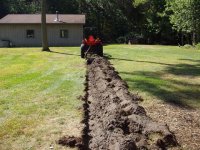
I did plow a little furrow to see how it works. The front plow did great but the back one didn't cut deep enough. I'll post a pic.

Also, would having TNT make this all easier? Sure seems like it to me.


I am not new to forums, but I'm new to this one. I'm amazed at the depth of wisdom here and the overall willingness to share it. I love this rural lifestyle, even though I'm only a year into it. Thanks for all your help. Be assured I'll be needing more.
 
/ Problems mounting 2 bottom plow...
  • Thread Starter
#23  
Okay, here's my first little run.

I think I may need those little circular blades that go before the plows to cut off the chunk of sod when I flowp it over.

I can see now how if my right tire was in a trench, I'd need the plow to be offset the other way in order for it to be even.

56273222.jpg
 
/ Problems mounting 2 bottom plow... #24  
Investorguy,

With the difficulty you had lining up the lower lift pins, you should consider Pat's EZ lift system or some other comparable brand.

I'm constantly fighting the level lift pin thing as I too drop my implements on uneven ground (have no choice). But once I got the EZ lift system, things went much easier. I set the width and lower the lift arms below the lowest pin, back up underneath and raise up until they "click in. Saved me a lot of pain and time. I was constantly kicking the lower lift arms, cussing and throwing a fit over something stupid like that.

I even went as far as to mount an eye bolt in the ROPS. I hooked a come-along to it to help move, lift and align my implements for hook up along with a crow bar. The cost sure beats the heck out of the frustration.

I don't have a plow yet, but I imagine the Top & Tilt complete system would also help you set your draft and side tilt WHILE you are plowing. Allowing you to make all the adjustments from the cab to get it to cut and dig properly. I found this out with my boxblade. I was pleasantly amazed to find how little adjustments while blading made it perform soooo much better for ripping, moving dirt and smoothing.
 
/ Problems mounting 2 bottom plow... #25  
This information on setting up a Dearborn plow is posted at our web site. some of this information I'm sure will apply to most plows. Maybe it will help plow setup
 
/ Problems mounting 2 bottom plow... #26  
Once it is set up correctly it should look like this.
 

Attachments

  • 828715-P1010009a (Small).JPG
    828715-P1010009a (Small).JPG
    90.3 KB · Views: 621
/ Problems mounting 2 bottom plow...
  • Thread Starter
#27  
</font><font color="blue" class="small">( Investorguy,

With the difficulty you had lining up the lower lift pins, you should consider Pat's EZ lift system or some other comparable brand.

I'm constantly fighting the level lift pin thing as I too drop my implements on uneven ground (have no choice). But once I got the EZ lift system, things went much easier. I set the width and lower the lift arms below the lowest pin, back up underneath and raise up until they "click in. Saved me a lot of pain and time. I was constantly kicking the lower lift arms, cussing and throwing a fit over something stupid like that.

I even went as far as to mount an eye bolt in the ROPS. I hooked a come-along to it to help move, lift and align my implements for hook up along with a crow bar. The cost sure beats the heck out of the frustration.

I don't have a plow yet, but I imagine the Top & Tilt complete system would also help you set your draft and side tilt WHILE you are plowing. Allowing you to make all the adjustments from the cab to get it to cut and dig properly. I found this out with my boxblade. I was pleasantly amazed to find how little adjustments while blading made it perform soooo much better for ripping, moving dirt and smoothing. )</font>

I ordered the EZ lift system 3 days ago. /forums/images/graemlins/grin.gif

TNT is next on my list. Might have to get that w/ my 50 hour tune.
 
/ Problems mounting 2 bottom plow... #28  
</font><font color="blue" class="small">( Okay, here's my first little run.

I think I may need those little circular blades that go before the plows to cut off the chunk of sod when I flowp it over.

I can see now how if my right tire was in a trench, I'd need the plow to be offset the other way in order for it to be even.

)</font>

The coulters (little round things - they should be big round things, 18 inches or so - if under 16" they are wore out, not worth the effort....) help 95% of the time, there are rare cases when you are better off without.

Yes, plow should have the bottom links tilted the other way once you are plowing. The plow should always be level when in the ground - whatever position the tractor is in.... You know you can use your tractor side link for fine adjustments, as well as for hooking up to the 3pt? That crank on there.

One year you plow down the left side of the field, back up the right side, throwing dirt to the outside. Do not plow when driving from one side to the other. As you kewep plowing down one side, up the other, you will meet in the middle. This will leave 2 slight ridges, one on each side of the field. And it will leave a bigger dip, or deadfurrow, in the middle of the field. Next year, you start going down the middle of the field, and return right next to that first path, throwing the dirt inward to the middle of the field. You continue going up & down, eventually getting to the outside edge of the field. This pattern will leave a hump in the middle of the field, and 2 shallow dead furrows one on each side. Notice that alternating these plowing patterns will fill in the dead furrows from the previous year, and keep your field level.

Oh, you plow the end rows (headlands) last, should only take 2-3 passes to get them plowed. As you pack the soil, they plow harder, but that is how it is.

An irregular field, or one you wish to actually move some ground, create a ridge on one side - then plow it how best you can. If a field is very big, you break it up into strips, alternate furrows and mounds.

It is not normal to till the ground before plowing, but on difficult soils one does what works, I won't say not to.

Your plow needs the top link longer, so the rear bottom ends up level with the front one.

Your plow doesn't quite look 'square', in that the rear wheel looks out to the right a bit. However, once in the dirt maybe that corrects itself. It is not a real big 'off', perhaps tilting the bottom arms the other way will take it up.

A hyd top link is fine, but if it drifts on you (the cylinder leaks down over time) then it would _not_ be something I'd want, it would require adjustment every time you start the tractor. This is something you set once, and never have to mess with again - sort of the opposite of what a hyd top link offers you....

All in all you look pretty close for a first effort, good job. Make the top link longer. If that does not help, let use see what condition your plow lays are in (the lowest part of the bottom, that cuts the ground) - if the front corner is rounded at all, can be worn out & difficult to get the plow to suck in properly. Dry ground would make that _very_ noticable.

Wow, green grass. It was -12 degrees last nite.....

--->Paul

 
/ Problems mounting 2 bottom plow... #29  
Your almost there.. now adjust the plows so that when you lower the plow tips to the ground.. both plow tips touch the ground at the same time.

After your first pass.. w/ your wheels sitting in the trench.. raise the right adj link. This is the reason the right side plow's attachment link is lower then the left side.

side -side: use right adj link.
front -back: extend/ contract upper link

Moldboard plowing requires a little speed to flip the dirt. When the soil's dryer.. it'll flip better.
 
/ Problems mounting 2 bottom plow... #30  
You will drive yourself nuts trying to plow with your plow. Someone has the cross drawbar turned 180 degrees out of position. Here is a picture of the cross drawbar on a JD plow that is correct. Rotate it until it looks like this--Ken Sweet

1jd.jpg
 
/ Problems mounting 2 bottom plow... #31  
Paul,

Man I sure learned a lot about plowing from your post and the others. Very informative. I was reluctant to get a plow because I didn't know the first thing about plowing. Of course, that applies to my whole tractor experience. But I'm please with the progress I've made using tips like yours and those from all the TBN threads. I think I'm getting the hang of it now. /forums/images/graemlins/laugh.gif

I did want to comment on this.
</font><font color="blue" class="small">( A hyd top link is fine, but if it drifts on you (the cylinder leaks down over time) then it would _not_ be something I'd want, it would require adjustment every time you start the tractor. This is something you set once, and never have to mess with again - sort of the opposite of what a hyd top link offers you....)</font>

Unfortunately I don't have the luxury of leaving the top link set for the plow. Don't have two tractors either. I'm constantly changing implements and each one requires a different set-up of the top link and the side links. For example, my backhoe requires "no" top link because it has a rigid top link brace that connects right to the tractor. Combine that with the fact I won't be plowing all the time and there you have it. That's why I suggested the hydraulic top and side links. Mine are adjustable while driving. The check valves should minimize "leak down" during operation.

This thread has shown what a plowed furrow should look like so by experimenting with different draft and tilt I can immediately see the result and match it up to what it should look like.

In my case and pehaps many other new tractor guys, I had no idea whether the implement I was using was giving me the correct results. Well, I kinda had an idea but didn't know exactly how to get it. TBN members have helped me realize this with instruction and pictures. The example I gave using my boxblade was just one. But I'll be honest, without being able to adjust it easily from the tractor while driving, I may never had gotton the top and side links set "just" right.

It was pretty frustrating to stop the tractor, adjust the turnbuckles to whatever I thought, (sometimes too much, sometimes not enough). So when I started again, I didn't know for sure if I could get it beter or not. Plus I don't have anyone there to teach me or tell me that the results were what they should be.

For myself (and perhaps others) I want to make my new tractor experience as rewarding as it can be. I don't do it out of "necessity" like some guys have to. I've been fortunate to utilize the "gadgets" available to CUT owners to make life easier in my retirement years. You know what I'm trying to say? I also realize they are not a "necessity" either. It's been done without them for many, many years.
Thanks,
 
/ Problems mounting 2 bottom plow... #32  
I understand what you are saying on the top link. Hyd is fine. In most cases, a hyd top link is much prefered!

I have 7 tractors, farm for a living, dad sat me on a tractor & I plowed when I was 8 years old. I have lots of seat time (my back knows it!) and a lot of toys, perhaps.

The top link being real solid is pretty important on a 3pt plow. I would not want one that moves during the day. That would mess up the plow settings. Just a 1/4 inch or so can make a big difference. I would be able to be much more accurate, plowing for 10-12 hours a day as I, or my wife, does, with a non-hydraulic top link. Set it, forget it, & go work.

Where I come from.

I understand where you are coming from, and the hyd top link will be fine I'm sure. It will get some stress when you hook a rock, but I'm sure they are built for it.....

--->Paul
 
/ Problems mounting 2 bottom plow... #33  
I've used a hydraulic top link for a couple seasons now. Last spring, I plowed a couple old hayfields with a 3-bottom mounted plow, never once moving the top-link after finding that "sweet spot" where it was in proper adjustment. The top link is equipped with pilot operated check valve. That keeps it where you put it. The hydraulic top link works like a charm. Bigger mounted plows (3 bottom and bigger) are sensative to top-link adjustment. A turn or two can get the back bottom in too deep or out of the ground while the front bottom is exactly where it needs to be. The hydraulic top link lets you get that spot on while never leaving the seat.

Like so many things, a hydraulic top link is a great item to have IF it's done right. Without the pilot operated check valve, it would tend to drift. With it? Not a hint of unwanted movement.
 
/ Problems mounting 2 bottom plow...
  • Thread Starter
#34  
</font><font color="blue" class="small">( I've used a hydraulic top link for a couple seasons now. Last spring, I plowed a couple old hayfields with a 3-bottom mounted plow, never once moving the top-link after finding that "sweet spot" where it was in proper adjustment. The top link is equipped with pilot operated check valve. That keeps it where you put it. The hydraulic top link works like a charm. Bigger mounted plows (3 bottom and bigger) are sensative to top-link adjustment. A turn or two can get the back bottom in too deep or out of the ground while the front bottom is exactly where it needs to be. The hydraulic top link lets you get that spot on while never leaving the seat.

Like so many things, a hydraulic top link is a great item to have IF it's done right. Without the pilot operated check valve, it would tend to drift. With it? Not a hint of unwanted movement. )</font>

Is this check valve something that comes standard w/ all hydraulic toplinks or do you have to specifically ask for it? What exactly is it?
 
/ Problems mounting 2 bottom plow... #35  
Investorguy,

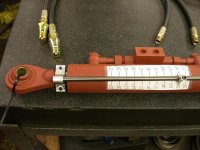
Off the shelf hydraulic cylinders generally do not come with check valves. You'd have to buy and install them. I bought mine from CCM and his comes with the check valves. That's the ONLY way to get one. (with the check valves, that is)
Here's a picture of mine. I made that level gauge for it.
 

Attachments

  • 829803-LEVEL GAUGE MOUNTED TO CYL.JPG
    829803-LEVEL GAUGE MOUNTED TO CYL.JPG
    89.8 KB · Views: 269
/ Problems mounting 2 bottom plow... #36  
Again, you HAVE to roll your drawbar over. You will go insane trying to make that run like it is. You will likely go insane trying to make it run right once its right, but at least you have a chance. /forums/images/graemlins/grin.gif You've got to get it mounted correctly BEFORE you try to make it pull.

My pics are MIA on this PC.

PB Blaster and heat on that bolt. You will not need to turn it all of the way out and there is probably a jam nut on it to move also. The bolt only goes into a hole in the drawbar about 1/2 inch ish. You need to back it out until you can turn the drawbar. There are probably 2 bolts at about 90 degrees offset, you might only need to turn one out. Once those are free, you can slide the plow along the drawbar left and right a little to take up the extra space in the furrow that your turfs or R4's use instead of the Ags like that was last used behind.
If you need to take it to a weld shop, do it. It shouldnt cost more than a few bucks to burn that paint off and put the heat to her.

Once you have the drawbar set right, mount the plow, put a 6 inch chunk of firewood in front of the right rear tire on a level surface, drive up on it. Set the plow down and adjust it till both bottoms are flat on the ground and more or less strait. That will get you real CLOSE, then you can make a pass, and adjust, make a pass and adjust. Once you get to the last furrow you will have it pretty close right before you take it off. /forums/images/graemlins/grin.gif

I just unretired a Ford 2 bottom last year. Grease, penetrating oil, wire brush and paint are your friends.
I painted my plows after I was done with them because it is stored outside, a few furrows this spring will help them shine and they really do pull nicer when they are shiney. Once a barn/shed is built I plan on just greasing them.
 
/ Problems mounting 2 bottom plow... #37  
</font><font color="blue" class="small">( get new plows from any of the "major manufacturers" anymore )</font>

Farmers in the know won't buy/use them after ag research found out how hard they are on the soil. Moldboards are bought and used mostly for nostalgic reasons nowdays.
 
/ Problems mounting 2 bottom plow...
  • Thread Starter
#38  
</font><font color="blue" class="small">( </font><font color="blueclass=small">( get new plows from any of the "major manufacturers" anymore )</font>

Farmers in the know won't buy/use them after ag research found out how hard they are on the soil. Moldboards are bought and used mostly for nostalgic reasons nowdays. )</font>
How are they hard on soil? I mean it's dirt... can you be "hard" on it?
 
/ Problems mounting 2 bottom plow... #39  
[quoteHow are they hard on soil? I mean it's dirt... can you be "hard" on it? )</font>

Notill has many advantages. It requires big, heavy, expensive planters that till up a 3 inch strip in front of the planting.

However, one trip and you are done. With plowing, you need to plow, field cultivate, & plant - at the least 3 trips. The plow & field cultivator wear out tilling all the ground, the notill planter only needs to till 10% of the ground.

Best to plow ground in fall, let the ground mellow over winter. This does expose it to erosion - water or wind. Even after you plant, it takes 3 weeks before the crop is holding the ground down, so spring plowing still leaves the ground open for erosion for some time.

In many areas the ground is pretty dry. Notill, with the cover trash, will not dry out as fast, conserving moisture for the crop.

All this is possible with herbicides. In perhaps 1/2 the USA, notill with spraying is much better for the enviornment, & ground, than plowing & tillage is.

Now, I live in south central Minnesota, and notill doesn't work worth a darn here. Heavy heavy yellow clay soil 120 feet deep, very cold winters, very little sunlight (short days) in spring, very much moisture from cold snow melt & typical spring rains. The ground stays _very_ wet & _very_ cold and we have a short growing season.

If I did notill, it would be June before I could plant corn some years.....

We try to get closer, and do a lot more multch tillage & such. But, plowing those cornstalks under in fall gives us a lot drier, warmer, & mellower soil to plant into in early spring.

I doubt there is 3% notill done in my county. I know in some better climates, in any direction from me, over 1/2 the ground is in notill.

I would love to save the fuel cost in my farming, but just too risky. Might not get a crop.

--->Paul
 
/ Problems mounting 2 bottom plow... #40  
The soil is hurt by wind and water erosion that causes the good topsoil to be blown or washed away thus lowering the fertility of the soil. This lowers crop yields and productivity of the acreage available for raising crops. Moldboard plows leave the soil unprotected from erosion. The old seed planters would only work in finely tilled and leveled soil. The soil needed to be plowed first to bury the previous crop residue and loosen the soil so that it could then be "fit" with discs, drags, cultipackers, etc. until the lumps were gone and the soil leveled. Nowadays, the soil is usually chisel plowed in the fall which leaves a lot of trash on the surface to prevent erosion. In the spring it is disced once before being planted with a very heavy planter that also additionaly tills the soil directly over the rows to be planted. This is a more efficient process that lessens wind and water erosion and saves fuel with fewer trips across the fields. It's all about keeping the cost of production to a minimum. This is accomplished by using large equipment and utilizing it for maximum efficiency by covering a lot of acres.


Marketplace Items

2007 Caterpillar C5000 5,000lb LP Forklift (A61567)
2007 Caterpillar...
2024 John Deere Gator TX4x2 (A62177)
2024 John Deere...
20ft Shipping Container (A61166)
20ft Shipping...
2021 CATERPILLAR 289D3 SKID STEER (A62129)
2021 CATERPILLAR...
New/Unused SD Lanch SDLD25 Mini Crawler Dump (A61166)
New/Unused SD...
2017 Ford F-250 Knapheide Service Truck (A60352)
2017 Ford F-250...
 
Top