
You are using an out of date browser. It may not display this or other websites correctly.
You should upgrade or use an alternative browser.
You should upgrade or use an alternative browser.
PTO generator
- Thread starter Tcfake613
- Start date
- Views: 95837
More options
Who Replied?
/ PTO generator
#241
SPYDERLK
Super Star Member
- Joined
- Feb 28, 2006
- Messages
- 12,635
- Location
- VA
- Tractor
- JD2010, Kubota3450,2550, Mahindra 7520 w FEL w Skid Steer QC w/Tilt Tatch, & BH, BX1500
I agree with Rob that you will need an expert to blame if it doesnt work. The trouble is that unless you have a real expert they arent going to want to do a minimalist system - they will want to go ample. With bigger performance margin they are more sure you wont have any complaint. Essentially you will be pushing anyone you hire toward a close accomodation of only the loads you have. You may have to study up in order to be able interact with them, or to make your own choices appropriately.I am assuming the elevator has an unloader valve to operate at start-up. The circ pump runs constantly, the only other surge would be the boiler burner draft fan, minimal in my guess. While I personally do not have the equipment to measure surge current, I am going by what demand(surge) I am billed for, so far a max of 21kW. Whille the measured demand has been as low as 14kW, I am also assuming the elevator start up would draw less than 14kW. So, I am hoping that a 22-25kW generator will suffice. Your expert advice is greatly appreciated. Thank you...
... It is good that the elevator motor does not [probably] start under load. This will enable it to start on suppressed voltage if it comes to that. But since you cant measure surge you need a sure definition of that "demand/surge" number you are billed for. Namely, is it an instantaneous maximum or a maximum that is sustained for longer than some minimal time. If the latter then you are probably not seeing the relatively quick [to very quick] surges such as those caused by motors starting or a bank of incandescent lights going on. I doubt that it does, but IF that number truly captures the quick surges then you are good to go with a 21KW gen.
...Please check what demand really means. Ask more than one person and resolve any conflicting answers.
larry
Rules of Thumb:
Most generators are capable of delivering 300% of the rated current for 10 seconds
This is way too broad of a statement to support. It is dependent on the type of engine in use, the power generation method (direct-coupled alternator versus inverter), and about 87 other factors. For example, some generators are "prime-power rated" -- which is the continuous (24/7/365) power output that will result in reaching a specified lifespan (e.g. 10K hours before rebuild). Above the prime power rating, there is typically about 20% headroom on top of that specified for non-continuous power (say, an hour or so). And, of course there is also some peak/overload capability power which is generally more a result of the alternator rotor and engine flywheel inertia than anything else. An inverter type generator, for example, lacks this sort of mechanical inertia and therefore generally is a bad choice for motor starting applications unless special methods are employed.
That said, typical motor start inrush does not last 10 seconds; ~1 second is more like it. That's 60 rotations of a 2 pole alternator driven by a 3600RPM engine, or 30 rotations of a 4 pole alternator head driven by a 1800RPM engine.
Wrooster
... some generators are "prime-power rated" -- which is the continuous (24/7/365) power output that will result in reaching a specified lifespan (e.g. 10K hours before rebuild). Wrooster
Thanks Wrooster, this begins to answer another question I had regarding cost of maintaining a prime power continous output unit. Is 10k hours an industry standard for operating interval between rebuilds? Can anyone estimate the costs of a rebuild on say a 100kW natural gas genset? What's involved besides a basic long block rebuild on the engine, say for the generator half? What I am trying to figure is the cost of running my own little neighborhood for an extended period of time. Natural gas recently hit an all time low($1.89/mmbtu 4/12), and I expect it to stay relatively cheap (with some fluctuation) over the next 25 years, with the advent of shale gas fracking. We may even see NG become an automotive fuel shortly. My recent cost of NG with delivery was $3.90/mmbtu. That gets my fuel cost down below $0.04/kWhour. Granted, these are not PTO questions, but I feel lucky to have contacted some smart guys. Thanks.
I agree with Rob that you will need an expert to blame if it doesnt work... I doubt that it does, but IF that number truly captures the quick surges then you are good to go with a 21KW gen. Please check what demand really means. Ask more than one person and resolve any conflicting answers.larry
I'm not looking for someone to blame. My only dissapointment would be wasting fuel. From specs I have read, generators are nearly 50% less fuel effiicient at half load. Maybe there is some sort of capacitor available to compensate for starting surge. If my average load is 8kW on a 21kW unit, isn't that 38% of max load, not the most fuel efficient. I will check with the power company regarding definition of "demand" with respect to length of time. Thanks for your input.
SPYDERLK
Super Star Member
- Joined
- Feb 28, 2006
- Messages
- 12,635
- Location
- VA
- Tractor
- JD2010, Kubota3450,2550, Mahindra 7520 w FEL w Skid Steer QC w/Tilt Tatch, & BH, BX1500
Yes, but with ALL that said, I have never seen or heard of a gen that will support 3x its rating for an instant, much less 10 sec. It has nothing to do with the engine driving it. Its that the gen saturates magnetically pretty near 1x. Above this point V output drops instantly. You get no more regardless how hard you drive it. Im sure there are deluxe gens that go higher than ~1.1x, but costly and far short of 2x.This is way too broad of a statement to support. It is dependent on the type of engine in use, the power generation method (direct-coupled alternator versus inverter), and about 87 other factors. For example, some generators are "prime-power rated" -- which is the continuous (24/7/365) power output that will result in reaching a specified lifespan (e.g. 10K hours before rebuild). Above the prime power rating, there is typically about 20% headroom on top of that specified for non-continuous power (say, an hour or so). And, of course there is also some peak/overload capability power which is generally more a result of the alternator rotor and engine flywheel inertia than anything else. An inverter type generator, for example, lacks this sort of mechanical inertia and therefore generally is a bad choice for motor starting applications unless special methods are employed.
That said, typical motor start inrush does not last 10 seconds; ~1 second is more like it. That's 60 rotations of a 2 pole alternator driven by a 3600RPM engine, or 30 rotations of a 4 pole alternator head driven by a 1800RPM engine.
Wrooster
larry

daybreak1998
Silver Member
Howdy,Yes, but with ALL that said, I have never seen or heard of a gen that will support 3x its rating for an instant, much less 10 sec. It has nothing to do with the engine driving it. Its that the gen saturates magnetically pretty near 1x. Above this point V output drops instantly. You get no more regardless how hard you drive it. Im sure there are deluxe gens that go higher than ~1.1x, but costly and far short of 2x.
larry
Alot really depends on how the genset itself is built. (inside components) My Tiger Power 30KW pto generator has a 90,000 watt surge capacity.
SPYDERLK
Super Star Member
- Joined
- Feb 28, 2006
- Messages
- 12,635
- Location
- VA
- Tractor
- JD2010, Kubota3450,2550, Mahindra 7520 w FEL w Skid Steer QC w/Tilt Tatch, & BH, BX1500
Howdy,
Alot really depends on how the genset itself is built. (inside components) My Tiger Power 30KW pto generator has a 90,000 watt surge capacity.
 They make an impressive claim. Do the specs provide any specifics? How long will it hold 240V at 375A?
avc8130
Platinum Member
Are there any concerns with wet-stacking?
If the tractor is singing along at ~2550 rpm to maintain 540rpm at the PTO to maintain 60hz...this would be a BAD situation on a standalone diesel genset unless the generator is loaded at least 40% of capacity.
Is this "problem" non-existent on the tractor?
ac
Bueller?

This is way too broad of a statement to support. It is dependent on the type of engine in use, the power generation method (direct-coupled alternator versus inverter), and about 87 other factors. For example, some generators are "prime-power rated" -- which is the continuous (24/7/365) power output that will result in reaching a specified lifespan (e.g. 10K hours before rebuild). Above the prime power rating, there is typically about 20% headroom on top of that specified for non-continuous power (say, an hour or so). And, of course there is also some peak/overload capability power which is generally more a result of the alternator rotor and engine flywheel inertia than anything else. An inverter type generator, for example, lacks this sort of mechanical inertia and therefore generally is a bad choice for motor starting applications unless special methods are employed.
That said, typical motor start inrush does not last 10 seconds; ~1 second is more like it. That's 60 rotations of a 2 pole alternator driven by a 3600RPM engine, or 30 rotations of a 4 pole alternator head driven by a 1800RPM engine.
Wrooster
Wasn't my determination, that came from here:
Generator Sizing for a Motor Load - Electric motors, generators & controls engineering FAQ - Eng-Tips
Fred,
I won't give you that answer and here's why:
First, you should pay an engineer to do a work sheet for you. ... You want someone to be responsible for their calculations and I would say PM me and I'll give you an invoice..."<end quote>
OK, thanks Rob. My reason for asking was to get some free advice, without any professional liability. Most engineers overdesign at the expense of their clients to cover their own Errors and Omissions. I'm a risk taker, and I accept that. The generator salesman wants to sell me a unit three times bigger than I need. The fuel salesman the same. I'm a survivor, just trying to get by. When the goin gets tough, every ounce of fuel really counts. That's why I originally posted your quote. We live in a wasteful society and we don't even know it, until we run out what we need. Just like our country has run out of affordable health care, because doctors order a lot of unnecessary proceedures to cover their own liability, and guess who pays. So, back to the drawing board I go...(BTW, what would you charge me to design the smallest, minimalist, survivalist back-up system that only gets used a few days a year, with a discount for waived professional liability?)
Fred, thank you for asking but I'm semi-retired now, most of my work is in electronic engineering using embedded microcontrollers and several audio designs I promised an editor. Perhaps one of the people here who found my solution overly simplified might be inclined to address your issue but, again, a 25hp hydraulic elevator mandates a bonded legal responsibility in my view.
Attachments
Last edited:
Thanks for the advice. I checked with the power company and "demand" does not measure peak surge, only the average of maximum usage in five minute increments. They recommended I measure with a pulse monitor; so I am still learning.
joshuabardwell
Elite Member
Thanks for the advice. I checked with the power company and "demand" does not measure peak surge, only the average of maximum usage in five minute increments. They recommended I measure with a pulse monitor; so I am still learning.
For less than $100 (on Amazon.com--more at your local big-box) you can get an "amp clamp" will answer this question definitively. Be sure to get one with an "inrush current" measuring feature that will detect and hold the peak draw from the motor.
aczlan
Good Morning
- Joined
- Mar 7, 2008
- Messages
- 17,540
- Tractor
- Kubota L3830GST, B7500HST, BX2660. Formerly: Case 480F LL, David Brown 880UE
For less than $10 at Harbor Freight you can get one that does the same: Digital Clamp-On Multimeter (note that you can only go over one leg of the wire going to the pump. If you go over both legs it doesn't read anything).For less than $100 (on Amazon.com--more at your local big-box) you can get an "amp clamp" will answer this question definitively. Be sure to get one with an "inrush current" measuring feature that will detect and hold the peak draw from the motor.
Aaron Z

PineRidge
Super Member
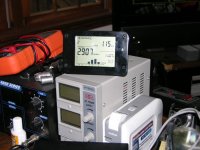
This digital monitor comes with 4 wrap around clamps 2 large and 2 small. I clamped one around each of the incoming load legs from the meter. The probes then plug into the back of a small transmitter that will send the signal a couple of hundred feet to the receiver. It gives a read out in real time and stores a 2 year log I believe. The whole shebang is battery powered.
aczlan
Good Morning
- Joined
- Mar 7, 2008
- Messages
- 17,540
- Tractor
- Kubota L3830GST, B7500HST, BX2660. Formerly: Case 480F LL, David Brown 880UE
Hmm, does it read amps per leg, or just combined amps?This digital monitor comes with 4 wrap around clamps 2 large and 2 small. I clamped one around each of the incoming load legs from the meter. The probes then plug into the back of a small transmitter that will send the signal a couple of hundred feet to the receiver. It gives a read out in real time and stores a 2 year log I believe. The whole shebang is battery powered.
Does it read voltage and/or Hz?
Thanks
Aaron Z
The inrush capability is based on three things:
1. As stated, the inertia of the motor-generator. This provides the energy to feed the inrush. You have the engine torque plus the j*omega^2 for the speed drop as the additional energy to provide the power for the inrush.
2. The "amount of copper" in the generator. Going light (or cheap) on the generator usually means wire in the windings just big enough for the load. At higher (in rush) loads, the additional current will result in a greater I^R voltage drop, and thus the voltage drop under that additional load will be higher. So bigger wire in the windings means less voltage drop, but higher cost.
3. The "iron" in the generator. This refers to the amount of steel in the laminations in the generator. More "iron" means that you can support a stronger magnetic field and therefore deliver more current. Again, cheaper generators tend to have just enough iron to meet the output requirement. This makes it lighter and lower cost. You see this with generators that have very little difference between the full load and surge capacities. The smaller the difference, the less iron in the design. For the technical types, as the current increases, so does the strength of the magnetic field in the gen. At some point the iron can not be magnetized further and the magnetic flux in the iron saturates, which means you can not increase it any further. This occurs around 20,000 Gauss in "magnetic" grade steels. The saturation value will define the limit of current that can be delivered. This is a law of physics, and when you hit that limit, that's it !
I always tell people to oversize generator heads, so a 12 KW head on a 10 KW rated genset will buy you much more surge capacity. On a residential generator, but the highest surge to running ratio that you can find. If will cost you more, but it likely has reserve in the copper wire size and additional iron in the laminations to provide more reserve capacity.
paul
1. As stated, the inertia of the motor-generator. This provides the energy to feed the inrush. You have the engine torque plus the j*omega^2 for the speed drop as the additional energy to provide the power for the inrush.
2. The "amount of copper" in the generator. Going light (or cheap) on the generator usually means wire in the windings just big enough for the load. At higher (in rush) loads, the additional current will result in a greater I^R voltage drop, and thus the voltage drop under that additional load will be higher. So bigger wire in the windings means less voltage drop, but higher cost.
3. The "iron" in the generator. This refers to the amount of steel in the laminations in the generator. More "iron" means that you can support a stronger magnetic field and therefore deliver more current. Again, cheaper generators tend to have just enough iron to meet the output requirement. This makes it lighter and lower cost. You see this with generators that have very little difference between the full load and surge capacities. The smaller the difference, the less iron in the design. For the technical types, as the current increases, so does the strength of the magnetic field in the gen. At some point the iron can not be magnetized further and the magnetic flux in the iron saturates, which means you can not increase it any further. This occurs around 20,000 Gauss in "magnetic" grade steels. The saturation value will define the limit of current that can be delivered. This is a law of physics, and when you hit that limit, that's it !
I always tell people to oversize generator heads, so a 12 KW head on a 10 KW rated genset will buy you much more surge capacity. On a residential generator, but the highest surge to running ratio that you can find. If will cost you more, but it likely has reserve in the copper wire size and additional iron in the laminations to provide more reserve capacity.
paul
For less than $10 at Harbor Freight you can get one that does the same: Digital Clamp-On Multimeter (note that you can only go over one leg of the wire going to the pump. If you go over both legs it doesn't read anything).
Aaron Z
That's a hard price to beat for a clamp on meter, even if you get just to kick around!
aczlan
Good Morning
- Joined
- Mar 7, 2008
- Messages
- 17,540
- Tractor
- Kubota L3830GST, B7500HST, BX2660. Formerly: Case 480F LL, David Brown 880UE
That was my thought in buying it... I have a nicer Ideal meter (which has a temp probe), but I cant even get a add-on amp-clamp for that price...That's a hard price to beat for a clamp on meter, even if you get just to kick around!
Aaron Z
PineRidge
Super Member
Hmm, does it read amps per leg, or just combined amps?
Does it read voltage and/or Hz?
Thanks
Aaron Z
I don't know of any clamp on devices that measure voltage and/or Hz
It measures combined kw usage cost per second, hour, day, week, or month – iConserve conveniently converts energy use to cost per second, hour, day, week, or month. It is easy to adjust iConserve's settings to get the most accurate reading for your time period.
Continuous Recording – iConserve conveniently logs activity.
Graphical Data – iConserve conveniently graphs your electricity use over time.
Alarm Warning – iConserve instantly issues a warning when a high amount of electricity has been consumed.
Backlit Display – Backlit display for quick and bright illumination during night time use.
CO2 Readings – Easily monitor CO2 (carbon dioxide) readings with iConserve.

