Retaining Walls

   / Retaining Walls #1  

netherla

New member
Joined
Sep 8, 2000
Messages
3
Location
Michigan
Tractor
Kubota 1750HSD (4WD), loader, mower
Our new house (in Michigan) is under construction, and the site plan calls for two retaining walls. We were planning on having a landscaping company build the walls out of bolders. However, the price for both walls installed is $20K. I am wondering if my Kubota B1750 with front end loader would be able to lift those large rocks. The top of the wall may be as high as 7' in places, and the total amount of bolders is about 100 tons. Anybody have experience doing this?
 
   / Retaining Walls #2  
Hello, I am from Michigan also. St. Charles area. Here is a picture of my retaining wall. It is about 6' at its tallest. I have used about 13 ton so far at a cost of about $1000. I am using an L3010 tractor with absolutely no troubles. You may have to just lift fewer boulders at a time. I am filling the bucket with no hesitations whatsoever.

Regards,

Dennis
 

Attachments

  • 33-51078-project2.jpg
    33-51078-project2.jpg
    25.6 KB · Views: 325
   / Retaining Walls #3  
One other word of caution. I had an cement drive slab that tapered to 1 corner. Tried to build this wall there and it completely washed out all the boulders in the corner. So I ended up pouring a cement "trough" (I guess for lack of a better word) and that seems to have solved my erosion problem on the corner. The rest of the wall has held up very well for a year now.

Just something for you to consider.

Dennis
 
   / Retaining Walls #4  
I had a b1750 also and found it was unable to lift even moderately large boulders. In fact, it struggled with loads of rock maple. The weakness of the FEL was the primary reason I traded up to an L3010 (which I absolutely love!). I guess the best advice I could offer would be to find a few boulders of the size you intend to use and give it a try. Also, you didn't mention the tire type you're running. Turfs aren't made for that sort of work, but you can get away with fairly heavy loads by running at the upper end of the inflation specs.

$20k is a lot of money. Could you rent a bigger tractor for a week?

Pete

www.GatewayToVermont.com
 
   / Retaining Walls #5  
James, If you take on the project, make sure you have a good counter weight hanging off the back. Big rock lifted 7' needs some weight in back to keep you on the ground. Let us know how it goes.

MarkV
 
   / Retaining Walls #6  
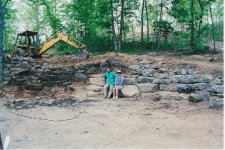
Do the retaining walls need to lay on the dirt say at a 45 degree angle, or do you need something more vertical? Do you insist on larger rocks, or can you use smaller, more "MAN"agable rocks? Here's a picture of my wall under construction. All lifted by hand. The finished wall will be about 130-150 feet long, 3 tiers high in places. The section you are seeing is about 20' long and is 5-6 feet high.

There are 2 keys. 1. Good footing below the frost line. 2. Wall must be THICKER at the TOP.

To accomplish #2, Build the wall a couple of feet high at a time (you can't cement much higher than that in a day anyway), place a wooden form behind and pour in a Stealth Fiber reinforced cement.

Hope this helps.
 

Attachments

  • 33-51124-house85.JPG
    33-51124-house85.JPG
    169.9 KB · Views: 295
   / Retaining Walls #8  
It really depends on how vertical a wall you are building. If you are trying to retain an existing grade with rip/rap or boulders, you should be able to size your boulders to the lifting capacity of your FEL and drop them in place. This kind of retaining wall is really just doing erosion control.

If you are going to back fill behind a nearly vertical wall you might just want to size your boulders to what you can lever and pivot them by hand. In this case you are building a structure.

I've built 1 1/2 dry laid retaining walls by our new bank barn. They are both structures. The first one was hand laid above ground. The foundation boulders were laid by the excavator. It's about 8 1/2 feet at the highest. The 1/2 wall is (still) under construction. I dug out and placed the foundation stones with my JD870. Many of the larger boulders were lifted to wall height with the FEL, but I positioned them by hand. I can lift and place stones up to nearly 200 lbs by hand, but I can position stones up to 500 lbs with pry bars and by pivoting.

I have some 800-1000 lb boulders to go into the rest of the retaining wall. I will be placing them with the FEL bucket using chains and positioning them at the bottom of the wall with the backhoe. This takes a careful hand and a lot of patience. As I progress upwards I will use the FEL for lifting and hand tools for positioning.

If you're building a dry structural retaining wall, you might want to consider what happens if the structure fails while you're working on it. That's the time that it is the least stable. It's pretty dangerous work and part of the $20,000 they are charging is for their experience in doing it right.

Matthew
 
   / Retaining Walls #9  
Matthew,

It's also going to depend on the soil. One thing Michigan has is a lot of beach sand. I tried dry laying my retaining wall. Got it up about 6' high and it looked real nice. Then one day I was out in back picking rocks and the plumber showed up. "That's too bad about your wall", he said.

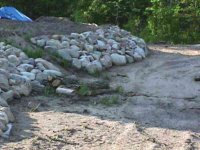
Needless to say, the sand backfill had dried out and while I was back picking rocks, it had spilled (flowed like water actually), starting at the top and working about 1/3rd of the way down the wall, taking all that work with it. Good thing I wasn't standing in front of it at the time. /w3tcompact/icons/crazy.gif That's when I decided cement might be a good idea. I don't have enough of the great big rocks to do any good and the few I have I want to use for anchoring at corners. I do have about half a million the size of basketballs. So, I have a cemented, "random rubble pattern" wall. It's really not too hard to do, kinda fun, and you don't need a gym. I keep tellin folks to quit paying those high priced gym fees and just come to my Health Spa (we don't use the term forced labor camp anymore/w3tcompact/icons/laugh.gif). Shoot, for 1/2 of what they're paying for gym fees, they can come see me and I'll let them stack and haul rocks and swing the shovel. Both strength and aerobic training at a discount price. /w3tcompact/icons/laugh.gif /w3tcompact/icons/laugh.gif
 
   / Retaining Walls #10  
Soil does make a great deal of difference, as you say. The area around my barn is pretty loose gravel, so I have my retaining walls raking back. While the rake is uneven it averages 5 degrees or so.

Another very important issue is grade. If you're building a dry laid retaining wall the top of the wall must be the highest part of the grade or the wall must be very thick. Allowing water to run over the top of the wall is a sure fire way to have it fail. Last weekend we got 2.75 inches of rain in an hour. It wiped out 6 feet of my "under construction" wall because the grade allowed the water to run down the wall (my 6 inch high dike was overcome).

One nice thing about dry laid walls, though, is that they inherently drain. That can be a real problem with solid walls.

Matthew
 
   / Retaining Walls #11  
We are just today putting finishing touches (plants/flowers etc) in this wall. Though I used the backhoe seen in the background, I collected some of the rocks with a rented L-35. It seemed to handle the rocks perfectly fine. I have no experience with a B series. I would suggest investigating renting a machine, or (like me) just buy something to use for a while and then sell it. (wanna buy Brutus???) /w3tcompact/icons/laugh.gif

Richard
 

Attachments

  • 33-51733-Rockwall1.jpg
    33-51733-Rockwall1.jpg
    155 KB · Views: 202
   / Retaining Walls #12  
James,
Just to throw out another option, we are see a lot of block retaining walls faced with cultured stone in our area. I have used the cultured stone to face a foundation wall and found it pretty easy to work with and it has a good look. Ours has been up about 2 years and is weathering well. If I remember right, the material we used had a 20 year warrenty.

MarkV
 
   / Retaining Walls #13  
Matthew,

You nailed the grade/thickness issue right on the head. I think that rule applies whether you are dry laying or cementing. Think about highway overpasses. When they pour those cement retaining walls, they always slope. That avoids the surface shifting phenomena, because as we've both found out, (in my case the hard way /w3tcompact/icons/crazy.gif), the dirt is going to shift at the top first.

I'm surprised you had a problem with all the gravel. Seems like you would have good drainage. I'm very concerned about the drainage problem as the main floor of the house is earth contact. In fact, the only reason I'm building the wall is to save the $1,500.00 worth of back fill that was washing out in heavy rains. My plan right now is to run 1 or 2 rows of sock tube around the top of the wall buried in washed stone and sitting in a lopsided valley of heavy mill ag plastic. The top of the bank will be sloped from the house to the wall with approximately a 5" drop in 14'. The basic backfil is sand. Over that, I'm placing about 1-2" of black clay. The idea is: anything that hits the clay will run into the sock tube and be routed safely away. Anything that gets through the clay will soak away into the sand.

Moisture here is a double problem as it contributes to frost heaving in the winter.

I don't know if this sock tube idea will work, but I guess I'll know if my crawl space floods out. /w3tcompact/icons/laugh.gif

Something like that might be worth a try on your wall. Have you had any problems with critters in your wall? I had a heck of a time with mice wanting to nest in the rock piles (right up until the cement went on). Even had a blow snake take up residence (got rid of the mice /w3tcompact/icons/laugh.gif /w3tcompact/icons/laugh.gif).

SHF

PS:Got any pictures of your wall?
 
   / Retaining Walls #14  
Yeah, one of the supply places here offers the block retaining wall stuff (Allen block? or something like that). Comes in "brick face", or "stone face" in at least 2 colors, and also comes with 6 degree backslope or 12 degree backslope, as well as different brick heights (4" and 8" I believe).

Not great for a "natural" looking wall (except the "stone face" looks pretty nice). However, if you need to go above 4', this stuff can be engineered with a "geo-grid" to go way above that (at least 12'-15').

Biggest issue is dealing with water retention, and making sure that it doesn't tilt out. Big ol' bummer if that happens.

The GlueGuy
 
   / Retaining Walls #15  
I have cut a swale from the barn out beyond the end of the retaining wall (over 30 feet) and there is a ramp from the lawn down to the bottom of the swale. I was draining about 10,000 sq feet into the swale. 10,000 times 2.75 is a whole lot of water to drain in 1 1/2 hours. It went over my dike and the rest is rubble at the bottom of the wall/w3tcompact/icons/frown.gif

Your top drain sounds like it will work, but you live where it freezes, so bottom drains are also very important. There is nothing that will break a concrete wall faster than having the soil behind it get waterlogged and then frozen.

The critters I have are chipmunks and rabbits. The rabbits are so tame that my wife made me promise not to step on them. They do run from the tractor, though/w3tcompact/icons/smile.gif

I have some pictures of the barn that show the first retaining wall. I'll see if I can figure out how to post them.

Matthew
 

Attachments

  • 33-51872-Save0010.jpg
    33-51872-Save0010.jpg
    71.1 KB · Views: 205
   / Retaining Walls #16  
I've seen walls over 30 feet high done with this kind of material. It's holding up a chain bookstore in Shrewsbury Massachusetts. It isn't pretty, but if properly installed it is effective.

Matthew
 
   / Retaining Walls #17  
I actually saw a version of this where they used the "rock" faced version, and mixed the gray and brown versions of the stuff (~~ 10% gray, ~~ 90% brown). It looked pretty nice.

Here's a link to the different product versions they have.

<font color=blue>PS - Previous message about faces should have read "stone" and "rock". The stone face is flat, the rock face is sculpted.</font color=blue>

The GlueGuy
 
   / Retaining Walls #18  
Matthew,

Mighty fine looking barn! You've got a pretty steep grade there that you're trying to hold back. I'll bet the water was flying down it in that storm. Did it effect your drive at all? (Wash out, etc?) You also have much bigger rocks than I have. It looks like they're flat. Did you cut them like that, or do you have a natural outcropping? Ours here are pretty much round, oblong, etc. (Big glacier from Canada comes down a few thousand years ago, dumps a lot of sand and round rocks. Later, along comes a bunch of people to set up shop on the sand and say "Hey! We got a state, and we're gonna call it Michigan." /w3tcompact/icons/laugh.gif Just don't tell the Canadians. They might want their sand back. /w3tcompact/icons/laugh.gif /w3tcompact/icons/laugh.gif.)

SHF
 
   / Retaining Walls #19  
GlueGuy,
I was not very clear when I was talking about cultured stone as a face on a block wall. What I was thinking of is a conventional block wall that a stone face is applied to like tile would be. This is a tinted, light weight contrete product that is cast from molds to look like stone. Often walls are finished with a true stone as a cap. Check out WWW.CULTUREDSTONE.COM to get past my weak writing skills./w3tcompact/icons/smile.gif

When I was first told of this product (there are a number of differnt manufactures) my mind thought of the cheap wood paneling people call wood walls. After looking at the finished product on several job sites my mind changed. This stuff looks very realistic and comes in many differnt styles of stone.

I used about 600 sf of this stone on our house in the mountains to face poured foundation walls, entry columns and as a back drop wall behind a wood stove. The cost was in the $3.50 a square foot range.

Getting back to retaining walls. The advantage,as I see it, is that a coventional block wall (or poured wall) with footing, rebar and the cells filled can be very strong and vertical. In most areas this is standard construction work, making it more cost effective than specialized work like stone construction.

All that said, I still think a true stone wall is as pretty as they come. I bring all this up only to offer another option that offers good results.

MarkV
 
   / Retaining Walls #20  
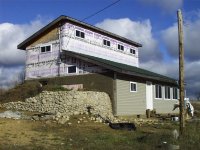
That barn took four years to design and build, but telling that story requires beer/w3tcompact/icons/smile.gif You're looking at the south side of the barn. It's 9 1/2 feet from the basement floor to the aisleway floor above. The finish grade will slope more away from the barn than toward the retaining wall so the finished wall height is a maximum of 8 1/2 feet.

The retaining wall in the picture has stood for two winters now without moving. I figure that I'm probably done with that one. The wall on the other end of the barn is now under construction (again). It's full height by about 7 feet. I've got another 16 feet to go.

I had just cut most of the swale on the north side of the barn the day before the deluge, so the damage to the drive was less than it could have been. The water went over the wall on the far side of the barn, instead/w3tcompact/icons/mad.gif There's an erosion channel about 8 inches wide and 6 inches deep running down the drive. Thank goodness my box scraper has finally arrived/w3tcompact/icons/smile.gif

The rocks you can see in the photo are from a highway construction site. They were freshly blasted when I (ahem) "acquired" them/w3tcompact/icons/wink.gif The excavation for the barn turned up three boulders too big for me to move (I didn't have a tractor then). The excavator placed them as the foundation for that wall when he came back for the rough grading. There were also a half dozen or so that I was able to place, then I had to get the rest from off-site.

It turned out that the entire barn site was an area filled with very high quality gravel, probably around 1918, when the house was built. The gravel that came out of the foundation hole was far better quality than the gravel I purchased to make that drive. The drive continues down to the pasture which is about five feet lower than the basement floor. There is a damned lot of fill in it and it's still pretty steep.

The boulders I'm using on the other side of the barn are _much_ bigger. The largest is a rough sphere, 3+ feet in diameter. I was able to pick that one up with the backhoe, but I had to put 600 lbs of rocks in the loader to put the front wheels back on the ground/w3tcompact/icons/shocked.gif

I found most of the boulders when cutting the swale. I used the backhoe to do the rough cutting. I pulled four loader buckets full of boulders and rocks without moving the backhoe in a place about 20 feet from the barn foundation.

I've also found a 66 inch section of finished granite curbstone and a granite quarry billet 81 inches long and seventeen inches wide, the depth varies from six to twelve inches. I found the latter one when digging out a 30 year old pine stump. I'll be using these in front of each of the two aisleway doors as steps.

When I'm done, I'll have a 12-24 inch deep swale from the Southeast corner of the barn to the the Northwest corner. The bottom of the swale is 30-32 feet away from the foundation. The East side will be covered with loam and seeded to lawn. The North side will be covered with five inches of stone dust and be a paddock for the horses.

The swale will carry all of the water from the barn roof, paddock and lawn (including the existing 7000 sq feet of lawn) to drainage pipes on the wooded slope from the barn level down to the pasture and woods on the lower level. After I've refilled the drive and given it a crown, the erosion problems should be minimized.

Matthew (who can be pretty long winded when he gets going)
 

Tractor & Equipment Auctions

Kubota M6 131 HP
Kubota M6 131 HP
HITACHI EX550LC EXCAVATOR (A58214)
HITACHI EX550LC...
22FT Roadway Dry Van Pup Trailer (A56438)
22FT Roadway Dry...
2013 FORD F-350 FLATBED (A58214)
2013 FORD F-350...
2014 KOMATSU HM400-3 OFF ROAD DUMP TRUCK (A60429)
2014 KOMATSU...
2022 KOMATSU D71PXI-24 CRAWLER DOZER (A60429)
2022 KOMATSU...
 
Top