ROPS modification

   / ROPS modification #1  

electrycmonk

Silver Member
Joined
Nov 6, 2018
Messages
210
Location
Near Denton, TX
Tractor
Satoh 370(still in storage mode); Cub Cadet 7260 (overheated & awaitint time for repairs); 7360SS Cub Cadet, 7300 Cub Cadet; L2250 Kubota that needs a shifter forlk replaced
Having read threads /seen/downloaded pics of several ideas here and other forums over the decades....

I have one to share here.

I’m Up-cycling (pun enforced) to provide better visibility regardless what’s I’m doing in OR off the lil’ tractor.

found the local cycle shop (Sprockets) and asked what they did with the frames you couldn’t repair. They said recycle them. I asked if they had 2 currently or in the coming days they would be scraping reusable a off and be willing to let me do a little Mcgyvering? The Mgr smiled and said, “I’m listening....”
“I would like to have the seat post section of two bikes of similar size to cut off and use while the rest of the metal will get dropped off at Tubb’s. I’ll also need to buy a pair of those cool spinner clamps for quick adjustment from your used stash as well as two seat posts of equal length.

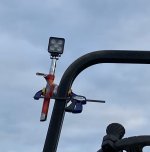
I want to weld them to the roll bar on my tractor so that the aux/flood LEDs I got can be tilted & rotated (180+ to possible 360*). Those LEDs will get welded to the seat posts. This is why I need to have them as close as possible to the same length & diameter so, if need be I can swap.

he said gimme a week & call me.

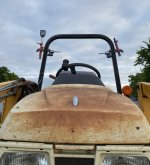
I did. He was great. Just charged me for the clamps. So, I’ve already chopped them down. Roughly ground them smooth. Here they are mocked up with squeeze clamps on the ROPS.
53FBCDA0-7969-44FD-9CDE-E2986F6F5873.jpeg
8544A828-375D-4FB6-89EB-FD5011133653.jpeg
The light is just balanced on top of the seat post for this picture.

it will likely be a week of so before I’ll be able to schedule time to fine tune and tac them in place. Depending on these last weeks of school - it might get done over Memorial weekend?
 
   / ROPS modification #2  
I'm all for ROPs and the safety they provide when it's ever needed. However, cutting into them or welding to them could compromise their strength. There is much hardware out there to just clamp things in place on the ROPs with u/-bolts and plates. The plates are the items used to mount things.

IF you ever resell the machine and the ROPs were found defective, it's an open issue of legal matters your not going to be happy with. Keep them "as-is" and just get mounts or make the bolt+plate mounts yourself.
 
   / ROPS modification #3  
Magnetic light bases:
 

Attachments

  • 470B0BFC-FA8A-43A6-AAEC-EA8BB6ECE9A8.jpeg
    470B0BFC-FA8A-43A6-AAEC-EA8BB6ECE9A8.jpeg
    865.5 KB · Views: 259
   / ROPS modification #4  
Magnetic light bases:

I like the concept, but over time magnets and moisture will develop rust. I have a pair of magnetic trailer lights from Harbor-Freight. They work great, but over time, the paint underneath discolored fast from black to a milky white-gray with tiny surface bubbles. In short time, like this year, it would show a round rust spot at the magnetic field of attachment. Plus, to keep those lights up, stronger magnets are needed due to the tractor bouncing around and the high mount location.

Wish the drawbacks were not so severe with magnets. It's a clever use, but causes troubles later.
 
   / ROPS modification #5  
I didn't know about the magnets. I got some square (kind of) U bolts (Lowe's I think) and some angle aluminum to attach to them. I drilled the aluminum for the U bolts and added a hole in each piece for my light bar. It may rust or fade or whatever over time (didn't think of that) but it's a secure mount which doesn't affect the integrity of the ROPS. To prevent (or discourage) damage to the paint I slipped drip line main tubing over the legs of the U bolts and split some neoprene fuel line for the flat top part of the U bolt.
 
   / ROPS modification
  • Thread Starter
#6  
This “warning” fascinates me from a purely physics stand point. I think I need to go chat with my long time mentor on this project and what y’all have raised....

I’m not thinking any disrespect here at all. I’m in full education mode currently.

To add context to where I thought this was a reasonable idea from a material & structural stand point is a few projects over the last 20 odd years that I have either witnessed or been party to: Modifying frame rails for making trailers, 5’ver/GN hitch, dump beds, snow plows, lift gates, & frame stretching or “bobbing” for a wrecker bed installs.
 
   / ROPS modification #7  
This “warning” fascinates me from a purely physics stand point. I think I need to go chat with my long time mentor on this project and what y’all have raised....

I’m not thinking any disrespect here at all. I’m in full education mode currently.

To add context to where I thought this was a reasonable idea from a material & structural stand point is a few projects over the last 20 odd years that I have either witnessed or been party to: Modifying frame rails for making trailers, 5’ver/GN hitch, dump beds, snow plows, lift gates, & frame stretching or “bobbing” for a wrecker bed installs.

About 10 years back, lots of vehicles had door side business info on them. From typical contractors, delivery or real-estate. Well, once those magnets came off, discoloring and grime were imbedded into the paint. In a little time, dimples of rust marks appeared. Needless to say, I don't see these large door side magnet mats used anymore.
 
   / ROPS modification #9  
I like the concept, but over time magnets and moisture will develop rust. I have a pair of magnetic trailer lights from Harbor-Freight. They work great, but over time, the paint underneath discolored fast from black to a milky white-gray with tiny surface bubbles. In short time, like this year, it would show a round rust spot at the magnetic field of attachment. Plus, to keep those lights up, stronger magnets are needed due to the tractor bouncing around and the high mount location.

Wish the drawbacks were not so severe with magnets. It's a clever use, but causes troubles later.
Everything I mount uses magnets and no problems 4 me.
However my cab is a DIY affair and I skinned it with galvanized stock* rather than weld, grind and paint.
Now my DIY cab is about 17 years old and has no rust while tractor fenders and a few other items have changed over to the rusty shade.

*I used somewhat thicker gauge galvanized material and fastened it to the frame using self tapping screws every 10" or so with a sealant material under the skins.
Kinda has an industrial look to it but has served me extremely well.
 
   / ROPS modification #10  
I'd make or buy u-bolts or clamps rather than welding on the ROPS.
Skip to about the 4:05 mark in that video. I wonder what the difference is between the "engineered holes" drilled into the ROPS and someone else's holes drilled into the ROPS. Please explain what that means. :oops:
 
   / ROPS modification #11  
Engineered holes = signed off by an engineer to still meet the required spec for the ROP to meet the current safety standards they have to meet.... (to save lives)... is it necessarily over-kill... maybe sometimes...

I'm in the building trade & it is the same.... an engineer needs to approve certain applications / penetration's in building materials so they meet building & safety code.... This is the norm in my world...

If your wondering what the difference is... a Degree which allows them to sign off & stamp their name on an approved specification (that they are liable for) which will hold up to a certain criteria of abuse prior to failure.... I deal with engineers all the time.... well worth our dime...
 
   / ROPS modification #12  
Skip to about the 4:05 mark in that video. I wonder what the difference is between the "engineered holes" drilled into the ROPS and someone else's holes drilled into the ROPS. Please explain what that means. :oops:

There is an OSHA CFR regulation that fully defines what the holes are engineered for. Either the holes are located where an additional wall insert is welded inside or it's at a structure location not to compromise the strength integrity of a roll over event. And engineering is done on CAD with FEA tools and DVT (Design/Validation/Test) for production intent are tested to extremes vs. a DIYer wanting holes in a location with no testing. ROPs are not cheap by any means, neither is a person's life. Testing must be done prior on models the ROPs are intended for.


Work on this project was supported by CDC/NIOSH Cooperative Agreement 3 U50OH007547-07S1,
Southeast Center for Agricultural Health and Injury Prevention, University of Kentucky.


For our Canadian friends
California Code of Regulations, Title 8, Section 1596. Roll-Over Protective Structures (ROPS).

- - -
Cost-effective Rollover Protective Structures (CROPS) | NIOSH | CDC

Performance Testing of NIOSH CROPS Designs​

NIOSH developed several designs through multiple iterations and tested them against the requirements of J2194 which was the accepted industry standard in 2008. NIOSH tested the tractor reference mass for these designs, and they exceeded the SAE J2194 standard by 25-32%. For example, the Ford 3000 has a suggested reference mass of 5300lbs (2404 kg); the tested reference mass was 7000lbs (3175 kg), which is 32% more than the suggested reference mass.

The Ford 3000 and 4000 model tractors’ axle housings were designed to support the installation of a ROPS by the manufacturer. The Ford 8N passed an axle strength test with a factor safety of two when evaluated by an external research study.10,11 The Massey Ferguson 135 axle is very similar to the Ford 8N axle and is considered to be of equal strength.

In 2016 a new industry testing standard, International Organization for Standardization (ISO) 570012, replaced SAE J2194. NIOSH is exploring having an external party assess if the CROPS designs are in compliance with the current ISO 5700 testing standard.
 
   / ROPS modification #13  
Skip to about the 4:05 mark in that video. I wonder what the difference is between the "engineered holes" drilled into the ROPS and someone else's holes drilled into the ROPS. Please explain what that means. :oops:

Tinback,

Here, I'll show you my ROPs engineering drawings certified to the OSHA regulations and the NIOSH Cooperative Agreement 3 U50OH007547-07S1

BTW, ROPs isn't just a roll bar on the machine. By law, it has to have seat belts too.

Manufactured ROPS has to have a certification sticker that defines several items for qualification. See the OSHA link I had posted above.

See attached.
 

Attachments

  • RF7.pdf
    587.4 KB · Views: 197
   / ROPS modification #14  
The way I see it is that it doesn't really matter if the modification to the ROPS is safe from an engineering standpoint. It's "if you changed it, it's now your liability". I personally would not modify a ROPS so that the liability stays with the manufacturer who has engineered and tested it to perform properly. Heating and cutting metal can do odd things when stressed in unusual ways.
 
   / ROPS modification #15  
Shoooooo! What a snow job. :rolleyes: OSHA rules only apply if you have employees, not home owners or personal use tractors. All it says is the tractor must have seatbelts--For employees. And it only means something if the employee/driver actually wears the seatbelt. Have you actually looked at a ROPS? I mean a factory ROPS, not a CROPS or CRAPS more like it. The CROPS are full of un-backed holes. I've included a pic of one of the CROPS you note below.

My factory ROPS came with "engineered holes" and there's no internal backing. And yes, it has a label attached. Hard to tell (signs of welding) in the video if there's backing since the paint job is so bad but I'd be willing to bet there isn't. One way to tell if there's factory backing is to put a bolt through it and start tightening a washer and nut on the other side. If you see the wall(s) start to deform, STOP. There's no backing.

I'll be using "pass-through tubes" at my factory top mounts to stop the compression. Mine are factory 1/2"+ holes so I'll use a tube through each hole with the bolts passing through the tubes and the ROPS. The compression force will be applied to the tubes, not the walls of the ROPS.

Incidentally, my new lawnmower came with holes in the ROPS and it doesn't have backing behind the "engineered holes" either. o_O

CROPS Version.JPG
 
Last edited:
   / ROPS modification #16  
I understand the drilling part but the welding makes no sense. I'm sure they don't temper these bars they use and that's all the heat of welding would change.
 
   / ROPS modification #17  
Im sure welding is fine as i assume its mild steel. But the weld should probably be decent and not add a bunch of burn thru holes and such.

Safety police will come in and hound you regardless. But i wonder how many of them have a rops but dont wear a seat belt everytime they sit on the tractor.....
 
   / ROPS modification #19  
The fanatical abhorrence at ROP modification is probably a blanket policy that's aimed at those who either didn't take or failed physics; the same people who are puzzled at why a trailer facing downhill will try and run away from them when they start to drive something onto it, or think that one loose strap across a skidsteer is good enough.
I don't balk at any modification; if I was drilling through a RT rollbar, I'd drill big enough to put in a piece of round tube so it wouldn't collapse, thereby making it stronger than original. Even weld on a couple of fender washers for doublers if there was a significant moment arm that could cause problems. Of course, that level of detail is better suited to a place like The Smallest Cog rather than a fabrication facility which banged out the ROPS in the first place.
 
   / ROPS modification #20  
The fanatical abhorrence at ROP modification is probably a blanket policy that's aimed at those who either didn't take or failed physics; the same people who are puzzled at why a trailer facing downhill will try and run away from them when they start to drive something onto it, or think that one loose strap across a skidsteer is good enough.
I don't balk at any modification; if I was drilling through a RT rollbar, I'd drill big enough to put in a piece of round tube so it wouldn't collapse, thereby making it stronger than original. Even weld on a couple of fender washers for doublers if there was a significant moment arm that could cause problems. Of course, that level of detail is better suited to a place like The Smallest Cog rather than a fabrication facility which banged out the ROPS in the first place.
Yes, there are the Smartest Cog ROPs makers and then there is Custom Products certified to the standards and testing. Many of the big name brands use Custom Products to manufacture their ROPs.

On the Gray Market tractor side of things, there are plenty of Smart Cogs making ROPS from Vietnam and China.
 

Tractor & Equipment Auctions

2013 International WorkStar 7400 4x4 Altec AM650 50ft Material Handling Insulated Bucket Truck (A59230)
2013 International...
New Holland S68 Square Baler (A56438)
New Holland S68...
2017 Nissan Rogue SUV (A59231)
2017 Nissan Rogue...
2017 Freightliner M2 106 AWD Terex Hi-Ranger 5TC55 55ft. Insulated Material Handling Bucket Truck (A60460)
2017 Freightliner...
2025 GPS Trailers (A56859)
2025 GPS Trailers...
207280 (A52708)
207280 (A52708)
 
Top