Tractor News Row Crop vs Utility

/ Row Crop vs Utility #1  

sqdqo

Silver Member
Joined
Jan 10, 2009
Messages
236
Location
Marquette Michigan
Tractor
Massey Ferguson 492 w/Quicke Q750 loader
What are basic differences between row crop tractors and utility in same HP class?
 
/ Row Crop vs Utility #2  
I'm not an expert, but I have always thought that row crop tractors were distinguished by having a higher ground clearance.

Steve
 
/ Row Crop vs Utility #3  
I think Row crop tractors are heavier, a little longer wheelbase, general more hydraulic capacity, a higher 3pt lift capacity, usually better tires. Umm, The have a tendency to come with adjustable axle settings. The row crop tractors are basically an upgrade to a utility class tractor. Better comfort for longer days as well.


Are we talking current tractors or historic?
 
Last edited:
/ Row Crop vs Utility #4  
Where I live a row crop tractor has a three point hitch and adjustable axles. A utility tractor does not have those features. Otherwise they are generally the same tractors.
 
/ Row Crop vs Utility #5  
Not a whole lot, but I think it's mostly little things that optimize the tractor for straight field work, going back and forth slowly all day across a big field as opposed to back and forth all the time in tighter spaces with a loader or something.
 
/ Row Crop vs Utility #6  
Row crop tractor: tricycle wheel arrangement, high ground clearance, adjustable track width on the rear wheels, 3 pt hitch, capability to accommodate mid-mount implements (seeders, cultivators).

Generally do not have a front end loader.

Some row crop tractors have a pair of tanks mounted on the sides of the engine compartment for liquid fertilizer, herbicide and mid-mount or rear mount spray bars to dispense the liquid.
 
/ Row Crop vs Utility #8  
Row crop tractor: tricycle wheel arrangement, high ground clearance, adjustable track width on the rear wheels, 3 pt hitch, capability to accommodate mid-mount implements (seeders, cultivators).

Generally do not have a front end loader.

Some row crop tractors have a pair of tanks mounted on the sides of the engine compartment for liquid fertilizer, herbicide and mid-mount or rear mount spray bars to dispense the liquid.

Some of these descriptions amaze me. Row crop are generally the same the tractor as a compact except that they are higher. The big difference is that they have taller tires and different rear-end gearing to compensate for the tire height difference, i.e. speeds and torques. Due to this height and different rear-end they were somewhat heavier but not a significant difference. They were obviously made for farming row crops but are really more all-purpose than compact tractors or what is sometimes referred to as a wheatland tractor (larger low to the ground tractors with shorter wider tires no PTO made for heavy pulling farm implements). The older row crop models were made for mounting attachments and other equipment such as loaders, cultivators, corn pickers, etc. Some had 'wrap-around' drawbars to bolt implements to the back end (prior to 3 pt hitches) as well as hole sin the frame along the sides and front for mid-mounting or front mounting. They can have wide or narrow front ends, they may or may not have a 3-pt (most of the old Farmalls did not), and had adjustable track width to match the row width. Today most ag tractors are what were considered row crop (large 4WD may or may not be considered row crop) but almost nobody calls them that anymore - it is just 'normal' versus the subcompact, compact, and utility tractors.

The real difference for someone purchasing a tractor is of course whether or not you need the height. Shorter tractors are much more convenient for getting on and off like most of us on this website use our tractors. Growing up around the farm all of our tractors were row crop except one small we had for raking hay, moving wagons, and other little odd jobs. It was nice for convenience.
 
/ Row Crop vs Utility #9  
hard to generalize, as every maker has their own idea.... look at offset rowcrops, and hicrop rowcrops.. Light industrial, heavy industrial.

No quick and dirty glossery here...
 
/ Row Crop vs Utility #10  
It's a pretty broad term that just says the tractor is equipped to handle "row crop" farming. Corn, sugar beets, etc, they are planted at specific row widths and the machines that care for the crop need to be able to drive between and above the rows and in many cases they need to do it many times. It kind of depends what vintage machine you are looking at. Many people will only consider a tractor a row crop tractor if it has the following; Tread width adjustments and machine height to drive between the rows, 3 point hitch, & either a closed center hydraulic system or the more current pressure and flow compensated open center systems. As many time the implement used require the operation of more that one hyd motor that basic open center systems, or even pressure compensated systems do poorly if at all.
 
/ Row Crop vs Utility #11  
It's a pretty broad term that just says the tractor is equipped to handle "row crop" farming. Corn, sugar beets, etc, they are planted at specific row widths and the machines that care for the crop need to be able to drive between and above the rows and in many cases they need to do it many times. It kind of depends what vintage machine you are looking at. Many people will only consider a tractor a row crop tractor if it has the following; Tread width adjustments and machine height to drive between the rows, 3 point hitch, & either a closed center hydraulic system or the more current pressure and flow compensated open center systems. As many time the implement used require the operation of more that one hyd motor that basic open center systems, or even pressure compensated systems do poorly if at all.
You are pretty modern in your description. There have probably been more row crop tractors built without 3 pt than with when you think of all the Farmalls (F-series, A, B, C, H, M, 300, 400, 350, 450, etc.) as well as Deeres, Cases, Minneapolis Molines, Coops, Cockshutts, Olivers, Allis Chalmers, Porshces, Massey Harris, etc. that were built until the late 50s. Of course back then it took a lot more tractors than it does now because they were not quite as powerful. Hydraulics were not a lot of consideration these models either, if they had hydraulics they were typically single action with the sole purpose to lift the machine.
 
/ Row Crop vs Utility #12  
You are pretty modern in your description. There have probably been more row crop tractors built without 3 pt than with when you think of all the Farmalls (F-series, A, B, C, H, M, 300, 400, 350, 450, etc.) as well as Deeres, Cases, Minneapolis Molines, Coops, Cockshutts, Olivers, Allis Chalmers, Porshces, Massey Harris, etc. that were built until the late 50s. Of course back then it took a lot more tractors than it does now because they were not quite as powerful. Hydraulics were not a lot of consideration these models either, if they had hydraulics they were typically single action with the sole purpose to lift the machine.

I see a confusion here between newer and older row crop tractors. I have a row crop tractor in my barn. It is a 1950s Farmall H, tricycle front end, one way hydraulic pump, over 2 ft clearance. It currently has a belly mower and an aftermarket 3PTH (though I do have the swinging drawbar). Not exactly a modern farming machine. My Kioti, a CUT, would outperform it in everything save ground clearance and maybe straight pulling power. What went as a row crop back then (when the modern CUT didn't exist) is much different than what a row crop tractor is now. However, there is a fuzzy line between high HP utility and a row crop. I think any tractor with more than about 125HP is capable of modern field work. I have also seen my neighbor use his 220HP JD row crop (It's his primary farm tractor) with a front plow to clear the road of 2ft of snow, so its a very fuzzy line.
 
/ Row Crop vs Utility #13  
Are there any 100 Hp+ tractors built today that are not row crop unless they are built as backhoes? For that matter has there ever been a 100 Hp+ tractor that was not a row crop and not a specific built backhoe? I can't think of any unless you want to somehow count one of those massive steam engines that would pull a 6+ bottom plow. I guess we also probably need to exclude crawler or tracked tractors.
 
/ Row Crop vs Utility #14  
Lots of options available today, each for a specific need...high wheel, narrow, low profile etc.
 
/ Row Crop vs Utility #15  
Not sure about others but John Deere's 6130M is 130 HP utility.
 
/ Row Crop vs Utility #16  
If a "row crop" machine were not identified by adjustable track width and implement mounting pads all around, I will be at a loss for what would set it apart.

I never thought about the big wheels, they all had them.

The Ford N's were chore tractors. They had nothing but a pto and a draw bar, Handy size though, even for a boy. ;-)
 
/ Row Crop vs Utility #17  
Are there any 100 Hp+ tractors built today that are not row crop unless they are built as backhoes? For that matter has there ever been a 100 Hp+ tractor that was not a row crop and not a specific built backhoe? I can't think of any unless you want to somehow count one of those massive steam engines that would pull a 6+ bottom plow. I guess we also probably need to exclude crawler or tracked tractors.

The JD 5E, 5M, 6D, and 6M models are utility tractors all with 100hp+ options.
 
/ Row Crop vs Utility #18  
The JD 5E, 5M, 6D, and 6M models are utility tractors all with 100hp+ options.

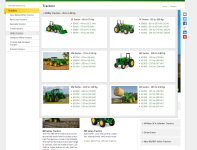
Per the JD site the 6D qualify with 105-140 Hp models. The 6M are not considered utility. The 5 series only goes to 100 Hp. I had missed the 6D series.
 
/ Row Crop vs Utility #19  
To be a true row crop tractor the tread must be infinitely adjustable and this is usually accomplished by sliding the wheel hub on an extended axle shaft. The shaft could be long enough to mount a dual tire on each side and have enough room between the duals for a center to center dimension to be up to 40" or more so that each tire is running in the middle of two rows.

Other than that, they are pretty much the same as all other tractors of similar size. Clearance may be a bit more than a CUT but only because it has larger and taller tires. The drive train ( engine, transmission, rear end and front drive if 4WD) are still configured in most cases exactly like a CUT or Utility with the front axle pinned directly to the drive train with swivel pin holding the front axle. They rarely need to have more than 24" of ground clearance for any crops raised. When they get too big for the tractor to pass over, the crops are considered "laid by" and then just waiting for them to mature for harvest.

On my utility tractor, I can only adjust the tread width by moving the inner rims around on the outer mounting Z points. This give me about 4" of adjustment wider or narrower with the inner cup setting out. I don't think I could even mount the tire with the cup in as the tire would hit the fenders. ON many CUT tractor the rims, have welded one piece rims so there is no other setting, the only adjustment is Wide or Narrow accomplished by flipping the rim so the cup is out or in.

There are high clearance rigs for spraying pesticides and herbicides that may have as much as 6 feet of clearance but they aren't considered tractors.
 
/ Row Crop vs Utility #20  
Per the JD site the 6D qualify with 105-140 Hp models. The 6M are not considered utility. The 5 series only goes to 100 Hp. I had missed the 6D series.

Check your info. Snapshot of the JD site today. These are all listed as utilities on JD's own website. Thanks though! :thumbsup:
deere.png
 

Marketplace Items

WBrock Meyer 2000S 70'x12' 2000 BPH Grain Dryer W/Legs&Mill Discharge Sylo,Controller is included (A57148)
WBrock Meyer 2000S...
2012 UTILITY REEFER TRAILER (A58018)
2012 UTILITY...
2006 Freightliner Auger Truck (A61306)
2006 Freightliner...
WINCH CABLE DRUM (A58214)
WINCH CABLE DRUM...
2013 Ford Explorer SUV (A59231)
2013 Ford Explorer...
2012 INTERNATIONAL DURASTAR 26FT NON CDL BOX TRUCK (A56138)
2012 INTERNATIONAL...
 
Top