Running Water Lines

   / Running Water Lines #21  
Robert, one additional tip, when using PVC with flared ends, put the flare open (female) end towards the discharge side of the pump or water source.
This will have the water running into the bevel flare instead of the squared off protrusion of the male pipe at the splice. Granted not a big deal, but it cost nothing and on a long water line it will cut down on overall friction loss.

cheers,
george
 
   / Running Water Lines #22  
Thanks Joe for the info. I do not know much about PE. I have installed systems up to 12" PVC but not much with PE except for drip systems. You nailed the explanation regarding friction loss. As velocity increases in the pipe, not only is friction a factor, but high velocitys also are hard on electric valves, cause problems on the inside of elbows, and as mentioned, create a greater pressure loss. Many times you will see a 1" supply feeding 1.5", 2" etc irrigation lines. Its all about GPM.
 
   / Running Water Lines #23  
I'm not a big fan of the poly pipes. To be honest, I think they are far inferior and should never be used.

There are a few diferent types, but anything that comes in black rolls is a poly to me.

Plenty of cities use them along with landscapers. It's easy, cheap and fast to install. Up front, it's much cheaper.

My issue is in reliability. Over time, it is more prone to rupture. Ground movement will wear down a spot fairly quickly. I'm convinced the utility company that insalls poly pipe is just creating job security.

Here in Tyler, there is a crew that is on call 24/7 to repair water line breaks in poly pipe. While repairing a leak in front of a house I owned, I asked how many breaks they deal with. I was told they keep very busy. Then I asked why the city used the poly pipe. I was told it was required for a period of time, and now they have so much in the ground it's too expensive to replace it. They learned the hard way.

SCH 40 is so much thicker then the poly pipes that it isn't even something you can compare. If you use good glue and clean your joints, SCH 40 will out live all of us. You can't say that for any of the poly pipes.

Eddie
 
   / Running Water Lines
  • Thread Starter
#24  
Thanks for all the great responses. What I have learned is that I should upsize to 2". Some like the black poly, but have no experience with it and I just don't see it used around here much. I do see bell ended PVC alot, although I was thinking of using the straight ended pipe with unions. The bell ends should be better - although they might be more expensive.

I haven't worked with the black poly, and so I would probably be leaning to the PVC.

Looks like I probably should not run 115V wire in the same trench with the water line. Where do you get the "conductor" that you put in the hole so you can find it later? Is this just a wire basically?

I stepped it off this morning and if I split and take one to the future gazebo it would be about 450'. I'll check the prices on ride vs walk beside and make a decision based on that, assuming the walk besides are not unreasonably slow.

My problem is that I get stuff mostly at the box stores, and it seems I need to go to a plumbing or irrigation supply outfit to get the pipe and also the large frost-free hydrants, and the fittings.

I might also check into an irrigation company doing the job. My impression from reading other people's experience is that running water lines is very expensive when done by folks in that business. Maybe they will surprise me.

Is my regular tractor with FEL OK for backfilling the trenches, or is the trencher itself a better tool? This would help in my planning, whether or not to take it back after digging the trenches and before laying the pipe.

My well pump is rated 20 GPM, but my well driller says it will probably go 25 at the 399' depth it is set. I have run it full out for hours at a time, but this was straight out of the wellhead, never through the pressure tank. This might be a complication because if I run it too slow the pump will cycle, but if I run out too much, the pressure might drop to the point of pumping the pressure tank dry. I have tried this for maybe an hour, adjusting the valve to keep the pressure steady, but invariably it either creeps up and cuts off the pump (then comes back on within 30 seconds because of the volume of water being run out), or it bleeds down and eventually runs all the water out of the tank. This needs to be thought through some how.

I like the idea of some sort of float valve on the pond, but I need to be sure I can regulate it so the pump will run the hole time.

Eddie, I couldn't quite grasp your explanation of the hydrant with the sleeve. Do you have a picture?
 
   / Running Water Lines #25  
Your pressure tank issue is the reason a Master Valve/ Pump Relay setup is used. The Pump relay bypasses(parallels?) your pressure switch, and turns the pump on or off.

Here is a page with lots of good info Strykers irrigation page
 
   / Running Water Lines #26  
I backfilled with the FEL on my tractor; the walk-beside trencher didn't have any sort of backfill blade and even if it did, it would be way too slow. The walk-besides are NOT very maneuverale. If you're lucky, you'll get a fancy one with hydraulic steering; even so, they steer about like a pencil through a pound cake.

I got my bell-end pipe from a specialty company, Okeechobee Pipe and Fittings, which does exactly what their name says. I think the bell-end pipe was slightly less money than the straight pipe with a coupler, and it was twice as fast to have only one joint at each coupling. LIke Eddie, I used purple primer and clear glue.

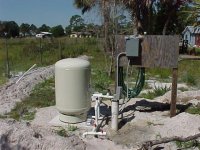
I don't have any problem regulating the flow; but maybe the size of my pressure tank has something to do with that. See attached.
 

Attachments

  • 694182-pond12_040404.sized (Small).jpg
    694182-pond12_040404.sized (Small).jpg
    56.4 KB · Views: 169
   / Running Water Lines #27  
Alan,

The walk behind trencher is just for digging. It has no means of filling the trench. Your FEL will do that easily, or a box blade. After you fill the hole, drive down it with one side of your tires to compact it.

The pipe from the box stores usually comes in 10 foot lengths. Plumbing suppliers and farm stores will have it in 20 ft joints with the bell. I buy mine from the farm store in Big Sandy. Cheaper than any other place I've found.

The bell is easily twice as long as the union. This gives you more strength, and saves you money buying unions.

A jump from 1.25 inch pipe to 2 inch is HUGE! You gotta realize that a general rule of thumb in guaging pipe is that for every half inch in diameter that you increase, your capacity increases 2 1/2 times.

Distance, friction and elevation also factor into this, but thats where the engineers come in to play. I've looked the formula up on the internet once, and was totally lost. For me, and for your application, this is good enough.

If your pump is cylcling and having issues with 1.25 inches, 2 will be way too much. The added volume in 2 inches would be important if you wanted to have a certain level of preasure at the outlet, but for jus moving water from your well to your pond, your wasteing your money.

If you wanted to run sprinklers, then the 2 inch line would help because it will allow you to build preasure at the outlet when you reduce it to half an inch, which is the size sprinkler heads are. Greater volume allows for more preasure over long runs. Going down hill works even better!!!

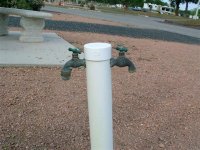
The picture is from an RV Park I visited in the Kerrville area. They have a 3/4 inch pvc pipe coming straight up into a PVC T, then two spickets.

The PVC pipe coming up is wraped in insulation. The 4 inch pipe you see is a sleeve that covers the insulation.

No hydrant or anything expensive. Total cost is gonna be around $10. Cheap, effective and simple.

Eddie
 

Attachments

  • 694196-Guadalupe RV Park water (Small).jpg
    694196-Guadalupe RV Park water (Small).jpg
    71.2 KB · Views: 215
   / Running Water Lines
  • Thread Starter
#28  
Thanks for the picture of the "frost free" rig , Eddie. Now I get it, looks like a great idea.

My problem is I can't find bell-end pipe on Saturday. The ones that carry it don't open on Saturday.

I call the rental store. A walk behind that does a maximum 24" depth at 4" wide is $150 a day. He says with our soil conditions I'll be lucky to get 50 feet an hour out of it. A Beretta I think, with 13 horse motor.

The riding version is $240 for 4 hours, or $370 per day. He says it will dig much faster.

The local lumber yard has 2" pipe wth bell for $.65 a foot, but they only have 10 sticks. Can't find anyone else that has it.

I have things I have to do for the next 2 weekends, so looks like this will have to wait for when I can get off and get the pipe during the week.
 
   / Running Water Lines #29  
A properly etched (primed) and glued PVC joint becomes fused, not just glued. Simply doing a quick wipe with the PVC primer may not actually etch the pipe enough. The more oxide on the pipe, the more "scrubbing" it takes with the primer. PVC pipe that has been stored in the sun will need more etching to get a solid fused joint.
 
   / Running Water Lines #30  
Here any pump or plumbing supply house carries PE up to 1.25" and could order 2".

As to the ID to use, I suggest that open discharge from a well pump doesn't require any larger ID than 1" for what was it, 350'? We use 1" on wells to 500' deep and up to 200' from the house, without velocity or other problems because those 'problems' depend on the pump that is used and at what pressure it is operated at. A 1" open discharge line will provide a very high flow IF the pump can deliver it. And then, the well dictates how many gpm can be pumped out of it. So the additional expense of 1.25" or 2" isn't needed unless.... you want to fill the pond faster but again, the well will dictate how fast that can happen and IMO the average well will never pump 30 gpm for as long as it should take to put a couple inches of water in a pond larger than a puddle. /forums/images/graemlins/wink.gif

Gary Slusser
 
   / Running Water Lines #31  
I haven't put a flowmeter on my float valve, but I believe it is putting out the maximum capacity of my well. The literature with the float valve, which has a 1" outlet, says it will provide "up to" 30 gpm. My 1 HP submerged pump is rated, according to my pump supplier, at 25 gpm. My well itslef is rated, by the well driller, as capable of 75 gpm. I have a 1-1/2" supply line to the 1" float valve. Therefore, I strongly suspect that I'm getting something very close to 25 gpm at the valve.

If I open once of the hose bibs in the line before it reaches the pond, the flow to the pond valve is dimished.

During the dry season, the pond vavle will run an hour or so per day to keep the pond topped up. I'm concerned that I won't have enough flow for the house during that period because the pond valve is so efficient. So, I plan to put an electric valve on the pond with a timer, so it can only run in the early morning hours, say between 2 am and 5 am, when we're less likely to need a lot of water.

I agree there is no reason to go to a larger size than is needed to transport the available flow with efficiency. I personally wouldn't go all the way to 2"; it seems a waste of resources. I think I was pretty indulgent to go with 1-12", but since all of the downstream uses are smaller (pond valve is 1", hose bibs are 3/4"), it makes for an efficient flow and, if I read correctly, increased pressure at the delivery point.
 
   / Running Water Lines
  • Thread Starter
#32  
Gary, I guess I don't quite understand what you are saying about the open discharge. My well produces about 35 GPM I am told, but the pump is only pumping out 25 GPM, so it would seem to me that it would run indefinitely, in fact I have done so for 72 hours straight when the well was first dug, trying to clear it up.

If I run 1.5 inch out to the pond and put a regular 3/4 bib right there, I wonder what kind of GPM I could pump through that regular bib? If I can do 20 or 25 GPM through only about 36" of 3/4 and out the bib, then I won't need the large discharge.

I don't expect to fill the pond by pumping water into it but would hope to mitigate the evaporation somewhat.
 
   / Running Water Lines
  • Thread Starter
#33  
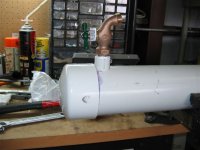
Based on Eddie's design, I made 3 Frost-free (hopefully) hydrants. Used 3/4 PVC and standard bibs, inside 4" schedule 40 well casing.

On all three I used that black foam insulation around the 3/4 pipe. On the first one I try to fill the void with spray in foam insulation. However, I'm not sure I was able to fill up the whole thing because it would back up on me. Hopefully I got enough on that one.

On the other two, I put first the foam insulation and then I wrapped the pipe with some 3.5 inch vinyl back wall insulation I had from my building construction. I taped it in place only on the top and let it fill up the void loosely.

Something I did really stupid. On the first two I cemented the 3/4 slip to thread union in place before screwing the bib in there. Of course both of them want the faucet pointed to the side or straight up no mater how you start threading it.

My wife mentioned that perhaps I should screw it in there as tight as it will go, then cement it into place. Duh....

The only thing I worry about is the weight of the thing sitting on top of that little skinny 3/4 PVC. Of course once I cement it into the water line and get dirt around it, it should be fine. The total length of the outside casing is 40", so I figure maybe 18 inches will be above ground.
 

Attachments

  • 694530-top.jpg
    694530-top.jpg
    48.4 KB · Views: 166
   / Running Water Lines
  • Thread Starter
#34  
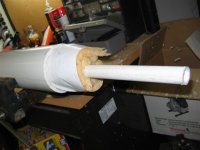
Here is the bottom that goes in the ground.
 

Attachments

  • 694531-bottom.jpg
    694531-bottom.jpg
    42.8 KB · Views: 170
   / Running Water Lines
  • Thread Starter
#35  
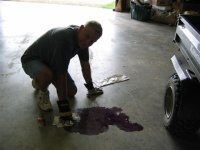
I managed to know over my can of primer. I now have a purple floor in the shop.
 

Attachments

  • 694532-mess.jpg
    694532-mess.jpg
    46 KB · Views: 161
   / Running Water Lines
  • Thread Starter
#36  
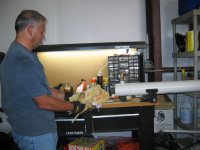
The insulation is not fun. And, it was about 90 in the shop with about 80% humidity.
 

Attachments

  • 694534-Stuffing.jpg
    694534-Stuffing.jpg
    52.2 KB · Views: 168
   / Running Water Lines
  • Thread Starter
#37  
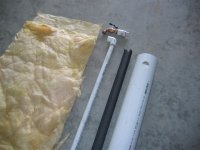
The pieces layed out.
 

Attachments

  • 694537-components.jpg
    694537-components.jpg
    45.9 KB · Views: 176
   / Running Water Lines #38  
Alan,

The spickets look great!!! No way you'll have any freezing issues with that setup.


Eddie
 
   / Running Water Lines #39  
<font color="blue">I agree there is no reason to go to a larger size than is needed to transport the available flow with efficiency. I personally wouldn't go all the way to 2"; it seems a waste of resources. I think I was pretty indulgent to go with 1-12", but since all of the downstream uses are smaller (pond valve is 1", hose bibs are 3/4"), it makes for an efficient flow and, if I read correctly, increased pressure at the delivery point. </font>

Water and the delivery of it is complicated and complicated to explain. For his situation, it really does not matter on the pipe size if the purpose is purely to dump water in a pond. If he were using it for irrigation on a sprinkler system or for the house even, it comes into play and in a very big way. If your ever at a irrigation supply shop, pick up a Hunter or RainBird manual. It shows the pressure loss for every 100' of pipe depending on flow rate or GPM and the internal diameter size. Here is a link to the RainBird site. It shows PE pipe with highlights in orange the velocities over 5' per second, something you try to avoid.

At 14 GPM, in PE pipe of 1" in diameter, you loose 5.08 PSI for every 100' of pipe. For 350' of PE pipe at 14 GPM, you drop 17.78 lbs pressure.

Here is a FRICTION LOSS TABLE for PE pipe.
 
   / Running Water Lines #40  
Do you think that will protect from freezing? If there is no heat source, then pretty soon everything above ground will reach the ambient air temperature as it drops below freezing. Insulation will just add a little delay to that happening.
 

Tractor & Equipment Auctions

*Selling at Royal Auction Tampa, FL Location* (A59228)
*Selling at Royal...
IRTPL LIFT (A58214)
IRTPL LIFT (A58214)
CATERPILLAR CB-224C DOUBLE DRUM ROLLER (A52707)
CATERPILLAR...
2019 Allmand Night-Lite V-Series 7 kW S/A Towable Light Tower (A55973)
2019 Allmand...
Bobcat T590 (A53317)
2017 John Deere 1025R Tractor - 626 Engine Hours (A56438)
2017 John Deere...
 
Top