Safety Tips

   / Safety Tips #41  
Re: Safety Tips - Tractor Overturn Hazards

Comparing a tilt-meter with a R.O.P.S. or a seat belt for that matter is inaccurate. A roll bar or a seat belt "protect" the rider, while a tilt-meter can only provide information about the tractor's position.
I think what ddl was trying to say is that the conditions you are working in (how high is the fel, your speed through a turn, the ground conditions, etc.) will greatly affect the probability of a roll-over. A tilt-meter cannot take these factors into consideration. Experience is USUALLY the best teacher.
Having said that, I can see your point, in that our gauges and meters can give us an added perspective that would otherwise be hard to see - as I too have unknowingly "creeped" over the speed limit a time or two.
Alas, I don't need a speedometer to tell me that I'm going too fast to turn into my driveway, but it sure does help distinguish between "55" and "65" as I pass the cop on the side of the road.
 
   / Safety Tips #42  
Re: Safety Tips - Tractor Overturn Hazards

<font color=blue>guess I'm treading on thin ice</font color=blue>

Thin ice will not stop a falling bullet, Steve, but I'll be a tiltmeter would. /w3tcompact/icons/laugh.gif

HarvSig.gif
 
   / Safety Tips #43  
Re: Safety Tips - Tractor Overturn Hazards

I think the comparison of seat belts to tiltmeter says it all. Seat belts ROPS actually provide protection. Think about it, if you are driving on a slope, you look at the meter and it says you are safe. the slope increases, and now it reads at the very limit of safety. What do you do, jump off, if the slope increases at any amount, you should fall off the slope if it works, the meter that is, but you do not. So next time, you know if the meter goes to that angle you were safe last time. The whole problem is when the slope changes suddenly, you do not have time to look at the meter to make sure that you should be tipping over, you just tip over. If the meter could predict in adavance that danger is approaching, than you would have a worth well device. A temperature gauage does tell you the engine is getting too hot, but unless you have a flashing light, chances are that you will not notice the meter until you see steam from the engine, than you look at the meter. To make this short, safety is not something you can put a meter on, any safety device must be reactive, that is when the worst happens, you are protective. Safety devices in a manufacturing setting, actually shuts the machine done, but an unsafe action has all ready occured, it just stops futher problems from occuring. Explain how the meter can do any of this. I think the manufactiring can be setting himself up for a large lawsuit unless he clearly tells hie users that this is not a safety device only a indictactor or guess that something will happen.

Dan Lutter
 
   / Safety Tips #44  
Re: Safety Tips-Smiles into Tears

safetyback-l.jpg


Don't Let These Smiles Turn To Tears

In a heartbeat, the most precious members of your family could be injured - or worse - in a farm accident.

Older or retired farmers are more susceptible to accidents since their reaction times become slower. They often repeat chores just as they always have, without questioning the risk.

Young children are vulnerable because they tend to play in work areas around equipment and farm animals. Children visiting the farm are even more at risk due to their general unfamiliarity.

Keep your loved ones safe. Warn them of potential danger and keep them in mind as you work.
{ From JD Ag Website}

18-35197-JD5205JFMsignaturelogo.JPG
 
   / Safety Tips #45  
Re: Safety Tips - Tractor Overturn Hazards

Dan, if you have a safety on your handgun, and fail to use it, who's at fault here realistically? If you also have that temp guage, and fail to look at it, is it the guages fault? Same applies to the TiltMeter, if you are running a 12 degree slope,(and your pucker factor is 10 degrees) you can visually see that it is getting steeper, are you going to keep going? Come on here, where is the common sense? Yes training IS important, but a big PART of that is the preventative training, i.e. look at the guages, look at the ground you are working, keep a constant eye on ALL factors. It all has to be trained into the operator of any equipment, and due to human nature, repetitive use will degrade that training over time and necessitate refresher training.
No that Tiltmeter will not tell you that you are going to roll...until you hit that magical combination of CG and Tilt...but it will let you know, in combination with your visual accuity of what lies in front of you, your current status, and a rapid calculation of your pucker factor, to STOP when approaching a dangerous combination.
off my bandwagon and back to the stall.
 
   / Safety Tips #46  
Re: Safety Tips - Tractor Overturn Hazards

I agree totally with that concept. In fact, the R&B tiltmeters are colored with white/yellow/red for safe/caution/danger areas. Myself, I would be keeping an eye on the meter if I felt at all like I was tipping too much, if the meter moves into the yellow zone, that should be a clue to me to look ahead and back off, not to go merrily along...

The GlueGuy
 
   / Safety Tips #47  
Re: Safety Tips - Tractor Overturn Hazards

[[[Thin ice will not stop a falling bullet, Steve, but I'll be a tiltmeter would. ]]]

Harv, how do you mount the tiltmeter on the bullet?? /w3tcompact/icons/shocked.gif (And doesn't this make shooting awfully expensive?? ...even WITH the TBN discount!)

/w3tcompact/icons/laugh.gif

Larry
 
   / Safety Tips #48  
Re: Safety Tips - Tractor Overturn Hazards

Dan,

[[[I know I will get lots of Sh_t from you all but safety is not something I can just buy a meter for and drive around with my head in a bag.]]]

I'm not missing your point, ...but my tiltmeters did NOT come with a bag.

I don't plan to stop looking-at/ thinking-about what I'm doing simply because I've got one more source of potentially helpful information on the machine.

I find it difficult to understand why you speak as if tiltmeter users are looking to turn over all responsibility for judgement and safety to a ball-bearing in a tube. /w3tcompact/icons/crazy.gif

For my part, I don't plan to operate my tractor with my head up a bag (or up anything else)!

And just because someone/something can't "protect" me when I've done something dangerously stupid, ...that doesn't mean I wouldn't appreciate some warning when I might be about-to! /w3tcompact/icons/blush.gif

Hey, ... what if I've been riding the tractor too-long, and the "seat of my pants" is ASLEEP?? /w3tcompact/icons/shocked.gif

I've lived through the invincible "Damn the torpedoes" years, ...not sure I always deserved to, but I appreciate being in one piece.

I'm older now, with still a lot of things I'd like to stay healthy-for, and I'll take all the help I can get to remember that THESE THINGS ARE DANGEROUS!

Thanks to all who have taken time to share opinions/links on safety issues here on TBN!!

Larry /w3tcompact/icons/smile.gif
 
   / Safety Tips #49  
Re: Safety Tips - Tractor Overturn Hazards

Hi ddl,
Rick here. The instruction sheet that comes with every meter
says to operate the tractor at 5 degrees less than limit.
We use the a.n.s.i. standard as a starting point. (20 degrees
static.). We also say that an implement like bucket etc.
will change that limit. We mention that washouts etc. will
also change that limit. We recommend that all wheels be
out to widest point. We recommend that all tires are fully
inflated. We ask that wheel weights and frame weights be
used when possible. We advise that the meter will NOT
prevent a roll-over. Its sole purpose is to show a degree of
slope, so an intelligent decision may be arrived at by the
operator. If I'm on a 15 degree slope, with a belly mower,
and familiar ground, I personally would proceed with caution.
If I'm on that same slope with a front end loader, my decisoin
would be to stay well below that 15 degrees. How do I know
it's 15 degrees? I checked it with my meter without the loader
attached. And by the way, we make a beeper module that
can be mounted anywhere on a tractor, that will set off a
beeper, light, etc. when a preset limit is reached. We just
introduced our latest version, that is now electronically
dampned as well as mechanically dampened. So even if
someone does operate the tractor with head in bag, it will
let you know. I even have access to a voice module that
will play a recorded message when activated. Combined with
our tilt module, it can say something like " Hey big boy,
your about to go belly up". Or whatever colorful message
you like. The tiltmeter is not the answer to ALL roll-overs.
But it can prevent some types of roll-overs if used
properly. Rick

Rick Hedgecock
R&B Manufacturing
http://www.tiltmeter.com
(816)587-9814
 
   / Safety Tips #50  
Re: Safety Tips - Tractor Overturn Hazards

Rick,

What is the average slope/angle/pitch a tractor can travel before side rollover occurs? Also front/back rollover? {I realize multiple factors have to be taken in consideration, but just wondering if your company had any averages.}

Do you have formula's that I could input in a spreadsheet that will determine the above? {Inputting data such as: rear wheel width, tractor length, tractor weight, drawbar height, tractor center of gravity point {how determined - other formula's}, implement weight, etc.}

Lastly, any formula's to convert between slope/angle/pitch?

Thank you Rick.

18-35197-JD5205JFMsignaturelogo.JPG
 
   / Safety Tips #51  
Re: Safety Tips - Tractor Overturn Hazards

John,

Just a comment while you wait for Rick's reply; I'll be posting some weight/balance studies that I did on my rig with various implement combos. Front/rear axle loadings, longitudinal c.g.'s for each, ...and some info on figuring such. It will be some time before I have the post ready.

Meanwhile;

Re. vertical c.g.; I saw a reference somewhere to it being about 10-12" higher than the rear axle, for a "normal' tractor WITH ANY LOADS HELD LOW.
My "guesstimate" is that this is fairly accurate, and using it and the tire-track width of your tractor will let you diagram the "theoretical " sideways roll-over angle. This assumes the tractor does not slip sideways, gaining momentum that will tip the tractor when something STOPS the slide, and that no soft dirt or holes(on the downhill side)/bumps(on the uphill side) tilt the tractor further. I t also assumes adequate tire strength/air-pressure so that the now-more heavily loaded "downhill" tires do not distort, lowering that side and causing more tilt.

These(and other) considerations are the reasons that the "theoretical" limit has to be taken with a very big grain-of-salt, when considering how steep a slope to attempt to operate on.

But, ...it IS interesting to picture a tractor mowing sideways on an "ideal" surface and a slope of 40 degrees or so. Interesting AND SCARY! DEFINITELY NOT-RECOMMENDED!

Front/rear- a tractor w/o front ballast is MUCH more likely to flip over BACKWARDS, than forwards. The caution to "TOW only from the drawbar (i.e. from BELOW the rear axle)" should ALWAYS be heeded! This tends to "lever" the front end into-the-ground.

More when I post the weight study.

HTH,

Larry
 
   / Safety Tips #52  
Re: Safety Tips - Tractor Overturn Hazards

As stated in the past, we use the a.n.s.i. standards as a starting point.
I feel it would be near impossible to give averages for all
tractors, and implement possibilities. Too many variables, as you know.
If you have been on a slope of say 15 degrees, with a brush
hog on rear, and next time you want to travel that slope, with
a fel. Of course you know that you must stay WELL UNDER
that 15 degrees, because of the fel changing center of
gravity. If you have been on a 10 degree slope with fel full
of dirt, and slightly above ground, without any problem,
you can now make an educated estimate of your limits for
this one applicaation. You have used the tiltmeter as a tool
to help determine your limits. Better than no meter, and
guessing, "well I think when I used the brush hog I was on
about a 15 degree slope, and this one looks like about 10
degrees." The meter allows for better determination.
As for a chart, I have the following.
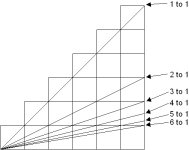
9.46 degrees=6 to 1 grade=17 percent.
11.31 degrees=5 to 1=20 percent.
14.04 degrees=4 to 1=25 percent.
18.43degrees=3 to 1=33 percent.
26.57=2 to 1=50 percent.
45.00degrees=1 to 1=100 percent.
I have a more complete chart if anyone needs it.

Note; 47 state highway depts. use a 3 to 1 grade as their
maximum limit for right of way mowing tractors. They all
use wheel weights, frame weights, or both.
These limits were researched by state and federal engineers
and were arrived at for a standard duty tractor, with rear
brush hog, in lowered position. I deal with highway depts.
on almost a daily basis, and a tiltmeter is a tool they rely
on to HELP in preventing some roll-overs. Of course, some still occur, due to washouts, stumps,operator in-attention, etc.
But EVERY dept. that uses them report fewer roll-overs with
the use of a meter. I can pretty much judge my speed on the
interstate, but if I had never had a speedometer, I probably
would not be able to judge my speed as well.
The a.n.s.i. says a standard duty tractor, static, must meet
20 degree limit side tilt, and 30 degree front to back tilt.
Rick

Rick Hedgecock
R&B Manufacturing
http://www.tiltmeter.com
(816)587-9814
 
   / Safety Tips #53  
Re: Safety Tips - Tractor Overturn Hazards

Hi Rick,

Thank you for the followup...

Please post your "full chart" for everyone if it's convenient, I sure others would be interested as well...

I can understand the pitch of a roof, or the angle of an object, but the grade 3 to 1 or 2 to 1 etc., and slope aspects are somewhat confusing... unless some of these terms are "interchangeable"?

Just wondering...

18-35197-JD5205JFMsignaturelogo.JPG
 
   / Safety Tips #54  
Re: Safety Tips - Tractor Overturn Hazards

Hi Larry,

It will be interesting to view your study when it's posted.

Thanks.

18-35197-JD5205JFMsignaturelogo.JPG
 
   / Safety Tips #55  
Re: Safety Tips - Tractor Overturn Hazards

Received my tiltmeter last friday. holding it in your hand and going to 20 degrees you think to yourself - "that ain't much!".

Mount it to a tractor and try to get to 15. You'll be leaning on the fender when you hit 20.

I'm guessing I wouldn't want my Case DC (tricycle) past 10 degrees!

Might be cool to mount one on a mo-cycle!

Steve
 
   / Safety Tips #56  
Re: Safety Tips - Tractor Overturn Hazards

John,

Maybe a simple graphic is the best way to show this. This little drawing shows the slope as the 6 to 1, etc. ratios, kind of like the terms used for roofs (6 to 1 slope would equate to a "2 in 12" roof, 3 to 1 slope would equate to a "4 in 12" roof). If you'd like, I could re-do this with the slope, grade, and degrees all labled side-by side?

The GlueGuy
 

Attachments

  • 34-45619-Slope.jpg
    34-45619-Slope.jpg
    29 KB · Views: 154
   / Safety Tips #57  
Re: Safety Tips - Tractor Overturn Hazards

Here's what Rick posted back in August, in addition to the figures he posted earlier...

----
%of slope.
1=0.5729 degrees.
2=1.1458
3=1.7184
4=2.2906
5=2.8624
6=3.4336
7=4.0042
8=4.5739
9=5.1428
10=5.7106
11=6.2773
12=6.8428
13=7.4069
14=7.9696
15=8.5307
16=9.0903
17=9.6480-------6 to 1 grade is 9.46 degrees
18=10.2039
19=10.7579
20=11.3099------5 to 1 grade is 11.31 degrees
21=11.8598
21=11.8598
22=12.4074
23=12.9527
24=13.4957
25=14.0362-------4 to 1 grade is 14.04 degrees
26=14.5742
27=15.1095
28=15.6422
29=16.1721
30=16.6992
31=17.2234
32=17.7446
33=18.2628-------3 to 1 grade is 18.43 degrees
34=18.7780
35=19.2900
36=19.7988
37=20.3044
38=20.8067
39=21.3057
40=21.8014
41=22.2936
42=22.7824
43=23.2677
44=23.7494
45=24.2277
46=24.7024
47=25.1735
48=25.6409
49=26.1048
50=26.5650-------2 to 1 grade is 26.57 degrees
100=45.00 degrees and is a 1 to 1 grade.
---

msig.gif
 
   / Safety Tips #58  
Re: Safety Tips - Tractor Overturn Hazards

bulb.gif


Ok, Ok, Ok.... The light just went ON...

Bill, Thank you! When you equated the roof pitch with the slope..., the same thing, just different terminology! {Or as my brother would put it... the same thing... just different... }/w3tcompact/icons/smile.gif

Muhammad, Thank you for the chart as well...but...

I don't see a 20 degree angle slope on paper to be that big a deal. I keep sidehilling to a minimum... so I'll have to measure a few of these and check.

18-35197-JD5205JFMsignaturelogo.JPG
 
   / Safety Tips #59  
Re: Safety Tips -Grade Meter

meter.gif


Making the grade meter
1. Remove the page containing the grade meter from this guide.
2. Cut our grade meter along dotted line.
3. Fold over at dashed line.
4. Cut plywood or board to size of paper below fold.
5. Put glue over the entire back side of paper and attach paper to board.
6. Spray with clear varnish or other waterproofing.
7. Put tack or nail at top center point and attach 15-inch string with nut or bolt on other end. Make sure string swings around nail.

Using the grade meter
1. Sight across top edge to person or object at your eye level. Keep the meter vertical so string hangs straight.
2. When the top edge is lined up, hold string against front and read scale of meter for grade (slope) of road or hill.
3. This meter give a rough measure of grade. For a more exact measurement use an Abney level or clinometer
{from the Web}

18-35197-JD5205JFMsignaturelogo.JPG
 
   / Safety Tips #60  
Re: Safety Tips - Tractor Overturn Hazards

Bird, I have to thank you, I think you saved my life!!! I used your link, and ordered my tiltmeter. (By the way, they give a $3 discount for TBN memebers). I got the meter in 2 days. I installed it immediately, and went right to a hill on my property that I felt very uncomfortable mowing, I always felt like the tractor was unstable, even though it always handled it. I found out that the slope was over 25% /w3tcompact/icons/shocked.gif!!!! Bird, you once said that if it feels unsafe, it is! Well I should have listened to you, and trusted my instincts. It's a good thing I got the meter before something happened!!!! I now swear by the meters, and have told all my neighbors to get them, because, I've seen them mow and plow much steeper hills than mine. That's why I thought I was overreacting, when I kept feeling it was unsafe. I'm new to farming, but when I told my neighbors about my fears on this hill, they said "Don't worry about it, your old tractor can handle much more than that!" I'm going to talk to them again, and I hope they listen, before something happens. I hope everyone in TBN gets a tilt meter, because its real hard to estimate a slope. I thought mine was about 12%. Turns out it was more than twice that!!!/w3tcompact/icons/shocked.gif Take my advice, your life isn't worth guessing!!! Get a tiltmeter!!!! Thanks, again, Bird!!!!!
 

Tractor & Equipment Auctions

2002 Frieghtliner Pressure Digger Truck (A55973)
2002 Frieghtliner...
Commercial Lawn Mower 652R (A56859)
Commercial Lawn...
2016 FREIGHTLINER CASCADIA SLEEPER (A59905)
2016 FREIGHTLINER...
Crown RM6025-45 4,500 LB Stand-On Electric Forklift (A59228)
Crown RM6025-45...
500BBL WHEELED FRAC TANK (A58214)
500BBL WHEELED...
12FT X 20FT STEEL CARPORT (A58214)
12FT X 20FT STEEL...
 
Top