Scaled my tow rig

   / Scaled my tow rig #1  

ovrszd

Epic Contributor
Joined
May 27, 2006
Messages
33,727
Location
Missouri
Tractor
Kubota M9540, Ford 3910FWD, Ford 555A, JD2210
I had access to a certified axle scales the other day so did some weighing.

My truck is a 2000 F250, 7.3L Diesel, AT, SRW, Extended Cab, Shortbed, Lariat model, half a tank of fuel.

My trailer is a Neal Brand GN, 28' + 4' dovetail, no ramps, wood deck, dual wheeled 10K Dexter axles, no spare.

Here's my results.

Empty Truck: Front axle 4110lbs. Rear axle 2730Lbs. Total 6840lbs.

Truck and empty trailer: Front axle 4080lbs. Rear axle 3700lbs. Trailer axles 5910lbs. Total 13,690lbs.

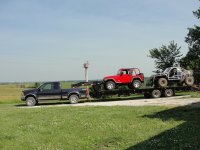
Loaded as pictured with two Jeeps: Front axle 4130lbs. Rear axle 4770lbs. Trailer axles 12,290lbs. Total 21,090lbs.

I was surprised by a couple things. First my trailer weight is 6850lbs. At least it's not 9000lbs as some suggested it was. But still heavier than I expected.

Second,I was surprised that increasing the total package weight by 14,250lbs only added 20lbs to the truck front axle??

On the other hand I was pleased that it added 2040lbs to the rear axle of the truck.

I like that the trailer is carrying the majority of the weight which was my goal. It pulls very well loaded as pictured.

For the safety police, internet researching revealed my truck's GCWR at 20,000lbs. So I am 1090lbs overloaded.

Overall I like the balance. I bought this trailer without a dovetail and added it myself. That's why my axles are so far forward. For what I'm doing I like that. Puts a bigger percentage of the weight onto the trailer axles and drastically increases the ability to get into tight spots.

I'm no trailer expert so open to any comments/suggestions. :)
 

Attachments

  • DSC02963.JPG
    DSC02963.JPG
    371.9 KB · Views: 567
   / Scaled my tow rig #2  
What is the GVWR of the truck, about 9200lbs or so? Which will give you a payload for the truck itself around 3500? So, you have plenty of weight to spare on the axles. Unlike semis, with a sliding 5th wheel, we are not able to shift weight between the front and rear axles. But, with the weight of the diesel engine, the front axle is carrying enough anyway. Although, I think you have 4-6" of positioning to play with for the front jeep, looks like you got them sitting in about the right spots on the trailer. Which is the heavier of the two? Also, how much does your dovetail weigh? That might be your 1090lbs right there. Only this I would recommend is consider adding air bags. It'll help your vehicle carry the weight and smooth the ride out considerably. Bottomline though, I think you are good with it set up as you have it. And, other than dropping the dovetail, I do not see anything you can do about 1090lbs overweight.
 
   / Scaled my tow rig #3  
Second,I was surprised that increasing the total package weight by 14,250lbs only added 20lbs to the truck front axle?
Now you see why some people still prefer a bumper pull trailer with a weight distribution hitch. If you have the rear axle/suspension capacity, a fifth wheel trailer allows more tongue weight but it goes directly over the rear axle. On a traditional trailer with a WD hitch, the weight is more evenly distributed to both axles of the truck leading to a more balanced overall combination vs a truck and trailer see-sawing on the rear axle.

One more note, check the GAWR (Gross Axle Weight Rating) which should be on your door sticker. I thought those older 3/4 tons were only rated to about 5k lbs. This would put you pretty close to capacity on the rear axle.

It's nice to be able to get real numbers on your setup. That's the first thing I do with a new truck or trailer. :thumbsup:
 
   / Scaled my tow rig #4  
Now you see why some people still prefer a bumper pull trailer with a weight distribution hitch. If you have the rear axle/suspension capacity, a fifth wheel trailer allows more tongue weight but it goes directly over the rear axle. On a traditional trailer with a WD hitch, the weight is more evenly distributed to both axles of the truck leading to a more balanced overall combination vs a truck and trailer see-sawing on the rear axle.

I would be very suprised if a WD hitch got equal or more load on the front axle that his GN does. It seems that most bumper pulls rely mostly on load balance as most have the axles very close to the C/L of the trlr on 2 axle trlrs. with a little bit more on a typ. 3 axle 9 ton that generally are a pintle hitch not avail. with a WD set up.
It just seems unlikely that a WD hitch can compensate for the close to 4' distance from the C/L of the rear tk. axle, to the ball, that is acomplished by a GN trlr. I allways wondered why they don't build the GN trlrs with a longer neck to allow the ball to be 8" or so in front of the rear axle, it would provide more weight to the towing unit's steering axle as well as faster response in steering (usefull backing up).
 
   / Scaled my tow rig #5  
Now you see why some people still prefer a bumper pull trailer with a weight distribution hitch. If you have the rear axle/suspension capacity, a fifth wheel trailer allows more tongue weight but it goes directly over the rear axle. On a traditional trailer with a WD hitch, the weight is more evenly distributed to both axles of the truck leading to a more balanced overall combination vs a truck and trailer see-sawing on the rear axle.

I would be very suprised if a WD hitch got equal or more load on the front axle that his GN does. It seems that most bumper pulls rely mostly on load balance as most have the axles very close to the C/L of the trlr on 2 axle trlrs. with a little bit more on a typ. 3 axle 9 ton that generally are a pintle hitch not avail. with a WD set up.
It just seems unlikely that a WD hitch can compensate for the close to 4' distance from the C/L of the rear tk. axle, to the ball, that is acomplished by a GN trlr. I allways wondered why they don't build the GN trlrs with a longer neck to allow the ball to be 8" or so in front of the rear axle, it would provide more weight to the towing unit's steering axle as well as faster response in steering (usefull backing up).


I agree with the load being a 4' differnts, it better to have the weight in the middle of the leaf springs instead on the end of the leaf springs, especialy the load you have, having a bp with the same load setup would make you truck set lower than with the gn setup due to the center line loading of the leaf springs. "Hope I said this right."
 
   / Scaled my tow rig #6  
. I allways wondered why they don't build the GN trlrs with a longer neck to allow the ball to be 8" or so in front of the rear axle, it would provide more weight to the towing unit's steering axle as well as faster response in steering (usefull backing up).

Looks to me that his GN has plenty of neck space for his short bed truck.

all he would need to do is reposition the hitch in the truck... so depending on the style of GN he has, it may be easy to do... or not
 
   / Scaled my tow rig #7  
I would be very suprised if a WD hitch got equal or more load on the front axle that his GN does.
You would be surprised if a WD hitch could put more than 20 lbs of the load to the front axle? Have you ever used one?
It would put a lot more than 1% of the tongue weight to the front axle! I've seen a squatting truck lift 3-4" with a proper WD hitch which easily computes to a couple of hundred pounds.
having a bp with the same load setup would make you truck set lower than with the gn setup due to the center line loading of the leaf springs.
Correct, but that's the whole point of the WD hitch. To "move" the load to the entire truck instead of a foot behind the bumper.
 
   / Scaled my tow rig #8  
Yes a WD hitch can transfer a LOT of weight to the front....I remember a picture a long time ago of a front drive car with the rear wheels removed, sitting level, to demo how this worked;)
 
   / Scaled my tow rig #9  
You would be surprised if a WD hitch could put more than 20 lbs of the load to the front axle? Have you ever used one?
It would put a lot more than 1% of the tongue weight to the front axle! I've seen a squatting truck lift 3-4" with a proper WD hitch which easily computes to a couple of hundred pounds.

Correct, but that's the whole point of the WD hitch. To "move" the load to the entire truck instead of a foot behind the bumper.


True, I havent used a WD hitch that much, they can transfer weight like you said, but then again a person must know the correct way to use it to.
 
   / Scaled my tow rig #10  
Did you know that you legally have to have a CDL for that rig? With the dual tandems, your GVW for the trailer is approx. 20,000 + 9000 or so for the truck = 29,000 lbs. You need to have a CDL and follow all the regulations to be legal. Most of the time you will not get caught, but beware the DOT when they are looking for money.

You would actually be MORE legal with a single tired trailer with a GVW of 14,000 lbs. Trailer would be about 1000 lbs lighter as well.
 
   / Scaled my tow rig #11  
True, I havent used a WD hitch that much, they can transfer weight like you said, but then again a person must know the correct way to use it to.
Yeah, proper setup is key.
Did you know that you legally have to have a CDL for that rig? With the dual tandems, your GVW for the trailer is approx. 20,000 + 9000 or so for the truck = 29,000 lbs. You need to have a CDL and follow all the regulations to be legal. Most of the time you will not get caught, but beware the DOT when they are looking for money
So how exactly is he using that trailer for "commercial use"? Looks like recreational use to me...
 
   / Scaled my tow rig #12  
I had access to a certified axle scales the other day so did some weighing.

My truck is a 2000 F250, 7.3L Diesel, AT, SRW, Extended Cab, Shortbed, Lariat model, half a tank of fuel.

My trailer is a Neal Brand GN, 28' + 4' dovetail, no ramps, wood deck, dual wheeled 10K Dexter axles, no spare.

Here's my results.

Empty Truck: Front axle 4110lbs. Rear axle 2730Lbs. Total 6840lbs.

Truck and empty trailer: Front axle 4080lbs. Rear axle 3700lbs. Trailer axles 5910lbs. Total 13,690lbs.

Loaded as pictured with two Jeeps: Front axle 4130lbs. Rear axle 4770lbs. Trailer axles 12,290lbs. Total 21,090lbs.

I was surprised by a couple things. First my trailer weight is 6850lbs. At least it's not 9000lbs as some suggested it was. But still heavier than I expected.

Second,I was surprised that increasing the total package weight by 14,250lbs only added 20lbs to the truck front axle??

On the other hand I was pleased that it added 2040lbs to the rear axle of the truck.

I like that the trailer is carrying the majority of the weight which was my goal. It pulls very well loaded as pictured.

For the safety police, internet researching revealed my truck's GCWR at 20,000lbs. So I am 1090lbs overloaded.

Overall I like the balance. I bought this trailer without a dovetail and added it myself. That's why my axles are so far forward. For what I'm doing I like that. Puts a bigger percentage of the weight onto the trailer axles and drastically increases the ability to get into tight spots.

I'm no trailer expert so open to any comments/suggestions. :)
Interesting. I weighed mine last year when hauling wood to see just how overloaded I was (Cliff notes version - a lot...). Mine is a 2005 F250 4x4, ext cab, long bed, 5.4 V8 gasser. With the truck empty, except for me and the extended sides on the bed that maybe add 50-75 lbs, plus some random tools in the back seat, I was at 4140 Fr, 3100 R 7240 total, Mostly just FYI. I'm surprised the front axles are so close given your much heavier diesel engine. Maybe the coil spring front suspension on the '05+ is heavier? Or the config (Ext cab/LB)? Dunno
 
   / Scaled my tow rig #13  
Not to steal the thread but according to federal law he isn't required to have a cdl since this isn't a "commercial" vehicle. If it was and under the law he would need a class a license since the loaded trailer weighs over 10,000 lbs.
If under 10,000 lbs he would need a class b. Has nothing to do with dual wheels either.
 
   / Scaled my tow rig #14  
The sterling 10.5 axle is rated at something like 9000 lbs, the GAWR in the rear is usually the tires in the older SD fords. If you had the really soft springs they may have derated it further but not many had them. I know my 350 its the exact sidewall rating of the original tires x2. The rims are good for a bit more weight over that but you can't get much higher rated 16" tires.

One more note, check the GAWR (Gross Axle Weight Rating) which should be on your door sticker. I thought those older 3/4 tons were only rated to about 5k lbs. This would put you pretty close to capacity on the rear axle.
 
   / Scaled my tow rig #15  
Not to steal the thread but according to federal law he isn't required to have a cdl since this isn't a "commercial" vehicle. If it was and under the law he would need a class a license since the loaded trailer weighs over 10,000 lbs.
If under 10,000 lbs he would need a class b. Has nothing to do with dual wheels either.

The CDL debate rages on. Some state's register all trucks (pickups included) as commercial. So over 26001 and DOT here would hassle him. Unless he's a camper or farmer.

Matt
 
   / Scaled my tow rig #16  
All states are now required to have the same drivers license weight/combination vehicle standards by federal law. Illinois considers all pickup trucks to be class II vehicles.
 
   / Scaled my tow rig
  • Thread Starter
#17  
Good debate. Good comments.

As for the Bumper Hitch discussion. That's a mute point for me. No way I'd sell the GN to get a Bumper Hitch trailer 30' long and try to haul my two Jeeps, WD hitch or not. The movie "Wag The Dog" comes to mind. :)

I talked to a Hiway Patrol and he said I don't need a CDL for what I'm doing. He did say I am required to cross the scales if I'm loaded, blow by them if I'm empty. I have 24K license on the truck. He said if I were licensed higher than 24K I'd need a CDL. Was also told that by a Tow Truck Owner/Operator. He wanted to put a heavier license on his Super Duty but didn't because his wife would then be required to have CDL to drive it.

I'm stuck on what to do about the 1090 lbs. I'm not losing the dovetail, it probably doesn't weigh that much and if I lost it I'd have to carry a couple good heavy ramps so for sure wouldn't gain that much. I think I need a bigger truck...... :(

I'm pretty content with how much weight is on the truck. It doesn't drive like it needs more on the front axle, I was just surprised more wasn't added as I loaded. I can't move the ball without serious modification. I could pull the rear Jeep further forward and load the rear axle of the truck more but that doesn't appear to be necessary either.

I think if I've done anything wrong here it's that I bought too much trailer for what I generally pull it with. I'm no where near hitting the capacity of the trailer before I go over the GCWR of the truck. As someone mentioned I could have bought a single wheeled trailer, lighter duty weight rating, and hauled what I need to haul and easily saved the 1090 lbs that I'm over. The plus side to this trailer is it carries my load like it's empty, no squishy swaying feeling and it has awesome brakes. Still goes back to my earlier statement that I think I just need a heavier duty truck.

Thanks for all the comments. A bunch of us are going on a 500 mile trip in a couple weeks wheeling in Kansas. We'll swap Jeeps around so I get a lighter load to get under my GCWR and see how we get along. :)
 
   / Scaled my tow rig #18  
Not to steal the thread but according to federal law he isn't required to have a cdl since this isn't a "commercial" vehicle. If it was and under the law he would need a class a license since the loaded trailer weighs over 10,000 lbs.
If under 10,000 lbs he would need a class b. Has nothing to do with dual wheels either.

According to federal law he is Commercial. He is over 26k CGVWR and towing over 10k GVWR making him a class A. He would only be non commercial if specifically exempt like an RV or farm vehicle.

It doesn't really matter what the trailer weighs and over 10k alone doesn't require a class A. It has to be over 26k CGVWR as well. You only need a class B if the tow vehicle is over 26k GVWR.

Dual wheels do make a difference as it is pretty safe to assume that the trailer GVWR is 20k or over so the CGVWR would easily be over 26k. IF the trailer had singles it would be pretty safe to assume 14k or less GVWR and a CGVWR of less then 26k.
 
Last edited:
   / Scaled my tow rig #19  
All states are now required to have the same drivers license weight/combination vehicle standards by federal law. Illinois considers all pickup trucks to be class II vehicles.

That is not true at all. IL is a prime example as well as CA. IL require different licenses for vehicles over or under 16k. CA requires CDL for trailers over 10k GVWR alone. A few states like MI still have a chauffeurs license. One southern state has a class D CDL.
 
   / Scaled my tow rig #20  
I talked to a Hiway Patrol and he said I don't need a CDL for what I'm doing. He did say I am required to cross the scales if I'm loaded, blow by them if I'm empty. I have 24K license on the truck. He said if I were licensed higher than 24K I'd need a CDL.

I would highly recommend researching the law for yourself and then consulting the commercial vehicle division of your highway patrol.

I think your truck and trailer is just fine as it is. Don't let one member here get your shorts all up in a bunch. I am with you on not ditching the GN. If you did that we could nominate you for bonehead of the year. :)
 

Marketplace Items

PALLET OF BLACK FENDER FLARES (A60432)
PALLET OF BLACK...
2018 KOMATSU PC138USLC-11 EXCAVATOR (A60429)
2018 KOMATSU...
UNUSED FUTURE FTH50-(50) SHEETS OFGALVALUME (A60432)
UNUSED FUTURE...
2022 Ford F-450 Liftmoore 5000W Crane Service Truck (A59230)
2022 Ford F-450...
2018 KENWORTH T680 TANDEM AXLE SLEEPER (A59904)
2018 KENWORTH T680...
TOOTHED BUCKET ATTACHMENT FOR MINI EXCAVATOR (A58214)
TOOTHED BUCKET...
 
Top