Show What Tool You Made*

   / Show What Tool You Made* #121  
Thats cool :thumbsup:
 
   / Show What Tool You Made* #122  
Better hang on to those photos! Vise Grip will want to patent that!! :thumbsup:
I have seen a similar but nowhere near as elegant tool make by welding two pieces of angle iron to a vise grip.
 
   / Show What Tool You Made* #123  
Cool idea. I see how that could be real handy.
My method usually a length of angle stock and 2 pairs of vice grips
 
   / Show What Tool You Made*
  • Thread Starter
#124  
jjmarotz that would really be a useful tool. I have several HF type Vise Grip copies without the pads. They are almost useless if they do not have the pads, so I think I will try to use them to make pipe welding clamps. Great idea. Thanks for posting it.
 
   / Show What Tool You Made* #125  
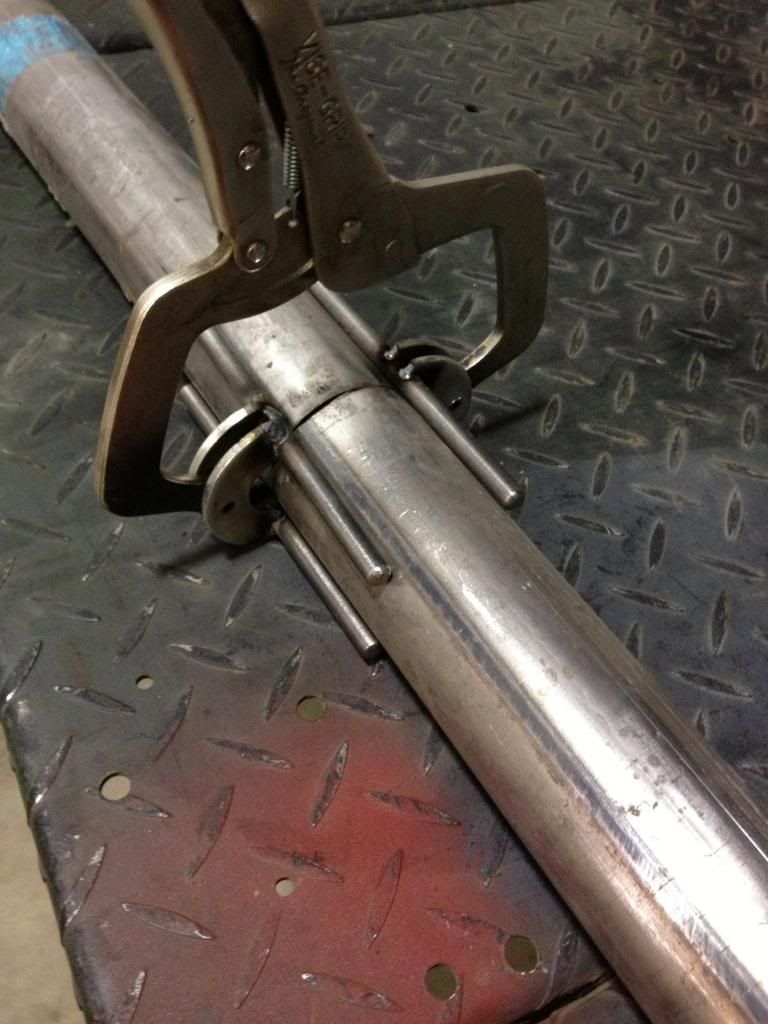
Need a way to hold two pcs of round pipe together to weld? There are ways of using angle iron, hose clamps, etc etc, but I wanted something that held 4 places and allowed access to tack weld in multiple places without it pulling out of square. I had seen pics similar to this but no measurements or instructions how to build one or where to buy. So here we go....
1-Vise Grip brand 11SP clamp
2-1" flat washers
4- 3/8"x 6" round bar
2- 1/4"x5/8" roll pins, or stove bolts would work too

Drill/grind off the rivets holding the pads on the clamp.
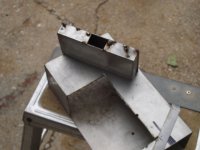
Cut 2 washers in half, I used a thin cut off wheel on my angle grinder. (ya I was a chitdip and in the pic, I had cut 4 washers before I realized it, dumb moment:eek:)
drill 7/32" hole in cut washers in the center
drill 15/64" hole in the clamp existing hole (where the pads were riveted on)
Trim the washers to allow the round bar to recess into the washers a bit. Die grinder works well here.
Install the washers, 2 per side, and allow some space between them and the clamp with the roll pins or bolts, to allow them to swivel.
Line up and weld the round bar to the washers keeping an eye on them staying strait.

There you have a clamp with a wide variety of sizes available. Also keep the original swivel pads as they can be reinstalled if needed to turn the clamp back to original if needed.


Awesum - I gots to make me one of these jiggers - reckon u can use with square tube too
 
   / Show What Tool You Made* #126  
Brilliant! Thanks for the detailed photos, I will be building one for myself soon.
 
   / Show What Tool You Made* #127  
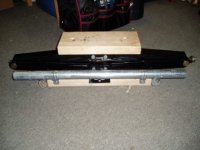
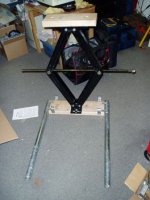
Here's one that is kinda simple but comes in really handy at times.
It is a panel jack that I made using a large scissors jack. I use it to hold large electrical panels in place while I fasten them to a wall. That process is almost impossible to do alone without it.
The scissors jack was made for an RV stabilizer and is rated for 6000# so you can hold almost anything with it. The outriggers are just for stability when it is raised made from 1-1/4" conduit.
The scissors jack will lift 36". I use an impact driver with a 3/4" socket to raise and lower it to the exact height that I need.
 

Attachments

  • Jack1.JPG
    Jack1.JPG
    27.6 KB · Views: 691
  • Jack2.JPG
    Jack2.JPG
    31 KB · Views: 838
   / Show What Tool You Made* #128  
I have always just used angle iron. I like the vise grip mod.
 
   / Show What Tool You Made*
  • Thread Starter
#129  
.
.
.
.
Scrap SS 1.jpg
Stainnless Steel scrap from salvage yard


Side plate tacked on 1.jpg
Work in progress


"Engine Turned" Face 3.jpg
Finished product


In use.jpg
In Use

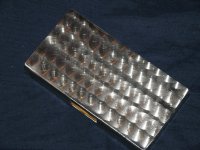
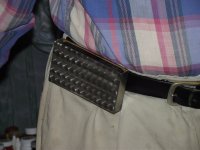
Several years ago I had Sony PDA in my pocket while working under my wheat truck. When I rolled over, I heard the crunch of my screen breaking. I needed a belt case for my iPhone and didn't want that to happen again. I was inspired by an instructable by Phil B's iPhone Case of Polished Metal to make a metal case.

Yesterday i made this stainless steel belt case for my newly acquired iPhone. Like most of you, I wanted to protect it from screen damage, but I have an affinity for SS, so I made it out of scrap SS I had picked up some time back at the salvage yard for just such a project.

Stainless is a difficult metal to work with, but well worth the effort. I tack welded it with my MIG wire welder using SS wire and ground down the tack welds. I was having trouble getting the front "mirror smooth" so I did some "engine turning" on the front. I used a sandpaper roll on my milling machine and it came out better than I expected.

I lined it inside with thin leather on the front, sides and bottom. A trial fit told me it would be too tight using the .070" leather, so I use a cloth backed vinyl upholstery on the front that measured .040. I used contact cement to glue the lining inside. Funny that .030" would make that much difference. After using .070 inside on the front and .040 inside on the back, the phone fits perfect with a little bit of drag and it is easy to remove using the tip of my finger through the hole in the bottom. iPhones uses it's aluminum frame for an antenna, and as long as 1/8" or so sticks out the top of the metal case, it receives calls fine.

Click on thumbnail photos to enlarge them.
 
   / Show What Tool You Made* #130  
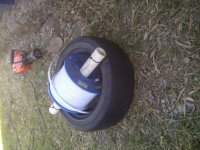
Redneck cable drum

Ok, so I figured if it takes any more than 5 minutes to plan, source parts and make it - then it would be just as quick to roll it out. Luckily the 2 main parts were in sight in the planning stage and then a quick trip to the cable tie storage area and it was done.
 

Attachments

  • image.jpg
    image.jpg
    136 KB · Views: 1,145
   / Show What Tool You Made*
  • Thread Starter
#131  
Re: Redneck cable drum

I had never tried to pull pipe through the ground with a Big Ox ripper, but a neighbor wanted to bury about 100 yards of 1" PVC. It was in straight joints, not a roll. I drilled a i/4" hole in a 4" piece of steel pipe a little bigger than the 1" PVC and tack welded it onto the back of the plow's shank. We glued all the PVC pipe together, pinned the PVC into the steel pipe and pulled it all in one pull. We buried 100 yards of pipe in a 2 foot ditch in about 2 minutes. We were both amazed.

Ok, so I figured if it takes any more than 5 minutes to plan, source parts and make it - then it would be just as quick to roll it out. Luckily the 2 main parts were in sight in the planning stage and then a quick trip to the cable tie storage area and it was done.
 
   / Show What Tool You Made* #132  
Hydraulic RAM spinner / polisher

20MTcrown_pitted_ram_spinner.jpg

Hydraulic ram needed a rebuild and was getting quotes for $500-800 for re-chrome. The machine is not worth that much and I don't use it much i just don't want it to leak.

So with some old motorcycle engine cartridge style bearings (like a 6204), I tackwelded the bearings onto an angle iron. Got a $16 air polisher and discs from Harbor Freight. Friction from the air polisher spins the ram nicely, polishes evenly. ( ! :thumbsup: ! ) Evenly enough for this job anyway.

Easy tool to make but probably will never use it again.... can't say it saved me money because I wasn't going to spend $5-800 anyway but this worked out well, got the new packing and all is well.
 
   / Show What Tool You Made* #133  
Re: Hydraulic RAM spinner / polisher

Was doing rear wheel bearings & brakes on my Son's Jetta. Rear calipers are a stupid screw-in design rather than the normal push in style. Mechanic buddy of mine lent me his snap-on set doing the first side but had to give it back before I got to the second after fighting with the bearing for a week. Dug thru the "too good or too many to throw out" bins and made this in about 15 min which is about the same amount of time it would have taken to drive to his house and back.

IMG-20131027-00772.jpg

IMG-20131027-00773.jpg

Did the job and actually worked about as poorly and the snap-on one did. As a bonus, the head is removable to compress regular calipers if I want rather than using a big C clamp.
 
   / Show What Tool You Made* #135  
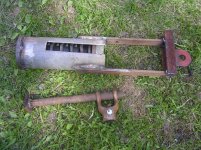
I restore old tractors quite often and it is not rare that the motor is frozen Therefore I created a handy tool to help me, when the cylinders have been left with rust solvent a while then I put this on the PTO so the engine is under tension while I gently taps on the pistons with the a mallet and a piece of wood. SANY0066.jpg
 
   / Show What Tool You Made* #136  
I restore old tractors quite often and it is not rare that the motor is frozen Therefore I created a handy tool to help me, when the cylinders have been left with rust solvent a while then I put this on the PTO so the engine is under tension while I gently taps on the pistons with the a mallet and a piece of wood. View attachment 358042

That sure is a nice one! Also, I have no idea how it works. Would you expand a little on that?
 
   / Show What Tool You Made* #137  
That sure is a nice one! Also, I have no idea how it works. Would you expand a little on that?

The part with a rod goes on pto and the tube has a spiral spring which pushes the rod. it is a piece of flat iron in the end of the rod so it does not go out of the slot. The idea is that the spring keeps the engine under tension and helps till when I loosen the pistons. The loop on tube is hung either on an engine lift or to a suitable location on the tractor, it is also a threaded rod so the spring can be compressed to make installation easier.
 
   / Show What Tool You Made* #138  
That sure is a nice one! Also, I have no idea how it works. Would you expand a little on that?

I would guess that the yoke goes on the tractor's PTO shaft and the cylinder/spring is attached to a solid structure with the "yoke" shaft riding in the cut outs in the cylinder. The now compressed spring puts constant rotational tension (pulls) on the yoke's shaft to help turn the PTO. Since the tractor's PTO is engaged, it is in essence coupled to the engines crankshaft. Any rotation of the PTO translates to the crank turning and producing piston travel. This pulls the pistons downward while Tor can tap the pistons from the top with a mallet to help free them. Is that correct Tor?
 
   / Show What Tool You Made* #139  
I would guess that the yoke goes on the tractor's PTO shaft and the cylinder/spring is attached to a solid structure with the "yoke" shaft riding in the cut outs in the cylinder. The now compressed spring puts constant rotational tension (pulls) on the yoke's shaft to help turn the PTO. Since the tractor's PTO is engaged, it is in essence coupled to the engines crankshaft. Any rotation of the PTO translates to the crank turning and producing piston travel. This pulls the pistons downward while Tor can tap the pistons from the top with a mallet to help free them. Is that correct Tor?

Exactly right. It is a great help when trying to loosen the pistons.:thumbsup:
 
   / Show What Tool You Made* #140  
would you have plans for this ??
thank you

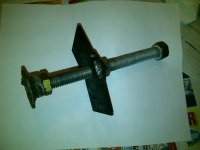
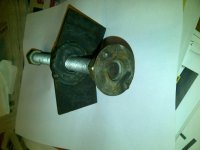
I'm guessing you are referring to me but not sure.

9" length of 5/8" threaded rod
4 nuts
3 washers
2 pieces of scrap metal

Welded the 2 washers/plates and 1 nut together
Welded one nut on the end of the threaded rod
Nut #3 welded to washer
Nut #4 is a jam nut against the nut/washer combo

As said, these are just parts I had kicking around and was able to make it work
 

Marketplace Items

2008 INTERNATIONAL WORKSTAR 7400 SBA 6X4 DUMP TRK (A57192)
2008 INTERNATIONAL...
10 Lug Wheels Full Set (A57453)
10 Lug Wheels Full...
2013 Land Rover Range Rover Sport 4X4 SUV (A55853)
2013 Land Rover...
2019 INTERNATIONAL 4300 26FT BOX TRUCK (A59905)
2019 INTERNATIONAL...
(2) NOS-8 LUG- 7000Ib 74SC-93 HUB FACE DROP AXLES (A60432)
(2) NOS-8 LUG-...
500 Gallon Fuel Tank with Pump (A55853)
500 Gallon Fuel...
 
Top