Slopes and tractor tilt

   / Slopes and tractor tilt #41  
Now if you went there, get your seat belt off, Do not depend on the ROP to save you. You will have a second or so to bail out on the high side. Lot better to watch the tractor go than to ride it. Don't ask how I know this.

Not sure if bailing out on the high side would be my first choice. The high side is the same side the mower blades are raising up to meet you, catch a foot or piece of clothing on the tractor and risk doing a face plant on the wrong side of the mower deck. If you're lucky, with your good eye, you could then watch your tractor along with the other half of your face roll down the hill.
 
Last edited:
   / Slopes and tractor tilt #42  
NEBRASKASPARKS has some good older threads on roll over time, reaction time, judging slopes, very well worth the time to look up and read.

Just a general observation, just because you can bail off a tractor successfully once or even twice, don't always count on it. My father in law did and spent several hours trapped under one and tore his foot up another time. I know anecdotes are of little relevance across the board, but something to consider.

I drive cab tractors, so I would just bounce off the glass if I tried.:eek:
 
Last edited:
   / Slopes and tractor tilt #43  
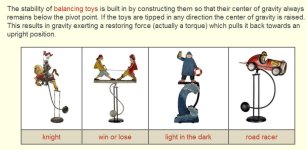
yes, that's what they are saying, but it isn't exactly so ...we probably all agree that raising the bucket higher and higher will raise the CG ...so, why doesn't lowering it lower the CG ...and if loading it and raising it raises the CG even more, then why doesn't loading it and lowering it makes the CG even lower ...

Check out these toys:
 

Attachments

  • balancing toys.jpg
    balancing toys.jpg
    74.7 KB · Views: 527
   / Slopes and tractor tilt #44  
yes, that's what they are saying, but it isn't exactly so ...we probably all agree that raising the bucket higher and higher will raise the CG ...so, why doesn't lowering it lower the CG ...and if loading it and raising it raises the CG even more, then why doesn't loading it and lowering it makes the CG even lower ...

The masts, majority of the arms and part of the bucket attachment system (Quick Attach or permanently mounted) are always above the CofG.
The only parts of the loader that are stationary are the masts (let's consider the loader mounting brackets part of the tractor for this post, shall we?).
My bucket, a 61" standard duty, weighs between 200-250 lbs (call it 225 lbs). The 430 loader, per Deere, weighs about 900 lbs (what I don't know is if that includes the bucket weight. But for this post, we'll assume it does include the bucket weight). So, 900 - 225 is 675 lbs (we're removing the bucket for this post) . The majority of this 675 lbs is above the the tractor's CofG...permanently. All one can do with this weight is lift it higher...moving the center of gravity higher as well.
IF the bucket was attached and empty, that 225 lbs (at it's lowest yet still allow forward travel of the tractor) would aid in lowering the CofG, but you still have that 675lbs working against you.
I suppose you could put enough weight in the bucket to counteract the weight of the loader masts and arms (when mowing), but that doesn't seem to make much sense when you could just as easily remove the loader.
Make sense?
 
   / Slopes and tractor tilt #45  
I suppose you could put enough weight in the bucket to counteract the weight of the loader masts and arms (when mowing), but that doesn't seem to make much sense when you could just as easily remove the loader.
Make sense?

I don't think that would work on side hills, due to the fact the extra weight in the bucket will try to slide the front tires down the hill. I put a Ratchet Rake on my loader and just 65lbs way out in front of the bucket acted much like I had the loader filled with dirt.:ashamed:
 
   / Slopes and tractor tilt #46  
I don't think that would work on side hills, due to the fact the extra weight in the bucket will try to slide the front tires down the hill. I put a Ratchet Rake on my loader and just 65lbs way out in front of the bucket acted much like I had the loader filled with dirt.:ashamed:

No it wouldn't...just as you wrote. What I wrote was more theoretical then practical. The practical thing to do is drop the loader off. If one does need some kind of front ballast, get suitcase weights (the majority of that weight is below the axle).
 
   / Slopes and tractor tilt #47  
yes, that's what they are saying, but it isn't exactly so ...we probably all agree that raising the bucket higher and higher will raise the CG ...so, why doesn't lowering it lower the CG ...and if loading it and raising it raises the CG even more, then why doesn't loading it and lowering it makes the CG even lower ...

Check out these toys:
I do , it does, etc. You are missing the key point tho. Proportionally shifting weight off the rears frontward unloads the rears. When you get them unloaded well you are going to tip on the slightest slope regardless of a low cg. On a slight slope tho the front axle stops wil save you.
larry
 
   / Slopes and tractor tilt #48  
In an earlier post, Jackson wrote:

"IF the bucket was attached and empty, that 225 lbs (at it's lowest yet still allow forward travel of the tractor) would aid in lowering the CofG, but you still have that 675lbs working against you. I suppose you could put enough weight in the bucket to counteract the weight of the loader masts and arms (when mowing), but that doesn't seem to make much sense when you could just as easily remove the loader."​

My intuition is that proper design of a FEL keeps the CG unchanged when the bucket is in the "carry" positiion ...and adding weight lowers the CG, as you (and I) said. Anyway, without a load in the bucket, on/off wouldn't matter much in lateral stability if kept low in the carry position, IMHO.

As for the subsequent poster, who said:

"...the extra weight in the bucket will try to slide the front tires down the hill."​

That doesn't coincide with the experience that many of us have had that the slide occurs most easily when the tires in question (front or rear) are "unweighted" ...just thinking out loud, if you put a very, very, very lot of weight on the front tires, you probably couldn't budge them sideways on any slope we might sensibly traverse, again, IMHO

I'll experiment...and, if I never post again, you'll know my experiments failed.
 
   / Slopes and tractor tilt #49  
I do , it does, etc. You are missing the key point tho. Proportionally shifting weight off the rears frontward unloads the rears. When you get them unloaded well you are going to tip on the slightest slope regardless of a low cg. On a slight slope tho the front axle stops wil save you.
larry

Yes, perhaps I missed the point...I thought we were talking about lateral stability, not longitudinal stability (fore and aft) ...speaking of which, you might enjoy:

YouTube - Front End Loader Stoppie
 
   / Slopes and tractor tilt #50  
I just purchased a Stoll FC 350 FEL for my 1720 last month. I have mowed my yard 3 times since then and have left it on. I run a 6' RFM, have lived on the farm 51 years, and have driven tractors since I was a little boy. Here are my observations thus far using the FEL attached while mowing.

1. I mow my yard in the same manner as before. No change in direction or procedures. I do have 2 specific areas of concern that are very steep. On those areas I still mow side hill when proper and then up and down when proper.

2. I can actually now mow one of those slopes uphill better with the FEL now as I can counter balance the tractor by lowering the bucket as I crest the hill.

3. So far I have been extra careful watching the front and rear of the tractor as the loader does add quite a bit of length to the unit.

4. Just a personal observation and no scientific data to back it up. I think that the balance and overall safety of the tractor is better with the bucket on since I can control the amount of weight placed forward of the front axle. If the loader was removed I don't know how the handling of the tractor would be affected. I would tend to think that the center of gravity would be higher with the loader off. The loader arms and bucket leverages against the higher center of gravity of the loader frame.

Again, these are just seat of the pants observations from a guy that was raised up on the farm and has driven tractors and run farm equipment most of his life.
 
   / Slopes and tractor tilt #51  
your experience coincides w. mine ...incidentally, if you are mowing down a steep slope, 4wd is almost a must.
 
   / Slopes and tractor tilt #52  
This is a great thread....I'm getting all kinds of ideas....or fears. My tractor is a 4X4, can't imagine heading down a hill without it. The REAR wheels are filled with A/F but not the front wheels. BTW, the front wheels are inset much narrower than the rears. Can they be offset wider someway? Are there spacers or plates or something? AND, here is an off the wall idea, how about "suitcase" weights hung IN the FEL bucket on the UPSIDE side so they don't fall on a slope? Just thinking of adding "upside" weight. And I ALWAYS wear my seatbelt......it reduces the pucker factor.;)
 
   / Slopes and tractor tilt #53  
Interesting debates but I think several points are amiss. First, today's loaders are attached at only one place on the tractor, coincidentally just about perfectly in the cog of the maichine. That isn't a mistake. It distributes the weight perfectly. There is no change to the cog since all the weight is always loaded to the same points on the frame. What is changing is the torque arm of the loader weight. On a side hill, the height of the arms above or below the attachment points act as a lever. Same weight, same cog, just a longer lever. No different than swinging a backhoe up the hill. The weight is the same but th lever is moved longer and opposite the down hill side. The same but smaller thing occurs with the loader.
 
   / Slopes and tractor tilt #54  
Here is another question that might leave some of you veterans scratching your heads at a newbie, however...here goes.

What is the max tilt or slope that you feel comfortable with? Granted, I know the standard "if you feel nervous then it's too much" kind of answer, but do tractor manufacturers engineer to a certain slope rating. Just curious.

TK100M slope question

--------------------------------------------------------------------------------
Some one asked this question in the NH forum regarding a crawler and this was my response.

Quote:
Originally Posted by dmiletich
The total width of the tractor is 69". New Holland told me the center of gravity is dead center of the width, which would be 34 1/2". From ground to center of gravity is 46 1/4" in height.


Given those dimensions, you should be able to take a maximum of 36.3° slope (arctan 34.5/46.25 =36.3°) to be at the threshold of tipping with no other loads considered. That's about a 75% grade.

The same principles apply. Adding a front loader may have a significant effect on the vertical location of center of graviy(cg). Certainly raising a bucket with a load on it will and to a lesser extent, so will raisng the bucket when it's empty. My guess is the weight of a typical loader installation slighly raises the cg so it s destabilizing.

This formula gives the limit of stability slope angle;
limiting slope angle = arctan (1/2 the rear wheel track/vertical height of the cg).

In this case, the limiting slope angle was 36.3° assuming no other loads on the vehicle. If you hit a bump and it tips the tractor slightly down slope, you could tip over at a lower slope angle.

This gives you an upper limit on stability. Given that tractors often operate on a rough ground, you really wouldn't want to operate at this limiting angle. I would limit myself to oerating at a maximum of 80% of this angle and keep my speed down to preclude big tipping from rough spots. You can also increase the track of the rear wheels and gain some stability.
Iif you know the effect of the loader installation on the verticle height of the cg, you can compute the limit for a tractor with a loader installed.

hope this sheds some light on the discussion.
 
   / Slopes and tractor tilt #55  
What I have found to be the best indication of safe slope is if you are tending to slide sideways in the seat, you are getting too steep. It doesnt take a lot of bump to dump you if you hit a low spot on the downhill side, or especially a hump, rock or other protrusion on the high side, you can flip your tractor so quickly that there is no way to dismount prior to it going over. Trying to climb up a 30 degree slope to get off a tractor is nigh to impossible and it will be 30 degrees before you can realize that you have screwed up so you had better have your ROPS and seat belt on. If at all possible, go up and down the slope and not side ways or even slanting it side ways. Even though the tractor may not flip over from a standing still position lets say if you were slowing jacking one side up just to check the angle, it may not go over till past 90 degrees but travelling it doesnt take much to flip it. I once saw a woman flip her car over while travelling on flat ground doing no more than 10 mph in a school yard. She was turning a 180 and oversteered hit a 4" curb which yanked the steering wheel while at the same time running the inside wheel up on the curb. She flipped it so fast that she had no time to react. The funny thing about it was when she told me that it was a rental as her car was in the shop getting repaired from a pervious accident. While this story has no relation to tractors, I relate it to tell that flip overs can happen very fast and you have no time to react in most instances so best thing it to react prior to it flipping by changing your tactics. I have some slopes that are beyond 45 degree but are only about 20 feet in length and maybe 100 feet distance before the hill levels out. I mow that are going down hill only and circle around to a flatter section to climb back to the top. Just like the OP talked about hitting a soft spot where the tires sunk a little and increased his slope considerably, ground conditions can change quickly so never push the limit. You can safely mow very steep angles if the distance is short going down hill if you just ride it out and stay off the brakes OR if using the brakes make sure that you dont lock up one side and slide sideways. If you have the fel on, you have to make sure that it doesnt dig into the ground as you approach to bottom of the slope. If you feel it is too steep to safely drive down, break out the hand held weedeater or just let it grow up for wildlife habitat.
 
   / Slopes and tractor tilt #56  
My brother an i used to race a 4x4 in a local club with some bad side slopes and steep up and down and generaly the rougher the better he managed to roll the car twice on side slopes and it was in the same places that i had driven around and many others that day had also done so with no problems

I think the real problem was that he was a little to fast and didnt read the ground in front of him properly

In one case he rolled 6 times to the bottom of the hill and was ok but he was strapped in the bucket seat with a 5 point harness with a good roll cage above him

The answer iS to go SLOW and WALK what you drive first it will give you a better indication of what is under that grass

Even with a seat belt you Don't want to test the roll bar it isn't a cage
and will not protect you like one

And you don't want to chance it when the is no one around to see it happen it will make a bad problem worse if there is no one to help you when it goes wrong
 
   / Slopes and tractor tilt #57  
So very true, ROPS is not a roll cage. It is supposed to limit you to side roll over only and if you got on a steep slope and did roll, then you would likely keep rolling till bottom and the ROPS might be of little to no use to you.
 
   / Slopes and tractor tilt #58  
This brings up a thought I've had about the design of Most all ROPS, I'm sure the Manufactures and Safety Inspectors have their reason for this design, although inquiring minds want to know?;)
Why is a ROPS design with rounded/curved corners at the top?
seems to me that with this design a tractor could continue to roll as stated if on a hillside, as appose to one that would have 90% corners, or even some I've seen have the bar extend out past and over side uprights, Looks to me a square corner ROPS would limit the roll over to a simple side roll,
anyone care to elaborate on this round corner design?:confused:
 
Last edited:
   / Slopes and tractor tilt #59  
This brings up a thought I've had about the design of Most all ROPS, I'm sure the Manufactures and Safety Inspectors have their reason for this design, although inquiring minds want to know?;)
Why is a ROPS design with rounded/curved corners at the top?
seems to me that with this design a tractor could continue to roll as stated if on a hillside, as appose to one that would have 90% corners, or even some I've seen have the bar extend out past and over side uprights, Looks to me a square corner ROPS would limit the roll over to a simple side roll,
anyone care to elaborate on this round corner design?:confused:

Cost would be my guess.
The ROPS (on most tractors) is just a bent length of square tubing with mounting flanges welded to the ends. BTW, I'm ignoring the complexity of the folding ROPS.
That seems like it would contradict the fact that some "value" (read "lower cost") tractors have squared off ROPS (Deere 790/3005 and 990/4005 come to mind). The ROPS on the 790/3005 consists of some bends, but the upper corners are seperate elbows bolted in place.
Costwise, I wouldn't be surprised if the 790/3005 ROPS cost more to manufacture (due to more manufacturing processes in the build) then the ROPS for a Deere 3320 (for example). The 790/3005 and 990/4005 ROPS are very old designs too (mid-1980's)
This cost theory is pure speculation on my part, BTW...
 
   / Slopes and tractor tilt #60  
Yes, perhaps I missed the point...I thought we were talking about lateral stability, not longitudinal stability (fore and aft) ...speaking of which, you might enjoy:

YouTube - Front End Loader Stoppie
I was talking lateral stability ... but coincidently, when the rear is unloaded you have no lat stability and longitudinal only against back tip. You can neither decelerate or negotiate a sideslope without setting the overhung front weight down.
larry
 

Tractor & Equipment Auctions

Le Roi 80-Gallon Air Compressor, 220 Volts (A59076)
Le Roi 80-Gallon...
2025 AGT YC-32G Saw Mill (A53317)
2025 AGT YC-32G...
2014 AMERITRAIL LAY FLAT HOSE TUGGER TRAILER (A58214)
2014 AMERITRAIL...
2017 Ram 5500 Bucket Truck (A56438)
2017 Ram 5500...
KUBOTA SVL97-2 SKID STEER (A60429)
KUBOTA SVL97-2...
2008 CAT D6T DOZER (A58214)
2008 CAT D6T DOZER...
 
Top