Wallenstein winch operation

/ Wallenstein winch operation #1  

MAN IN BLACK

Gold Member
Joined
Mar 18, 2013
Messages
312
Tractor
MF GC2610 tlb,mmm
I just bought a new FX65 Wallenstein skidding winch.
I'm waiting for the weather to clear to head to the woods and give it a try ( been raining all weekend here)
My question is...do I need to run the tractor motor at full throttle to have pto 540 rpm, or can I operate the winch at lower motor rpm, and if so, can I still pull the same load ?
Thanks for any advice !
Black
 
/ Wallenstein winch operation #2  
That is an excellant question.
No need to run at full throttle. In fact I would strongly advise against it. Your deisel motor delivers good torque a low rpm's. Deisel have a flat torque curve, meaning the torque is about the same for any rpm once you are above idle. Torque is what generates the pulling capacity not horse power. PTO torgue in foot-lbs turning the winch drum determines the cable pull in lbs.
I run my winch between 1500 and 1800 rpm motor speed which is 300 to 360 rpm at the pto.
Go slow at first. You will find there is a lot to learn to be efficient. And be careful.
 
/ Wallenstein winch operation #3  
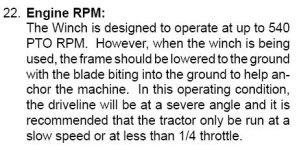
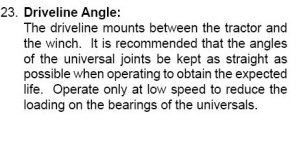
No, don't run it at 540rpm. When winch blade is lowered, the PTO shaft is at a steep angle. I usually run tractor rpm at 1200 (where 2200 rpm engine = 540rpm PTO), or about 300rpm (PTO). For "heavy" loads I'll "crank engine up to 1500 rpm (or about 368 rpm). I keep the universals regularly greased.

The max load is determined by the friction clutch on the winch. Trying to remember my physics (how max torque relates to power and speed), but i think that at a slower speed the clutch would actually "hold" a heavier load moving at a slow speed than at faster speed? (However its most likely to slip when your cable speed = 0 (i.e. the log is hung up on a stump or rock, etc.)).
I run the FX65 on a 64+hp (rpm) tractor and hardly ever hear the tractor "load", even when the winch's clutch is slipping.
From the operators manual:
untitled.JPG
untitled1.JPG
 
/ Wallenstein winch operation #4  
Good advice above. I usually run my fx 90 at 1300-1500rpm
 
/ Wallenstein winch operation #5  
I just bought a new FX65 Wallenstein skidding winch.
I'm waiting for the weather to clear to head to the woods and give it a try ( been raining all weekend here)
My question is...do I need to run the tractor motor at full throttle to have pto 540 rpm, or can I operate the winch at lower motor rpm, and if so, can I still pull the same load ?
Thanks for any advice !
Black

There's no need to go above idle for most pulls. The beauty of the winch is its automotive clutch. Pull on the rope and the clutch engages as gently as the clutch on a good standard transmission. The thing works best at relaxed speeds. If there's smoke coming off the clutch when you pull, though, you'll need to take the pull more seriously, with safety considerations: more revs will mean more strain on the tractor, so be sure the brakes are set and that you are standing at the end of the rope, because the winch has the torque to spin the tractor around, tow it backwards, or, as my neighbour warned me, break it in half if you have chained the front axle to a tree.

You'll find the winch is a great tool around the property. One of its early uses for me was uprooting sumacs from a building lot. Another time it delicately lifted a large limb from a maple tree off the front of our house without damage. It's great for cleanup of small dead elms: hook on to control the fall, cut the tree, tow the whole thing to a landing in a more convenient location on the farm. It's also the only safe tool I know for taking down widow makers. Just hook onto the butt and pull.

With practice you'll likely use it instead of a felling wedge to control the direction of tree falls. Pre-tension the cable enough that it doesn't sag from as high as you can reach. Cut the wedge. Add more tension if necessary. Cut the tree. It's very accurate. Of course you'll need the full 150' of cable for most uses of this sort.

Another bonus of the machine: the cage around the unit is to protect the operator, not so much during skidding operations as when backing up to pile brush and logs. The winch is virtually indestructible when used as a bulldozer blade against logs and brush.

Notice how I've left the actual skidding until last? That's because it gets used as a winch on my property more than as a log skidder. It works fine for the few logs I take out each year (high quality hardwoods or firewood) but it's useful enough the rest of the time I never take it off the Massey Ferguson 35.
 
/ Wallenstein winch operation
  • Thread Starter
#6  
Thanks for the great comments & advice ev1 !
Black
 
/ Wallenstein winch operation #7  
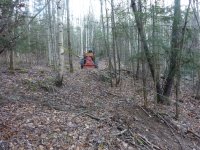
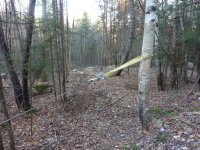
You may find having a snatch block or two will help a lot especially if you have rough, steep, or swampy terrain where you can't just drive anywhere you want. They enable you to keep the cable straight back from the tractor and then change the direction of pull with the snatch block. They help to get around good trees you want to save and not damage by rubbing the bark off. Here are a couple examples. The first two are a winch line I set up down a stteep hill over a ledgey place. The third I have my tractor in a skid road with a snatch block on an ash right behind it. Then I hung the cable high on a tree with a second block (a slider actually) so I could pull that tree that is hung up and behind the stump up and over the stump and then skid it down to the road.
 

Attachments

  • Winching.JPG
    Winching.JPG
    889 KB · Views: 412
  • BigFirWinchTrail1.JPG
    BigFirWinchTrail1.JPG
    717.6 KB · Views: 382
  • BigFirWinchTrail2.JPG
    BigFirWinchTrail2.JPG
    702.6 KB · Views: 296
/ Wallenstein winch operation #9  
If there's smoke coming off the clutch when you pull, though, you'll need to take the pull more seriously, with safety considerations: more revs will mean more strain on the tractor, so be sure the brakes are set and that you are standing at the end of the rope, because the winch has the torque to spin the tractor around, tow it backwards, or, as my neighbour warned me, break it in half if you have chained the front axle to a tree.

Also: Watch out you don't tip the tractor over if pulling from an angle. Especially if you're not running the cable through the lower pulley on the blade of the winch and pulling directly from the upper pulley like a Farmi does. If pulling at an angle from a point above the tractor's center of gravity, watch the tractor's tire to make sure they stay on the ground. :rolleyes:
Yes, you should always use the lower pulley as it takes the stress off the upper 3pt link, but I sometimes cheat because it helps to pull the end of the log over stumps, or from the log butts dragging 4 wheelbarrows worth of brush and sticks that get all bound up in the choker chains.
 
Last edited:
/ Wallenstein winch operation #10  
Yes, you should always use the lower pulley as it takes the stress off the upper 3pt link, but I sometimes cheat because it helps to pull the end of the log over stumps, or from the log butts dragging 4 wheelbarrows worth of brush and sticks that get all bound up in the choker chains.

I respecfully disagree with your statement that the lower pully should be used while winching. The only way to get down pressure on the winch blade is by using the upper pully. Downward pressure is necessary to propery anchor the winch. With the blade anchored properly the pulling force is on the winch itself and the ground it is buried in with very little force transferred to the lift arms and top link. If you winch from the lower pully there is very little downward force to bury the blade so the tractor has to hold the winch back thru the lift arms and top link. That is hard on the tractor and it is more likely to move.
Many people do not believe this but it is true. If the cable is not angling down there is no downward force on the winch to anchor it. It is that simple.
Reading this may be interesting. It is not Farmi hype it is basic physics. Note the highlighted bold text.
 
/ Wallenstein winch operation #11  
I was quoting the manual (i think). I hear what you're saying, but as long as the 3 pth arms attach below the lower pulley there's a downward force. I know that when it's running off the top pulley I can watch the draft control sensor on the top link flex, but I don't worry about it stressing the top link, then again I don't worry the blade not digging in when it's on the bottom pulley. It's all good.
 
/ Wallenstein winch operation #12  
Yeah I've never had an issue with my fx90 not digging in when using the low pulley. I've buried it way down on many occasion. I use the low pulley almost exclusively because I winch in then lock the drum and skid all in one effort without leaving the seat.
 
/ Wallenstein winch operation #13  
I agree with you guys. You can use your winch many different ways and it will work fine. They are robust versatile impliments. The weight of the winch provides some down force but a lot more is added by winching from the top. If you are on frozen or hard ground winching from the top really helps to make the blade grab. There are more of advantages winching from the top. For one, using the top tends to lift the logs so they don't plow so much and are more likely to ride up over snags and debris.

The point I was disagreeing with was where Coby said that you should never winch off the top pully. That is not at all true. And I feel a new user needs to know that. They are designed to be used that way. And if the winch matches the tractor the top link is plenty strong. Pulling at a side angle is what will tear your top link out. The top link should take a hard straight winch just fine. The weakest part of of the winch line is most often the cable or pully shaft not the top link.
 
/ Wallenstein winch operation #14  
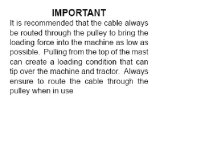
I'm not crazy, I did read it in the manual:
Pulley.JPG

....although I don't follow their guidlelines. What do they know!:D
 
/ Wallenstein winch operation #15  
I can see what you mean and why you would thing as you did. That is very unclear. But I believe that they are referring to when you are skidding the logs out to the landing and not to the act of winching. The key being they state you are less likely to tip over (backwards if the load catches or up hill, or sideways during a turn) when using the bottom pully. That only makes sense skidding. It would be almost impossible to tip the tractor over with a straight winch pull off the top pully unless the tractor is way to light for the winch. You could winch it over with a side pull however, which is a big no-no, and also twist up your lift arms and top link. Tip over is a definately a higher risk when skidding from the top pully especially if the load is to heavy for the machine set up.
If you read your manual the way I suggested about it agrees exactly to what the Farmi manual says about pully usage.
 
/ Wallenstein winch operation
  • Thread Starter
#16  
Thanks ev1 for your comments.
I put my unit to work this past week, and it's unbelievable how much power they have !
I had my GC2610 stuck to the frame with a fully loaded 1.5 ton dump trailer of wood...hooked the winch to the front of tractor frame, and home we go...not more than that !
Running the tractor idle , I was pulling 20" trees as nothing !
Should have bought one of these much sooner...not having to carry multiple lengths of 3/8 grade 70 chains, through hills , creek , brush and all was great + being able to watch what is happening while pulling, is nice, not having to drive forward
I would certainly recommend a winch to anyone working in the forest seriously.
Black
 
/ Wallenstein winch operation #17  
Thanks ev1 for your comments.
I put my unit to work this past week, and it's unbelievable how much power they have !
I had my GC2610 stuck to the frame with a fully loaded 1.5 ton dump trailer of wood...hooked the winch to the front of tractor frame, and home we go...not more than that !

Black

Cautionary Tale:

In my salad years I worked as a surveyor in the summer. This job was a long, rising curve with muskeg between the hills on the Rideau Ferry Road. When it came time to install the 6' culvert, a new kid on a Case Construction King backed down to the edge of the gravel, set his stabilizers, reached out for a bucket full of muskeg, and sank to the axles.

Not to be deterred, he hustled up the slope and asked the operator of the Caterpillar D10 bulldozer to give him a hand. The kid took the winch cable from the back of the D10, passed it over the front axle, under the oil pan, and back over the axle before hooking back to the cable. The D10 tightened up the cable, then actually spun a little bit before the Case's engine block split in half and dumped several gallons of black oil onto the ground.

The kid reached into the cab of the backhoe for his lunchbox and walked back up the hill to his car. We never saw him again.
 

Marketplace Items

John Deere HX14 Rotary Cutter (A64047)
John Deere HX14...
SECTION OF PALLET RACKING (A63745)
SECTION OF PALLET...
Quick Hitch Mini Excavator Attachment (A61572)
Quick Hitch Mini...
2016 Ford Escape SUV (A61569)
2016 Ford Escape...
Arrow Quip 10' Bow Gate (A64047)
Arrow Quip 10' Bow...
2020 MACK GRANITE (A63569)
2020 MACK GRANITE...
 
Top