Washout-proofing a ditch

   / Washout-proofing a ditch
  • Thread Starter
#41  
Sounds like you need bigger culverts or a second one. I have two driveways at my place. One paved and another gravel one that leads to a small storage building. The gravel drive had a single culvert that was to small and to short. People turned around in that drive and crushed the end. The water during a big rain would over top the culvert and run down the gravel drive and wash it out. I put in two new culverts instead of one and made them 10 feet longer.

In the pic is where I was installing the new culverts. They have handled the flow so far. The drive way runs left to right in the pic and our main road is on the right.View attachment 706644
Ah, wide open space and unencumbered tractor operations in three dimensional space. You're living the dream!
 
   / Washout-proofing a ditch
  • Thread Starter
#42  
As for getting the water thru the culverts, there are some posts in TBN here somewhere, where they used old guard rail from road construction projects. That would allow you to drive over them, wouldn't be very deep so bedrock should not be an issue and will control the water and prevent washouts as the water flows across the top of the road. It sounds like what you need is a lined water bar.

guard rail water bar
Interesting. Not sure it scales up when the water is a foot deep though, which is what is flowing in my trench when it rains hard enough. Heck, it is some inches deep just on snow melt. Still, interesting to see your approach.
 
   / Washout-proofing a ditch
  • Thread Starter
#43  
Just to better understand your problem, doesn't your washout show water running alongside your road - not across the road?

Washout across your road = undersized culverts.
Washout alongside your road = Water moving too fast / ditch too narrow/ ditch material not stable enough.

View attachment 706676
The problem I'm trying to solve in this thread is water running alongside the road. That is what does the most damage to my driveway. What I was hoping to find was a solution that would let me toughen up the face of the driveway material alongside which the water is running. So between your red arrow and the gravel on the right. Doesn't really matter how deep the ditch is if it continues to erode the material alongside it, undermining the driveway.

I did mention a "wash over" the top of the driveway in one storm, but it did relatively little damage, isn't a pervasive problem, and I'm, going to just chalk it up to the conditions of that particular storm (which occurred in december with ice, snow, & debris in the ditches).

From a cost & trouble standpoint, lining the driveway with these might be my best option: 4 in. x 8 in. x 16 in. Solid Concrete Block-30168621 - The Home Depot if I can make them stable. And I don't know enough about cement mixes to know if I can cement them together in a water resistant way. Cheaper and more solid than the paver blocks you suggested, but I'm looking at a vertical solution, not one on the bottom of the culvert which, when the little rocks are washed out (which all came from the driveway), is generally bedrock.
 
   / Washout-proofing a ditch #44  
Ah, wide open space and unencumbered tractor operations in three dimensional space. You're living the dream!
Isn't a nightmare also a dream?
20200531_152828.jpg
 
   / Washout-proofing a ditch #46  
You don't have to widen all of the ditch - just bump out a swale here and there to slow and capture the water.

Swale5.jpg

Swale 5b.jpg
 
Last edited:
   / Washout-proofing a ditch #47  
Just an add on.

I've seen.....

That corrugated plastic pipe culvert, sawn in half the long way, and laid down to define the ditch.

Not cheap, not easy, but an idea.
 
   / Washout-proofing a ditch #48  
Many years ago the local highway department where I lived in NY tried to fix the ditch across the road from my house. They first tried putting rip-rap in, except they used round stone! I just shook my head. (This is on a fairly steep hill, so plenty of water velocity). Couple days later it rained. A lot. All the stone washed to the first culvert under a driveway at the bottom of the hill, scouring the sides of the ditch as it went, and plugging the culvert. A few days later I came home to find they had lined the ditch with concrete, I assume fiber reinforced, and apparently placed and packed against the side of the ditch with the back side of a backhoe bucket. Still there when I moved away 10 years ago, probably still there now.
 
   / Washout-proofing a ditch #49  
Going untraditional here. I used this method on a creek to control storm runoff. I purchased a pallet of bags of ready mix concrete. I used 60 lb I stacked & lined up the bags where I wanted them. After each course I used a pitchfork to stab a few times so the moisture could enter and cure. After the paper disintegrates you are left with round rocks carefully locked together. There are some pictures online of huge retaining walls done in this style
 
   / Washout-proofing a ditch #50  
You don't have to widen all of the ditch - just bump out a swale here and there to slow and capture the water.

View attachment 706740
View attachment 706742

You are so fortunate to have such flat, level and open lands.

My situation, and it seems to be that of the OP, is much less available to such accommodations.

Myself, I've got a six foot high or more band of ledge on the high side of the road, with ledge defining the course, grade and slope of the roadway. Gravel was added OVER the solid rock to make the roadway surface, and it is anything but flat! Every rain washes away some of the small stone and fines that are there to hold it all together. It was all that could be done when the road went in. Short of blasting!
 
   / Washout-proofing a ditch #51  
I don't disagree. That ledge makes things difficult. We don't know exactly what he has to work with. If he does have an area in the right place where he can dig out a swale, it is a cheap fix.
 
   / Washout-proofing a ditch #52  
Like digging it said the county here uses rip rap and they hold up very well
 
   / Washout-proofing a ditch #53  
If you've got a picture of what a "rip rap" lined ditch looks like that might help.
Had similar problem on my steep driveway. Just had professional company come in and cut 2x2 ditch down the low side and fill with 4+ rip rap. Also lines it with fabric. Then regraded the lane to pitch that way and cut down the hills a bit. Then layed modified stone and compacted it thoroughly. Holding up great so far, but the real test will come next spring.
 

Attachments

  • 6829401F-72F0-4328-B4EA-3413F09F52CB.jpeg
    6829401F-72F0-4328-B4EA-3413F09F52CB.jpeg
    4.6 MB · Views: 257
  • 2C039362-FFE7-4C26-940D-983FCD3166EB.jpeg
    2C039362-FFE7-4C26-940D-983FCD3166EB.jpeg
    5.2 MB · Views: 246
   / Washout-proofing a ditch #54  
Around here the county highway dept uses straw bales in many locations. Every 75 to 100 feet down the ditch. Usually two or three bales laid across the ditch. Dirt will collect upstream of the bales. Soon grass will grow. The bales have created an almost permanent structure.
This is done to slow erosion from the water movement. Depending on the slope, is how close the bales will be placed.
 
   / Washout-proofing a ditch #55  
Would that just cause a huge unfortunate mass of water at the end points of the bales?
It slows the water flow, it does not stop the flow. During a heavy downpour, you may have some ponding happening
Would you prefer erosion or temporary ponding?
 
   / Washout-proofing a ditch #56  
I hate riprap lined ditches. You can’t mow it. I’d rather have the erosion.
This is true! But with deep cut trenches from rushing water can you mow anyway? Not to mention if the sides of the ditch ate steep and depth of ditch may in itself prevent mowing. Each must decide which evil he wishes to endure. The rip-rap is hard on string trimmer lines as well.
My approach was to spray grass/weed killer (your choice of which). Be sure to follow all safety precautions when dealing with chemicals as well as spraying on days without wind, wether drift is a concern or not, get soaked with chemicals is not good for your long term health.
 
   / Washout-proofing a ditch #57  
The only three things you need to know about road maintenance are drainage, drainage, and drainage -- in that order!. The common solution is to line the ditch with stone, but first you need to be sure you have adequate cross-drainage. Check with AOT website or your town road commissioner for class three highway specs. Culverts should be a minimum of 15" diameter, laid an angle to the road, and at a proper depth--usually covered by same depth as culvert diam---15" cover for a 15" culvert. That may not be possible due to your ledge. Number of culverts and spacing is very important. It depends on grade of road. In VT rip-rap usually applies to big stone such as would be used to line an eroding stream bank--too big for your needs. See what your town uses, because they are going by State specs. Don't use stone from a gravel screening process, because it is round stone--you need crushed so it can lock together. Hay bales are only useful as a temporary solution--weeks or months, not years. Your principal objective needs to be diverting the water off the road, not just slowing it down.
 
   / Washout-proofing a ditch #59  
I just moved from my 1/2 mile gravel drive with a swamp halfway between the house and main road. Nothing like a U-shaped road (as seen from the side) to cause all sorts of erosion issues. It was a PITA, but over the years I got it under control. Went from 30-50 tons per year of new material to about 4.

Agree 100% on the OP's need to slow the flow. Even stepping ponds with small water falls will slow the water as the grade drops and severely slow the erosion.

Where that is not feasible, look into the 1' wide by 2" deep drive-over gravel erosion systems (similar to permeable paver systems) to line the edges of the road (under surface) and support the height of the road bed, while the water runs alongside the paver system. These systems are generally run $6-10 / LF at 2-4" high. Start where the problem is worse, strip down 4-5" of road, 18" wide.. lay the plastic "paver" grid then backfill with Item4 w/ extra fines. Do a bit at a time until your problems go away. Should not have to do the full run.. The ledge is helpful here, as its less likely the mesh gets undermined.

Another alternative would be to use those same mesh systems in the ditch to slow the water, though I've not tried that so don't have personal experience. I somehow doubt it will slow anything when the volume is highest.

The more you can slow the flow, the less of the plastic paver stuff you'll need.

Also go really heavy on the fines for any new road surface material. I would have the quarry add 1 ton stone dust to every 3 tons of DOT Spec Item4. NO, and I mean NO, round rock. No bank run. No "crushed gravel". No pebbles. Angular only. All sides. Its twice as much but lasts 20x as long.
 
   / Washout-proofing a ditch #60  
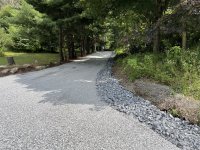
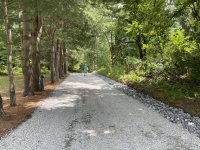
See attached photo, which unfortunately doesn't show the 10-12 vertical inch drop from driveway surface to water very well.

I have this drainage ditch along my gravel driveway feeding multiple culverts all in the hope it will keep my driveway from washing away.

Mostly it works. Most of the length of the driveway the bedrock is right at the base of the ditch. It probably is here too, the pebbles you see are the gravel it's constantly washing out of my driveway. So it's not something I can deepen with a tractor. I might be able to push it back a, but that probably wouldn't work unless I move the ditch back the whole length of the driveway, which isn't pragmatically feasible (trees, rocks, difficult spaces).

So need some way to line the driveway gravel so that the next rain won't just wash it out. I have no idea what to use. Cement / cinderblocks of some kind seems easiest, would that work? I'm looking for suggestions from people who have overcome this particular erosion problem.

I hate having to regularly throw more gravel (purchased by the truckload) at this problem.
Around here the county/state folks have used a cement poured liner over a 3/4+fines gravel lined ditch. On the steeper sections they make a kind of water slalom course in the cement (think poured cement brick shaped structures @ a 30-45 angle facing down slope) to slow down the water. So far the only thing really "trapped" in the slalom course are larger (4"+) branches, leaves etc, go through to the bottom where the culvert is. I doubt this would be an inexpensive fix, but our gravel roads haven't washed out since they put this system in place.

I don't have a pic of this but if my description doesn't make sense I could get one & post it next time we head to town.
 

Tractor & Equipment Auctions

UNUSED FUTURE 16" HYD AUGER (A52706)
UNUSED FUTURE 16"...
2017 Wacker Neuson LTV6 Towable Light Tower (A56857)
2017 Wacker Neuson...
2013 CATERPILLAR 308E CR EXCAVATOR (A60429)
2013 CATERPILLAR...
Pat's QH and hydraulic top-link.
Pat's QH and...
2014 JOHN DEERE  544K WHEEL LOADER (A58214)
2014 JOHN DEERE...
10,000 PSI AIR HYDRAULIC PUMP (A58214)
10,000 PSI AIR...
 
Top