I don't know if this will help your issue but I had a a problem holding a pond over flow. I took old car tires cut out one side wall and bolted them in a grid cut out side up and filled them up with rip rap. The tires kept the rip rap in place and silt filed in and Bermuda grass took over and now you do not see the fix.
You are using an out of date browser. It may not display this or other websites correctly.
You should upgrade or use an alternative browser.
You should upgrade or use an alternative browser.
Washout-proofing a ditch
- Thread starter Bullwinkle123
- Start date
- Views: 33616
More options
Who Replied?
/ Washout-proofing a ditch
#61
3 or 6 inch crushed stone. Screened round stones won't work. They need to be trap rock. I have a 6 foot drop from my driveway and in the spot where it washed out, I filled with 1.5 inch crushed stone, and it is working fine, and I am not far from southern VT (northern MA) just below Keene NH and it has rained like hell for the past month.See attached photo, which unfortunately doesn't show the 10-12 vertical inch drop from driveway surface to water very well.
I have this drainage ditch along my gravel driveway feeding multiple culverts all in the hope it will keep my driveway from washing away.
Mostly it works. Most of the length of the driveway the bedrock is right at the base of the ditch. It probably is here too, the pebbles you see are the gravel it's constantly washing out of my driveway. So it's not something I can deepen with a tractor. I might be able to push it back a, but that probably wouldn't work unless I move the ditch back the whole length of the driveway, which isn't pragmatically feasible (trees, rocks, difficult spaces).
So need some way to line the driveway gravel so that the next rain won't just wash it out. I have no idea what to use. Cement / cinderblocks of some kind seems easiest, would that work? I'm looking for suggestions from people who have overcome this particular erosion problem.
I hate having to regularly throw more gravel (purchased by the truckload) at this problem.
I hear ya, man! After dealing with the same problems with our half mile driveway for 20 years, we had it paved. It was expensive but, not having to rework the driveway after every heavy rain and scraping off a layer of dirt and gravel every time plowing snow, it has been way worth it. Anything done, short of paving, is wrought with additional maintenance headaches that continue to make more work for you and, as you know, cost you more time and money. The paved driveway makes it much easier to plow snow since you can put the bucket or blade down right on the pavement and not worry that it will take half your driveway away. 

kwbobwi
Bronze Member

EasyPave Grid - Grass Driveway Grid - Gravel Grid System
Introducing Standartpark EasyPave Grid! 2 Inches in height, will withstand loads up to 88,000 lbs without even anything inside it, and even comes with the ability to utilize installation anchors (optional). So what is better about this than the competition? We have put a lot of thought into the...
 standartpark-usa.com

OhioCowboy
Silver Member
- Joined
- Jul 28, 2009
- Messages
- 166
- Location
- N. Ohio
- Tractor
- KIOTI CK3510se HST Open Station w/FEL, RK24 HST w/FEL & Backhoe, DEAD-NH TC33D HST
My solution after many years of the same problem was to install an 8" double walled corrugated pipe (whatever size as needed) down the driveway. Expensive but I installed 60 ft one year, 100 ft the next and so forth until it was complete. I found rerouting worked for a while.See attached photo, which unfortunately doesn't show the 10-12 vertical inch drop from driveway surface to water very well.
I have this drainage ditch along my gravel driveway feeding multiple culverts all in the hope it will keep my driveway from washing away.
Mostly it works. Most of the length of the driveway the bedrock is right at the base of the ditch. It probably is here too, the pebbles you see are the gravel it's constantly washing out of my driveway. So it's not something I can deepen with a tractor. I might be able to push it back a, but that probably wouldn't work unless I move the ditch back the whole length of the driveway, which isn't pragmatically feasible (trees, rocks, difficult spaces).
So need some way to line the driveway gravel so that the next rain won't just wash it out. I have no idea what to use. Cement / cinderblocks of some kind seems easiest, would that work? I'm looking for suggestions from people who have overcome this particular erosion problem.
I hate having to regularly throw more gravel (purchased by the truckload) at this problem.
polarisalpacas
New member
A commercial product we have used on a number of road and highway projects is becoming widely available in the US. It's known as Concrete Cloth or Concrete Canvas. Essentially a roll of two layers of fabric (usually geosynthetic or canvas) with a layer of cement/fiber/sand sandwiched between. It comes dry and wrapped up in a roll, and comes in several thicknesses depending on expected conditions. You roll it out, either in overlapping transverse sections if it is a wide ditch or channel, or longitudinally if it's a narrow ditch. You should toe it in at the top of the ditch or channel. Once it's in place, you wet it down. The cement mixture sets up, and you have an impervious "relatively" quick concrete ditch lining. It comes in various widths and roll lengths. There used to just be one supplier in the US, but I see that a number of companies are now producing and selling it. You can probably find it at a commercial building materials supplier. Be aware, it's not cheap (placing a cast-in-place concrete ditch is slightly cheaper), but it's quick to install, and pretty much instant and permanent. You can do a search on Youtube for Concrete Canvas or Concrete Cloth for videos to see how it's installed and used. The British have also used it to make "permanent" inflatable shelters for military and medical use - pretty cool stuff!So need some way to line the driveway gravel so that the next rain won't just wash it out. I have no idea what to use. Cement / cinderblocks of some kind seems easiest, would that work? I'm looking for suggestions from people who have overcome this particular erosion problem.

FERLING
Gold Member
- Joined
- Sep 30, 2018
- Messages
- 339
- Tractor
- New Holland WorkMaster 50
Weed killer takes care of it or if you like to work weed eater the high spots.I hate riprap lined ditches. You can’t mow it. I’d rather have the erosion.
Louhasaboat
New member
- Joined
- May 28, 2011
- Messages
- 4
- Tractor
- Kubota L5740 HST
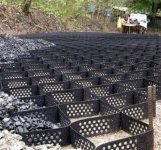
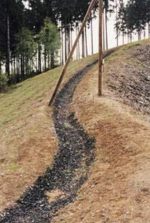
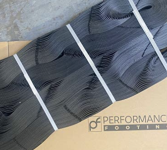
I have the same issue along one of my access roads that I’m about to rebuild. A few years ago I discovered a GeoTech Pocket product that comes in 9’x26’ segments that works for both roadbed and ditch purposes. It also allows water to migrate underneath the rock that drains well and really packs even better as it ages. My first use was putting a rock access driveway access to my 5th Wheel cover. It’s been in use for over 6 years and is designed for 20,000 lbs or more per squire foot. I used a 6” pocket, but for a ditch I would recommend 2” or 4” pocket. I’m going to us the 2” pocket on my 6% to 8% ditch grades and 4” pocket for the steepest 10% ditch grades. My water management ditch base design is 18” wide and 12” deep. Using 16” strip segments, I get 6.75 16” strips of 4” and 6”, or 175 feet of ditch lining per package. I have never lost gravel even at the swill entrance to a culvert or ditch turn location. Yes it costs, but so does the time and gravel lose I had beforehand. Hopefully this is useful. My first use was in TX, my new location is on a hillside driveway with lots of WA rain runoff. I’m attaching product images on design and layout.See attached photo, which unfortunately doesn't show the 10-12 vertical inch drop from driveway surface to water very well.
I have this drainage ditch along my gravel driveway feeding multiple culverts all in the hope it will keep my driveway from washing away.
Mostly it works. Most of the length of the driveway the bedrock is right at the base of the ditch. It probably is here too, the pebbles you see are the gravel it's constantly washing out of my driveway. So it's not something I can deepen with a tractor. I might be able to push it back a, but that probably wouldn't work unless I move the ditch back the whole length of the driveway, which isn't pragmatically feasible (trees, rocks, difficult spaces).
So need some way to line the driveway gravel so that the next rain won't just wash it out. I have no idea what to use. Cement / cinderblocks of some kind seems easiest, would that work? I'm looking for suggestions from people who have overcome this particular erosion problem.
I hate having to regularly throw more gravel (purchased by the truckload) at this problem.
Attachments


Tony H
Platinum Member
- Joined
- Mar 18, 2013
- Messages
- 683
- Location
- Summit, NY lots of Lake Affect snow
- Tractor
- JCB MIDI CX / 1985 Cub Cadet 782
Anyway to slow the water coming down the slope? Multiple swales on the slope?

smiley
Platinum Member
I spent 40 years building and repairing roads from dirt roads to superhighways and rip rapping sometimes by the mile and hundreds of tons. The bigger the rock, the better it will stay. On some jobs we individually placed huge rocks where you might get only 2 or 3 on a truck and weighing many tons. It all depends on the force of the water in flood conditions and how steep the slope is. The small stuff 4 inches and under are for dressing up that gently flowing brook in your backyard. Most of our jobs used man size that are up to 8 -12 inches. The step up from that are the large, up to 2-3 ft that must be placed with at least a backhoe. Most of the time we placed them on geo-textile to prevent erosion behind the rocks but if the slope is to steep the rocks can slide on the geo-textile. If you have vertical slopes you can use it against the bank and 2 or 3 feet into the stream to prevent washout and collapse behind the rocks. What we called shot rock, blasted from quarries is best because of the sharp edges and varying sizes locking together. Cobbles can be used and look nicer but can be moved easier under extreme conditions. Gabions are another option where space is limited and near vertical faces are necessary. They are large wire baskets in many sizes Seach gabions. Generally we used about 3 x 3 x 8 ft for road use, that are set in place and filled with smaller, generally 4" stone. I also saw but never built a used tire retaining wall that seemed to work well. You can search it online and find a lot of info.See attached photo, which unfortunately doesn't show the 10-12 vertical inch drop from driveway surface to water very well.
I have this drainage ditch along my gravel driveway feeding multiple culverts all in the hope it will keep my driveway from washing away.
Mostly it works. Most of the length of the driveway the bedrock is right at the base of the ditch. It probably is here too, the pebbles you see are the gravel it's constantly washing out of my driveway. So it's not something I can deepen with a tractor. I might be able to push it back a, but that probably wouldn't work unless I move the ditch back the whole length of the driveway, which isn't pragmatically feasible (trees, rocks, difficult spaces).
So need some way to line the driveway gravel so that the next rain won't just wash it out. I have no idea what to use. Cement / cinderblocks of some kind seems easiest, would that work? I'm looking for suggestions from people who have overcome this particular erosion problem.
I hate having to regularly throw more gravel (purchased by the truckload) at this problem.
Hope this helps with any size job you have.
Smiley
gc2310
Bronze Member
See attached photo, which unfortunately doesn't show the 10-12 vertical inch drop from driveway surface to water very well.
I have this drainage ditch along my gravel driveway feeding multiple culverts all in the hope it will keep my driveway from washing away.
Mostly it works. Most of the length of the driveway the bedrock is right at the base of the ditch. It probably is here too, the pebbles you see are the gravel it's constantly washing out of my driveway. So it's not something I can deepen with a tractor. I might be able to push it back a, but that probably wouldn't work unless I move the ditch back the whole length of the driveway, which isn't pragmatically feasible (trees, rocks, difficult spaces).
So need some way to line the driveway gravel so that the next rain won't just wash it out. I have no idea what to use. Cement / cinderblocks of some kind seems easiest, would that work? I'm looking for suggestions from people who have overcome this particular erosion problem.
I hate having to regularly throw more gravel (purchased by the truckload) at this problem.
gc2310
Bronze Member
Your picture and description matches my driveway exactly. A friend [ who works for a concrete company ] suggested a v shaped curb that they often use along roads with big water flow. I haven't tried it yet, I'm saving up. It's a lot of concrete. Keep us posted.

Shutesbury
Silver Member
- Joined
- Sep 22, 2010
- Messages
- 169
- Location
- Western Massachusetts
- Tractor
- Kubota BX-24 - other goodies listed in my profile.
If the base is bedrock, it sounds like you don't care if the water runs along that... so could you create a roadside wall on the ditch with railroad ties, or just some long straight 6-8" trees of limbs, to keep the water from eroding your driving surface?
I had similar issues and carving drainage ditches with the rear blade and backfilling with 7-minus ( blue stone, rough edged, 2" -7"plus in size. It worked very well for me. In some instances I did entire drive surfaces in 7minus and covered that with hard pack. It has held up well, even in the 6" plus rain from the storm last week. I wouldn't recommend concrete as it is impervious and serves to speed up the runoff water which could then overwhelm your culvertsSee attached photo, which unfortunately doesn't show the 10-12 vertical inch drop from driveway surface to water very well.
I have this drainage ditch along my gravel driveway feeding multiple culverts all in the hope it will keep my driveway from washing away.
Mostly it works. Most of the length of the driveway the bedrock is right at the base of the ditch. It probably is here too, the pebbles you see are the gravel it's constantly washing out of my driveway. So it's not something I can deepen with a tractor. I might be able to push it back a, but that probably wouldn't work unless I move the ditch back the whole length of the driveway, which isn't pragmatically feasible (trees, rocks, difficult spaces).
So need some way to line the driveway gravel so that the next rain won't just wash it out. I have no idea what to use. Cement / cinderblocks of some kind seems easiest, would that work? I'm looking for suggestions from people who have overcome this particular erosion problem.
I hate having to regularly throw more gravel (purchased by the truckload) at this problem.
My grandad owned a half mile long abandoned railroad bed with side ditches providing drainage. One day we were driving the pickup along the bed and ole gramps suddenly jammed on the brakes. We skidded to a stop just short of falling into a gully washout 5' wide and 5' deep. It cut right across the sub-ballast rail-bed material. All it takes is a dead-fall blocking ditch flow and a downpour. If there had been an upstream crossover culvert (hydraulically connecting both ditches) flow would have bypassed.
As described in so many of the previous posts, you must take the power in the water developed by way of gravity, and mitigate it. ....This is usually done by slowing the water down so the turbulence in the water subsides and the solids in the water settle. I do this where I live by blocking the bottom third of all of my culverts to effectively make a little 'dam' that the water encounters. This does multiple things. .....It slows the erosive power at the bottom of the ditch, while it also keeps the culvert clean so it doesn't silt up(the water crossing the little 'dam' has enough power to keep the culvert clean). .....A splash pad at the exit of the culvert also helps distribute the erosive power of the water. ....A fair amount of maintenance is needed to keep it clean and working, but it can be made to be quite effective. ......Extracting energy from run off water can be a tricky, complicated challenge.

oosik
Epic Contributor
Flowing water creates a need for scheduled maintenance/repair. The straw bales are not a maintenance free answer. Eventually the Highway Dept comes along - mucks out the sediment & bales with some form of heavy equipment and replaces the straw bales.
However - the roadside ditch has not been damaged by the water and the road has not been washed out.
However - the roadside ditch has not been damaged by the water and the road has not been washed out.

SaddleBronc
New member
- Joined
- Sep 5, 2013
- Messages
- 22
- Location
- Duncan, OK
- Tractor
- Kubota M8560, JD 110TLB, New Holland C238 CTL
If you can't divert the water, the next option is to slow it down - which will work. As others have said, larger rocks are the ticket. They help form eddies in the flow which keep the smaller rocks from being dislodged or washing past.
I've had good luck with broken up concrete (with no rebar) that I've picked up for free. Talk to your county commissioner...if they don't have some they will know where to get it.
As for mowing it, that's not practical. If the weeds are a problem you can RM43 it a couple times a season.
I've had good luck with broken up concrete (with no rebar) that I've picked up for free. Talk to your county commissioner...if they don't have some they will know where to get it.
As for mowing it, that's not practical. If the weeds are a problem you can RM43 it a couple times a season.
mk2133
New member
If you're looking for a cheap fix you have already discarded all the options.
Here are some similar links:

- Replies
- 110
- Views
- 12K

