Water storage solutions in a drought

   / Water storage solutions in a drought
  • Thread Starter
#22  
We had two 1750 gal storage tanks set up on our well system (when I was still using the well). Our first well went dry, drilled a second well 200' deeper. It produced 15 gal / min at first, but over 3 years, also went almost dry (maybe 10 gal per HOUR)

At that time, set up a timer in conjunction with the pump protector. When the pump protector tripped to "off", the timer would trip on, keeping the pump protector from starting the pump for 2 hours until the well would replenish. This is when we installed the tanks.

The well would feed into one tank with a float valve to turn it off when full. The second tank was just gravity fed from the first (effectively filling both tanks simultaneously). The same pipe that gravity fed the tank was where a booster pump was installed (off a "T" fitting) so it pulled from both tanks. The original 60 gal pressure tank was right after the pump, then going to the house.

It worked very well like this for years, supplying a 5 BR, 3 bath house, 6 people. ......Until that well went dry. It cost me over $35K to get the municipal water line run a mile to our house.

In your situation, I would probably just install a couple of tanks, plumb them into the system with shut off valves. You would need to put a shut off on the well pump supply line (or at least a one way check valve) to prevent the tanks from draining back down the well. Also a valve prior to the pressure tank to isolate the pressure tank to the house (This will allow shunting the well to fill the tanks without backflowing from the house). I would also put a booster pump on the tank line before the shutoff. (You can still fill the tanks just flowing backwards through the pump).

This will allow a few things...
1) if the well pump ever went out, you could still operate the household at full pressure running off the tanks.
2) you can fill the tanks from the well by turning a few valves.
3) you can run a booster pump off of a small generator, in case of power failure.
4) you can set up a hose tap after the booster to be able to connect a hose for fire suppression.... won't put out a wildfire, but could wet stuff down if needed.

I hope this helps. Don't hesitate to ask any other questions.
LS, I know it is difficult to apply a solution that worked for one circumstance to other situations - different elevations, and such - but perhaps something might be feasible.

Some more background before my questions;

The well head is at the same elevation as the house and about 40 feet away. Just behind the well the elevation increases and there are several terraced flat areas - each about 5 feet higher as they go up. I estimate that the highest elevation is about 40' higher than the well and about 80 feet farther back. So, I could use your two tank suggestion, or maybe one tank, if I ran water from the well to the tanks high up but that may not be the best course - or easiest course.

Because, as you say, I could run a small booster pump off of a generator, what about:

-putting a tank (or two tanks) next to the well head
-having water pumped into the top of the tank (and possibly into two tanks)
-having a shut off float switch in the tank to shut it off when it is full
-having a second float switch in the tank set lower down to turn it back on to fill it
-installing a booster pump for the tank (or tanks) to fill the pressure tank and pressurize the system. (I am assuming a booster pump could achieve the 40-60 range needed)
-
-I would not have any gravity fed advantage by putting the tank near the well and at the same elevation as the house, but as you state, I could use a generator to power the booster pump as necessary if power went out. And to get the gravity fed advantage would make the project many times more difficult.

Questions: 1)I understand the need for a check valve between the booster and pressure tank but, as you advise, would I need a check valve to prevent water from flowing back to the well if it entered the tank at the top and that entry point would never come in contact with the water as the float switch would be set to prevent that? I guess I am not clear on where each check valve would be needed.

2) Not sure I understand comment: "I would also put a booster pump on the tank line before the shutoff. (You can still fill the tanks just flowing backwards through the pump)"

3) re your comment that 'you could fill the tanks from the well by turning a few valves' - wouldn't the tank or tank be filled automatically by having the well pump controlled by a shut off and on float switches set at different levels? (or would that work only if had one tank?)

Again, thanks for your detailed post - thinking this through is interesting. Appreciate the help. Old men need hobbies.
 
   / Water storage solutions in a drought #23  
FWIW: You probably know this from your rain barrels, but rainwater tends to have lots of sediment and debris in it. Ideally, there is a first flush diverted to let the first hit of debris filled rain bypass the collection system completely and then the remainder goes to a large tank, where it can slowly settle. After it has settled, you could pump it uphill. Just be aware that running dirty water through the pump is going to make the particles smaller and take them longer to settle.

I saw a design that had a spiral of perforated drain pipe at the bottom of a rainwater tank attached to the drain valve as a way to get sediment out of the tank easily. Some friends have an ozonator running continuously, or 8hrs out of 24, to keep the water from smelling.

A rainwater system has been on my do list for awhile, but for us the tank site is a major operation needing new concrete retaining walls, etc., so it has not moved to the "do now" list quite yet. Personally, I would love to have it to be able to wash things without having hard water spots.

Good luck!

All the best,

Peter
 
   / Water storage solutions in a drought #24  
I understand the need for a check valve between the booster and pressure tank but, as you advise, would I need a check valve to prevent water from flowing back to the well if it entered the tank at the top and that entry point would never come in contact with the water as the float switch would be set to prevent that?

I have looked into similar issues for my property. A very big choice for you is whether to save and store water exclusively for outside irrigation, or to have water for combined use that includes drinking, bathing, etc. Outside-only water, not connected at all to the drinking water system, is much easier for the obvious reasons.

If you intend to use it for drinking water, you must ensure it is safe and clean at all times during storage. I'm not sure how to do that. Maybe others are.

Where the delivery splits/combines between household water and outside irrigation, you will need a reduced pressure backflow preventer (RPBP) or similar device. A single check valve to protect your drinking water simply is not sufficient. Some will advocate plumbing two check valves in a row as double protection, but even that opens the chance of contamination. A RPBP is best although you will lose some psi due to the workings of the device. Or a vacuum breaker on the irrigation side of things is another choice.
 
   / Water storage solutions in a drought #25  
LS, I know it is difficult to apply a solution that worked for one circumstance to other situations - different elevations, and such - but perhaps something might be feasible.

Some more background before my questions;

The well head is at the same elevation as the house and about 40 feet away. Just behind the well the elevation increases and there are several terraced flat areas - each about 5 feet higher as they go up. I estimate that the highest elevation is about 40' higher than the well and about 80 feet farther back. So, I could use your two tank suggestion, or maybe one tank, if I ran water from the well to the tanks high up but that may not be the best course - or easiest course.

Because, as you say, I could run a small booster pump off of a generator, what about:

-putting a tank (or two tanks) next to the well head
-having water pumped into the top of the tank (and possibly into two tanks)
-having a shut off float switch in the tank to shut it off when it is full
-having a second float switch in the tank set lower down to turn it back on to fill it
-installing a booster pump for the tank (or tanks) to fill the pressure tank and pressurize the system. (I am assuming a booster pump could achieve the 40-60 range needed)
-
-I would not have any gravity fed advantage by putting the tank near the well and at the same elevation as the house, but as you state, I could use a generator to power the booster pump as necessary if power went out. And to get the gravity fed advantage would make the project many times more difficult.

Questions: 1)I understand the need for a check valve between the booster and pressure tank but, as you advise, would I need a check valve to prevent water from flowing back to the well if it entered the tank at the top and that entry point would never come in contact with the water as the float switch would be set to prevent that? I guess I am not clear on where each check valve would be needed.

2) Not sure I understand comment: "I would also put a booster pump on the tank line before the shutoff. (You can still fill the tanks just flowing backwards through the pump)"

3) re your comment that 'you could fill the tanks from the well by turning a few valves' - wouldn't the tank or tank be filled automatically by having the well pump controlled by a shut off and on float switches set at different levels? (or would that work only if had one tank?)

Again, thanks for your detailed post - thinking this through is interesting. Appreciate the help. Old men need hobbies.
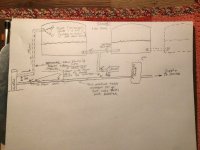
Just saw your post.... I will sketch out a simple diagram and post on here in a bit....

#2 was if you wanted to run normally off the well, using the tanks solely as backup. Essentially isolating the tanks and booster pump.

#3 was including #2, being able to run off the tanks OR the well.

#1 would be my preferred choice, but, a little more complicated, but you would always be cycling fresh water through the tanks. The tanks would also serve as "drop points" for any minerals or sediment.

There is no need for two float switches. There are 2 types:
#1 -- type that "turns on" the equipment when raised, "off" when lowered.

#2 -- type that "turns off" the equipment when raised, "on" when lowered.

You would want the one that "turns off" when raised (tank is full), turning off the well pump.
You could add an additional one of the first type, much lower in the tank, to turn off the equipment in case of low water level in the tank (to prevent damage from running dry) but is not necessary. Having both types of float valves just makes the wiring a bit more complicated.

Stand-by for that diagram....
 
   / Water storage solutions in a drought #26  
Here is the diagram.... I have done better work...:rolleyes:
 

Attachments

  • image.jpg
    image.jpg
    3 MB · Views: 158
   / Water storage solutions in a drought #27  
What if the government spent some of those billions in infrastructure money on research for an efficient and economical desalinization process? California has over 1100 miles of coastline on the largest ocean in the world. It could be powered by wind, solar, or wave action. Just a suggestion Mr. government, forget mars, explore the pacific. Don't curse the darkness, light a candle.
Bill
 
   / Water storage solutions in a drought
  • Thread Starter
#28  
Here is the diagram.... I have done better work...:rolleyes:
Thanks again - really helps to think through my options. BTW - yesterday I contacted a tank supplier - they are apparently having a run on tanks - prices increasing and at least an eight week wait for any delivery.
 
   / Water storage solutions in a drought #29  
Thanks again - really helps to think through my options. BTW - yesterday I contacted a tank supplier - they are apparently having a run on tanks - prices increasing and at least an eight week wait for any delivery.
Same here. I am upgrading my well at my Nevada residence and the supplier said his prices have increased. If I don't commit to work by May 15 he is passing those new charges onto me.
 
   / Water storage solutions in a drought #30  
Thanks again - really helps to think through my options. BTW - yesterday I contacted a tank supplier - they are apparently having a run on tanks - prices increasing and at least an eight week wait for any delivery.
I was surprised a couple months ago when I decided to sell my tanks.....

First a neighbor wanted them, and I was going to swap him for his time doing some welding for me.... after 6 months of waiting, he told me "never mind, go ahead and sell them".....

So I loaded them on a trailer and took them down the road to the little town. There is a lot there where people sell trucks, cars, anything....

By the time I got back home (15 minutes), had my first call inquiring about them. About 10 minutes later, the second call offered full asking price and an additional $100 if I would deliver them about 2 miles from where they were sitting. An hour later, the deal was done!

I got the same price for what I paid for them 12 years earlier.....
 
   / Water storage solutions in a drought #31  
One possibility for water storage is the modular concept that involves a hole lined with a waterproof liner and the volume held up by plastic components such as milk crate type boxes or plastic pipes. The apparent advantage is not needing a structural tank and flexibility in placement and size.
 
   / Water storage solutions in a drought #32  
Have you have kept records on the static water level in your well? If so - then the first step is to see what the static water level is now. Maybe all your concern is for naught.
Much ado about nothing ?
 
   / Water storage solutions in a drought #33  
What about an outdoor natural swimming pool? It’s an obvious above ground pond but it might be a way to bypass the insanely restrictive Cali regulations.
 
   / Water storage solutions in a drought #34  
You probably know this from your rain barrels, but rainwater tends to have lots of sediment and debris in it.
I eliminate most of that going into my IBC totes from the gutters with screens that you can buy at any box store that fit over the downspout and I added stainless screens in each one. They slant towards the overflow opening so they self clean. Work really well. Very little sediment gets in the totes.

SOP for me is to always open the gate valve at the bottom for a few seconds just to get anything out and my pressure washer has a cannister stainless steel screen on the inlet to catch anything anyway. Pressure washers don't like sediment in the water, screws up the ceramic pistons. 7 years on this one so far. Just change the pump and engine oil every year. Keep in mine that pressure washer pumps don't take regular motor oil, the take NON DETERGENT hydraulic oil. Motor oil will kill a pressure washer pump.

I guess having minerals in the ground water is still better than none at all.
 
   / Water storage solutions in a drought #35  
Timely Thread especially for many in the West...

Know many came up dry at great expense... like 40k with nothing to show.
Thanks again - really helps to think through my options. BTW - yesterday I contacted a tank supplier - they are apparently having a run on tanks - prices increasing and at least an eight week wait for any delivery.
Of course they are... just remember the toilet paper run when rolls stolen right out of institutional holders...

Destroy a $35 holder for a half used roll of TP
 
   / Water storage solutions in a drought #37  
Good water and lots of it is what attracted me to the Pacific Northwest and specifically Olympia area.

As we head for another round of restrictions just how many more rock gardens will be created so kids have rocks to throw?

0ne of my friends has tanks totaling 20k gallons for irrigation... twice now he has found valves opened and all water gone... he is just glad tanks not damaged.

I leveled the pads and helped with placement using the 110 as a backstop when rolling tank down trail... worked great.

For the shale hillside pads the Deere 110 made quick work and the BX23 superb for leveling...
 
   / Water storage solutions in a drought #38  
One possibility for water storage is the modular concept that involves a hole lined with a waterproof liner and the volume held up by plastic components such as milk crate type boxes or plastic pipes. The apparent advantage is not needing a structural tank and flexibility in placement and size.
The problem with water storage for irrigation is the massive amount required. If you run one 3 gpm rainbird 4 hours a day for 60 days, you need about 45,000 gallons.

Capturing rainwater from your roof, parking lot or driveway​

in many parts of the world, capturing rainwater from roof tops is common. Check to see if a permit is required in your state.

Some useful figures and calculations for rain water catchment:

Inches rainfall x Square feet of catchment area x 0.625 = gallons of water captured
The 0.625 Factor = (7.5 gallons per cubic foot of water / 12-inch depth per cubic foot = 0.625)

Example:

30-inches per year is equivalent to 18.75 gallons per of water
collected from each square foot of surface area.

30-inches of rainfall collected from the roof of a 1,600 square
foot home = 30,000 gallons water

30-inches of rainfall collected from the roof of a 2,500 square
foot home = 46,875 gallons water

Storage tank capacity will depend on total rainfall, surface area
collected, seasonal rainfall patterns, and seasonal water use patterns.

 
   / Water storage solutions in a drought
  • Thread Starter
#39  
Larry, regarding the rainwater capture - the amount your post references that you can capture is really interesting. I may work on that for next year as I have four buildings I could draw rain water from - if only I can figure out a way to get all of those connected to a single line and to a storage unit of some kind. That would have to be a really big storage unit though.

An aside: I recall a post on here a while back discussing how it was illegal to capture your own rain water as it was owned by the state. I think the state was Colorado. It seemed that the state's concern - and thus the law - was that that water was needed as runoff for rivers and such.
 
Last edited:
   / Water storage solutions in a drought #40  
Some places you have to incorporate some capture if I understand and parts of AZ might be included.
 

Marketplace Items

Year: 2019 Make: Nissan Model: NV200 Vehicle Type: Van Mileage: 88,557 Plate: Body Type: 4 Door Van (A55853)
Year: 2019 Make...
2016 Volkswagen Tiguan SUV (A59231)
2016 Volkswagen...
2018 Chevrolet Camaro 1LT Coupe (A59231)
2018 Chevrolet...
BUYERS PREMIUM & PAYMENT TERMS (A59905)
BUYERS PREMIUM &...
2427 (A60432)
2427 (A60432)
2025 RB66 66in Rock Bucket Skid Steer Attachment (A59228)
2025 RB66 66in...
 
Top