Went solar

/ Went solar #61  
How about the newer leds, with the heat sinks built into them. I was looking at gettting a bunch of them.
 
/ Went solar #62  
It's really hard to tell if there is enough heat sinking in a LED light, but if you can see signs that an effort was made that's a good sign. The manufacturers of the LEDs are making packages for the chips themselves that have both better thermal characteristics and make it easier to make a fixture for the LED that can get rid of the heat.
It would still take a tear-down, look at the parts, and a measurement of the LED surface itself to know for sure, hard stuff to do. And it's hard to tell by measuring the outside temperature of the device. A device with good heat sinking might be hotter on the outside than one with poor heat sinking. This would be because good heat sinking would move more of the heat to the outside of the device whereas poor heat sinking bottles up the heat and the rest of the device is like insulation, keeping you from feeling how hot it is.

I'd try one or two and see how they hold up. Until such time as a group like Consumer Reports starts measuring the LED die temperature and looking at the temperature rating of the capacitors in the device, it's very hard to tell what you have. It's kinda like some tractors- you have to run them for a couple hundred hours to get a feel for how well they will hold up.

Sorry I don't have a better answer...

Pete
 
/ Went solar
  • Thread Starter
#63  
I have been eyeing panels for my 5th wheel. Have an acquaintance with health issues. They have medical equipment they need to run at night. They boondock/dry camp. He runs a couple extra batteries, and has solar. He can run primarily battery/solar. He only uses the generator fo big items, and occasionally on cloudy days to boost the battery charge. AC is not an issue; he camps mainly on the N. Calif coast where the temps are very mild.

For a long time, we have been more energy concious, mainly because of the bills... And, living on a well after growing up on city water too. I am amazed at how much water my parents and brother waste down in town...

I would agree with that... having recently bought an RV that we take camping/dirtbike riding. We are always 'boondocking' which is camping without a grid hookup, just what was in the battery when we started and what we can produce with a generator. Kind of an eye opening experience as to what you take for granted at a house where you just 'flip the switch'. Goes for water usage to :)
 
/ Went solar #64  
CFLs tend to not work from an economic point of view if they are on for less than 5 minutes. Like a well pump, they may run forever but only turn on so many times. Incandescence have the same problem, but with a lower price they don't have to turn on as many times to be cost effective. There is a lot of manufacturer variation in quality and how much heat CFLs can take, and some of the problem here has been a rush to market with poor/cheap designs.
Pete

If you do an economic analysis of a CFL for say 10000 hours or something with a common incandesant that will burn out in x hours vs the CFL in y hours it will be cheaper considering the fewer bulbs used (even though at a higher price) and the cheaper perhour useage cost.

Also mythbusters did a turn on turn off test and the CFL lasted longer i think than the incandesant and the LED lasted longer. Get on the Discovery website and search for the energy efficient episode or lightbulb episode or something. I dont miss an episode so i remember seeing the test. They had some set up that would cycle on off every so many seconds, there theory was the same that this would kill the CFL sonner than it should. I think i remember the results right?
 
/ Went solar #65  
Clemsonfor, as far as CFL life goes it all comes down to temperature. If you compare a CFL vs. incandescent in a table lamp where the bulb is upright, the CFL is a big win. Put a 23W CFL in a ceiling can with no ventilation and it gets so hot that the electronics doesn't last and even with the energy savings it's a loose.

Had not seen the mythbusters episode on on/off tests, and it would be great if there was a brand that did better. Like the old florescent with the starter modules vs. newer electronic balast there are different schemes for starting the bulbs. Good ones (long life) cost more than bad ones, nothing new there :laughing:. I'd love to see the episode. What would be interesting is to compare the number of on/off cycles the bulbs can take, then look at the cost of the bulbs and see what's cheaper. If the CFL cost 4 times as much as the incandescent, than it needs to have at least 4 times the turn on/turn off life to be a wash. If the lifetime of the CFL is determined by on off cycles, then the energy savings is much less important. So a bulb in a pantry closeset that gets cycled a lot but is rarely on for more than a minute or two is the test case here.

I have some high sconces in the TV room that I run 5W CFLs in (so they are roughly equivalent to a 20 watt incandescent). So they are on for many hours each day. They are horizontal in an open top fixture. Between the low wattage of the device and all the air, they run super cool and should last a very long time.

Even if you blow the temperature of a LED a bit, you'll still get OK light out of it at 25,000 hours and the limiting factor might be the electronics.

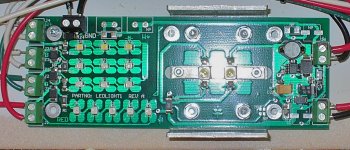
Finally, just for grins, here's a circuit board I did so I could play with LED light. The right side has two 1 watt LEDs. LEDs want a constant current, so the little circuit on the right is a switching power supply that makes constant current. There are now chips that do this explicitly designed for LEDs, this is a modified power supply chip. The driver is about 85% efficient, the new chips are closer to 95% efficient. You can see the .090 tick aluminum heat sink. It's about 2" long. After the LEDs have been on for 5 minutes, the heat sink is about 40 degrees above ambient, a bit hotter than I'd like. The dies (actual leds) are about 15 degrees hotter than the heat sink. On the left there are low power LEDs for colors- they don't need much heat sinking so the extra foil on the board is enough. I did that so I could have the top of the room light up in Red, Green, and White during the holidays :thumbsup:.

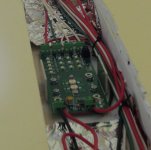
The 2nd picture is how I installed 27 of these in catwalk of our great room. They were covered with a strip of white plexiglass. The whole system runs on 10 to 20 volts DC. The circuit boards all fit in a channel that is the width of a 2x4. The aluminum foil helps reflect light back up in the room- these are pointing towards the ceiling for indirect light.

The system is no where near commercially feasible now, but everything that makes it expensive is electronics stuff that keeps getting cheaper as seen by the LED driving chips available now. The LEDs I paid $10 for are now in the $5 range. The effect of the distributed, diffuse light is very nice. I have three clusters of 9 boards. I have one of those as part of the emergency light system for the house. The problem gets harder/more expensive when you have to take 120V AC and make a .3 or .5 amp current source at about 6 to 24 volts vs. having a DC power source to begin with.

Hope this isn't a thread hijack...

Pete
 

Attachments

  • ledlight_small_1.jpg
    ledlight_small_1.jpg
    308 KB · Views: 94
  • ledlight_small_2.jpg
    ledlight_small_2.jpg
    383.9 KB · Views: 95
/ Went solar #66  
Storm, all energy sources get some form of government subsidies. But I also realize that the argument "well, everyone else is getting money from the government" is a pretty weak argument. An interesting question is this:

If none of the energy sources we used received government assistance, tax breaks or preferential regulatory laws, then would the price of electricity be high enough that solar would be finically feasible with no tax credits? Wish I new the answer...

Moss Road, As for the CFLs, I put a lot of ceiling can lights in my house only to find out that the CFLs have much lower life in them. They are best when used in the upright or sideways position in an open air environment. In a can light, the electronics is taking the brunt of the heat from the bulb and it runs very hot. Often the plastic in the base turns brown from the heat. The capacitors and semiconductors have much shorter lifetimes than if they are kept cooler. Parts that can withstand the heat are much more expensive to use. Googling CFL problems has more on all this.
Fortunately, I also put a number of sconce type lights in my house for hallways and bathrooms and those work very well with the CFLs. I also used dimmers on incandescent bulbs for the bedroom and my office. With incandescents the combination of a slow ramp up when turned on and running at partial brightness means long life and lower energy use.

CFLs tend to not work from an economic point of view if they are on for less than 5 minutes. Like a well pump, they may run forever but only turn on so many times. Incandescence have the same problem, but with a lower price they don't have to turn on as many times to be cost effective. There is a lot of manufacturer variation in quality and how much heat CFLs can take, and some of the problem here has been a rush to market with poor/cheap designs. Another problem is that since the bulbs rectify the AC and make DC for the electronic ballast, they do not draw current like a resistive incandescent bulb. They draw a peak current near the top of the AC wave form, and they draw current out of phase due to the capacitor in the bulb (in other words, bad power factor). So the 13W CFL that replaces the 60W incandescent really requires generation capacity of close to 30 watts from the power plant, adds a lot of harmonic distortion, and has bad power factor. The power bill is good for the owner since there is no charge for harmonic distortion or power factor problems but the reduction of power plant resources and pollution is half of what it might seem. Bottom line, they have a place in the house, cut generation requirements in half, are great for the light you might leave on for an hour or two, but can't replace every incandescent bulb.

Note that LED lights will have the same sorts of problems. If you look at efficiencies (lumens per watt kind of stuff), and the incandescent bulb is a '1', then florescent is a '4' and LED is a '5'. But the LED still has electronics in it, still has the harmonic distortion and power factor problem, and still has the problem of getting rid of heat in a standard fixture where the electronics and bulb are in the same screw in device. The life of the LED is proportional to how cool you keep it, so there will be problems with companies cheaping out on heat sinking the parts as well as problems with the lifetime of the electronics driving the LEDs.

soapbox:
It's sad that the world can't agree on a form factor and connector style/pinout for external electronics to drive fluorescent bulbs and LED lights (different boxes for each type). When you remove the heat from the electronics, the life of the systems makes the economics work. But that means new fixtures and a means to access the electronics. Perhaps even sadder is that if the world can't agree on this sort of thing, how do we solve the really big problems?
/soapbox

If done right, both bulb types are economically viable in terms of high initial cost of the bulb vs. savings from low energy use. The two problems are getting the designs right and getting consumers who will pay now and save later.

Hope this wasn't a TMI post...

Pete

Heck, that was an elegant post I ever read one. It makes complete sense. I have CFLs in an outdoor fixture hanging down. It lasted over a year being on continuous. I have some in my basement can lights hanging down. Not so good. They lasted less than half a year. I have one in a floodlight fixture over my kitchen sink. Looks awful but there is an air gap around it and heat escapes the fixture. It has also lasted well over a year. I have noticed the browning of the bases in the ones in the cans. I still have mostly incandescents in the house because they are all dimmable. I like my soft, yellow glows at dinner or during a movie. I also have them come on at 30% in the morning so my wife can walk around the house when she gets up without being blinded. They gradually brighten over the course of a half an hour. Can't do that with cheap CFLs.
 
/ Went solar
  • Thread Starter
#67  
The one thing I have noticed with LED is it is not as "natural" of light. I know my headlamp is very blue. The thing lasted two duck hunting season before needing batteries which is nice.

Most other lighting gives a wider spectrum. LED's will emit depending on the junction makeup; different dopants yield different ranges in the light spectrum. Guess I ned multi-junction LED's with multi dopant gates for a wider portion of the white light spectrum :D

Even if you blow the temperature of a LED a bit, you'll still get OK light out of it at 25,000 hours and the limiting factor might be the electronics.
 
/ Went solar #68  
Loren49 said:
I haven't read the whole thread so sorry if I'm repeating something. I believe that one of the ways that money is saved when the decision is made to go solar is that you become much more aware of your power usage. This helps you to conserve and become more efficient. In the long run much less energy is used and wasted. More efficient use does not mean a lower quality of life. My family (now just wife and me) has been off the grid for 28 years.

Loren

Totally agree
 
/ Went solar #69  
On the topic of the color of CFL and LED lights: CFLs use mercury gas that's ionized and emits ultra violet light. Then a phosphorous coating on the bulb converts the ultra violet into visible light. A "white LED" also produces ultra violet light and also uses a phosphorous coating to shift that to visible light.

So the composition of the phosphorous coating determine the color temperature of the light. You see this in regular long-tube florescent as a "cool white" or "warm white" type of bulb. The "cool white" phosphorous is cheaper to make and has a higher efficiency as far as the conversion process is concerned. A lot of LED flashlights use "cool white" (higher color temperatures) to get more light out of them.

There are CFLs now that have an incandescent coloring, once that match the sun, and ones that are the "cool white". LEDs are also being produced in different color temperatures. The ones I used match the sunlight color spectrum. It's weird to have all that diffuse lighting in the room and have it be the same color as daytime when the room is lit by diffuse sunlight, but it's dark out. Incandescents also set our perception of what a "light should look like". Who knows, for the next generation all light might be considered perfect when it has the same color balance as the sun, which looks decidedly blue next to an incandescent bulb. If anyone remembers Ecktachrome slide film, it was available in "daylight" and "inside" versions (if I remember that correctly...)

Moss, tnx for the feed back. If/when I drone on too much just send me a PM...

Pete
 
/ Went solar #70  
When you run your generator are you powering the house or charging the batteries, or both?

Both, Mr. Lichen Lane.

The inverter for the water pressure converts to a charger when the generator is on (I have it limited to 100 amps 12VDC). If the water pump comes on, it is powered by the gen.

The appliance inverter does the same but I have it limited to 80 amps 12VDC and anything on is then running off of the generator while the inverter is charging the battery bank.

The entertainment+ lighting+ A/C inverter doesn't charge (it could, but the generator input isn't hooked up). I prefer electronics not get the "hand-off" when an inverter switches from inverting to charging and back, plus generator frequency and voltage can vary a little so this supplies cleaner power.

Our Maytag Neptune washer (on the appliance circuit) doesn't like this "hand-off". Too much electronics in it. We can't start or stop the generator when washing. If the washer starts while on generator, we don't shut off the gen until the wash is done. If the washer starts on inverter, we don't start the gen until the wash is done (or we can shut off the washer, start the gen, the restart the washer). The "hand-off" (either way) causes the washer to 'lock up' and never go into spin (when that happens we unplug it for 1/2 hour and then it's ok).

I just installed my first LED light last week. It's 80 lumens and uses 2 1/2 watts. I installed it in the range hood (yeah, I considered the heat, but it really doesn't ever get very hot where the light sits... I'm definitely NOT going to try an LED for the light in the oven). The light output is about the same as the bulb it replaced after going through the plastic diffuser. This is a light we leave on all evening until bedtime, and the little 40W incandescent was just too much power to waste for a "night light" in the kitchen.
That little bulb used as much power as each of the two big fluorescents in the kitchen and almost as much as the CFL there too (it's 27w for "60w of light").

Phil

Off-grid since 1977
 
/ Went solar #71  
Phil

Off-grid since 1977

A house paying an average electric bill of $200/ month since Jan. 1977 would've paid a total of ~$79,000 over that ~33-year period.

Curious how you've fared against that, if you've kept track or even a guesstimate?
 
/ Went solar #72  
i use a 13W incandesant on the range hood and has been the same light for 2-3 years stays on all night and sometimes all the next day
 
/ Went solar #73  
A house paying an average electric bill of $200/ month since Jan. 1977 would've paid a total of ~$79,000 over that ~33-year period.

Curious how you've fared against that, if you've kept track or even a guesstimate?

Was not alive in 1977 but i would guess a power bill of $200 today would have been more like $100 back then.
 
/ Went solar #75  
I just looked at my power generation for today. Enclosed is the plot for it.
Yesterday it was 68 degrees, clear blue sky, windy and occasional cloud.
Today it is 80 degrees, clear blue sky and absolutely no clouds.

Two things to see here: The peak energy was higher yesterday when it was cooler than today. The 2nd thing to see is that if you look at yesterday, you can see an average power "top of the peak" that looks a lot like the smooth peak of today, but every so slightly higher. You especially see that in the 1st half of yesterdays power output.

What happened yesterday is when the cloud would come over, the power dropped. The panels had a chance to cool off and the winds helped. When the cloud went away and the sun hit the array again, there was a peak in the power that then backed off as the panel heated up. I can see this if I look at the power output display on the inverter- when you come out of the clouds, there is a peak (say 6900 watts) for about 10-15 seconds, then it drops off by about 50-200 watts as the panels heat up. What you see on the graph are the little spikes in the power output.

Now I also suspect that with the higher temperatures came higher humidity, and that drops the amount of sunlight hitting the panels. I also suspect that since there is just a light breeze today, the panels are not cooling off as much. Then add in the drop due to the higher ambient temperature, and you see why there is less power today than yesterday. The inverter would also be slightly less efficient since it's also 10 degrees hotter.

Anyway, the plot is a good example of some of the effects of the temperature of the panels, and also points out that there are many factors influencing the output (ambient air, panel temperature, humidity, clouds, wind, inverter efficiency vs. temperature). I've got to work on my plotting software- I need a way to enlarge sections of the plot to see these effects in better detail.

Pete
 

Attachments

  • 2_day_solar_watts.bmp
    234.5 KB · Views: 105
/ Went solar #76  
Storm, all energy sources get some form of government subsidies. But I also realize that the argument "well, everyone else is getting money from the government" is a pretty weak argument. An interesting question is this:

If none of the energy sources we used received government assistance, tax breaks or preferential regulatory laws, then would the price of electricity be high enough that solar would be finically feasible with no tax credits? Wish I new the answer...
Pete

That was a fair answer. At least we would all be on the same playing field, and that is all I ever ask.
 
/ Went solar #77  
Hey eepete, how clean RF wise are your inverters,? I know they can be, but the one inverter I have (tripp-lite) is so dirty I cannot use it for any radio work. and are they pure sine-wave,? Did you have to put on any suppression?
Thanks
James K0UA
 
/ Went solar #78  
The inverter is a Fronius IG Plus 10,0-1 (a 10 KW inverter). In the manual, they define what FCC class A (commercial) and class B (residential) are. But then, under FCC compliance they just say "This device complies with Part 15 of the FCC Rules. Everything I make I have to have tested, typically to class B, and state that so I don't know what's up there. This device is sold globally, so I suspect it's pretty clean.

I know it has a power factor of 1. At night, when it's off, there is 1 amp of out of phase current which make me think there is a lot of filtering on this thing. I need to change my power monitoring to factor in this out of phase current so that low power readings are more accurate. I know it is a multi-step inverter (vs. the tripp lite stuff which is a square wave- I have one of those). The inverter is a high frequency PWM type, so it probably is very close to a sine wave. The harmonic distortion is < 3%. There are three identical inverters running in parallel in the device for efficiency reasons (at low power levels, only one inverter runs, etc).

With the cooler weather, I might take the spectrum analyzer out a take a peak some day. I hear/see no interference on the AM bands, 6M, FM band, 140/150 VHF, 220, 440, all TV channels and the 800 MHz trunking radio stuff. Not as good as sweeping it, but not bad. And I've got 8 channels of UHF modulated NTSC for security cameras so I'd see if there was any change in the noise floor there. I've not taken my HF receiver and tuned around at random looking for birdies.

Guess that's every answer but "I know for sure". If I sweep it someday, I'll update and post it.

Pete
 
/ Went solar #79  
Sorry to jump in, just wanted to say go to petfinder.com there are places giving alpacas away. the boom on them was through the roof....now with this economy people are giving them away. We have a friend who went with lamas, bigger animals, bred for fleece so their a higher quality then your run of the mill lama, which means more usable fleece, and a cheaper price. Plus she can sell them as guard lamas, to take down the coyotes.
not to hyjack the thread but yes we are seeing that in our area to. our budget included fencing, small 20x20 ish building aka barn. There are a few people in my area that would give away alpacas and lama's also if they went to a good home. The budget was not just for paying for the animals :thumbsup:


on the falling price of pannels.

When we moved to the property in 2007 it was at the top of my to do list. like within a year. I had priced everything, had paperwork printed out... ready to go. just other projects kept comming up with the new property that we wanted to use that cash for.

at that time (3 years ago) a "good" price for a panel was $5 per watt.

per my research today "good" panels can be had for $3 a watt.

not to mention better inverters that do more for less money. Battery tech continues to evolve and if we see some mass manufacture of Li-ion packs for EV cars comming next year (like the packs Tesla motors is selling to Daimler in Germany) then we should see a huge jump in battery performance per $ for off grid, backup systems.

Our plan was to start at about a $5K system. with an inverter that would take up to 2K watt's of DC (wind/PV) grid tie-able inverter. start at about 600w of pannels and add a 200w pannel (at the time about $1K) a year till we hit that ~2Kw size. Over that 5 or so years we would focus on not only how pannel development evolved but also what are TRUE output would be for our area/installation and how that compared to our usage and how we might trim usage at the same time.

We felt for "city folk" moveing to the property the transition listed above would give us time to adapt to the system, get to know it, learn how it works, determine what would be best moveing forward instead of dropping $40K or something "crazy" into a huge system all upfront. (then having some shock about actual output and or actual usage)

Our goal was to never sell power back to the grid, but at the same time not be entirely off grid. But to generate all or most of the power we needed 90% of the time.
 
/ Went solar #80  
Thanks eepete, I was wondering mostly about HF, I have been working on my ethernet network for a long time, and while much quieter than it was, it is far from clean, with quite a few birdies still on the upper hf bands and even some on 6 and 2. With a lot of ferrites it has went from awful to tolerable.
thanks
James K0UA
 

Marketplace Items

Kubota Snow plow with subframe
Kubota Snow plow...
2012 Infiniti QX56 (A61574)
2012 Infiniti QX56...
2014 MAGNUM PRODUCTS LIGHT TOWER COMBO (A58216)
2014 MAGNUM...
2024 JCB 35Z (A60462)
1985 GREAT DANE 45' SLIDE AXLE FLATBED TRAILER (A59911)
1985 GREAT DANE...
2018 INTERNATIONAL RH613 TANDEM AXLE DAY CAB (A59575)
2018 INTERNATIONAL...
 
Top
