What is a pump dump?

/ What is a pump dump? #1  

BeezFun

Veteran Member
Joined
Jul 1, 2009
Messages
2,493
Location
IL
Tractor
Kubota B2710
I have an aerial lift with a problem I'm trying to debug. One of the components in the electrical logic diagram is a "pump dump". It is some kind of electrically operated valve because it's shown on the electrical schematic with 2 wires going to it, a ground and 12v controlled by a set of relays. Here's where it appears on the hydraulic diagram, it's called a "dump valve" in the parts description. The machine has a DC motor and a gas engine to operate the pump. Any help on what it does would be appreciated, including what it might look like.

1743899153270.png
 
/ What is a pump dump? #3  
Most likely it is a solenoid valve.
 
/ What is a pump dump?
  • Thread Starter
#4  
A dump valve unloads the pump back to tank so not running under load and frequently used to allow motor to start unloaded.
Thanks, that helps me make sense of the logic diagram. I have a parts diagram and don't find that part on it, even though it's' shown in several schematics. I know where the wires for the valve terminate in the control module, but they disappear in a tightly packed mess of looms and oily hoses. So I can't follow the wires to find this valve.
 
/ What is a pump dump? #5  
Can you post some pictures of the pump assembly? That might help a member of this board identify the components. The valve in question could be either line mounted or part of a manifold assembly.
 
/ What is a pump dump?
  • Thread Starter
#6  
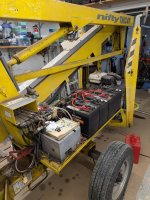
Here's an overview of where things are, the DC motor and tank are just to the left of the batteries. The DC motor drives a pump that lives inside the tank. The gas engine at the far end drives it's own pump that's external and visible.
PXL_20250406_145258933.jpg

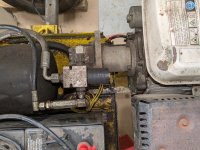
Here's a view of DC motor, the contactor is right on top of the motor, it has 2 wires coming out of it. I've tested the contactor and motor by jumpering directly from the battery, both work fine. The red filler cap for the tank is just visible at the right edge of photo and the control board is at the left.

PXL_20250406_145052449.jpg

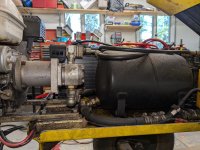
Here's a view of gas engine and its pump.

PXL_20250406_145140125.jpg

Photo of gas engine and tank from the other side:

PXL_20250406_145206863.jpg
 
/ What is a pump dump? #7  
On the photo of gas engine and pump shows the unloading valve. By the shape of the coil it could be a Delta Power valve. If it is the name should be molded on the coil. If schematic is correct it is Normally closed and energized to open allowing flow in the side ports and out the nose to tank.

The DC unit probably has the valve in that block between the motor and reservoir.
 
/ What is a pump dump? #8  
But back to basics: When lowering the boom, you don't need the hydaulic pressure supply. You just release the pressure proportional to the control handle (joystick) demand.

I have the JLG version (all electric) and no motor operation (needed) when you are landing the basket. My reference calls it a 'dump valve'.
 
Last edited:
/ What is a pump dump?
  • Thread Starter
#9  
On the photo of gas engine and pump shows the unloading valve. By the shape of the coil it could be a Delta Power valve. If it is the name should be molded on the coil. If schematic is correct it is Normally closed and energized to open allowing flow in the side ports and out the nose to tank.

The DC unit probably has the valve in that block between the motor and reservoir.
Thanks, now I understand.

If I understand the operation, the dump valve is energized when I push the button that turns on a hydraulic pump (either motor or gas engine, it doesn't matter), but then something has to deenergize it so it closes. I'm guessing the flow switch is somehow doing that, even though it isn't shown on the logic diagram. So as soon as flow starts, power is removed from the dump valve.

The problem I'm chasing is that when I push the hydraulic button that should turn on the DC motor, it doesn't come on. I've traced it to the wire on the control board that goes to the contactor on the motor, and it's not raising 12v when I push the button, so something in the logic circuit is preventing it.

Here's the logic diagram if you have time to look at it. The resolution isn't great unless you have a larger monitor. Look at the far left two logic streams, one is labeled "DC Motor Run", the other is labeled "Pump Dump". The top horizontal line on drawing is +12v, the bottom line is ground. The connection point labeled "101" always has 12v, in order for the motor to run the connection labeled "14" must be 12v, but it's not. The connection point labeled "116" has 12v, which is energizing the dump valve. My machine doesn't have that device labeled "Battery Management" with the dotted line around it, so connections 14 and 114 are jumpered together.

So my problem comes down to figuring out why that relay labeled "RL8/1" (which is almost impossible to read) isn't closing and putting 12v on connection 114.

Nifty Lift Electrical Logic Schematic.PNG
 
Last edited:
/ What is a pump dump?
  • Thread Starter
#10  
But back to basics: When lowering the boom, you don't need the hydaulic pressure supply. You just release the pressure proportional to the control handle (joystick) demand.

I have the JLG version (all electric) and no motor operation (needed) when you are landing the basket. My reference calls it a 'dump valve'.
Interesting, my motor seems to labor as much when I lower as when I raise. I wonder if that's because it has to run the cage leveling cylinders?
 
/ What is a pump dump? #11  
All the manlifts I've had anything to do used cylinder locks. The more common use for tractors is on hydraulic top links.
They can be singles; these used to be common on out riggers and such. They require pressure to move in the unloaded direction.
1743959678133.png


And the more common in the tractors is the double;
1743959853299.png


When used in lifts they provide a safety function in that a deliberate operation is required for movement. A minor bump of a control will have no effect. a blown hose on the sensing side will lock the cylinder in position.
 
/ What is a pump dump?
  • Thread Starter
#12  
All the manlifts I've had anything to do used cylinder locks. The more common use for tractors is on hydraulic top links.
They can be singles; these used to be common on out riggers and such. They require pressure to move in the unloaded direction
Yes, all my cylinders have pilot operated check valves built right on the cylinder.
 
/ What is a pump dump? #13  
Beez
Do you also have the hydraulic schematics for that lift. With that we might be able to determine what valve or valves need to be energized for each function.

On photo 8933 I see three manual operated valves but I can’t tell if they also have electrical operation.
 
/ What is a pump dump?
  • Thread Starter
#14  
Beez
Do you also have the hydraulic schematics for that lift. With that we might be able to determine what valve or valves need to be energized for each function.

On photo 8933 I see three manual operated valves but I can’t tell if they also have electrical operation.
I attached the hydraulic schematic.
In photo 8933 you might be looking at the manual hydraulic hand pump. That's used if the system fails, you can lower the boom by pumping that by hand.
 

Attachments

  • Hydraulic Circuit.pdf
    247.8 KB · Views: 76
/ What is a pump dump?
  • Thread Starter
#15  
There are 3 other circuits on the logic diagram I'd like to understand as long as I'm doing this. I'm not sure it will help solve my problem but I'll be a little smarter:
  • One is "Slew Motor Bypass" which I assume is to avoid too high a pressure on the hydraulic motor that drives the slew motion of the lift.
  • The second is "Cont Boost" which must be an abbreviation for something, but I have no idea what.
  • The third is "Dump Boost"
 
/ What is a pump dump? #16  
There are 3 other circuits on the logic diagram I'd like to understand as long as I'm doing this. I'm not sure it will help solve my problem but I'll be a little smarter:
  • One is "Slew Motor Bypass" which I assume is to avoid too high a pressure on the hydraulic motor that drives the slew motion of the lift.
Are you referring to the "Slew override"(optional) valve? If yes I believe that valve is to bypass the slew motor and provide full pressure to lower or decent function to release the P.O. check. This is required since the valves are in series and if slew motor requires to much pressure you cannot slew and lower simultaneously.
  • The second is "Cont Boost" which must be an abbreviation for something, but I have no idea what.
I see "cont boost" on electrical schematic but not sure what it relates to hydraulically.
  • The third is "Dump Boost"
If, repeat IF I am flowing the electrical schematic correctly Relay 9 is energized which powers the dump pump solenoid S1. I believe the "flow Switch" which powers relay 7 does the same function.

My electrical knowledge is limited so the answers could be 100% wrong.

In studying the hydraulic schematic their may or may not be a pump dump valve on the DC unit.

On the electrical schematic are S1 - S8 limit switches or selector switches the operator controls? S1 - S4 show being tied to the out riggers so not sure what they are.


Hydraulically it appears that all of the cylinder movements are manual so if motor is running and dump valve is off the machine should operate.
 
/ What is a pump dump?
  • Thread Starter
#17  
Are you referring to the "Slew override"(optional) valve? If yes I believe that valve is to bypass the slew motor and provide full pressure to lower or decent function to release the P.O. check. This is required since the valves are in series and if slew motor requires to much pressure you cannot slew and lower simultaneously.

I see "cont boost" on electrical schematic but not sure what it relates to hydraulically.

If, repeat IF I am flowing the electrical schematic correctly Relay 9 is energized which powers the dump pump solenoid S1. I believe the "flow Switch" which powers relay 7 does the same function.
I think the flow switch ensures there is hydraulic flow. If there isn't, it shuts off the engine/motor so you can't damage the pump. It would make sense for it to also determine when the dump valve should close because if there's flow, the motor is up to speed.
My electrical knowledge is limited so the answers could be 100% wrong.

In studying the hydraulic schematic their may or may not be a pump dump valve on the DC unit.
I can't find one, and can't see any evidence of wires going anywhere it would be.
On the electrical schematic are S1 - S8 limit switches or selector switches the operator controls? S1 - S4 show being tied to the out riggers so not sure what they are.
S1-S4 are micro switches in the pads on the outriggers. If the pads become unweighted, the switch opens and an alarm sounds. This would happen for example if the soil is soft and the pad sinks down far enough that the tires start to take some of the machine's weight.
S5 is a micro switch that tells whether the boom is in the lowered/parked position. This allows raising the outriggers.
I don't see an S6.
S7 is a micro switch that tells when the slew position has reached it's limit.
S8 is a duty selector that determines whether the hydraulic flow is through the outrigger circuit.
Hydraulically it appears that all of the cylinder movements are manual so if motor is running and dump valve is off the machine should operate.
Yes, the problem is I can't get the motor to run unless I jumper it directly to the battery.
 
/ What is a pump dump? #18  
Looking at electrical schematic:
I believe RL6 & RL41 have to be energized to provide power to the coil for RL8.
I believe RL6 is powers by Selector Cage start switch.

I believe RL41 is controlled by S5 boom raised.
 
/ What is a pump dump?
  • Thread Starter
#19  
Looking at electrical schematic:
I believe RL6 & RL41 have to be energized to provide power to the coil for RL8.
That is very helpful. If it's not too complicated, can you explain how you figured that out.

I believe RL6 is powers by Selector Cage start switch.
agree
I believe RL41 is controlled by S5 boom raised.
Yes, and S1-S4 for the outriggers pads. I have no idea why they label those two logic paths as "Jack Light No 1" and "Jack Light No 2". Maybe on the other side of the ocean that means something obvious.
 
/ What is a pump dump? #20  
That is very helpful. If it's not too complicated, can you explain how you figured that out.
On the electrical schematic it looks like there is two options to power RL8.

on the schematic vertical locations are labeled A thru G and horizontal is 1 thru 10

Reference location 5 E:
this shows S1 - S4 NO contacts in series with jacks up so no power to terminal 108

Below information is based on RL7 not being energized:
Terminal 7 connects to contact on RL6 (I think, hard to read) Terminal 108 connects RL41 (I think, hard to read) Both RL6 & RL41 must be energized for this path to close and power RL8.

Once the outriggers are in position and S1 - S4 change state I believe RL8 is held active & RL4 is now de-energized.

Where are the electrical gurus when we need them?
 

Marketplace Items

2012 INTERNATIONAL PROSTAR+ (A58214)
2012 INTERNATIONAL...
UNUSED FUTURE DM39-39" HYD DISC MULCHER (A60432)
UNUSED FUTURE...
2006 John Deere 120C Hydraulic Excavator (A56857)
2006 John Deere...
2004 Pierce Tilt Crew Cab Enforcer Fire Truck (A59230)
2004 Pierce Tilt...
2018 Chevrolet Tahoe SUV (A59231)
2018 Chevrolet...
2007 Kenworth Tandem Axle Road Tractor (A47477)
2007 Kenworth...
 
Top