When to use four wheel drive?

   / When to use four wheel drive? #161  
Greetings Overszd,

I had posted: "As another example - my scut is certainly not awd - however I'm in 4wd (front wheel assist if you require the phrase) - but neither I or anyone else could tell on lawn or dirt or gravel - that my steering is altered in any way from 2wd. Only on dry concrete or dry blacktop can you "sense" a different sound in 4wd to 2wd - and in no way does it alter the turning ease and turning circle. Maybe larger compact tractors and older equipment is stiffer steering in 4wd compared to 2wd - but I've never ridden on any that are even though I know my neighbor's jd x728 lawn tractor is stiffer in 4wd."

And in response you posted:


Well Overszd, I guess you don't know many current day scuts then, because my Massey GC1715 is one of 4 models and I would propose that all 4 of those models will handle the same. And in testing - my particular unit performs exactly as I stated on grass. You "challenged" me to do a set of instructions you listed and then you prophesied I would have 1 of 2 types of occurrences display themselves. Well . . . . in 2wd, I tight turned to the left in the tightest circle possible and at moderate speed (not creep or crawl speed) - and as you specified it wasn't for one lap but 3. Then I switched in to 4wd as per your requirements and went in the same tight left hand tight turn circle . . . again 3 laps. Then as you required, I turned to going straight ahead.

The result? I was able to maintain the same turn circle size and position over the 2 sets of 3 laps. (I varied in 2wd on the 3 laps by 1.1 inches of each other in circle size - in 4wd I varied within 1.2 inches of each lap in circle size.) And I was able within those individual variations of each lap to be in the very same turning circle between 2wd and 4wd of LESS THAN 0.2 inches. Then I went straight and saw or felt or heard no difference in performance.

At no time during this "challenge" did I sense any tightening or stiffness or resistance to steering. At no time did it require more or less strength or did I hear or experience any of the conditions you stated.


You also posted as a followup to our discussion the following:

"I've had a FWA SCUT for 15 years. Two models. Nothing bold about my statement at all. Simple logistics."

But Overszd - I suggest you make bold statements like this one was "I don't know of any SCUT, CUT or Utility class FWA tractor that doesn't display one of these "push" "pull" conditions."

How is that not a very bold statement when you have such a tiny little (and aged) experience with only 2 scuts and especially older model equipment besides. The universe of well known scuts is 8 to a dozen brands minimum with numerous models in each and then who knows how many more not well known brands besides.

I also suggest Overszd that you predicted CERTAINTY of the future results to be stated in more than two following posts as well. When in fact the result was anything but certain.

As a poster, I quite often communicate my opinion but also clarify that opinion to my model or my amount of experience or other model experiences so as not to mislead readers and imply a level of knowledge I don't have or can prove. I post too many words often - but its specifically because I specify the conditions of my statements. I only have experience having driven/operated about 12 different models/brands of scuts and only 3 models of small compacts, and I never state or assume product size or equipment I have no experience with. All of us can make mistakes in our posts - but we also need to be responsible as words have importance - and brash statements can influence some readers to be influenced incorrectly by inaccurate posts.

I appreciate you wanted to challenge my statements - and I think that is fine as long as youdon't think you can "command it". But I dislike your boldness (or maybe its just arrogance) that you could be the only possible correct one (and with only 2 scuts as experience besides).

I'm sure you have a ton of valuable and desired experience in various areas relating to tractors that I don't have even though we are likely very similar in age (early 60's). Please aim that valued experience with a more accurate siteline and direction or clarify it so there is no confusion. I'd hate to see you look wrong again after prophesying certainty several times. Thank you.

I agree with everything you said. I'm obviously ignorant of the tractor world.

You Sir truly have a unique FWA tractor!!! Go Massey!!!
 
   / When to use four wheel drive? #162  
:rolleyes:?


I get the impression someones 4 wheel drive has never work and they do not know it! :)

I think it's more likely a difference of mechanical understanding. :)
 
   / When to use four wheel drive? #163  
I agree with everything you said. I'm obviously ignorant of the tractor world.

You Sir truly have a unique FWA tractor!!! Go Massey!!!

Agreed it’s impossible for the wheels not to slip turning a tight circle, going straight and any point in between on a fixed linkage drive train. Maybe with an electric drive train with 4 independent motors and a bunch of sensors that might be possible.
 
   / When to use four wheel drive? #164  
Agreed it’s impossible for the wheels not to slip turning a tight circle, going straight and any point in between on a fixed linkage drive train. Maybe with an electric drive train with 4 independent motors and a bunch of sensors that might be possible.

Yep. And evidently that's how Axlehub's Massey is built. Go Massey!!!! :)
 
   / When to use four wheel drive? #165  
There is a difference of the type of settings and function of 4x4 offerings. My Boomer had an Auto position and a 4x4 lock setting. The Auto was basically 4x2 until slippage occurred, then it would go into 4x4. If you would lock it in 4x4, you could really feel you were in 4x4 because it would scrub while turning. My dad's Deere x749 has front wheel assist and only helps when needed. Otherwise, it is just 4x2. Just as in road vehicles, full time 4x4 is much different than a vehicle with part-time being PUT in 4x4.

Then you have dad's Case tractor...you turn circles with that in 4x4, you are really tearing up some sod.
 
   / When to use four wheel drive? #166  
There is a difference of the type of settings and function of 4x4 offerings. My Boomer had an Auto position and a 4x4 lock setting. The Auto was basically 4x2 until slippage occurred, then it would go into 4x4. If you would lock it in 4x4, you could really feel you were in 4x4 because it would scrub while turning. My dad's Deere x749 has front wheel assist and only helps when needed. Otherwise, it is just 4x2. Just as in road vehicles, full time 4x4 is much different than a vehicle with part-time being PUT in 4x4.

Then you have dad's Case tractor...you turn circles with that in 4x4, you are really tearing up some sod.

Yep. And one of those setups might be on the Massey SCUT. thought maybe we'd hear from an owner to confirm that.

Same basic mechanics as in a Limit Slip axle.
 
   / When to use four wheel drive? #167  
Well Overszd, I guess you don't know many current day scuts then, because my Massey GC1715 is one of 4 models and I would propose that all 4 of those models will handle the same. And in testing - my particular unit performs exactly as I stated on grass. You "challenged" me to do a set of instructions you listed and then you prophesied I would have 1 of 2 types of occurrences display themselves. Well . . . . in 2wd, I tight turned to the left in the tightest circle possible and at moderate speed (not creep or crawl speed) - and as you specified it wasn't for one lap but 3. Then I switched in to 4wd as per your requirements and went in the same tight left hand tight turn circle . . . again 3 laps. Then as you required, I turned to going straight ahead.
The result? I was able to maintain the same turn circle size and position over the 2 sets of 3 laps. (I varied in 2wd on the 3 laps by 1.1 inches of each other in circle size - in 4wd I varied within 1.2 inches of each lap in circle size.) And I was able within those individual variations of each lap to be in the very same turning circle between 2wd and 4wd of LESS THAN 0.2 inches. Then I went straight and saw or felt or heard no difference in performance.
At no time during this "challenge" did I sense any tightening or stiffness or resistance to steering. At no time did it require more or less strength or did I hear or experience any of the conditions you stated.
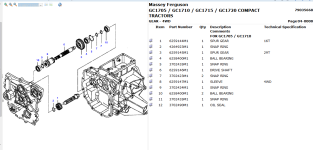
How about doing that again and trying to shift the tractor in and out of 4WD while making the tight turns? Our BX2660 has a good enough power steering that it is easy to turn in 2WD or 4WD, but it will bind and be hard to shift in or out of 4WD when turning. Looking at the parts diagram online:
566732d1534265581-when-use-four-wheel-drive-gc4wd-png

It look like you just have a sleeve (#8) to engage/disengage 4WD, so (other than the power steering and perhaps a better match between front and rear tire sizes), its not any more advanced than a 1960s era 4WD tractor.

Aaron Z
 

Attachments

  • GC4wd.PNG
    GC4wd.PNG
    136 KB · Views: 261
   / When to use four wheel drive? #168  
How about doing that again and trying to shift the tractor in and out of 4WD while making the tight turns? Our BX2660 has a good enough power steering that it is easy to turn in 2WD or 4WD, but it will bind and be hard to shift in or out of 4WD when turning. Looking at the parts diagram online:
566732d1534265581-when-use-four-wheel-drive-gc4wd-png

It look like you just have a sleeve (#8) to engage/disengage 4WD, so (other than the power steering and perhaps a better match between front and rear tire sizes), its not any more advanced than a 1960s era 4WD tractor.

Aaron Z

Good stuff Aaron. Looks like a simple gear engagement system. Will most certainly bind and scuff somewhere in the combinations of tight turns and/or driving straight.

Maybe it's like that one scene in the movie "Cool Hand Luke".

What we have here is a failure to communicate. :)
 
   / When to use four wheel drive? #169  
How about doing that again and trying to shift the tractor in and out of 4WD while making the tight turns? Our BX2660 has a good enough power steering that it is easy to turn in 2WD or 4WD, but it will bind and be hard to shift in or out of 4WD when turning. Looking at the parts diagram online:
566732d1534265581-when-use-four-wheel-drive-gc4wd-png

It look like you just have a sleeve (#8) to engage/disengage 4WD, so (other than the power steering and perhaps a better match between front and rear tire sizes), its not any more advanced than a 1960s era 4WD tractor.

Aaron Z

Greetings aczlan,

It's illogical to try to make equipment fail just to support a faulty or incorrect opinion.

1. Why would anyone need to change in and out of 4wd multiple times in the middle of making a tight turn? It's just not something an operator does. It's not logical to try to conduct an action hoping it will fail and then claiming vindication. Either it does it as was specifically prescribed or it doesn't. The concept of testing what is not normal operational behavior is for design engineers when a problem exists . . . No problem existed before or during the testing for me.

2. How "advanced" the Massey 4wd system is was never the issue one way or another - never stated or discussed. The fact is, it doesn't create the issues and problems that overszd stated would certainly happen to all FDA units. However a far more logical conclusion exists. . and that is that possibly many units may not have the issues Overszd stated they had. His total level of experience with scuts turns out to be only 2 units, and those are not even remotely current units. So a far more logical approach than attempting many odd strange or illogical variations to try to find one variation that would fail. . . . Is to get owners of other scuts that are 6 years old or newer to report if they experience a problem when doing overszd's same test.

My original statements ended up being tested and matched my original statements exactly and completely contradicted the outcome "that was certain to happen" . . That didn't happen.

So either 1 or all 4 models of the gc1700 series are clear or maybe even the gc2300, gc2400, and gc2600s are also clear. Proper testing requires knowing about all the newer BX models and the newer JD scuts and etc. etc. etc. .

I don't believe 1960s designs apply here either as SCUT were never even initially produced until the first BX product in 1999. Comparing apples and oranges only gives you Fruit Loops. Lol.

Jmho
 
Last edited:
   / When to use four wheel drive? #170  
Maybe the turf tires slip and you don’t notice it. Try driving in a tight circle on clean asphalt in 2wd and in 4wd. I’m betting you’ll see worse marks in 4wd.
 
   / When to use four wheel drive? #171  
Maybe the turf tires slip and you don’t notice it. Try driving in a tight circle on clean asphalt in 2wd and in 4wd. I’m betting you’ll see worse marks in 4wd.

Greetings 4570,

Again, this suggestion is illogical because the discussion between myself and then overszdstated was specifically not about concrete or blacktop. No one doubts that use of 4wd on a hard surface creates some issues . . . Says so right in the manual. Never was part of the discussion. But overszdstated stated and then restated 2 more times to others, that performing the specified test would definitely verify his statements and demonstrate my inaccuracy.

Get other brand users of recent scuts to test the exact same specifed testing on lawn or ground just as was stated. Think how that would prove how many wrong assumptions are being accepted as fact.

Jmho
 
   / When to use four wheel drive? #172  
What was the original debate about? I thought it was rather or not driving in 4wd caused undue stress on the drive components by binding up?
 
   / When to use four wheel drive? #173  
My wife would scalp me if I used 4wd in the yard. My New Holland tears up the turf with a slight turn in 4wd. So, it's safer to use 2wd in the yard.
 
   / When to use four wheel drive? #174  
What was the original debate about? I thought it was rather or not driving in 4wd caused undue stress on the drive components by binding up?

The original issue came from this statement of mine in post 139 orc140

"As another example - my scut is certainly not awd - however I'm in 4wd (front wheel assist if you require the phrase) - but neither I or anyone else could tell on lawn or dirt or gravel - that my steering is altered in any way from 2wd. Only on dry concrete or dry blacktop can you "sense" a different sound in 4wd to 2wd - and in no way does it alter the turning ease and turning circle. Maybe larger compact tractors and older equipment is stiffer steering in 4wd compared to 2wd - but I've never ridden on any that are even though I know my neighbor's jd x728 lawn tractor is stiffer in 4wd."

Then overszd had his post 141 challenge.
 
   / When to use four wheel drive? #175  
My wife would scalp me if I used 4wd in the yard. My New Holland tears up the turf with a slight turn in 4wd. So, it's safer to use 2wd in the yard.

Interestingly in order to perform the challenge, I went in a tight circle 3 full laps, then shift into 4wd and did Thevexact same tight turn for 3 more laps in that very same circle.


I had no tear ups of grass or sod even though my unit weighs over 2000 lbs plus my weight (no fel on). That is one of the several reasons I have turf tires.

In addition as the test measurements showed, in 2wd the 3 test laps created a 1.1 inch variance from lap to lap. Then in 4wd in the same circle it was a 1.2 inch variance. In other words, 2wd and 4 we both created the same variation in each 3 lap tight turning circle.

And yes, 2wd works as 2wd should and 4wd works the same way except with front wheel assist and with access to hydro braking on the front wheels. Neither tore up any grass or sod orodamaged that part of the lawn.
 
   / When to use four wheel drive? #176  
Axle,
It appears that my tractor is about twice the size of your tractor. That obviously would make a difference. I have found no reason to use 4wd while driving on my lawn except in deep snow. It may be that 4wd would not be as effective on your tractor in the snow or a grade. My R4 tires are obviously more aggressive than your tires.
 
   / When to use four wheel drive? #177  
Less weight makes a big difference too.
 
   / When to use four wheel drive? #178  
I mow the lawn all the time in 4 WD with my 35 HP tractor when mowing the hill (especially when wet)
Never noticed it tearing up the yard (R-4 tires)
 
   / When to use four wheel drive? #179  
I was hoping this discussion could be used to educate owners/operators that might not understand the mechanics of simple linkage engaged 4wd/FWA. It has not. Sorry for the distraction.

Axlehub's Massey is simple linkage engaged 4wd/FWA. It binds and scuffs at certain positions when it's engaged. All tractors regardless of size with this system do. Not condemning them. It's just a simple truth.

The cleanest operating system is true 4wd. They are Center Pivot. No disengagement required. No binding/scuffing. Ever.
 
   / When to use four wheel drive? #180  
I was hoping this discussion could be used to educate owners/operators that might not understand the mechanics of simple linkage engaged 4wd/FWA. It has not. Sorry for the distraction.

Axlehub's Massey is simple linkage engaged 4wd/FWA. It binds and scuffs at certain positions when it's engaged. All tractors regardless of size with this system do. Not condemning them. It's just a simple truth.

The cleanest operating system is true 4wd. They are Center Pivot. No disengagement required. No binding/scuffing. Ever.
Exactly, the system in his tractor is exactly the same as the system in our BX 2660, L3830 & B7500 (and, as far as I know every other 4WD Kubota). It is also the same as every other SCUT, CUT, and UT out there ( with the possible exception of those who have an electronic shift 4 wheel drive, a New Holland with a super steer front axle or a European model tractor which has automatic engagement for the 4 wheel drive to give you 4 wheel braking).
The only difference is that his tire wear and the gearing have worked out perfectly so that the ratio is exactly right between the front and rear tires.
It will still bind under the correct conditions when it is in 4-wheel drive even though it may not be noticeable in the steering due to the improved power steering over older tractors.

Aaron Z
 

Marketplace Items

golf cart (A56859)
golf cart (A56859)
2373 (A60432)
2373 (A60432)
2015 Freightliner M2 106 AWD Altec AT37G Bucket Truck (A60460)
2015 Freightliner...
DEUTZ MARATHON 60KW GENERATOR (A58214)
DEUTZ MARATHON...
CATERPILLAR 21" PIN ON BUCKET (A52706)
CATERPILLAR 21"...
2025 MACK GRANITE GR64F DUMP TRUCK (A59823)
2025 MACK GRANITE...
 
Top