windmill composter

/ windmill composter #21  
I like this. What say we drop the drum in a cradle of little rollers, and stick the anenometerimeteremeter thingy on the end of one of the rollers. Naw, even with 1/2" roller and 36" drum you only get 64:1.

But driving a small roller under the drum is good. We get 36:1 or so with a 1"roller, and we can use an enclosed worm gear hooked to a horizontal anenometer for another 100:1 or more. 3600 to 1 and the only gears needing lubrication are in the enclosed worm gear. What do you think?
Todd
 
/ windmill composter #23  
I think I'm narrowing down the search here ... check out these links to the Composter 1 and Composter 2 by Augspurger Engineering.

comp1.GIF


This is bigger than you would want for a wind powered system, but that's a neat looking mid-mounted pivot that would be handy!

Another interesting link for farmers is here.

Seems that the correct term (and magic phrase for search engines) is 'in-vessel compost'.
 
/ windmill composter #25  
Now that's making compost!! /w3tcompact/icons/smile.gif

How did you figure out "in-vessel compost"? I don't think I would have though of that one.

That IS a neat trick with the pivot.

SHF
 
/ windmill composter
  • Thread Starter
#26  
Re: windmill composter/blades-props

Hey guys,

I'm leaning away from the anemoneter-type blades, for esthetic reasons. Looks too much like a measuring device/scientific equipment, instead of a rustic Rube Golberg-ian contraption (which I prefer). /w3tcompact/icons/laugh.gif

When/if I ever figure out how to post photos on this site (several failed attempts), I'll show you the inspiration for my plan. It's a picture of a human-powered hovercraft, that I took at the "Human-Powered Speed Championships" in Visalia, Ca. a few years back.

The prop was about 8 feet long, and powered solely by a bicyclist (1/2 to 3/4 hp, for the short timed-run). it looked cool, turning relatively slowly, and propelled the craft to a near-record 14-15 mph, If my memory is correct (I'm not far off, I'm sure!).

This was even though some of the rider's power went to a second "fan" that inflated the skirt to support the craft/rider above the water surface.

Many a jaw was hanging as this thing went by!! /w3tcompact/icons/shocked.gif

I have some info on the family of airfoil shapes that are applicable to these (wind)speeds, and would like to build such a "windmill", even though a tower would be required, both for ground-clearance, and to get the prop-tips above head-chopping height.

Guaranteed to put out enough power to turn a drum, in any decent breeze.

Larry
 
/ windmill composter #27  
Re: windmill composter/blades-props

Lemme see the picture! Lemme see the picture! I wonder if there's a web site? RPM would know. He knows all the cool websites.

It occurs to me that the old windmills used a pump jack that converted the rotary motion into up/down motion. Maybe something like that with a ratcheting system to turn the drum? Seems if they could lift water from several hundred feet, they ought to be able to turn a composter.

SHF
 
/ windmill composter #28  
Re: windmill composter/blades-props

I hadn't heard of human-powered hovercraft before - I'd like to see those pictures!!
 
/ windmill composter #29  
Re: the term 'in-vessel'

I just tried a bunch of terms like 'drum' and 'rotate' and came across the web-site. Who'd a guessed that it was a whole little industry?
 
/ windmill composter #30  
Re: windmill composter/blades-props

Just remembered seeing a fly powered airplane once. Always wanted to build one, just never had the plans. Wife still makes pet flies for kids by tying one of them to a hair.

But a human powered hovercraft has all that beat by a mile.

SHF
 
/ windmill composter #31  
Something I saw awhile back might fit perfectly with your composting. It's an incredibly simple device that I will try to explain in less than 5,000 words.
Picture a device that looks like a Ferris wheel, about 8' in diameter. At the 12, 3, 6, and 9 o'clock positions you attach propane tanks. Fill the 6 o'clock tank with propane and run a pipe from it's valve straight up to the 12:00 tank valve. Also fill the 3 o'clock tank and run a pipe to the 9 o'clock tank.
Now if you raise the temperature a minimum of 3.5 degrees higher in the six o'clock tank the propane will vaporize and travel into the 12 tank. The wheel will now start turning as the tank fills with propane. I hope this word picture is clear.
As the wheel turns, 3 o'clock move to 6 and starts the process again. The inventor of this idea has built one of these devices and it works beautifully. In a new one he's designed the wheel will be about 30' in diameter and will put out 8.9Hp. The RPM of the smaller unit is 1 rpm. You could calculate the hp of the small one but basically the weight of fuel and tank with the distance from the pivot point will give you an idea of what kind of leverage you'd have.
Now the guy who devised this motor(?) uses a solar water heater. But with the heat generated by compost it seems like you'd have a natural heat source that would power it with no additional equipment necessary. Maintenance is nothing more than greasing one zerk fitting on the axle shaft for the wheel. Potentially it'd run for ever. No wind, no sun, nothing else required but a good compost pile.
By the way, a similar principal is used with solar panels, utilizing refrigerant in tubes heated by the sun. As the sun follows its arc the freon flows from the hot to the cool side of the panel and causes the panel to pivot in constant alignment with the sun. It's been done for a lot of years and is truly maintenance free.

Branch
 
/ windmill composter #34  
I spoke to the guy who originally faxed me the article and he said it was from a 1977 Popular Mechanics article. I would post the article but the FAX copy is so bad it's not worth trying. I'm going to get a better copy of the original and I'll post it. May take awhile though.

Branch
 
/ windmill composter #35  
Sounds interesting - a few problems that come to mind though ...

1. <font color=blue>the weight of fuel and tank with the distance from the pivot point will give you an idea of what kind of leverage you'd have.</font color=blue>

Since the tanks are mounted symmetrically, the rotational force would be provided by the difference in weight of the fuel between the tanks - not the weight of the tanks themselves.

2. I'm assuming that somehow only one tank at a time is heated? Is this when it is at the bottom of the cycle and somehow in contact with the heat source?

3. The other problem I see is that when in full sun the tanks will get hot. I believe that the heat of the compost may be less than the temperature of the tanks in sunlight - or that the temperature differential between hot tank and hot compost would be too small to make it work. Who knows, maybe it would only turn at night.

I've never seen anything like this so am fascinated to see the plans. To be honest I am a little sceptical /w3tcompact/icons/crazy.gif. That's my engineering background for ya.

Now if those propane tanks were to be opened up and the gas ignited - now that's a windmill!! Probably would do around 1 RPmS /w3tcompact/icons/cool.gif
 
/ windmill composter #36  
RPM,

Are you thinking that this propane engine is basically trying to use the same heat principle as the Stirling engine? (gas expands and moves something). I saw a small model of a heat driven engine made from rubber bands. A crank is built and set into a base so that is spins freely. Rubber bands are attached to the crank and stretched and tacked around the perimeter of a circle with the crank at the center line. A cardboard disk is affixed to the crank. A portion of the disk is cutout to allow a high intensity light source to reach some of the rubber bands. As the bands are warmed, the disk turns, exposing new rubbers bands to the light and allowing the previously exposed ones to cool.

I think that cold would also effect the propane engine. I'm afraid it would react to changes in ambient temperature by speeding up or slowing down. Since we can't vary the temperature of the compost, there would be no control over rotational speed. It would be cool to build though. /w3tcompact/icons/wink.gif Astound your friends and neighbors. /w3tcompact/icons/laugh.gif

SHF
 
/ windmill composter #37  
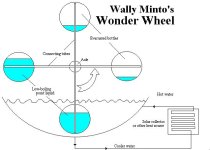
Here is the original article. From Popular Science on "Wally Minto's Wonder Wheel"
Wally Minto's Wonder Wheel
by E. F. Lindsley
Popular Science, March 1976

Wally Minto's eyes twinkled. "Now that you've got your pictures of the serious stuff, I want to show you our latest engine. It's at least 85% effecient, never wears out, requires no fuel or maintenance, costs very little, and should have been invented 100 years ago."

I'd just finished shooting pictures of Minto's solar-powered, Freon engine/generator set (P.S. Feb 1976) and I wasn't quite sure if he was kidding about this newest engine. Four - used propane bottles were hose- clamped to the ends of two pieces of aluminum angle, each about four feet long.

The angles crossed at 90 degrees at the center and were mounted on a central hub like a skinny four-blade windmill with bottles to swing in the breeze.

Each bottle was connected to its mate on the opposite end of the angle with steel brake-line tubing. Under the rig's support was a tank of the type used to locate leaks in an inner tube.

While I gazed in disbelief, Wally explained how his incredible power wheel works

A few weeks later I again visited the Kinetics Lab. By then the propane bottles had evolved into 12 containers of steel pipe welded into a polygon.

The principle remained the same. I watched as Wally opened the valve to let in a trickle of water from solar panels on the roof of his parking shed. The water temperature was 155 degrees F.

Almost imperceptibly, the wheel started to turn. The speed picked up a bit and I timed a revolution -- about one rpm. Minto noted my misgivings.

"Try holding onto the shaft," he said. I grabbed the shaft firmly -- it was if I'd tried to stop some eerie, irresistible force: no sound, no evidence of power, just pure twist.

"Picture one 200 feet in diameter," he said. This time my mind boggled. Such a rig might hoist the pyramids.

Wally doesn't expect industrialized nations to scramble for his wheel, and he isn't selling anything. He's donating it as a "gift to the world" and expects it will be used in underdeveloped, energy short areas.

For example, a practical 33 ft. diameter wheel running on a temperature difference of as little as 3.5 degrees F and producing several horsepower could pump irrigation water, grind grain, or saw wood. The materials could be scrap pipe, and no machining or skills are needed to build it.

Several low-boiling materials might be used, but propane or R-12 may be best.

Minto estimates a slightly larger (40 ft.) wheel with 14 pairs of one-ft. by 4.5 ft. containers would provide 10,240 ft/lb of work per container as each 269 lb. of liquid responds to gravity through a 20 ft level arm.

At only one rpm this is 8.69 hp; not spectacular, but low cost and capable of running steadily for generations. The slow rotational speed can be stepped up to whatever is needed, just as with the old-time waterwheels.

No fuel would be needed in many cases. The temperature difference required between the liquid on the bottom and the top occurs naturally in many situations: water and air, light and shade, etc.

Minto has outlined construction details in a two-sheet paper entitled "The Minto Wheel." There are NO restrictions on building or experimenting with the wheel.

Sun Power Systems, Inc.
1121 Lewis Ave.
Sarasota, Fla 33577
[sorry, no graphic for figure 1] Polygon wonder wheel is made of individual containers. (Almost any leakproof container can be used.) Tubes connect opposite pairs. I wasn't sure it would run. It runs! Minto demonstrates wheel's torque; simple pony brake on output wheel measures hp. Speed is about one rpm, but torque is strong.
--------------------------------------------------------------------------------


Low-boiling liquid, such as freon or propane, fills one bottle of each pair. The opposite bottle is empty and void of air. The liquid collects in the lower bottle, which is immersed in warm (solar-heated) water.

Heat from the water (or a solar reflector, or any other source slightly warmer than the surrounding air) vaporizes the liquid and forces part of it up through the connecting tube and into the empty bottle on top.

Gravity does the rest:

The heavy bottle starts down; - the lighter bottle floats up.

As each pair shuttles its liquid mass back and forth, the whole thing turns and repeats the process endlessly

<P ID="edit"><FONT SIZE=-1>Edited by Branch on 06/24/01 10:13 AM (server time).</FONT></P>
 
/ windmill composter #38  
Couldn't get the picture attached the first time so here goes a second try.

Branch

P.S. I did a search for more information on the Minto Wonder Wheel and came up with more websites where people have tried it and made improvements. For those as fascinated as I am with this let me know what you find and think about it.
85% efficiency is nothing to sneeze at.
 

Attachments

  • 6-52586-minto2.jpg
    6-52586-minto2.jpg
    36.6 KB · Views: 125
/ windmill composter #39  
Branch,

Thanks for taking the time to post that - it looks really interesting! I'm off to an in-law gathering, so should have plenty of time to think about this. Will do a search on that tomorrow ...
 
/ windmill composter #40  
Re: windmill composter/blades-props

Jor El

How Rube Goldberg do you wanna be? The anemometer type vanes could be used to basically turn a screw, which could be used to raise lead shot through a tubular housing. The shot would drop at the top into another tube which would guide it into a bin attached to a teeter totter with bins at both ends. When the bin is full, it falls and a lever attached to the bin turns the drum, while another lever moves the shot tube over so that the screw will fill the other bin. The full bin, upon reaching the bottom of its path would dump its shot into the hopper for the screw and the whole cycle would start all over, as the opposite bin was filled and dropped, etc.

As dumb as this sounds, it does offer some advantages. First, the power required to turn the compost drum will vary depending on how full (and how heavy) the drum is. The above system could be easily adapted by the addition of small weights to handle this variation in work required. Second, the load that the windmill is required to carry is limited to turning the screw and lifting a small amount of shot, so a great amount of gear reduction shouldn't be required. Third, The process would be slow, since the shot required to drop the upper bin with enough force would probably take some time to build up. Fourth, it'll make your neighbors nuts trying to figure out what it is. /w3tcompact/icons/wink.gif

Just trying to think outside the box for ya.

SHF
 

Marketplace Items

STACK OF FABRICATED BUMPER SHEETS (A62130)
STACK OF...
427013 (A61165)
427013 (A61165)
2008 GMC W4500 4X2 14FT BOX TRUCK (A59909)
2008 GMC W4500 4X2...
2004 Subaru Impreza STI AWD Sedan. (A61569)
2004 Subaru...
New/Unused 72in No Till Seed Drill (A61166)
New/Unused 72in No...
2001 Ford F-150 4x4 Pickup Truck (A61568)
2001 Ford F-150...
 
Top