WR Long 3rd Function Install

   / WR Long 3rd Function Install #21  
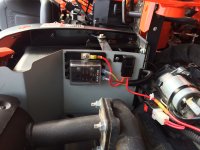
I added an aux fuse block on my tractor, fed off the alternator. I may, in the future, add a relay to power the entire block and trigger it with an ignition wire to liven the whole panel, I just didn't see the need for now. I am sure I will once i go out to start the tractor and the battery is dead because I inadvertently hit the switch for the light bar and left it on without the tractor running!

Kubota Fuse Panel.jpg
 
   / WR Long 3rd Function Install #22  
I added an aux fuse block on my tractor, fed off the alternator. I may, in the future, add a relay to power the entire block and trigger it with an ignition wire to liven the whole panel, I just didn't see the need for now. I am sure I will once i go out to start the tractor and the battery is dead because I inadvertently hit the switch for the light bar and left it on without the tractor running!

Very professional install!!!! :thumbsup:
 
   / WR Long 3rd Function Install #23  
If going to a circuit that is hot all the time, the relay really isn't needed. Relays are only needed in switched situations. Just take the power from the source at a location able to handle the additional flow. My fuse block simply doesn't have anything I'd consider "rated high enough" to service the extra load.
 
   / WR Long 3rd Function Install #24  
If going to a circuit that is hot all the time, the relay really isn't needed. Relays are only needed in switched situations. Just take the power from the source at a location able to handle the additional flow. My fuse block simply doesn't have anything I'd consider "rated high enough" to service the extra load.

Whether the circuit is hot all the time or not doesn't change the use or need for a relay. And in this particular application we are most certainly talking about a switched situation. The switch being the controller for the 3rd function.

Without a relay = The power required to activate the 3rd function is obtained and ran thru the 3rd function switch to the solenoid.

With a relay = Low amp power is obtained from wherever you choose. That low amp power goes thru the 3rd function switch to the relay. High amp power required to run the 3rd function solenoid is obtained from an adequate source, in this case I'd go to the battery, and provided to the relay. When the 3rd function switch is activated power goes to the relay and makes the high amp connection. At that time your high amp power is conveyed thru the relay and to the 3rd function solenoid. Thus all the load is carried by the high amp circuit and the relay.

Sounds confusing but it's actually not. :)
 
   / WR Long 3rd Function Install #26  
WR Long's instructions included in my kit recommended connecting the fuse to the battery, the red wire from the controller to the fuse, and the two black wires from the controller to the black wires on valve solenoid. I assume they have a switch rated for the load or a relay inside the control handle to remove the load from the switch. I did not disassemble it to find out. Adding a relay in this scenario, I don't think is required either way.
 
   / WR Long 3rd Function Install #27  
Yeah, I'm sure the switch is "rated" to handle the amp draw without a relay. They probably saved $10 by going that route rather than including a relay. And you'd probably have to look a long time to find a failure related to overloading the switch.

With all that said I'd still wire a relay into the system for insurance. But I'm kinda OCD like that.
 
   / WR Long 3rd Function Install
  • Thread Starter
#28  
It's wired up, I ran the hot directly to the battery and everything was soldered and heat shrunk and ran in loom, looks pretty much factory as soon as I get some dust on the new loom.
 
   / WR Long 3rd Function Install #29  
It's wired up, I ran the hot directly to the battery and everything was soldered and heat shrunk and ran in loom, looks pretty much factory as soon as I get some dust on the new loom.

Sounds good!!!! You are gonna love it!!! :)
 
   / WR Long 3rd Function Install #30  
Whether the circuit is hot all the time or not doesn't change the use or need for a relay. And in this particular application we are most certainly talking about a switched situation. The switch being the controller for the 3rd function.

Without a relay = The power required to activate the 3rd function is obtained and ran thru the 3rd function switch to the solenoid.

With a relay = Low amp power is obtained from wherever you choose. That low amp power goes thru the 3rd function switch to the relay. High amp power required to run the 3rd function solenoid is obtained from an adequate source, in this case I'd go to the battery, and provided to the relay. When the 3rd function switch is activated power goes to the relay and makes the high amp connection. At that time your high amp power is conveyed thru the relay and to the 3rd function solenoid. Thus all the load is carried by the high amp circuit and the relay.

Sounds confusing but it's actually not. :)
Wouldn't a true 3rd function then require 2 relays? There are 2 switches after all. Just how many amps are we talking here?
 
   / WR Long 3rd Function Install #31  
To remove all high load current from the switch, yes you would need two in his scenario. Considering the fuse supplied by WR Long is 10A, it would have to be less. Likely 6 or 7A typical.
 
   / WR Long 3rd Function Install #32  
To remove all high load current from the switch, yes you would need two in his scenario. Considering the fuse supplied by WR Long is 10A, it would have to be less. Likely 6 or 7A typical.

Went back and reread the wiring description for the WR Long. Yes, that would require two relays to remove the high amp draw from the supplied switch. That might be non-practical. Relays are very easy to wire into a system. I have no experience with said system so don't know the useful longevity of the switch provided?? I'll step back and say use what is supplied. If you have a premature switch failure issue, add relays. Sorry for the confusion. :(
 
   / WR Long 3rd Function Install #33  
It's just a matter of balancing needs, requirements, cost, and reliability. In this case, the needs of the solenoids is not high enough that would require relays when used with a properly rated switch; and a properly rated switch doesn't exceed the cost of additional wiring and relays.

I would still use a relay if you want switched (key-on only) power. Prevent the load from being shared with another function over an existing circuit.
 
   / WR Long 3rd Function Install #34  
It's just a matter of balancing needs, requirements, cost, and reliability. In this case, the needs of the solenoids is not high enough that would require relays when used with a properly rated switch; and a properly rated switch doesn't exceed the cost of additional wiring and relays.

I would still use a relay if you want switched (key-on only) power. Prevent the load from being shared with another function over an existing circuit.

My factory 3rd function is "key on" only. I just prefer that. :)
 
   / WR Long 3rd Function Install #35  
I prefer the "worksite" method (at least what I was taught back when I operated equipment). Lower everything to the ground, set the parking brake, turn off any lights, shut the machine off, remove the key, work all the levers and switches to let off any pressure, then exit the operator station. Need power to the 3rd function switch for that scenario.
 
   / WR Long 3rd Function Install #36  
I prefer the "worksite" method (at least what I was taught back when I operated equipment). Lower everything to the ground, set the parking brake, turn off any lights, shut the machine off, remove the key, work all the levers and switches to let off any pressure, then exit the operator station. Need power to the 3rd function switch for that scenario.

Yep, I park everything I operate like that. That same "OCD" mentality is what concerns me with walking away from a live circuit. :)
 
   / WR Long 3rd Function Install #37  
It's no different than any other circuit. Power is routed to the device that controls it, whether that is a switch, relay, or a solenoid. As long as it is fused, any sort of "short" failure is protected.
 
   / WR Long 3rd Function Install #38  
Just FYI, there are wire charts showing how much current a wire size can carry, The wire is ALWAYS supposed to be able to carry 15 - 20% more current than the fuse. That way, the fuse burns out and there is no wire damage whatsoever.

For reference, here is one: American Wire Gauge table and AWG Electrical Current Load Limits with skin depth frequencies and wire breaking strength

For credibility, I am an electrical engineer currently training in an electrician program at a college in California.

Cheers.
 
   / WR Long 3rd Function Install #39  
Just FYI, there are wire charts showing how much current a wire size can carry, The wire is ALWAYS supposed to be able to carry 15 - 20% more current than the fuse. That way, the fuse burns out and there is no wire damage whatsoever.

For reference, here is one: American Wire Gauge table and AWG Electrical Current Load Limits with skin depth frequencies and wire breaking strength

For credibility, I am an electrical engineer currently training in an electrician program at a college in California.

Cheers.

Then you would know the wire size isn't the issue. It's the amp load placed on the switch. Relays are used to handle that load with minimal load being placed on the switch circuit.
 

Tractor & Equipment Auctions

500 BBL FRAC TANK (A58214)
500 BBL FRAC TANK...
New/Unused Quick Attach Bale Spear (A57454)
New/Unused Quick...
Freightliner Columbia (A56438)
Freightliner...
2018 CATERPILLAR 323 EXCAVATOR (A60429)
2018 CATERPILLAR...
1997 FREIGHTLINER WESTERN STAR DUMP TRUCK (A60430)
1997 FREIGHTLINER...
2019 CAT TL1055D (A58214)
2019 CAT TL1055D...
 
Top