Yet another woodworking question.

/ Yet another woodworking question. #1  

N80

Super Member
Joined
Aug 2, 2005
Messages
6,995
Location
SC
Tractor
Kubota L4400 4wd w/LA 703 FEL
I posted a while back about building some shelving for my wife's dressing room/closet in regard to what material to use. I have decided to use cabinet grade plywood.

I have read some reviews about some cabinet grade plywood that say certain circular saw/table saw blades cause splintering of the veneer and sometimes even of the filler ply in between.

What type of saw blade do I need for this sort of work? I'm assuming something with more and smaller teeth. What are the downsides or limitations of this sort of blade?

Thanks for the help.
 
/ Yet another woodworking question. #3  
If you are trying to cross cut the plywood a track saw works very well. I have been using a Festool track saw for years and it does not let plywood splinter when it is cross cut. Otherwise you can tape the edge to keep the fibers down.
 
/ Yet another woodworking question.
  • Thread Starter
#4  
Thanks guys. I guess what I really need to know is how many teeth for this job. Plywood will likely be 3/4".
 
/ Yet another woodworking question. #5  
Diablo makes a good blade. It's what I run on my table and miter saws.
Whenever I cut cabinet grade plywood, I watch which way my finish side is facing on the saw. A table saw cuts down, so turn your finish side up. A miter saw or circular saw cuts up, so turn finish side down. This allows the rest of the wood to support the finish side during the cut. Any splintering happens on the hidden side. Tape also helps to reduce splinters.
 
/ Yet another woodworking question. #6  
The smoothest cutting blade I have found is a Forest. You might look at Russian Birch plywood, it has fibers in with the glue. Metric sized 12mm and the thicker version is 17 or 18. The sheets are square.
 
/ Yet another woodworking question. #7  
I posted a while back about building some shelving for my wife's dressing room/closet in regard to what material to use. I have decided to use cabinet grade plywood.

I have read some reviews about some cabinet grade plywood that say certain circular saw/table saw blades cause splintering of the veneer and sometimes even of the filler ply in between.

What type of saw blade do I need for this sort of work? I'm assuming something with more and smaller teeth. What are the downsides or limitations of this sort of blade?

Thanks for the help.

One way to hold splintering down to a roar is to make two cuts instead of one. On a table saw first a very shallow cut to cut though just the lower venier with minimal splintering, then adjust depth of cut and resaw the whole way though on the final pass. Same thing with a circular saw only reversed, first make a shallow top cut followed by another pass with the depth of cut adjusted to cut all the way though. Yes you can buy plywood blades but a cross cut blade and the two cut technique will probably suffice to minimize chipping.
 
/ Yet another woodworking question. #8  
Saw blades, #teeth, kerf width, hook angle and type of saw all come together.

Suggest a neutral hook medium kerf 80 or so tooth blade. If expensive go narrow kerf.

Depending on your saw you may be able to use a smaller diameter blade. When cutting the teeth should just clear the depth of wood. Saw has to be properly aligned. Ten inch blade should cost about eighty Canadian dollars or more. Keep the blade dedicated to finish work.
 
/ Yet another woodworking question. #9  
Saw blades, #teeth, kerf width, hook angle and type of saw all come together.

Suggest a neutral hook medium kerf 80 or so tooth blade. If expensive go narrow kerf.

Depending on your saw you may be able to use a smaller diameter blade. When cutting the teeth should just clear the depth of wood. Saw has to be properly aligned. Ten inch blade should cost about eighty Canadian dollars or more. Keep the blade dedicated to finish work.

You forgot carbide. I don't think anything but a carbide toothed blade is worth taking from the store.

Another thing to be wary of, those very fine toothed specialty plywood blades are typically, non carbide and about as slow cutting as molasses at Christmas so tend to burn. However they are cheap. Smarter money is investing in a good quality thin kerf, carbide cross cut blade and double cut if you have to. You'll get much more use out of it.
If you intend to make a single pass cut, keep the finish side down with a circular saw and finish side up on a table saw. When the tooth exits the cut where the unsupported face laminate is, that's where chipping and tearout occur. Sharp blades also chip and tearout less than dull blades.
 
/ Yet another woodworking question. #10  
In addition to carbide, make sure you use a combination/all purpose blade for plywood - since some of the cuts will be "rip" cuts to the surface and other will be "crosscut".

Here is a good article that may help
 
/ Yet another woodworking question. #11  
You forgot carbide. I don't think anything but a carbide toothed blade is worth taking from the store.

Another thing to be wary of, those very fine toothed specialty plywood blades are typically, non carbide and about as slow cutting as molasses at Christmas so tend to burn. However they are cheap. Smarter money is investing in a good quality thin kerf, carbide cross cut blade and double cut if you have to. You'll get much more use out of it.
If you intend to make a single pass cut, keep the finish side down with a circular saw and finish side up on a table saw. When the tooth exits the cut where the unsupported face laminate is, that's where chipping and tearout occur. Sharp blades also chip and tearout less than dull blades.

Haven't used a non carbide blade for almost fourty years!
Lot's of other things I didn't mention.

[video]http://justsawblades.com/ten/choosing_the_right_blade.html[/video]d

This fellow may also have not mentioned a few of the design properties.
 
Last edited:
/ Yet another woodworking question.
  • Thread Starter
#12  
Here's an update. We decided to do the shelves ourselves. We used 3/4" "cabinet grade" plywood from one of the big box stores. I used pine trim of decent quality. My wife insisted on adjustable shelves so we used metal rail shelf standards the same color as the paint. Her father had a bunch of old pine boards (not antique) that had served as shelving in her mother's shoe store years ago. I did not like them because they had knots and some rough edges but my wife wanted to use them. We sanded, puttied defects, primed and painted them and they look okay.

I ripped the plywood sides using saw guide on Makita circular saw. It worked very well. Used a 60 tooth Frued blade and there was very little splintering etc.

The hardest part was the fact that nothing in the house was square, flat or flush. We also had to deal with doors, vents and electrical outlets. We took the molding off the bottom of the wall and ran it around the base of the shelves so they look built in, which they are. We painted them the same color as the room trim (white). Just the measuring, figuring, fitting and refitting took forever.

I think they turned out okay. My wife is very happy with them so that is what counts. There are lots of little flaws that I see when I'm looking for them but they are not particularly noticeable if you're not looking. We spent about $350 dollars on materials and paint. Our best professional estimate was $2000 and that guy never showed up. The next lowest was $3000. (There would have been drawers at the bottom of the double unit at that price. I was not ready to tackle drawers.) It took us a solid two and a half days of work but we went real slow. My shop is also in the basement and this room is on the second floor. We spent a lot of time running stairs.

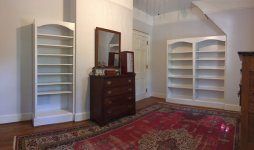
Here is a picture. It is a panorama shot so things are a little distorted. The shelves are actually the same height. The unit on the left will be for shoes.

IMG_0354.JPG
 
/ Yet another woodworking question. #13  
Here's an update. We decided to do the shelves ourselves. We used 3/4" "cabinet grade" plywood from one of the big box stores. I used pine trim of decent quality. My wife insisted on adjustable shelves so we used metal rail shelf standards the same color as the paint. Her father had a bunch of old pine boards (not antique) that had served as shelving in her mother's shoe store years ago. I did not like them because they had knots and some rough edges but my wife wanted to use them. We sanded, puttied defects, primed and painted them and they look okay.

I ripped the plywood sides using saw guide on Makita circular saw. It worked very well. Used a 60 tooth Frued blade and there was very little splintering etc.

The hardest part was the fact that nothing in the house was square, flat or flush. We also had to deal with doors, vents and electrical outlets. We took the molding off the bottom of the wall and ran it around the base of the shelves so they look built in, which they are. We painted them the same color as the room trim (white). Just the measuring, figuring, fitting and refitting took forever.

I think they turned out okay. My wife is very happy with them so that is what counts. There are lots of little flaws that I see when I'm looking for them but they are not particularly noticeable if you're not looking. We spent about $350 dollars on materials and paint. Our best professional estimate was $2000 and that guy never showed up. The next lowest was $3000. (There would have been drawers at the bottom of the double unit at that price. I was not ready to tackle drawers.) It took us a solid two and a half days of work but we went real slow. My shop is also in the basement and this room is on the second floor. We spent a lot of time running stairs.

Here is a picture. It is a panorama shot so things are a little distorted. The shelves are actually the same height. The unit on the left will be for shoes.

View attachment 474662
Looks like it turned out very well, nice job!
 
/ Yet another woodworking question. #14  
Nice job, the depth of the shelves would not make for a lot of usable space if you had built drawers. If you want the look of drawers on the bottom, make doors designed to look like drawer faces.
 
/ Yet another woodworking question. #15  
Looking good. Don't think drawers would be very difficult for you.

one question; anything to keep the shelves from tipping forward?
 
/ Yet another woodworking question. #16  
You did a really nice job. Those quotes were pretty much telling me that they didn't want to fool with the job. We have a finish carpenter/cabinet builder that attends our church. He is really good and charges prices like you was quoted. He tells me he can get it because very little competition in the field. A lot cabinet and finish carpenters don't want to fool with custom work for existing homes. You saved a ton of money.

Just curious, what method of construction did you use. Kreg jig?

Thanks for the pictures. You did a great job.
 
/ Yet another woodworking question.
  • Thread Starter
#17  
Egon, the double shelves have a plywood back which is screwed to the wall. The single unit on the left has a board, in the back that is screwed into the wall.

Turbys, construction was just with a nail gun and screws. All surface nail holes were puttied over and sanded. Shelves are adjustable on metal standards. The plywood back on the double unit provides most of it rigidity and both are supported by being attached to studs in the wall.

I feel good about the job and the money we saved. My wife is very happy with them. The little mistakes and cosmetic errors bother me and would not have been there if a pro hand done the work.

Again, the hardest part is working around the existing molding, air vents, outlets and irregularities you see in any old home. The double unit took me an entire day's work just to get it roughed in. Building a free standing shelf unit would have take a couple of hours at best. However, I think these look a lot better as built ins.

Thanks for all the replies and assistance guys.
 
/ Yet another woodworking question. #18  
I agree with every one so far, they look very nice. The important thing is your wife likes them!
 
/ Yet another woodworking question.
  • Thread Starter
#19  
Thanks guys. Another project complete thanks to the experience and wisdom of the folks here at TBN.
 
/ Yet another woodworking question. #20  
Congratulations on a job well done.

As to your earlier question about splitting the plywood when cutting, I've found that any decent name brand blade works just fine. What you are paying for is how long it will last. Cheap saw blades go dull quickly, quality ones last a very long time. To get the cleanest cut possible, you need the blade to be as shallow as possible. For 3/4 inch plywood, the blade should only stick out an inch at the most. That shallow angle of the blade allows for more of the blade to cut the wood, giving it a cleaner finish. Adding blue tape to the wood also helps, but really not enough to be worth the effort. If I'm cutting wood that will be stained, I make sure that the top/finish side is on the top when cutting with my table saw, or the bottom when cutting with a circular saw.
 
 
Top