Your last generator Maintenance Run

   / Your last generator Maintenance Run #5,701  
Those photos of a professional control panel certainly give me an example to follow. I feel an upgrade my be in my future.
I have solar city so I can’t hijack any power.
However the thought crossed my mind if things got crazy. I would need a charge controller rated at 600 volts to do that.
I wish I bought my system but at the time it wasn’t an expense I could afford ☹️
90cummins
 
   / Your last generator Maintenance Run #5,702  
Those photos of a professional control panel certainly give me an example to follow. I feel an upgrade my be in my future.
I have solar city so I can’t hijack any power.
However the thought crossed my mind if things got crazy. I would need a charge controller rated at 600 volts to do that.
I wish I bought my system but at the time it wasn’t an expense I could afford ☹️
90cummins
Victron's Multiplus 2 inverters have the ability to play ball with something like the solar city grid tied inverters: Meaning you can AC couple your battery system to the house and solar system.
 
   / Your last generator Maintenance Run #5,703  
I quite like using finger trunking to keep the panels I build organised:

View attachment 752771
Above is a work in progress (one of the few non commercially sensitive photos I could find 😂) capping not yet installed on the trunking.


Would it be possible to duct some waste heat from the generator to the batteries in winter? They will definitely perform a lot better if operating at a human comfortable temperature.
Nice looking panel.
 
   / Your last generator Maintenance Run #5,704  
Nice looking panel.
Thanks, ruined by me installing it temporarily 😁

20220707_121017.jpg
 
   / Your last generator Maintenance Run #5,705  
Got to love wiring in the UK, New Zealand, Europe, etc with household voltage of 220-240 volts.

The higher voltage means smaller wire size for the same US amperage at 120volt.

It was a joy to wire up the panels in Austria with the smaller Guage often stranded conductors.

I believe most of my circuits were either 8 amp or 12 amp.

Also a lot of 380v 3-phase in rural homes.
 
   / Your last generator Maintenance Run
  • Thread Starter
#5,706  
I remember a UK audio-hobbyist commenting many years ago..... "Proper "earthing" is not just helpful to eliminate audio noise over here, but down right necessary for survival !". :oops:

Rgds, D.
 
   / Your last generator Maintenance Run #5,707  
Got to love wiring in the UK, New Zealand, Europe, etc with household voltage of 220-240 volts.

The higher voltage means smaller wire size for the same US amperage at 120volt.

It was a joy to wire up the panels in Austria with the smaller Guage often stranded conductors.

I believe most of my circuits were either 8 amp or 12 amp.

Also a lot of 380v 3-phase in rural homes.

Yep, I have 22kW available in a socket outlet just outside the kitchen: ~32A 400V. Even our hob is 400V, having 3 phase makes running machine tools at home a lot easier.

I remember a UK audio-hobbyist commenting many years ago..... "Proper "earthing" is not just helpful to eliminate audio noise over here, but down right necessary for survival !". :oops:

Rgds, D.
Guessing that's due to a combination of more sites where multiple houses share the same transformer, the multiple earthed neutral system, and the weird UK arrangement of doing 32A ring main circuits in houses...

More on the subject of generators:
Outage yesterday began at 8am, UPS carried my wife's WFH workstation until we sorted out transferring over to the backup inverter. Internet, computers, egg incubator, and lights all ran fine on the solar system for the duration.
2000W inverter shoebox which seems to spend most of it's life loaned to the neighbours: Refused to start, neighbours called me before I left for work so went to investigate... Issue between ears: Fuel tank breather tightly closed, coupled with ambiguous labelling of the combined fuel and ignition kill knob. Defeated me too for longer than I care to admit to :)
 
Last edited:
   / Your last generator Maintenance Run
  • Thread Starter
#5,708  
2000W inverter shoebox which seems to spend most of it's life loaned to the neighbours: Refused to start, neighbours called me before I left for work so went to investigate... Issue between ears: Fuel tank breather tightly closed, coupled with ambiguous labelling of the combined fuel and ignition kill knob. Defeated me too for longer than I care to admit to :)
You are too generous with that 2kw Patrick - your neighbours are getting all the practice-time in with it !

We all get reminders like that..... I recall an article in 4Wheeler years back - one of the staffers (seasoned wrench) wrote about tearing into the Scout II he built-up, that his daughter drove to school, due to a driveability issue..... had the Timing Cover off the front of the engine, checking the chain - went into the house to grab a sandwich....... daughter (grew up in the garage) comes in to house, and drops the totally plugged air-filter on the counter......

Some days, the Bear gets You..... :cool:

Rgds, D.
 
   / Your last generator Maintenance Run #5,709  
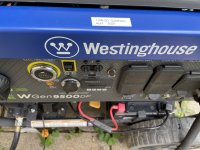
ran the Westinghouse for a few minutes this afternoon, just a follow up test after the bad on off switch replaced.
Oil full. Propane on. Press button. 1001 Vroooom
all is well

because of almost no hours on this, going to wait one more year on oil change. Full syn oil isn't going to wear out.
I'm just changing it to get rid of any condensation. Was changed once at about ten hours, and now likely around 25.
couldn't get the display to show hours, I'm sure op error. 246 volts thank you, but how many hours?
 

Attachments

  • IMG_1008 (1).JPG
    IMG_1008 (1).JPG
    1.9 MB · Views: 134
   / Your last generator Maintenance Run
  • Thread Starter
#5,710  
ran the Westinghouse for a few minutes this afternoon, just a follow up test after the bad on off switch replaced.
Oil full. Propane on. Press button. 1001 Vroooom
all is well

because of almost no hours on this, going to wait one more year on oil change. Full syn oil isn't going to wear out.
I'm just changing it to get rid of any condensation. Was changed once at about ten hours, and now likely around 25.
couldn't get the display to show hours, I'm sure op error. 246 volts thank you, but how many hours?
Good catch on the switch D..... not what you'd want to find out, start of a multi-day outage.......

I'm not a fan of non-intuitive instrumentation..... kinda defeats the point of a piece of equipment that sits a lot, then needs to be used NOW in an emergency....

I think I've posted this before...... Briggs is one that had hour meters listed on their site, for 3600 rpm units.... IRCC, they were non-contact, non-wired - I think they detected vibration. If your stock meter is a pain, you might consider a stand-alone one.

Rgds, D.
 
   / Your last generator Maintenance Run #5,711  
Maintenance run puzzle

I used to load test my portable genset by plugging in a 1500w heater
into each of the 120 volt outlets. No problems with this.
I thought I coud make it easier.
I Have a ceiling hung space heater in the garage so I connected a DPDT
(doule pole double throw) switch and a generator cord connection box to it.
Started genset and plugged in twist lock cord and started heater. All was well.
After 10 minute run under load I shut off heater to let the generator cool and started to put stuff away.
When I was coiling up the cord I noticed it was very hot to the touch. Not burning
hot but hot enough to not keep still in my hands. The twist lock ends were not hot.
Just the cable. Nothing was melting.
Here are the numbers:
Champion 6250/5000 Digital Hybrid generator
240v/5000w ceiling heater
40 foot 30A Bourge cable rated for 7500 watts. 4-#10 wires. Brand new.
The generator output and the heater load are the same.

Can anyone tell me if if a digital hybrid (sine wave) generator connected to a
resistive load would cause the cable to heat? An induced current component?

The cable is rated to handle 50% more power than it was using.
(I don't know of a way to load test a cable)

Any ideas on why the cable was heating?

Thanks,
R
 
   / Your last generator Maintenance Run #5,712  
Was the excess cord coiled in a nice neat coil?
 
   / Your last generator Maintenance Run
  • Thread Starter
#5,713  
Roric - was that 40' cable coiled up, under load, by chance ? Even partially coiled, @ higher power levels, you may get some self-induced heating. (What Lou said :)).

If the cable was not looped under power, then it's something else; if it was looped, that's an easy enough experiment to re-run.

I'd tend to suspect the Champion last, unless it's been through a lightning strike, or a major fight with a welder etc...... a scope (properly coupled) would be one way to check it.

Before that ^ test, I'd check the (rolled out straight) cable with the same load again, while carefully (it's 240 :oops:) measuring the voltage @ each end under-load. If you are at all uncomfortable with meters/probes/high voltage, don't attempt this test, for your own safety - 240 is NOT where you want to start gaining experience with these type of measurements.

Assuming that ^ caveat is OK with you, and you arrive @ two different voltages from the ends of the cable under load, then a bit of work with ohms law vs. a 5000 watt load will give you an idea of what the resistance/foot of the cable looks like. Post voltages here if you need help with the ciphering....

If that heater has not been blowing your regular household breakers, chances are it's within spec, but a clamp-on current meter would be handy to measure the exact load the heater is drawing.....

Rgds, D.
 
   / Your last generator Maintenance Run #5,714  
I went to a 10,000 watt duel fuel generator. Electric start runs off a 100 pound propane tank. I have never put gas in the tank but nice knowing if I had to I could. It stays connected to a battery tender. We just installed a automatic whole house generator that test runs every Tuesday morning for a few minutes. The portable will now move to the barn and mobile use around the property.
 
   / Your last generator Maintenance Run #5,715  
Roric - was that 40' cable coiled up, under load, by chance ? Even partially coiled, @ higher power levels, you may get some self-induced heating. (What Lou said :)).

If the cable was not looped under power, then it's something else; if it was looped, that's an easy enough experiment to re-run.

I'd tend to suspect the Champion last, unless it's been through a lightning strike, or a major fight with a welder etc...... a scope (properly coupled) would be one way to check it.

Before that ^ test, I'd check the (rolled out straight) cable with the same load again, while carefully (it's 240 :oops:) measuring the voltage @ each end under-load. If you are at all uncomfortable with meters/probes/high voltage, don't attempt this test, for your own safety - 240 is NOT where you want to start gaining experience with these type of measurements.

Assuming that ^ caveat is OK with you, and you arrive @ two different voltages from the ends of the cable under load, then a bit of work with ohms law vs. a 5000 watt load will give you an idea of what the resistance/foot of the cable looks like. Post voltages here if you need help with the ciphering....

If that heater has not been blowing your regular household breakers, chances are it's within spec, but a clamp-on current meter would be handy to measure the exact load the heater is drawing.....

Rgds, D.
You guys are very perceptive. I had the remainder of the cable in a couple of large loops.
This was a case of self-induced heating and I should have thought of that.

Thanks for pointing it out to me.
regards,
R
 
   / Your last generator Maintenance Run
  • Thread Starter
#5,716  
You guys are very perceptive. I had the remainder of the cable in a couple of large loops.
This was a case of self-induced heating and I should have thought of that.

Thanks for pointing it out to me.
regards,
R
(y) NP..... like my recent post about an experienced wrench (not me, but I've had my own stories that are similar :cool:) overlooking a plugged air-filter, we all benefit from this TBN sounding board, kicking around these puzzles.....

Rgds, D.
 
   / Your last generator Maintenance Run
  • Thread Starter
#5,717  
I went to a 10,000 watt duel fuel generator. Electric start runs off a 100 pound propane tank. I have never put gas in the tank but nice knowing if I had to I could. It stays connected to a battery tender. We just installed a automatic whole house generator that test runs every Tuesday morning for a few minutes. The portable will now move to the barn and mobile use around the property.
Nice setup two !

Is the whole-house on propane too ? I do like the cleanliness of propane and natgas, and the inherent stablity vs. time - provides less ammunition to 'ol Murphy (y).

Rgds, D.
 
   / Your last generator Maintenance Run #5,718  
Any ideas on why the cable was heating?

Does your cable have aluminium conductors perchance? I'm seeing more and more "stuff" made with alloy that should not be.

Also re: extension cables coiled up, it's just resistive heat build up (cable touching cable has less surface area to shed heat) and nothing to do with induction :)
 
   / Your last generator Maintenance Run #5,719  
it's just resistive heat build up (cable touching cable has less surface area to shed heat) and nothing to do with induction :)
\

ok professor, can you explain that in more detail?
good to know, hot cables never a good idea, hot connectors even worse

I ask this partially due to what may be a misunderstanding on my part.
I thought if you coiled a higher amperage cable, the circular coil created an electrical effect of its own.
as in the "oscillating magnetic field" described below

perhaps you could explain induction as it might apply here? : in an induction stove (also "induction hob" or "induction cooktop"), a cooking vessel with a ferromagnetic base is placed on a heat-proof glass-ceramic surface above a coil of copper wire with an alternating electric current passing through it. The resulting oscillating magnetic field wirelessly induces an electrical current in the vessel. This large eddy current flowing through the resistance of the vessel results in resistive heating.

curious minds ask
clearly I am no EE
 
Last edited:
   / Your last generator Maintenance Run #5,720  
it's just resistive heat build up (cable touching cable has less surface area to shed heat) and nothing to do with induction :)
\

ok professor, can you explain that in more detail?
good to know, hot cables never a good idea, hot connectors even worse

I ask this partially due to what may be a misunderstanding on my part.
I thought if you coiled a higher amperage cable, the circular coil created an electrical effect of its own.
as in the "oscillating magnetic field" described below

perhaps you could explain induction as it might apply here? : in an induction stove (also "induction hob" or "induction cooktop"), a cooking vessel with a ferromagnetic base is placed on a heat-proof glass-ceramic surface above a coil of copper wire with an alternating electric current passing through it. The resulting oscillating magnetic field wirelessly induces an electrical current in the vessel. This large eddy current flowing through the resistance of the vessel results in resistive heating.

curious minds ask
clearly I am no EE

On a really hot night when the A/C is out, do you want to crawl underneath the covers, cuddle up to your significant other, or sprawl out ontop of the covers away from everything? I my love my wife, but cuddling when it's 100 degrees is not in the cards.

Similar principle for cables. You want as much air to get to every bit of cable as possible to keep them cool. Electrical codes specify the maximum fill capacity for conduit so that there is a bit of air that can cool things.

It's generally not a problem in most circumstances. But you don't want to fight it if you are maxing out cables amp rating. The hotter a cable thing gets, the higher the resistance, which (assuming the same current draw) creates more heat. You can get a nasty negative feedback loop. Not likely to happen with properly rated cable, but it is possible if you have other issues.

Looping wire creates an inductor. Inductors can mess with the timing of the AC waveform & increase the power factor of a circuit.
 

Tractor & Equipment Auctions

2018 Peterbilt 348 T/A Rollback Truck (A59230)
2018 Peterbilt 348...
RAKE ATTACHMENT FOR MINI EXCAVATOR (A58214)
RAKE ATTACHMENT...
406 (A52706)
406 (A52706)
2007 MACK GRANITE CV713 DUMP TRUCK (A60430)
2007 MACK GRANITE...
2023 CAN-AM DEFENDER RTV (A59823)
2023 CAN-AM...
2021 CAT 304E2 (A53317)
2021 CAT 304E2...
 
Top