Fence Questions

/ Fence Questions #1  

briancreed

New member
Joined
Jun 19, 2008
Messages
13
This is my first post, but I have been lurking around here for a while... You guys definitely know whats going on. I don't know if it's customary for a first time poster to seek advice, but I guess I'll give'r a whirl.

I recently bought 80 acres that needs completely refenced. I've been around farms all my life, so I know a thing or two about fencing, but I am by no means an expert. I'd like to build a fence that will last a lifetime, with the usual repairs and upkeep of course.

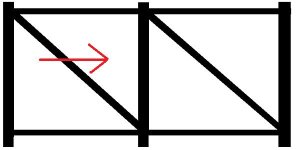
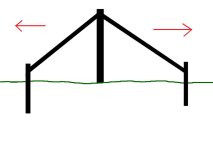
My plan is to use 4" pipe for the corners, braced with 8' long 2 7/8" pipe top and bottom and a diagonal. I am going to try to attach a sketch to show what I'm talking about. I plan on using these double h-braces at all corners, and every 330' or 660', not sure which (advice?). I am going to run 47" Red Brand Field Fence (9 guage top and bottom wires) around the whole property, with a hot wire across the top through t-post caps, and one in the middle.

I plan on using 6' t-posts spaced every 12', with 52" sticking above the earth.

I will be containing cows, horses, and possibly sheep and goats. Also, I'd like to keep it semi-dog proof (another plus for the field fence).

Is the design on these h-braces adequate? Do I need the cross bar? What size of pipe should I use (sch 30, sch 40, etc) I plan on sinking the posts 6' in the ground (skid steer with auger rental), and concreting them in. I also considered filling the pulling post to the top with concrete before it is capped.

What would be a fair price to pay a welder to notch and weld these pipes on for me?

How often should I run another h-brace to hold up the fence? Obviously for all corners, grade changes, etc, but how often on a straight stretch?

And last but not least, how should I attach the field fence to the corner posts? I've never put it up before, so I have no idea. I was thinking of stretching it tight like barb wire and then wrapping the ends around the post, but not sure how to go about this.


Any help would be greatly appreciated. I'm sure I'll have more questions in the future, so I apologize in advance for my lack of knowledge.:eek:
 

Attachments

  • fence.jpg
    fence.jpg
    17.6 KB · Views: 453
/ Fence Questions #2  
I think it's more than adequate. When I redo my fence I'll be using a standard "H" brace and make sure that it's in the ground at least 3ft in concrete. I prefer my "t" poles to be 10 feet apart if keeping cattle. When you say field wire I assume you're meaning barbless wire. If so then hears how I'd accomplish it. Top strand barbed, next 3 strands barbless, 4ft. goat wire in front of that. Main reason for barb on top is horse will have a bit more respect on the fence and won't be to eager to lean on/over for that tasty morsal on the other side. Should keep all other critters in there place without any problems.

Good luck.
 
/ Fence Questions
  • Thread Starter
#3  
I am going to put 2 electrified wires on the fence to prevent the leaning/rubbing issues that both the horses and cows seem to have.

I will attach a picture of the fence I plan on using.

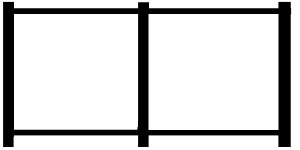
I guess with the h-braces, I'd like to know if I need the diagonal brace, like the sketch above, or if top and bottom braces alone will be adequate, like the sketch below.
 

Attachments

  • field fence.jpg
    field fence.jpg
    28.5 KB · Views: 799
  • fence 2.jpg
    fence 2.jpg
    10.7 KB · Views: 483
/ Fence Questions #4  
If everything is welded and you sufficiant depth then I don't see why you'd need diagnoils. Generally the way it seems to be done around here is using your last picture shaped into a corner brace with a single "h" brace every 100ft. This will allow that should the wire be broken through you'll have a mounting/stress point without redoing the entire strand. I personally am not a big fan of electric. I guess I'm more old school. You're wire looks fine but I'd still back it with barbless for added strength. I've seen bulls walk through most wire fences and some have jumped 5" fences to get to the neighbors cows.
 
/ Fence Questions
  • Thread Starter
#5  
I don't plan on keeping any bulls, but I guess it could happen in the future. I never thought about backing it with barbless wire, but that is not a bad idea.

I had the field fence with barb wire on top around 10 acres before, and the horses just leaned right over the barb wire, leading to scratches on their necks/heads. I put a hot wire on the top and that prevented that mess.

While this will occasionally hold horses, that will not be the main purpose. I will mainly be keeping cows in with it, and using it for a perimeter fence. I plan on fencing 10 acres with the v-mesh and pipe fence for the horses...just as soon as I learn to weld! :eek:

What would be a decent price to pay someone to weld the h-braces up for me? I'm in NE Oklahoma...

I understand about putting the h-braces every 100' in case it is broken, but that would get real pricey real quick. If a fence is broken, I can either splice it back together, or put an h-brace in at the specified interval and go from there.
 
/ Fence Questions #6  
There was an outfit advertsing metal corner posts in the Daily Oklahoman and I think they were located in Purcell. I can't recall the name of the business.
 
/ Fence Questions #7  
Heres my $.02,

Go to the website for electrobraid (electrobraid.com) Download the install manual. Very clear instruction on bracing. No need to weld or use pipe. Just go with 7 foot or 8 foot posts 5-6 in diameter. Bury 3 feet deep. I know it is for electrobraid but applies to wire as well. I use a single H brace and use the tensioning wire as shown in the electobraid manual. Actually I tensioned using electrobraid instead of brace wire. I agree NO BARB WIRE for horses. Their hide is not cowhide. I have used electrobraid as a top wire as well as 4 strand braid for horses in some paddocks. If installed properly (good grounding) it works like a charm. I also prefer electrobraid to other brands since it has a very high tensile strenght and has copper woven into the braid as opposed to other material.

I would think a brace every several hundred feet is plenty. My only concern is field fence for horses could equal caught foot = fracture= dead horse. However you mentioned v mesh or no climb- good idea.
 
/ Fence Questions
  • Thread Starter
#8  
I'm fairly familiar with building fences, not an expert by any means, but familiar with the general concepts.

My goal is to overbuild corners so I never have to replace them. Hence the six foot depth, welded pipe, and overbracing. I realize I'll have to go back and mend fence, probably restretch it, but I think if I put in the time at first I can build a fence that will far outlast me.

I have built several fences using the 6"x8' treated posts set 3' deep, with the typical h-brace. I have also seen a lot of these rot, posts break, lean, concrete footings pull out, etc. I do not want to have to go back and replace my h-braces.

I realize by going 6' deep is probably more than needed, but that's what I'm looking for. The pipe comes in 21' lengths, so that will leave me with 4.5 feet sticking out if I cut them in half. Perfect.

I've had horses in barbed wire before, besides scratches and scrapes I've been pretty lucky and had no injuries.

The field fence will mainly be for cows, not horses. However, I will have electrified strands on it to keep the horses back when theyre in there. There are no neighboring horses, which is usually where you run into trouble. There will also be caps on all of the t-posts to prevent them from being impaled.

My main questions are as follows:

Do I need the diagonal cross brace for the corners?

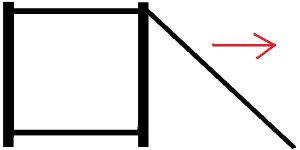
Another design I have seen is to have a single h-brace with a deadman, as I have attempted to sketch below. How is the deadman anchored in the ground? Welded to a pipe set in a footing? Set in a 3-4' deep footing as far down as the angle will allow?

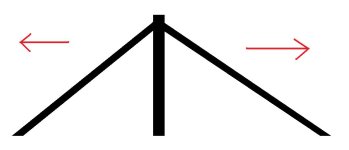
Would putting up single h-braces, or a single post with a deadman on both sides (as sketched below), every 330' be adequate? This is the length of the rolls.

Thanks again.
 

Attachments

  • single deadman.jpg
    single deadman.jpg
    12.5 KB · Views: 640
  • double deadman.jpg
    double deadman.jpg
    23.7 KB · Views: 560
/ Fence Questions #9  
Since no one else has mentioned it, first off all, welcome to the site. And, as you can see by the replies so far, there is certainly no harm in starting your first post with a question.

I like your first "H" brace sketch with the diagonals myself. I also think a single post with two angles would be an adequate line brace.

That said, I just "Goodle"d up Red Brand Fencing and they do indeed have a website with downloadable installation and bracing guides. I stopped when I saw how long the bracing guide was taking to download though.

I have no personal experiance with Red Brand though I know plenty of horse people like it. Most of the installs for horses that I see have a board across the top to negate the effects of leaning but electric will do as much. Having used fencing from a number of other suppliers, I always study up on the manufactures recomendations first. That is not to say that I adhere to them though.
 
/ Fence Questions
  • Thread Starter
#10  
Thanks for the welcome! I have found a ton of useful information on this site, and I really appreciate all of the replies I have received so far.

The first h-brace with the diagonals would be the strongest I'm sure, but also the most expensive. The least expensive would be the single h with the deadman, but I am not sure how it is built (how the deadman is anchored to the ground). I imagine sinking the posts for the h-brace 6' deep it would be plenty sturdy.

I have seen the floating deadman, with a band used for tension and the deadman itself on a piece of wood, concrete, etc, but I don't want a band of wire that close to the ground, that spells trouble to me (think hooves, tangles, cuts, sprains, breaks, etc).

Thanks again for all of the advice guys! Hopefully somebody can explain to me how the deadman brace is built.

I will be giving a detailed post when I do build the fence, so everybody can see exactly what I do. I've noticed TBN users like pics! :D
 
/ Fence Questions #11  
The few times that I used a deadman, I just placed a piece of concrete or a large rock in a hold dug into the ground to negate sinking. The tension is towards the ground. Securing to the post depends on the material which in your case is welded pipe?

I use a five foot fence for my mares and geldings. I set an eight foot post three feet into the ground with concrete. For my stallions, I go with a six foot fence and add a foot to the depth of the brace posts, ie; I use a ten foot post.

I do not like diagonal wire bracing for my braces either but I do use it. Usually, I had used tensile which is dangerous to horses especially in loop form. When I built some fence last summer, I used "Hotcote" (coated tensile wire). It was extra work but when I built my braces, I used tensile wire for the diagonals. Later, after all of my runs were in place, I took my scrap pieces of Hotcote and replace the tensile. For the single "H" braces, I used a single wire with crimps securing the bottom and a "Gripple" securing the top. Hotcote wire secures to wooden posts with a screwed on plastic clip or a stapled on piece of plastic tubing. I took the four inch pieces of tubing and slid them over the crimps and excess wire that is required with Gripples.

Reluctantly, I used a loop for my double H braces for the required equal tension. Rather than Gripples which did not secure as well in this instance, I used the ratchet style connectiors. (The coated wire is visable and the horses respect it as though it were hot)

For what it's worth, soild type can go a long way when fencing. I have used pounded PT posts sans concrete for bracing with minimal movement.
 
/ Fence Questions #12  
The first h-brace with the diagonals would be the strongest I'm sure, but also the most expensive.

Brian, I use 45deg diagonals on all my corners. I use the 45deg braces on my h-braces if I did'nt use concret, and just used a true H-brace if I did. You want the 45deg braces in your corners to braceup the top of your corner post from the pull. The top of your corner post has to get its strength from the it's side post at the ground level where its strongest. Sure horizontal bracing might look better and seem to be strong enough when first built but in matter of months you can shake your corner post and might have noticed your fence sagging way before then.
I believe in my H-post every 100' on straight runs. I know thats a drag, and I fenced in 85acres myself by myself. Them 100's come very fast. I tried a couple times to push out to 200' but the fence just would'nt take it. 100' is just the best number for me. Of corse much more than that is really begging around here in N.Al. The land is up and down.
I went about my fence the same way you did. I built the heck out of the frame. Although I used wood. I dont mind running wire but building all those braces takes time and money. My fence has been standing for 10yrs now. I've had to fix a few broken strands, and 2 H-braces in that time. I'm well pleased.
 
/ Fence Questions #13  
Another design I have seen is to have a single h-brace with a deadman, as I have attempted to sketch below. How is the deadman anchored in the ground? Welded to a pipe set in a footing? Set in a 3-4' deep footing as far down as the angle will allow?

Would putting up single h-braces, or a single post with a deadman on both sides (as sketched below), every 330' be adequate? This is the length of the rolls.

This may be what you are looking for. I've seen this design used by the DOT and US Military around their installation perimeter fencing. No deadman used just short pieces, what would have ended up as scrap, set in concrete.
 

Attachments

  • Design Mod.jpg
    Design Mod.jpg
    53.6 KB · Views: 1,613
/ Fence Questions #14  
What I suggest you do first is go for a drive. Look at fences you know have been up for a long time. Try to figure out what has happened with the fence over time.

One of the problems with braces on tensioned fences (if you stretch your fence right it will be under tension) is the corners end up being jacked up or jacked down by their braces. The best way to notice this is to look at the second or third post in a welded brace system. Invariably they will be either raised up while the corner post is pushed down or they will be pushed down and the corner post will be raised up.

The standard H isn't much help for corners. Unless of course you make the H into what is referred to as a box brace. The way a box brace works is the bottom of the brace post is used to push against the top of the corner post. This is accomplished with a twisted wire or turnbuckle method.

I look at it like the brace is a sheet of plywood. When you stand the plywood with the short side up you're putting pressure on the end nearest to the force of pull. When you look at it like that you see those prefabbed welded braces like they sell at TSC and some hardware stores where the uprights are four feet apart aren't worth a flip.

What I would do if I wanted to build a brace for t post fence that would live for a long time I would make a double H. I would have three uprights eight feet apart. I would have two horizontals, one at the top and one at the bottom, again, think of a sheet of plywood.

If your brace post is the fulcrum then the longer the lever, sixteen feet versus eight or four feet then you have to have more strength.

The hiccup in the get up with this is your soil. If you're in dirt then you're at the lower end of design and construction for an effective brace needed. If you're in sandy soil then you're in the middle. If you're in clay then you really need to look at overdoing it being barely enough to get by over time. This is because the clay will expand and contract over the season between wet and dry times. The closest thing to it for the non-clay citizens is frost heave. So you not only have the tension of the fence working against you, you've got the clay doing its darnedest to rid itself of the posts.

When you stretch a woven wire fence you will have tighter and looser horizontals. Even with the newer fabrics where you have everything pre-kinked there will be a difference in the tension. What I use is simple tool. I can take V Mesh which is double horizontal twisted every four inches and run them up and down a grade. When I'm done you won't see the slack strands because I've pulled out the slack. You can go back later as the wire relaxes over time and abuse by the livestock and retension it with the tool.

I'll try to post some pictures of the tool later. Anyone can make it.
 
/ Fence Questions
  • Thread Starter
#15  
wroughtn_harv,

Around here, there are quite a few people who use wooden posts. The problem is, they all seem to rot, warm, or pull out of the ground. I can't find 10' wood posts locally, and I dont think 3.5' is deep enough on a corner post to keep it from pulling.

The highway department uses mainly wood posts with both a horizontal and a diagonal brace, along with a diagonal tension wire. There are a few of their fences that use metal posts, and they all have a diagonal and horizontals top and bottom.

Most of the farms with fences that are old, including the one next to me, use pipe corners. Mainly heavy pipe, with double h-braces.

Recently I was down in Arizona for a Bowl Game. I stopped to take a look at their fences, as they did something we don't see here in Oklahoma. They set a single post, and on both sides had a deadman brace. I don't know if it was because of the amount of rock they had to dig through, or if it's just how they do it there, but their fences looked pretty dadgum tight. That's why I asked about using that inline in the fence, rather than h-braces.

I had originally thought of doing the double h brace, with a diagonal brace in the middle. There is a sketch of what I was thinking in the first post. I will use 8' between the corner post and each brace post (16' total length), with top and bottom horizontals.

I plan on sinking the 4" pipe about 6' in the ground, in concrete, with 2.5" sch 40 cross bars.

I am sinking this into dirt and some rock, not a lot of sand or clay where they'll be going.

I believe I have seen the tool in one of your other posts. I'll go through and refresh my memory on how it's used. I believe I have read most of your fencing threads 20 times at least.

--Brian
 
/ Fence Questions #16  
Around here, there are quite a few people who use wooden posts. The problem is, they all seem to rot, warm, or pull out of the ground. I can't find 10' wood posts locally, and I dont think 3.5' is deep enough on a corner post to keep it from pulling.--Brian

I dont think that 3.5' is deep enough either. Your Lowes or Home Depot does'nt have 10' 4x4 or 6x6's? Can you get your hands on any old railroad ties? Is there any timber being cut around your area? Most times you can get some grat post out of what they leave behind.
I'm not trying to talk you out of metal by no means. On that note I have a fence manual I picked up from Tractor supply. It shows a fence corners being built out of tee post using some kind of lock collors. Might be something to look into. It really did'nt look to hard to do.
 
/ Fence Questions
  • Thread Starter
#17  
I dont think that 3.5' is deep enough either. Your Lowes or Home Depot does'nt have 10' 4x4 or 6x6's? Can you get your hands on any old railroad ties? Is there any timber being cut around your area? Most times you can get some grat post out of what they leave behind.
I'm not trying to talk you out of metal by no means. On that note I have a fence manual I picked up from Tractor supply. It shows a fence corners being built out of tee post using some kind of lock collors. Might be something to look into. It really did'nt look to hard to do.

I can get 4x4 and 6x6 10' locally. 4x4 would not be strong enough for the pulls I'll be doing. The 6x6 would, but I don't want to use wood due to rot. I want my kids and grandkids to stretch off of the same metal corner posts I'll be stretching off of.

The t-posts for corner posts definitely would not work for me. I have used them for temporary fences around gardens, areas where I've worked, etc, and they work for that, but they are definitely not for stretching long distances. I also used 8' t-posts 4' in the ground for my temporary fences, if anybody is thinking of doing this I would recommend the same.
 
/ Fence Questions #18  
I dont think that 3.5' is deep enough either. Your Lowes or Home Depot does'nt have 10' 4x4 or 6x6's? Can you get your hands on any old railroad ties? Is there any timber being cut around your area? Most times you can get some grat post out of what they leave behind.
I'm not trying to talk you out of metal by no means. On that note I have a fence manual I picked up from Tractor supply. It shows a fence corners being built out of tee post using some kind of lock collors. Might be something to look into. It really did'nt look to hard to do.
You may want to check the retention on any post from Lowes or HD before you shell out your hard earned cash. From what I have seen, they mainly sell above ground or ground contact. Anything below ground is not going to last. I would only use squared posts if I was runing some plank fence for looks. For animals, square corner may cost you in vet bills sooner or later, even if you run some electric inside of them.

Manufacturers can still sell fence posts treated with CCA as opposed to ACQ which is pretty much what you find in squared lumber these days. I happen to have a treatment facility about an hour drive or so away where I can purchase my posts directly. The pricing though gets pretty scary. I would have to run to my file cabinet to dig up my prices but the 8' posts were around the ~12 bucks that most businesses want around me. Not bad for a 6-8" dia. post which are the only size they carry. The 9 footers', ~18 bucks and the 10 footers, ~24 bucks were a bit much IMHO. Funny thing, the 9' were like telephone poles and the 10's were about 5-6" diameters.
 
/ Fence Questions
  • Thread Starter
#19  
Locally, our Lowe's, Home Depot, and other lumberyards carry .40 treated wood. I can order .60 or .80 treated wood, but the cost rises big time.

I am going to stick with the pipe on this fence. It will outlast any of the wood I can put in the ground, is stronger, and the cost is pretty close to being the same.

I believe I am going to go with the double h brace on all corners, with the top and bottom horizontals. I will put in a single post with two deadman braces every 330' (the length of the rolls of field fence). All of my posts will be set in 6'x12" holes, filled to the top with concrete.

T-posts will be set 12' apart, and 6.5' t-posts will be used rather than 6'. They'll stick out 52" above ground level.

I am going to use the Red Brand field fence, as it is available locally. I will run 2 strands of barbless wire behind it for additional strength, and 1 strand of barbed wire above the field fence.

I will run 2 electric wires around the perimiter fence, one on the caps on top of the t-posts, and one approximately 30" from ground level. Not sure on the charger yet.

Gates will be Priefert 2" bull gates for now, and I will probably have gates welded if those don't cut it. Entrance gate will be a custom job, but that's a ways down the road.


Anyone see any flaws in my game plan? I'm gonna be shellin out a lot of dough, so I wanna make sure I do it right.
 
/ Fence Questions #20  
And last but not least, how should I attach the field fence to the corner posts? I've never put it up before, so I have no idea. I was thinking of stretching it tight like barb wire and then wrapping the ends around the post, but not sure how to go about this.

:eek:

This link on the Redbrand website has a video tutorial on field fence installation as well as other good topics.

http://www.redbrand.com/installation/index.asp

A neighbor down the road a piece installed this type of fence last last year using thick cedar post and t-post with two strands of barbed on top. Real nice looking fence, I'm waiting to see how it wears with his cattle.
 

Marketplace Items

Tafe 45DI (A60462)
Tafe 45DI (A60462)
2015 DODGE RAM 1500 CREW CAB TRUCK (A60430)
2015 DODGE RAM...
2014 Freightliner Cascadia 125 S/A Day Cab Truck Tractor (A59230)
2014 Freightliner...
Amada M-3060 Mechanical Metal Shear (Japan) (A59213)
Amada M-3060...
2021 MULTIQUIP 25 WHISPERWATT AC GENERATOR (A59823)
2021 MULTIQUIP 25...
DRAGON 500 BBL ACID TANK (A58214)
DRAGON 500 BBL...
 
Top