OP

MtnViewRanch
Elite Member, Advertiser
- Joined
- Mar 19, 2005
- Messages
- 10,691
- Tractor
- Mahindra 7520, Mahindra 3215HST, Case 580 extendahoe, Case 310 dozer, Parsons trencher, Cat D6,

Well after a little research the easiest way to handle two cylinders is with a rephasing cylinder arrangement. Using double acting cylinders and two way valve the base of each cylinder is plumbed to the valve and the two rod end ports are connected together. Check valves are also used. Setup this way the cylinders can both move equal amounts (assuming the cylinders are the same size bore, stroke and rod size) . With this method there is no need to have a fixed connection between the two cylinders to keep them syncronized. The two cylinders move together not independently, while one is retracting the other is extending at an equal rate. The advantage is that you get a full range of motion to the hitch arms, tilting the implement in both directions the maximum amount.
I may not be understanding your statement, but it seems that if you "send" the same volume of fluid to both cylinders, the one that is retracting will travel farther than the one that is extending. This is because of the lesser displacement caused by the cylinder rod. Same reason that extend has more power than retract. I guess you could mount one cylinder opposed (up side down) to equalize the strokes.

Look at the diagram again on my last post. The fluid moves between the rod sections of the cylinder so the displacement is the same. You can mount the cylinders in either position.
Is this what you have in mind? http://www.tractorbynet.com/forums/hydraulics/161377-hydraulic-side-link-idea-am.html

Unfortunately, there is no diagram in your post displayed on my computer.
I added post 15 to the above thread on arranging the cylinders so they are timed together independent of load. As suggested there, go with rod-side admission to limit the pressure in the slave loop oil.
That is a good point since in use the cylinders would be turned base up. Whats the deal with the check valves on the left cylinder are these necessary to function?

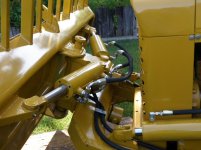
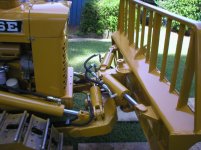
Couldn't you just plumb it like my front blade. Simple and this works to angle the blade. I don't know why this wouldn't work for tilt on a 3pt. Or am I missing something?
Steve, I had thought more about what I was thinking when I posted earlier, and yes I have realized that the center has to be a fixed position. I think that in trying to get it to what I think would have been simple and not costly I just plain over looked the obvious.
That should work, but that machine is really begging for some dirt time.
The orientation of the cylinders really is not important. The check valves allow the cylinders to remain in phase, or lets them return to phase at the end of the stroke in either direction. I'd consider them necessary for implementation, but not function. Without the CVs, you'd be breaking fittings to bleed, fighting to regain any lost timing, fighting to achieve synchronization at end of stroke, etc. The CVs allow bypass flow around the piston when the cylinder is at the end of the stroke, letting the other cylinder travel to the end of its stroke when they are out of time.
Come on now, those pics were taken just after I was done refurbishing it. It is a little dirtier now.
Is there going to be a problem with the balls in the hitch binding up with all the tilt that 2 cylinders are going to give you? I am pretty sure that they would on my tractors. Something that is easy to check out before a lot of time and $$$ is spent.
Is there going to be a problem with the balls in the hitch binding up with all the tilt that 2 cylinders are going to give you? I am pretty sure that they would on my tractors. Something that is easy to check out before a lot of time and $$$ is spent.