Fertilizer

   / Fertilizer #21  
I think the beer party in the field would be cheaper & more effective than that Root Magic scammer. :)

Actually that sort of product from a reputable place is beoming quite popular, it tops off a field with the right lime and fertilizer to start with, an extra push. The micros are indeed important. But you gotta start with good soil with good fertility already, not skipping the real applications.

2 gallons are about 20 lbs of product.

Typically one applies 500-5000 lbs of lime to a field low on lime, to help it out for the next 5 years or so. How does this 20 lbs of product help a whole acre with ph?

A 16-8-4 product applied at 20 lbs per acre is 3.2 lbs of N, 1.6 lbs of P, and .8 lb of K spread per acre. About a worthless amount. Your hay will use up remaining nutrients in your soil trying to grow, and this magic spray will make it 'look' greener for a week, and one thinks wonders what it does. Actually, it is depeating your soil of nutrients, and leaving you much poorer for the next years, as you need to deal with poor soils now.....

The micros, which were not mentioned as to what they were, can be worthwhile _IF_ your plants are well fed with N, P, and K to the levels they need.

Without a soil test, you have no idea what ph your soil has, how much N,P, or K is in the soil.

_No one_ can tell you their fertilizer will feed the whole crop with a set amount of fert unless they know what your soil tests to begin with. _No one_ can say their product will satisfy all ph issues with one set rate.

On that alone, I would _never_ do business with a scammer like this. He is lying to you.

But, I'm not against a good micro, or a foliar product, from a good company that gets your soil right to begin with with good fertility products, and then puts these light applications over the top.

One can't really believe 20 lbs of magic liquid is going to substitute for a 1000 lbs of real fertilizer and lime, would you? We only get 45-50 crops in our life if we are lucky, it really hurts to mess one up by skimping too much on magic products.

--->Paul

Was going to use this while also applying chicken liter,fertilizer cost $510 ton.(ammonium nitrate),like I mentioned just looking for other options.Also another I been curious about is Terra One Thicker Pasture.
 
   / Fertilizer #22  
Actually, chicken manure/litter is fairly quick release, but the microbes and tilth increase is outstanding and the benefits last for a long time. It transforms dirt into soil quicker than anything else I've ever used. Dairy/beef is my second choice. Any feedlots out your way that would be closer than a chicken house?

I don't know of any feed lots ... I need to do a google search.
 
   / Fertilizer #23  
Yep ... when I take in my samples I tell the extension office what I'm planning and thats what the test are for.

Do you soil sample everytime you spread fertilizer?

Most here only apply according to what the crop needs after a baseline has been established with soil samples. Can't really afford to sample every year.

N and K are the main 2. N is easy to predict what is needed and K if over applied doesn't go away so it isn't wasted.
 
   / Fertilizer #24  
Do you soil sample everytime you spread fertilizer?

Most here only apply according to what the crop needs after a baseline has been established with soil samples. Can't really afford to sample every year.

N and K are the main 2. N is easy to predict what is needed and K if over applied doesn't go away so it isn't wasted.


I do annual soil samples or when I am planning something new ... this year I'm thinking about some Pearl Millet.

Its probably the same across the country .. $10 per sample.

No row crops here, some are contemplating peanuts and cotton. I do hay ... Bermuda Grass, Bahia Crass and I have one field with established Native Indian Grass ... with more ground (up north) going into corn and if folks go nuts around me with peanuts and cotton that will remove acres from hay production. For me I am geared towards the round and square bales and have the equipment for that ... I'd hate to expand to something else and then be faced with more equipment cost.

I do dream however of a corn field ... man would I love to have a corn field.
 
   / Fertilizer #25  
Wow. Sake oil. Lot of these sorts of products make your crop look greener for a week, but give you no long lasting effect and don't add any yield at all.

While trace minerals can be a good and needed thing on a grass crop - you didn't say what you are growing I'm assuming a grass hay? - you canget those minerals in a higher rate with less killing salt content for less money, so this seems to be a terrible waste of money.

You won't get any nitrogen from the salt product, so there is no comparison, one would not replace or preform like the other one in any ay shape or form.

You need your P, K, & N right, and first your ph proper, before those minor trace monerals will ever have any effect.

Get the big ones right first.

--->Paul

Right TO A POINT, but not 100% accurate....You can pile on all the NPK you want, and (corn) plants uptake is restricted somewhat with "minor trace minerals" being in limited supply.... Lots of BIG yield benefits to be had from your fertility program with correct levels of some mirco nutrients. Boron and sulfur being most commonly "low". Sulfur was once "free" before low sulfur fuels came into vogue. (Remember "acid rain"?) Now we need to apply it in most areas of the country. The University studies I've read say it's particularly an issue in the Northern states. as with ANYTHING added to the soil, micro nutrients need to be applied AS NEEDED and not over applied.

PH is the first thing to correct, as you mentioned.

As an experiment on my own farm this past year, we planted 1/2 of two different fields with just basic fertilty program, and the other half of each with an eye on micro nutrients along side of exact same application rates of NP&K. (Applying sulfur, boron and zinc as suggested by soil test) Half WITH micro's yielded almost 15 bu/ac better on one field and right at 11 bu/ac better on second. Return on investment (inc 2 rounds of soil testing) amounted to well over 400%. As part of the experiment, we did soil test's on same fields AFTER harvest. N & K levels were significantly lower behind use of micro's, indicating plant uptake was HIGHER. Test weight on corn using micro's was almost 3 lbs heavier. Of course (and now the down side) that means needing to apply more fertilizer NEXT year. All things considered, I'll do that and take the higher yields.....

With $6+ corn, that sort of yield increase adds up fast. (Just hoping it STAYS that high....:) )

Plan is to do some of the same sorts of micro nutrient testing on my soybean crop this coming season, as well as applying on ALL corn ground.

My biggest "gainer" in recent years has been from doing anything and everything to improve cation exchange capacity. All the added fertility in the universe doesn't help much if the soil can't hold it until the plant can use it.....
 
Last edited:
   / Fertilizer #27  
Right TO A POINT, but not 100% accurate....You can pile on all the NPK you want, and (corn) plants uptake is restricted somewhat with "minor trace minerals" being in limited supply.... Lots of BIG yield benefits to be had from your fertility program with correct levels of some mirco nutrients. Boron and sulfur being most commonly "low". Sulfur was once "free" before low sulfur fuels came into vogue. (Remember "acid rain"?) Now we need to apply it in most areas of the country. The University studies I've read say it's particularly an issue in the Northern states. as with ANYTHING added to the soil, micro nutrients need to be applied AS NEEDED and not over applied.

PH is the first thing to correct, as you mentioned.

As an experiment on my own farm this past year, we planted 1/2 of two different fields with just basic fertilty program, and the other half of each with an eye on micro nutrients along side of exact same application rates of NP&K. (Applying sulfur, boron and zinc as suggested by soil test) Half WITH micro's yielded almost 15 bu/ac better on one field and right at 11 bu/ac better on second. Return on investment (inc 2 rounds of soil testing) amounted to well over 400%. As part of the experiment, we did soil test's on same fields AFTER harvest. N & K levels were significantly lower behind use of micro's, indicating plant uptake was HIGHER. Test weight on corn using micro's was almost 3 lbs heavier. Of course (and now the down side) that means needing to apply more fertilizer NEXT year. All things considered, I'll do that and take the higher yields.....

With $6+ corn, that sort of yield increase adds up fast. (Just hoping it STAYS that high....:) )

Plan is to do some of the same sorts of micro nutrient testing on my soybean crop this coming season, as well as applying on ALL corn ground.

My biggest "gainer" in recent years has been from doing anything and everything to improve cation exchange capacity. All the added fertility in the universe doesn't help much if the soil can't hold it until the plant can use it.....


All good points, you have to be somewhat analytical to see the benefits but with good analysis you can improve your yields. To be competitive and make higher prifits guessing simply doesn't cut it. Good luck with next years weather and crop yields.:thumbsup:
 
   / Fertilizer #28  
It's Superbowl time. Throw a party and have everyone pee outside ...:laughing:

I thought BEER pee,killed the grass:laughing:
 
   / Fertilizer #29  
Ralph, good one. It'd take one big family to pee 20 acres, I reckon.

That's one reason to separate your livestock waste stream into solids and liquids. Of course several of the dairy farms in the area liquify their manure, probably including the urine, and spray their fields with the mixture a couple times a year.
 
   / Fertilizer #30  
I thought BEER pee,killed the grass:laughing:
Prolly cuz you were drinking Miller Lite;)

I need to get soil samples done here. Its just that we have had 3 years of drought and ANY money thrown at it has just gone down a black hole...:mad:

FMJ, I would keep an eye on the politics of ethanol as to what the corn prices will do.
 
   / Fertilizer #31  
If you had Tyson chicken operation nearby that needed to be rid of a few hundred tons of litter, you'd be golden.
I have a couple tons of it.
 

Attachments

  • Mobile Hen House X.jpg
    Mobile Hen House X.jpg
    39.3 KB · Views: 184
   / Fertilizer #33  
Now thats the way to apply chicken *t,I new we were doing it wrong down south:D

You guys have better weather for pastured poultry. For five months out of the year this is what it looks like:
 

Attachments

  • corralled.jpg
    corralled.jpg
    55.5 KB · Views: 162
  • winter3.jpg
    winter3.jpg
    57.9 KB · Views: 156
  • winter2.jpg
    winter2.jpg
    59.3 KB · Views: 174
   / Fertilizer #34  
You guys have better weather for pastured poultry. For five months out of the year this is what it looks like:

Are those "chicken tractors"? I've seen chicken tractors advertized on Craigs List a hundred times, but never had any idea what they were. Pardon my ignorance, but we only farm rocks up my way...

JayC
 
   / Fertilizer #35  
Are those "chicken tractors"? I've seen chicken tractors advertized on Craigs List a hundred times, but never had any idea what they were. Pardon my ignorance, but we only farm rocks up my way...

JayC


A "chicken tractor" is more of a moveable open floored large cage that you raise meat birds in. These units are generally 10' W x 10' L x 2' H or so, and get moved to fresh ground once or twice a day.

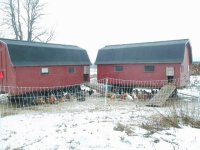
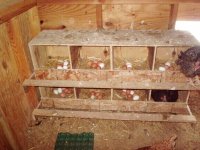
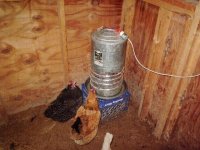
What you see here are "mobile hen houses" or "eggmobiles". People often run these behind cows, sheep, and goats out on pasture. The chickens will pick through the manure piles and eat the undigested grain, flies and maggots. They will also chase down any other edible insects and eat tender grass. This will often result in a 20% reduction in food costs. Inside these units are roosts for nighttime and eggboxes for the hens to lay in. My operation also uses one acre of electric poultry netting and a livestock guardian dog for protection.

I was actually serious about using chickens to offset costs for fertilizing fields.
 

Attachments

  • winter6.jpg
    winter6.jpg
    61.9 KB · Views: 156
  • winter7.jpg
    winter7.jpg
    60.4 KB · Views: 147
  • Nightime.jpg
    Nightime.jpg
    56.4 KB · Views: 151
  • lgd.jpg
    lgd.jpg
    54.2 KB · Views: 170
   / Fertilizer #36  
A "chicken tractor" is more of a moveable open floored large cage that you raise meat birds in. These units are generally 10' W x 10' L x 2' H or so, and get moved to fresh ground once or twice a day.

What you see here are "mobile hen houses" or "eggmobiles". People often run these behind cows, sheep, and goats out on pasture. The chickens will pick through the manure piles and eat the undigested grain, flies and maggots. They will also chase down any other edible insects and eat tender grass. This will often result in a 20% reduction in food costs. Inside these units are roosts for nighttime and eggboxes for the hens to lay in. My operation also uses one acre of electric poultry netting and a livestock guardian dog for protection.

I was actually serious about using chickens to offset costs for fertilizing fields.


I was thinking that maybe it didnt have a bottum in it and you just park it and they fertilize,then you pull it up and so on until you get the pastures done....
 
   / Fertilizer #37  
Uhm.....all this talk of chicken tractors made me think of this song by Ozark Mountain Daredevels, "Chicken Train".

Chicken train, runnin all day,
Chicken train, take the chickens away,
Chicken train runnin all day cain't get off cain't get on
Chicken train take the chickens away.........................:D

Now I've got that crazy tune in my head. :confused2:

This post qualify for (ahem) fertilizer?
 
   / Fertilizer #38  
I was thinking that maybe it didnt have a bottum in it and you just park it and they fertilize,then you pull it up and so on until you get the pastures done....

Some mobile hen houses or eggmobiles don't have solid floors, but rather wire or expanded metal floors. In my case, the units are also their winter housing.
 
   / Fertilizer #39  
Paid $744/ton last year for 20-11-11-6(sulfur) delivered. I'll gladly pay $510/ton this year!!! :D

AKfish
 
   / Fertilizer #40  
Paid $744/ton last year for 20-11-11-6(sulfur) delivered. I'll gladly pay $510/ton this year!!! :D

AKfish


We use to buy it delivered and spread by the ton in medium duty fertilizer trucks from the local coop. Now I have to buy it in 40# sacks at a LOT higher price. So $744 sounds good to me.:(
 

Tractor & Equipment Auctions

TAYLOR WAY 962 48" HYD TILLER (A57192)
TAYLOR WAY 962 48"...
2014 VOLVO A40G OFF ROAD DUMP TRUCK (A60429)
2014 VOLVO A40G...
1998 REINKE TRAILER HEAVY HAUL TRAILER (A58214)
1998 REINKE...
New Holland S68 Square Baler (A56438)
New Holland S68...
2016 FREIGHTLINER CASCADIA SLEEPER (A59905)
2016 FREIGHTLINER...
2021 VERMEER S925TX STAND ON SKIDSTEER (A52709)
2021 VERMEER...
 
Top